The RIBA's recent report "City Health Check: How Design Can Save Lives and Money" looks at the relationship between city planning and public health, surveying the UK's 9 largest cities in a bid to improve public health and thereby save money for the National Health Service. The report includes useful information for city planners, such as the idea that in general, it is quality and not quantity of public space that is the biggest factor when it comes to encouraging people to walk instead of taking transport.
Read on for more of the results of the report - and analysis of these results - after the break
Long Island’s downtowns have more than 4,000 acres of surface area dedicated to parking lots. That’s roughly 6.5 square miles of prime real estate, a phenomenon quite common in most American cities. When necessary, these lots are often exchanged for a standard “set of concrete shelves” that share little to no connection with their surroundings. This leads to the question, why must parking garages be so monofunctional and, well, ugly?
To help solve this nationwide issue, the Long Island Index challenged four leading architectural firms to envision a more innovative way to free up surface lot space in four Long Island communities.
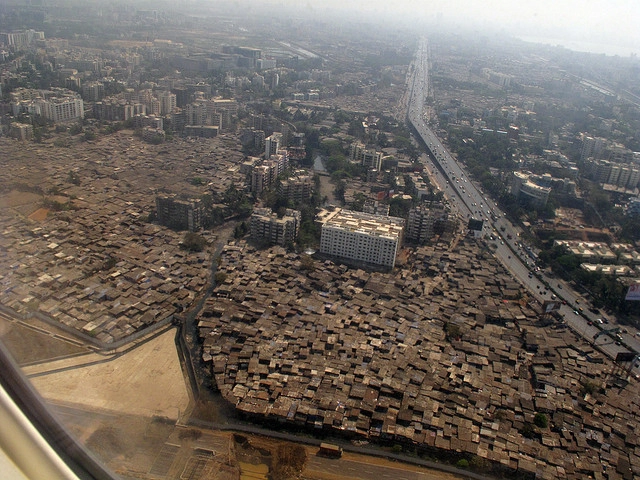
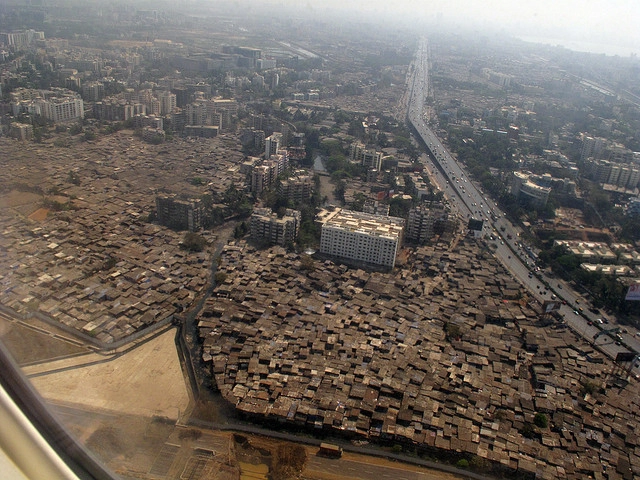
In a recent article for the Atlantic Cities, Richard Florida examines some new research from MIT that criticizes the idea that slums are a natural stage in the modernization of cities, showing that many slums continue to persist and even grow in cities/countries experiencing increased prosperity. Rather than economic growth, argues Florida, accountable governments and institutions make much more of an impact on slum development. You can read the full article here.
Earlier this week, the Guardian launched its new Cities website, which - as discussed by Oliver Wainwright in his opening article will be "an open platform for critical discussion and debate about the issues facing the world's metropolitan centres". In this introduction, Wainwright offers a fast-paced rundown of some of the major challenges facing cities, from technology to transport, housing to high streets, and economic to environmental disasters. You can read his full article here.
In this article on the Atlantic Cities, Richard Florida delves into recent research by Edward Glaeser, the author of Triumph of the City, which investigates the emergence in recent decades of mega-cities in developing nations. Though cities have long been connected to prosperity he points out that in these new cities, residents remain poor. The answer it seems is linked to our globalized economy, as well as the under prepared governments in these countries. However Glaeser and Florida don't see this as a reason for panic, or to abandon urbanization, but rather to ensure that urbanization is supported more effectively by government. You can read the full article here.
“A New Online Marketplace for Mobility,” an innovative proposal by city planner Philip Parsons and mobility expert Federico Parolotto that aims to optimize mobility in megacities, has been named the first participant in the Audi Urban Future Award 2014. Selected from a shortlist of three, the winners will now assemble a team of urban designers in order to pursue their visionary idea. Read more about their winning proposal, here.
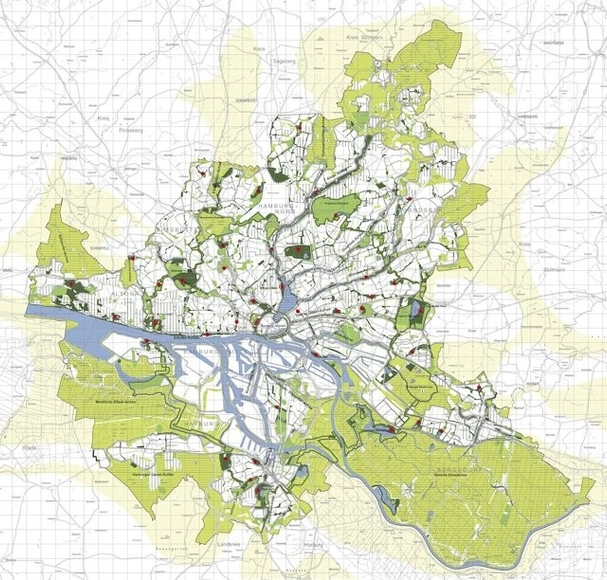
About 40% of the area of Hamburg, the second largest city in Germany, is made up of green areas, cemeteries, sports facilities, gardens, parks and squares. For the first time ever, the city has decided to unite them together via pedestrian and cycle routes. It's all part of the "Green Network Plan," which aims to eliminate the need for vehicles in Hamburg over the next 20 years.
According to city spokeswoman Angelika Fritsch, the project will help to turn the city into a one-of-a-kind, integrated system: "Other cities, including London, have green rings, but the green network will be unique in covering an area from the outskirts to the city centre. In 15 to 20 years you'll be able to explore the city exclusively on bike and foot."
TimeLAX travels across the sprawled city of Los Angeles, connecting some of the city’s most iconic landmarks - Disney Concert Hall, the Griffith Observatory and John Ferraro Building - with over 200 locations that reveal the true essence of the city’s fabric.
In 2007, Oklahoma City was ranked the most obese city in America. The heavy news caused the city’s - at the time - overweight mayor, Mick Cornett to take a hard look at himself and his city. He realized that the city he deemed great, was only great if its citizen was the car.
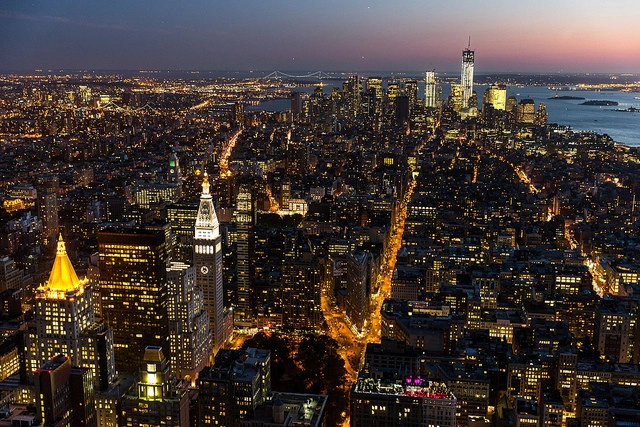
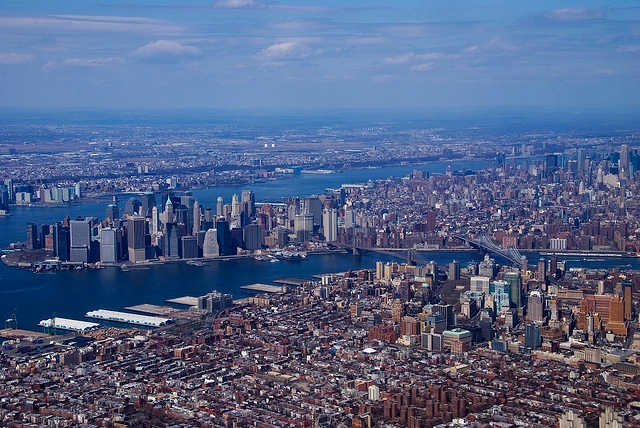
New York - Twice the size of LA. Via Flickr CC User. Used under Creative Commons
An interesting article on io9 unveils a curious law that can apparently predict the size of cities - a law developed by a linguist. The original version of Zipf's law states that in any language, the most common word was used twice as much as the second most common, three times as much as the third and so on. It seems though, that this law also applies to the populations of the cities in a given country. And the most interesting part? Nobody really knows why. You can read the full article here.
The American Institute of Architects (AIA) and MIT’s Center for Advanced Urbanism has produced a new report examining urban health in eight of the USA’s largest cities, which has been translated into a collection of meaningful findings for architects, designers, and urban planners. With more than half of the world’s population living in urban areas - a statistic which is projected to grow to 70% by 2050 - the report hinges around the theory that “massive urbanization can negatively affect human and environmental health in unique ways” and that, in many cases, these affects can be addressed by architects and designers by the way we create within and build upon our cities.
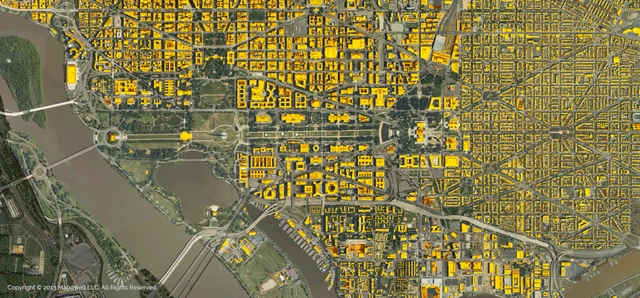
Mapdwell announced today the unveiling of Mapdwell Solar System for the Washington, D.C. The MIT-born project has formed an alliance with the District Department of the Environment (DDOE) to provide its state-of-the-art rooftop solar resource to the U.S. capital.
DDOE was the first of several organizations to partner with Mapdwell after the platform was introduced in Cambridge, Massachusetts. The District’s map comes only seven months after the initial rollout of Solar System, and constitutes the first step in Mapdwell’s expansion in the United States and abroad.
White Arkitekter’s winning proposal for New York’s “Resilient Rockaway” competition.
The Rockefeller Foundation has named the first group of cities selected in the “100 Resilient Cities Centennial Challenge.” Each city has been chosen for demonstrating “a commitment to building their own capacities to prepare for, withstand, and bounce back rapidly from shocks and stresses.” More than 1,000 registrations and nearly 400 formal applications from cities around the world were submitted. After careful review of each city's challenges, these 33 where chosen:
OMA’s Taipei Performing Arts Center Set for Completion in 2015.
It’s official: Taipei has been selected as the 2016 World Design Capital (WDC). This doesn’t come by surprise, as back in August they were the only city selected by International Council of Societies of Industrial Design (ICSID) to move onto the competition’s final round.
The city campaigned under the slogan “Adaptive City: Design in Motion,” focusing on how design can improve the living standards of their citizens. To strengthen their campaign, officials proposed 20 projects under the “Public Policy by Design” program that intended to strengthen the connection between designers, the public and funders. Over 600 workshops have already been conducted, encouraging collaboration between the city’s top officials and design professionals, and many more are scheduled to take place.
Jeff Speck, the city planner and architectural designer best known for advocating smart and sustainable growth, was recently interviewed by MSNBC to discuss the key to success for future cities: walkability. It is no secret that both millennials and the aging population have expressed an overwhelming desire to live in a walkable, urban hub. Though many major cities across the U.S. have embraced this philosophy, some are lagging behind. It is becoming increasingly apparent that a city’s walkability will have a major influence on the city’s competitiveness in the near future.
Watch the interview above to learn about the four keys to having a great walkable city.
Filmed at TEDxToronto in September 2013, this talk by architect, educator and theorist Rodolphe el‐Khoury is based on the inevitable “internet of things.” As TEDxToronto described, “More than ever before, the line between the digital and real worlds is increasingly blurred. Historically, computers and devices have functioned as a separate layer within our lives... In this world, our homes, workplaces, and the objects within them will all be digitally connected, intelligent, and responsive.” It is only a matter of time.
Cities are diverse places, home to a rich spectrum of people and lifestyles. Chris Downey, however, believes that there are only two types of people, "those with disabilities and those that haven't quite found theirs yet." Downey, a distinguished architect of over twenty years, lost his eyesight four years ago and found a new way of seeing the world. "If you design for the blind in mind, you get a city that is robust, accessible, well-connected...a more inclusive, more equitable city for all." Hear his story, contrasting his daily life before and after this newly found "outsight."
https://www.archdaily.com/449481/chris-downey-design-with-the-blind-in-mindJose Luis Gabriel Cruz
By now, we have all heard the mantra. In twenty years time, the world's cities will have grown from three to five billion people, forty percent of these urban dwellers will be living at or below the poverty line facing the constant threat of homelessness - scary statistics and even scarier implications.
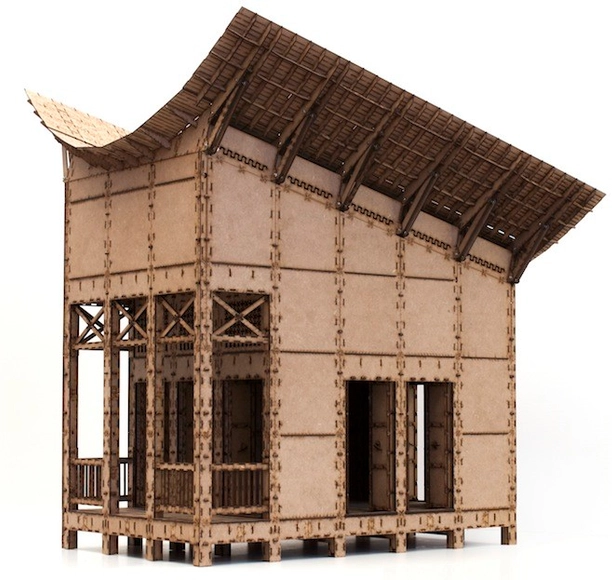
ECOnnect, a Holland-based design firm, envisions a solution for these future housing shortages, one that could build a one-million-inhabitant city per week for the next twenty years for $10,000 per family. Peter Stoutjesdijk, architect at ECOnnect, created the concept after widespread devastation in Haiti caused by a massive earthquake left of hundreds of thousands of people homeless depending on tents for temporary relief.
https://www.archdaily.com/445418/puzzle-piece-homes-a-solution-for-rapidly-growing-populationsJose Luis Gabriel Cruz