

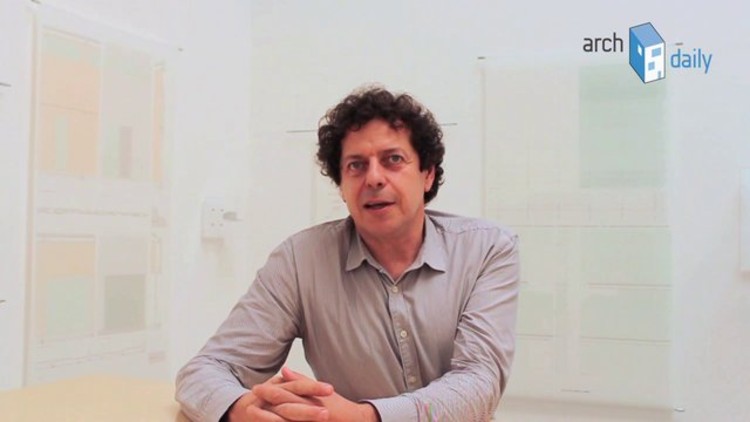
In this video, ArchDaily interviews MASS Design Group co-founder Alan Ricks, who describes the firm’s working process and how the practice, with offices in Boston and Kigali, Rwanda, is intent on improving people's lives through architecture. The firm has established a fundamental process for creating structures, that according to Ricks "Have an obligation to catalyze and amplify the outcomes that are the core services delivered in our buildings.” Whether serving the fields of health, education, or housing, the firm’s modus operandi is public benefit. "[It’s] how we leverage the building process to expand the impact," says Ricks. "We’ve taken to the calling that lo-fab, or locally fabricated, it doesn’t mean lo-tech and it doesn’t mean not pre-fab. It just means we’ve uncovered the available resources where we work and are leveraging them to deliver value.” With clinics in Haiti, primary schools in Rwanda, and proposals for library and hospital projects in the United States, MASS Design has proven its ability to act in the realm of public good. The firm has previously been lauded by New York Times critic Michael Kimmelman, was named one of the Architectural League of New York’s Emerging Voices in 2013, and was the winner of both the Zumtobel Group Award and Curry Stone Design Prize in 2012. Watch the video for more about this entrepreneurial design practice that is redefining what it means to be local, sustainable, and most importantly, for the community.
ArchDaily Interviews: The Latest Architecture and News
AD Interviews: Alan Ricks / MASS Design Group
AD Interviews: Kulapat Yantrasast / wHY
Kulapat Yantrasast is one of the founding partners and current Creative Director of wHY (Workshop Hakomori Yantrasast): a multi-disciplinary firm that works with designed objects, architecture and ideas. Yantrasast values humanist design, focusing on the way architecture directly relates to its human inhabitants. The firm has a diverse portfolio, with much of their work focusing on the relationship of public spaces to the city. They have been shortlisted to revitalize Los Angeles’ oldest park, selected to design the performance spaces for Chicago’s re-designed Jackson Park, and designed and built the “Art Bridge” – a cultural piece of infrastructure – over the Los Angeles river.
AD Interviews: Amale Andraos and Dan Wood / WORKac
Ever present in the forum of architectural discourse, WORKac is known not only for their playful and well-developed projects, but also for their exhibits, installations and publications that all have a message: architecture has the power to change the way we live. Most recently, they’ve participated in the Chicago Architecture Biennial, re-producing famous speculative drawings by Antfarm to illustrate alternative ways of living. Even before that however, WORKac has been shifting its focus on the impact of architecture on the environment, looking at the way city planning and housing could improve to lessen our damage to the earth. Their book, 49 cities, explores the plans and strategies of its namesake to speculate on how we can begin to improve our own, current cities, while their exhibit at the MoMA PS1 event, “Foreclosed: Rehousing the American Dream” advertised a potential “Nature City” that could change the way we live.
AD Interviews: Vo Trong Nghia / Chicago Architecture Biennial
Visitors to the Chicago Architecture Biennial were greeted with the appearance of a small, 30 square meter home built of thatch and steel – the S House 3. The latest prototype in experiments with affordable, sustainable housing by Vo Trong Nghia, the exhibit allowed visitors to experience the home firsthand. Designed to be built for as little as $1,000 and last over 30 years, the exhibit challenged notions of sustainability and cost, proposing an optimistic look at the future of affordable housing.
AD Interviews: Santiago Calatrava on the Museum of Tomorrow
Last week marked the opening of Santiago Calatrava's Museum of Tomorrow in Rio de Janeiro. Prior to the its opening, ArchDaily sat down with Calatrava to learn more about the museum's design and how the project's fruition resulted in the removal of an elevated highway that once isolated the city from the harbor.
AD Interviews: BIG's Jakob Lange / Chicago Architecture Biennial
One of BIG's most high-profile projects under construction, the Amager Bakke waste-to-power plant in Copenhagen, will have quite the party trick up its sleeve. In order to give locals a new understanding of the issue of global warming, for every tonne of CO2 generated by the burning of waste, the plant will emit a super-sized ring of steam into the sky from the chimney perched at the top of its sloping roof. However, when construction on the project started, BIG hit a road block: as Bjarke Ingels explained to FastCo Design, "there were no smoke ring-emitting manufacturers in the yellow pages."
AD Interviews: Vicente Guallart / Moscow Urban Forum
During the 2015 Moscow Urban Forum, city experts from different regions and countries united to exchange practices, projects, and trends. The event fueled discussion on the city of Moscow, which is currently working on its expansion plans, new transport infrastructure, and a series of urban initiatives that are having a positive impact on the quality of life in the city.
AD Interviews: Sou Fujimoto / Chicago Architecture Biennial
Sou Fujimoto Architects' "Architecture is Everywhere" was among the ArchDaily editors' favorite exhibitions in the Chicago Architecture Biennial. The thought-provoking, entertaining collection of mundane objects truly embraced the idea that the public—not solely architects—should be included in the Biennial's celebration of architecture.
Before the fruits of architectural labor are realized, we rarely revel in the seeds cultivated in the minds of architects. It's hard to capture these formative ideas, much less present them in a way that seizes the satisfying moment in which architecture is "found."
The deceiving simplicity of displaying "found architecture" actually imparts a deeper, thoughtful lesson, which Fujimoto has inscribed on an accompanying placard "Architecture could come into being from anywhere. I believe fostering that architecture-to-be into real architecture itself is also architecture."
AD Interviews: Joseph Grima / Chicago Architecture Biennial
A few weeks ago, during the opening of the Chicago Architecture Biennial, we eagerly awaited our opportunity to speak with Joseph Grima, the co-artistic director of the first Chicago Architecture Biennial. In an exhibition with such an open theme, we wanted to understand the driving forces behind the assembly of the participants, in addition to how the city of Chicago itself influenced decisions in the planning of this largest gathering of architecture in North America. Watch the video above and read a transcript of Grima's answers below.
AD Interviews: Santiago Calatrava
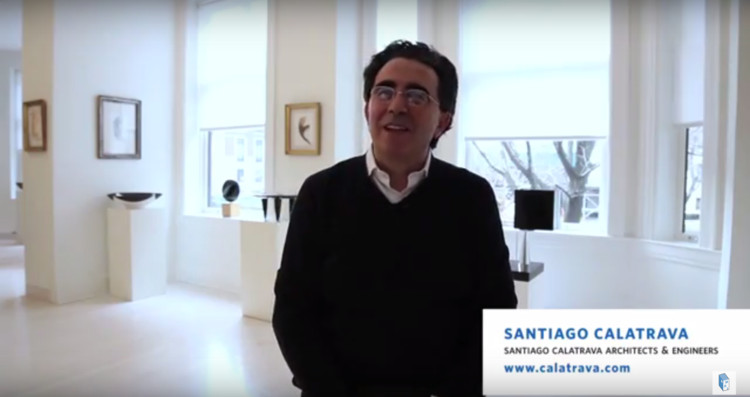
Earlier this year we had the chance to interview Spanish-born architect Santiago Calatrava in his New York apartment. Trained first as a structural engineer, he has designed and completed over 50 projects, which include bridges, transportation hubs, theaters and even a skyscraper. Calatrava has built a career through public architecture, and thanks to open competitions he has received commissions for mostly large-scale, cultural and transport projects. Many cities around the world—from Europe to the US and Asia and beyond—can proudly lay claim to the structurally dramatic projects that Calatrava has dreamed up.
His architectural explorations fuse engineering and art, and result in impressive structures that are honest in revealing the forces at play. In this respect, he is a pioneer; when working on his earliest projects, he didn’t have access to software and tools that are ubiquitous today.
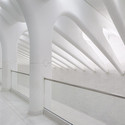
We asked him about his definition of architecture, his high-profile commission for the World Trade Center Transportation Hub, and the challenges he has faced while running his practice. The WTC hub is one of Calatrava's most-anticipated projects in New York; though its inherent complexity has resulted in a long construction period, he has created a project rich in not only form, but also in spatial quality.
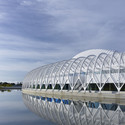
Some of Calatrava's projects use an almost modern-day gothic vocabulary—where big spans, vaults and thin lines define large spaces. Other works, such the St. Nicholas Cathedral in New York, mobilize larger masses and big, stacked walls.
Watch the interview above to learn how Calatrava sees the intersection of art and architecture.
.jpg?1441986671 "Margaret Hunt Hill Bridge / Santiago Calatrava © Alan Karchmer")
.jpg?1441986639 "AD Classics: Bac de Roda Bridge / Santiago Calatrava © Flickr littleeve / www.flickr.com/littleeve. Used under <a href='https://creativecommons.org/licenses/by-sa/2.0/'>Creative Commons</a>")
AD Interviews: Li Xiaodong / Li Xiaodong Atelier
During our last trip to Beijing we had the opportunity to visit Li Xiaodong at his recently opened extension for the School of Architecture at Tsinghua University. Li Xiaodong has become recognized worldwide thanks to his recent projects in rural China, which are deeply connected with the landscape and local community and use a mix of traditional and contemporary techniques.
His built works are strongly connected with his academic research. As a professor at Tsinghua University he has focused on understanding Chinese architecture, co-authoring publications such as “Form Making in Traditional Chinese Architecture” and “Chinese Conception of Space." His research has led him to develop a unique style, which he calls a “new regionalism," focusing on how the local can deal with the global in this era.
AD Interviews: Giovanna Carnevali / Director of Fundació Mies van der Rohe
For the past 27 years, the European Union Prize for Contemporary Architecture - Mies van der Rohe Award has not only recognized the most relevant buildings in the EU, but has also served as a timeline of the evolution of European Architecture.
By looking back on the thousands of projects that have been nominated over the years, one can see a new identity take shape in the EU after the fall of the Berlin Wall, and thanks to the free movement of people — and therefore creative capital - that the EU developed.
In this interview, Giovanna Carnevali, the director of the Fundació Mies van der Rohe, tells us how the award is also becoming a database of hundreds of recognized architects, a powerful network that can be used to assist EU countries by linking "institutions that do have money but they don’t know how to use it and professionals."
AD Interviews: Martha Thorne / IE School of Architecture and Design
During the Mextropoli Festival in Mexico City, we had the chance to sit down with Martha Thorne, the Vice Dean of the IE School of Architecture and Design, and the Executive Director of the Pritzker Prize, who spoke with us about some of the challenges currently facing architecture education.
"When there is globalization in any field there’s the danger that every place becomes similar, or in this case the danger that schools can become similar or standardized, all trying to approach architecture and the academics of architecture in the same way,” she explained. “I think what’s really interesting is to try to look at schools and see how they try to differentiate themselves.”
AD Interviews: Barozzi / Veiga
Earlier this month, during the award ceremony for the 2015 EU Prize for Contemporary Architecture-Mies van der Rohe Award, we had the opportunity to speak with winners Barozzi / Veiga, who won for their Philharmonic Hall Szczecin. We asked Fabrizio Barozzi and Alberto Veiga, founders of the eponymous, Barcelon-based firm, about their project and their office.
The architects describe the process of incorporating and filtering many influences to arrive at the final design for the Philharmonic Hall, emphasizing that they strove to "create a quality" that transforms from day to night. Learn more about the project by watching the video above, and see what the jury had to say after the break.
AD Interviews: Peter Cook / CRAB Studio
Having taught architecture for almost fifty years, Sir Peter Cook has seen generations of architects go from student to high-profile practitioner. In almost half a century, though, architecture education has not particularly moved on: "I don't see the general situation as being any more progressive than it was when I was a student," he says.
Cook tells ArchDaily that instead of focusing on curriculum, structure and countless other preoccupations of many schools, "my experience is that doesn't matter, it depends who's teaching and how enthusiastic they are and whether they understand people," adding that "a really good architecture school is like a village," with tutors who simply don't go home because they are enjoying it so much (or perhaps for other, less innocent reasons).
In addition, Cook also explains that there is potential for a radical shift in the understanding of architecture education, so that we think of it not only as a route into an architectural career, but rather as a route into a whole host of other jobs. "I know people who have science degrees but they actually organize railways," he says. "There's a role for a wing of architectural education at a certain point to take off and say, 'that person is never going to design buildings, but a certain form of architectural education can enable them to look at the world in more depth.'"
AD Interviews: Leong Leong, designers of US Pavilion at the 2014 Venice Biennale
We sat down with Leong Leong Architecture, designers of the US Pavilion at the 2014 Venice Biennale to discuss their concept for OfficeUS. Commissioned by Storefront for Art and Architecture, Leong Leong was tasked with designing a temporary and multi-functional space for architectural practice and exhibition. The minimal, airy US Pavilion features over 1000 projects designed by American architects abroad, set amongst a functional office space.
AD Interviews: Pedro Alonso, Curator of the Chilean Pavilion at the 2014 Venice Biennale
We had the chance to sit down with Pedro Alonso, one of the curators of the Chilean pavilion “Monolith Controversies,” at the 2014 Venice Biennale, to learn more about the concept and inspiration behind the Silver Lion-winning pavilion. “We were interested in demonstrating that architects didn’t absorb modernity, but rather, they supplied it. The ones who absorbed it were the workers and the people,” Alonso told us, outside of a replica of a Chilean apartment – the entrance to the Pavilion. “The absorption of modernity has to do with the pieces we are exhibiting. For example, this apartment, the apartment of Mrs. Silvia Gutiérrez in Viña del Mar, which is an exact replica – object by object- of the 518 things that make up her living room.”
AD Interviews: Juan Herreros
Juan Herreros is one of the most influential Spanish architects practicing today. Executing a delicate balance between his role defining the practice of architecture with work in the academy, he has not only overseen the construction of significant built projects, but also teaches at School of Architecture of Madrid and is a Full Professor at GSAPP Columbia University in New York. It was recently announced that his winning proposal for the Munch Museum/Deichman Library competition was given the green light. The museum will house the world’s largest collection of Edvard Munch artworks and is scheduled to open in 2018.
Herreros strives to highlight architecture’s multi-faceted, multi-disciplinary nature by revealing the complex relationships that lie behind individual projects—undergirded by what Herreros identifies as a “technical culture” (see the exhibition Dialogue Architecture that he curated at the last Venice Biennale).
Together with Iñaki Abalos he founded Abalos&Herreros in 1984. In 1992 they founded the International Multimedia League (LMI), an organization that contributes to the simplification and intensification of artistic practice. Since 2006 he practices with the firm Herreros Arquitectos a collaborative office that has won numerous competitions and commissions. His projects can be found around the world and range from schemes for public spaces to designs for houses.
“Something unique about [our] studio is that, given the difficulties of doing research in architecture today and the usefulness of the “research applied to architecture” concept, we maintain two open, integrated lines of work: one line maintains small projects, very quick, very immediate; and the other is related to the large projects, generally the result of international competitions around the world.”
Check out a full transcript of our interview with Herreros after the break…