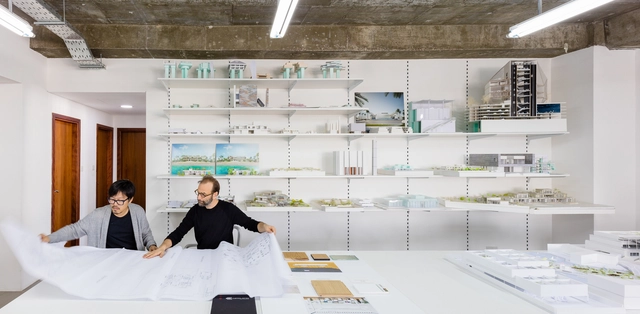
Throughout the history of architecture, representation has always played a vital role; it is the very birthplace of a project. Over time, prominent architects have stood out precisely because of their style of representation. Examples include Viollet-Le-Duc, whose drawing style brought to light the restoration of several historic buildings in Europe, and Le Corbusier, whose famous sketches were anything but beautiful yet managed to convey the essence of his projects.
In the following interview, we delve into his inspirations and ways of incorporating these new technologies, while also discussing his projections for the future of timber in Chile.
"Traveling Without Leaving Home" is a project by artist and designer Jorge Cejudo, also known as “Cejas.” Over the course of seven months, he shared a pandemic-born series of over 200 drawings on his Instagram account @soyelcejas, reconnecting with his followers after the emergency lockdown by inviting them to join him in imagining journeys through various cities around the world.
Italy has approved a program providing a bonus of up to 500 euros (approximately R$ 3,100) to help residents of cities with more than 50,000 inhabitants buy a bicycle. The measure is part of a decree-law approved on May 13 by the Council of Ministers to boost the country's economic recovery amid the novel coronavirus pandemic. Additionally, the initiative encourages the use of non-polluting vehicles.
The São Paulo International Architecture Biennial is the most significant project organized by the IABsp. Since its inaugural edition in 1973, the event has sought to review, discuss, explore, and expand access to issues surrounding territorial occupation and society.
Horizontal Monuments is a participatory intervention carried out at Plaza Juárez in Guadalajara, Mexico. The project began with the construction of a 1:1 scale replica of the obelisk located in the plaza, placed on the ground and shifting its materiality, turning this monument into a malleable and accessible object. This shift sparked a central question: what should be done with it? This question triggered a series of discussions that transformed into actions; students and local community members gathered to give voice and form to the ideas emerging from the transformation of the object. The work was conceived as an educational project to imagine alternative models of monuments capable of addressing the demands and possibilities of specific sites. Its development led to a series of collective actions described below.
https://www.archdaily.com/1123752/horizontal-monuments-a-participatory-intervention-in-guadalajara-mexicoArchDaily Team
Students from the Barcelona School of Architecture are organizing a live-streamed architecture lecture series, featuring both local and international guests, to reflect on quarantine, confinement, freedom, repression, and viruses.
Structural analysis. Image Courtesy of Oliver Krieg
When we think of architectural visualization, sketches, drawings, and 3D renderings usually come to mind. This association is natural, as "visualization" is typically equated with imagining a project before it is built—whether to validate aesthetic and functional decisions or to communicate concepts to clients unfamiliar with technical drawings. However, beyond superficial elements like materials, layouts, textures, and colors, architects must also address highly technical, invisible factors that directly impact a building's performance.
We may still have a long way to go when it comes to addressing the diversity of flora and fauna in urban habitats, yet it is incredible how fast, easy—and even fun—the architecture that makes this possible can be.
In practice, how are we promoting spaces for animals and plants in our cities?
The Eco Pavilion 2020 marks the tenth edition of this competition, which, since 2010, has served as a space for architectural reflection through temporary construction inside the courtyard of the Museo Experimental el Eco. This year's edition was structured around Mathias Goeritz's "snake" concept, under an approach proposed by architect Javier Senosiain.
Carlos Figueroa, under license CC BY-SA 4.0. ImageHeadquarters of the Ministry of Cultures, Arts, and Heritage of Chile in Valparaíso.
In the context of the global health emergency caused by the COVID-19 pandemic, Chile's Ministry of Cultures, Arts, and Heritage has launched a public survey for freelancers, workers, and representatives of the cultural and artistic sectors to assess the status of their organizations, centers, and agents across the country.
Avance Red Bridge Par, colaboración con con LOLA y L+CC. Image Cortesía de Taller Architects
Following the conversation ArchDaily hosted on Instagram Live during the quarantine with Pablo Forero, one of the founders of Taller Architects (formerly Taller 301), we present this interview, in which he discusses the principles and approaches of this young practice based in Bogotá and Amsterdam.
Climate Care – A Curriculum for Urban Practice was a 10-day public program curated by Gilly Karjevsky and Rosario Talevi for the Floating University in Berlin. Climate Care explored the correlations between the environment, urban practices, and education, constructively addressing not only environmental climate challenges but also scrutinizing the complex social, political, and economic climates that surround us today.
Solar tiles work on the same principle as the photovoltaic panels widely used in architecture. The main difference lies in their installation: while photovoltaic panels are mounted on top of an existing roof, solar tiles are integrated into the roof structure from the very beginning, replacing conventional roof tiles.
These tiles are composed of photovoltaic cells. When they absorb sunlight, they generate an electric field that provides electricity to the building's interior. Each tile is connected by cables to a power distribution board.
The following article proposes rethinking architecture in social housing in Colombia. Natalia Carrero Rojas and Pablo González delve into the subject as educators and through their practice 57Uno, where they constantly balance high-quality housing with real estate viability.
https://www.archdaily.com/1123726/57uno-strategies-for-the-design-of-sustainable-social-housing-in-colombiaNatalia Carrero Rojas y Pablo González
The winners of the 'Proyectar a Conciencia' 3.0 competition have been announced. Organized by STO, the call for entries invited students and guiding architects from across Chile to research and reflect on potential ways to retrofit existing buildings to reduce energy consumption and meet contemporary environmental goals—particularly in relation to COP25.
In the architecture of Peru, concrete took center stage during the development of the Modern Movement. In pursuit of a new urban geography, many architects set out to renew their architectural languages. As a result, new concrete buildings—residential, office, and commercial towers—began to emerge across the city, leaving behind the Neocolonial and Republican styles that had long characterized Lima's architecture. Today, the structural advantages, versatility, expressiveness, and aesthetic value of concrete continue to make it a preferred choice for many architects, keeping exploration around the material highly relevant.
It is 12:11 PM on November 7 (2018). An "S" on the door indicates who this bathroom is supposedly for. I am in a bathroom located in a small building designed in the 1950s by Vilanova Artigas, the Brazilian modernist architect, in the Santa Cecília neighborhood. This is my second time inside, and to me, it is still a space slowly revealing itself. At first, what really caught my attention was the almost-purple blue cast by the blacklight, which tints every tone in the room toward that color. It brings a deep sense of serenity during the day.
Architect Severiano Mario Porto passed away today, December 10. At 90 years old, the architect died at 11 a.m. this Thursday from coronavirus. The burial will take place tomorrow, December 11, at the Parque da Colina cemetery in Niterói, Rio de Janeiro. In compliance with social distancing guidelines, the wake will be open only to the family.
Originally published as "El espacio público en asentamientos de origen informal: una construcción colectiva del espacio social" in the third edition of Revista CLEA —an annual publication of the Latin American Coordinator of Architecture Students (CLEA)—, this article argues that the most important aspect of public space is the opportunity it offers to build ourselves as citizens.
The production and meaning of public space in informal settlements are driven by the people who inhabit them. Consequently, the process of forming the concept of publicness is forged from the moment of occupying a void that lacks municipal services (Hernández, 2011). This stems from the fundamental need for shelter, which shapes this void through housing as the primary objective of the individual.
One thing that unites all human beings is that during the first years of our lives, we absorb our surroundings to develop as we grow. Consequently, education plays an irreplaceably important role. In early childhood, however, learning differs from more theoretical methods, as young children assimilate knowledge through continuous experience, developing their motor skills and their sense of dimension and space in relation to their own scale and body.
On July 23, the prequalification meeting for the international tender of the full-process design of the Guiwan Unit 4 Nine-Year Consistent School Project was successfully held. The jury was composed of renowned domestic architects and educational architecture experts. As Qianhai's first nine-year consistent public school, the project is a crucial pillar for establishing Qianhai as an educational hub and an effective practice in exploring full-process design management models. After carefully reviewing the conceptual proposals and commercial bids of the 76 registered applicants, the jury ultimately selected 5 shortlisted firms to proceed to the next stage.
https://www.archdaily.com/1123654/shenzhen-guiwan-unit-4-school-competition-seven-chinese-and-international-teams-shortlisted-for-pre-qualificationMilly Mo
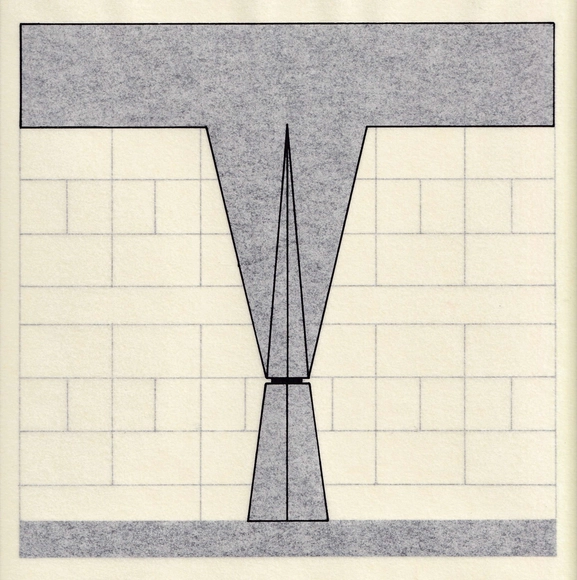
Historically, stone materials have offered ancient cultures the ability to build robust structures by interlocking stones of various shapes and sizes. The simplicity of the technique and its ability to deliver efficient, durable results have sustained the transmission of this construction method over time, enabling multiple contemporary architectural variations and reinterpretations.