Thai Architecture

Capital Bangkok

Language Thai

Area 513,120 km2

Population 67,959,000

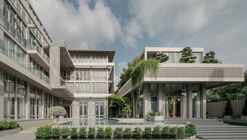
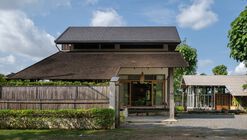
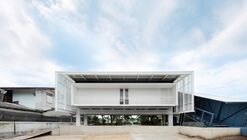
The architecture of Thailand is rooted in the traditional design influences of its surrounding Asian countries but continues to evolve towards a contemporary aesthetic. Thailand has seen the introduction of many high-rise buildings and skyscrapers as major cities such as Bangkok develop. In smaller scale Thailand architecture, architects have integrated transitional space of interior and exterior to accommodate for the intense tropical climate. The vibrant nature of thai architecture is examined in this collection of Thai architecture projects, interviews, and events.
  1. ArchDaily
  2. Countries
  3. Thailand

Latest projects in Thailand

Latest news in Thailand

Pavilions as Stances: 6 Unbuilt Proposals from the ArchDaily Community

Audio available

In architecture, the word "pavilion" can describe an endless variety of structures. It might be defined as a principle and a typology, a freestanding structure, a temporary intervention, a gathering place in the city, or a space for experimentation. This last quality is what unites the six unbuilt projects featured here, all designed and submitted by ArchDaily readers. Here, the definition lies in their sculptural qualities and formal exploration, while their permanence and location vary according to each structure's purpose. The proposals also demonstrate another quality inherent to the pavilion: the intention to symbolically represent a stance. Their exploration of form and material thus also reflects a search for a sense of boundary, wonder, or a shared future.

Built-in Agility and the Architecture of the Infinite Lifecycle

 | In Collaboration
Audio available

While architecture often responds to a specific program of uses, taking into account areas, contexts, and various economic and technical conditions, buildings rarely remain the same throughout their lifespan. Programs, spatial dynamics, and users' needs change, as do environmental, economic, and technological conditions, requiring interventions that were likely not anticipated at the beginning of a project. Steel structures make it possible to envision architecture capable of growing, transforming, being disassembled, and reassembled. Their dimensional precision, industrialized components, and potential for mechanical connections enable the design of open systems prepared for future interventions.

Escapism from the Streets: How Air-Conditioning Reshaped the Asian City

Audio available

In many Asian cities, the summer climate can increasingly be experienced from a distance. In Hong Kong, it is possible to move from an apartment tower through a podium mall, enter the Mass-Transit-Railway system (MTR), arrive beneath another commercial complex, and continue through enclosed footbridges or underground passages while encountering remarkably little of the atmosphere outside. Heat, humidity, rain, and seasonal variation remain present, but they can be largely bypassed through a continuous network of conditioned interiors.

Steel Architectural Awards ASEAN 2026 Announces 12 Finalists Advancing Regional Design Excellence

 | Sponsored Content
Audio available

The Steel Architectural Awards ASEAN 2026, presented by BlueScope, has announced the 12 finalist projects selected to advance to the ASEAN-level appraisal. Representing outstanding achievements in architecture across Indonesia, Malaysia, Thailand, and Vietnam, the finalists were selected through the Country Awards programs and now move forward to regional evaluation by an international judging panel.

Building at Scale: How Long-Span Steel Expands Architectural Possibilities

 | In Collaboration
Audio available

What happens when architecture is asked to create a room without boundaries? Convention halls, stadiums, factories, and logistics centers all begin with the same architectural challenge: creating large, uninterrupted interiors that can accommodate movement, visibility, and changing uses. The larger the span, the greater the structural demands, and the greater the architectural possibilities.

Climate Infrastructure at Human Scale: From Water Management to Urban Cooling

Audio available

Water management, air quality, and heat mitigation are usually planned through systems much larger than the spaces where people actually experience them. Drainage networks sit below the street. Air pollution is measured across entire cities. Yet these conditions are felt much closer to the body: while waiting for a bus in the sun, walking through a flooded street, crossing an exposed plaza, or looking for somewhere to sit when the air itself feels difficult to breathe.

Industrialized Steel Construction: Lessons From a Naval Foundry in Thailand

 | In Collaboration
Audio available

Industrial buildings are often expected to prioritize efficiency, production, and technical performance above all else. As a result, architectural quality is frequently treated as secondary to functional requirements. Advances in material systems, however, allow industrial facilities to balance both, creating buildings that respond to climate, improve working conditions, and establish a distinctive architectural identity.

Rooms That Appear: Sliding Partitions and Conditional Domestic Space

Audio available

Sliding doors are often discussed through efficiency. They save the swing radius of a conventional door, allow compact rooms to function more easily, and help small apartments borrow a few extra centimeters of usable space. Yet in many interiors, their more interesting role is not only spatial economy. Sliding partitions transform the reading of the room itself. A bedroom, study, guest room, dining area, or workspace can appear when a panel is closed, disappear when it is opened, and remain ambiguous when the boundary is translucent or partial.

Schools at the Border: How Architecture Supports Learning in Conditions of Displacement

Audio available

For millions of displaced children and young people, education unfolds amid conditions of forced mobility, administrative uncertainty, and prolonged precarity. Schools situated in borderlands, refugee settlements, and sites of climate-induced displacement therefore operate as more than educational facilities. They become spatial infrastructures that negotiate the contradictory demands of emergency and continuity, offering environments where learning persists despite the instability of legal status, living conditions, and the very feeling of being at home.

From Aalto Works to Tashkent Modernism: Discover the 19 New Cultural Sites Added to the UNESCO World Heritage List in 2026

Audio available

The UNESCO World Heritage Committee has announced 25 new inscriptions to the World Heritage List during its 48th session, expanding the international register with sites that reflect a wide range of architectural, cultural, and natural heritage. The 2026 additions include 19 cultural properties, five natural sites, and one mixed property, alongside approvals for two significant boundary modifications and one revision to the criteria of an existing inscription. Spanning every inhabited continent, the newly recognized places range from archaeological landscapes and historic urban centers to modernist architecture and industrial heritage, underscoring the diversity of the built environment and the evolving scope of heritage conservation.