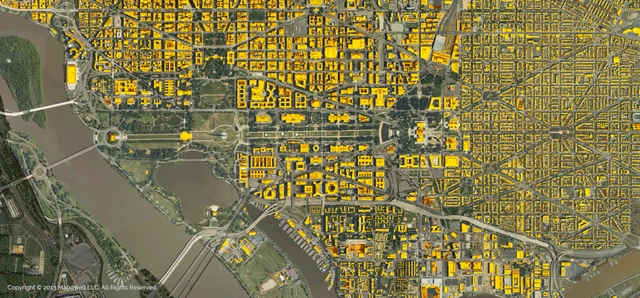
Mapdwell announced today the unveiling of Mapdwell Solar System for the Washington, D.C. The MIT-born project has formed an alliance with the District Department of the Environment (DDOE) to provide its state-of-the-art rooftop solar resource to the U.S. capital.
DDOE was the first of several organizations to partner with Mapdwell after the platform was introduced in Cambridge, Massachusetts. The District’s map comes only seven months after the initial rollout of Solar System, and constitutes the first step in Mapdwell’s expansion in the United States and abroad.
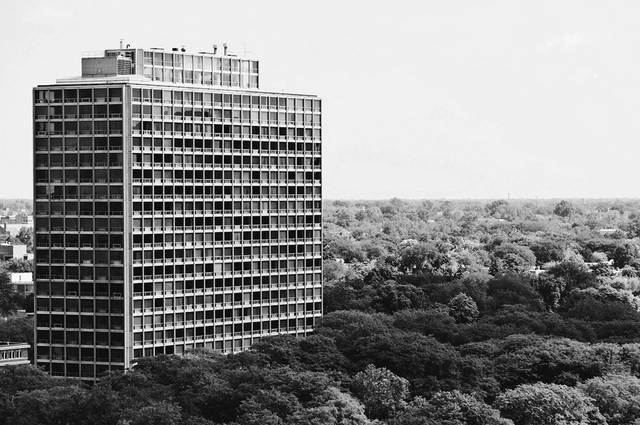
Situated at the eastern edge of Downtown Detroit, Lafayette Park constitutes the world's largest collection of buildings designed by Mies van der Rohe. The 78-acre complex was completed in 1959, just after Crown Hall and the Seagram Building. It is not as well known as several Mies projects of that decade, however, and many critics argue the project deserves greater recognition. One of the first examples of urban renewal, it is a testament to the development's design that it remains a vibrant neighborhood more than fifty years after its construction.
https://www.archdaily.com/455524/ad-classics-lafayette-park-mies-van-der-roheRennie Jones
From the window of an airplane it's all too plain that apartheid has been deeply written into the South African landscape. Even the smallest town appears as two distinct towns. One features a spacious grid of tree-lined streets and comfortable houses surrounded by lawns. The other, its shriveled twin, some distance away but connected by a well-traveled road, consists of a much tighter grid of dirt roads lined with shacks. Trees are a rarity, lawns non-existent. This doubling pattern appears no matter the size of the population: here, the white town; over there, the black township. -- Lisa Findley, “Red & Gold: A Tale of Two Apartheid Museums.”
There are few systems of government that relied so heavily upon the delineations of space than the Apartheid government of South Africa (1948-1994). Aggressively wielding theories of Modernism and racial superiority, South Africa’s urban planners didn’t just enforce Apartheid, they embedded it into every city - making it a daily, degrading experience for South Africa’s marginalized citizens.
When Nelson Mandela and his party, the African National Congress, were democratically elected to power in 1994, they recognized that one of the most important ways of diminishing Apartheid’s legacy would be spatial: to integrate the white towns and the black townships, and revive those “shriveled twin[s].”
As we remember Mandela - undoubtedly the most important man in South Africa’s history - and ponder his legacy, we must also consider his spatial legacy. It is in the physical, spatial dimensions of South Africa’s towns and cities that we can truly see Apartheid’s endurance, and consider: to what extent have Mandela’s words of reconciliation and righteous integration, truly been given form?
In this article, which originally appeared on Australian Design Review as "Reframing Concrete in Nepal," Aleksandr Bierig describes how New York-based MOS Architects, a firm better known for its experimental work, is designing an orphanage for a small community in Nepal.
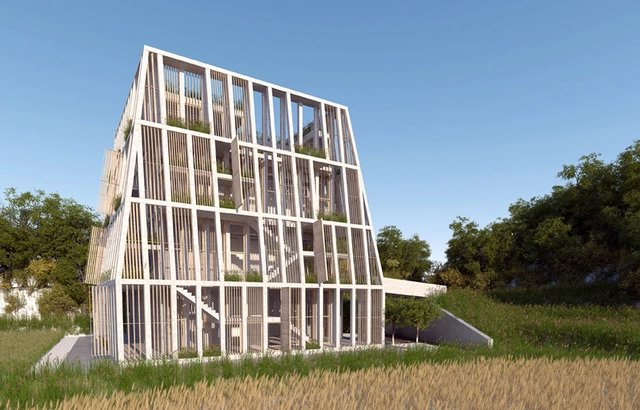
Strangely enough it has become almost unremarkable that an office such as New York-based MOS Architects would find itself designing an orphanage for a small community in Nepal. Now under construction in Jorpati, eight kilometres north-east of the capital, Kathmandu, is the Lali Gurans Orphanage and Learning Centre, which finds itself at the intersection of any number of tangential trends: the rise of international aid and non-governmental organisations, the seeming annihilation of space by global communications networks and the latent desire of architects to use their designs to effect appreciable social change. Emphasizing simple construction techniques and sustainable design features, the building hopes to serve as a model for the surrounding communities, as an educational and environmental hub, the provider of social services for Nepalese women and as a home for some 50 children.
MOS Architects, founded in 2003 by US architects Michael Meredith and Hilary Sample, is not a practice known for its involvement in humanitarian projects. Its work is often experimental and, at times, willfully strange. Alongside its architecture, MOS makes films, teaches studios, designs furniture and gives lectures on its work. It was after one lecture in Denver, Colorado in 2009 that Christopher Gish approached Meredith and Sample to ask if they would be interested in designing an orphanage.
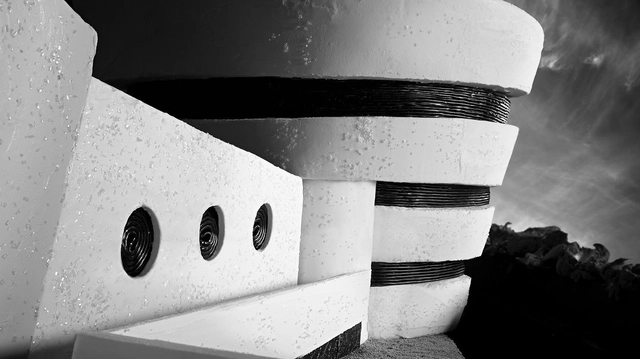
Had Hansel and Gretel stumbled across one of these sugary structures, they may have taken off in the opposite direction. Dark, gloomy, and foreboding, the confectionary architecture would have made quite the impression on Jack Skellington, however. The project, by food artist Caitlin Levin and photographer Henry Hargreaves, is clearly indebted to the gothic mise-en-scène of the latter’s expressionistic underworld, a dreary, but whimsical land where one might half expect to find a twisted (gumball) doppelganger of the Tate Modern or Zaha Hadid’s MAXXI.
Find out more about the process behind this sweet project after the break
For his thesis project, Javier Lloret turned a building into a giant, solvable Rubik's Cube. Making use of the media facade of the Ars Electronica in Linz, Austria, he projected the world's most famous handheld puzzle onto a huge scale - inviting passers-by to solve the puzzle. In the process, Lloret transformed the nearby area, showing that (when used correctly) technology can make the urban environment more fun.
Herzog & de Meuron just celebrated the grand opening of the Pérez Art Museum Miami (PAMM), alongside the commence of the Art Basel in Miami Beach. Located on a waterfront site overlooking the Biscayne Bay, near the MacArthur Causeway, the three-story museum’s low-profile seems to almost disappear into its surroundings - a pleasant contrast to the ornate and often form-based architecture that is typically found throughout the city. This lack of form, as Jacques Herzog described, is all about “permeability.”
“Miami is known for its iconic art deco district – in fact art deco was about decorated boxes with no great relationship and exchange between inside and outside,” Herzog continued. “The greatest thing, however, that makes Miami so extraordinary is its amazing climate, lush vegetation and cultural diversity. How can these assets be fully exploited and translated into architecture? That’s the way we tried to go with our design for the new art museum in Miami.”
Continue reading for a sneak peak inside the Museum...
As we celebrate the 25th anniversary of Arup’s New York office, we’ve spent the past few months talking with people inside the firm and beyond about the future of the city. We asked them to come up with blue-sky ideas about the New York of 2050 without worrying too much about financial or political feasibility. Circumstances can change a great deal over almost four decades, after all, and tomorrow’s constraints might look very different than today’s. We then worked with graphic designerJosh Levi to synthesize and visualize the results — view the large version here. Our main goal: to spark conversations about long-term priorities for the city and possible ways to achieve them.
What would you add to the list? How would you change it?
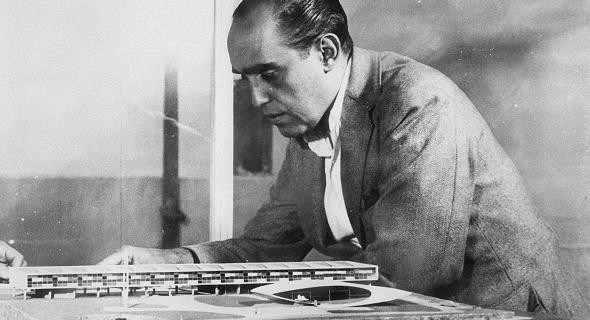
Niemeyer observa maquete da escola projetada em Belo Horizonte (MG). Image Courtesy of ON
It's been exactly one year since the world first mourned the passing of a great master of 20th century architecture: Oscar Niemeyer.
After 104 years of life, the renowned architect left a profound legacy. His works - known for their impressive curves, embrace of light, and profound relationship to their surroundings - made him an icon. Not just in Brazil, but the world.
Destruction of Pruit-Igoe. Image Courtesy of US Department of Housing and Urban Development
This article by Chris Knapp, the Director of Built-Environment Practice, originally appeared on Australian Design Review as "The End Of Prefabrication". Knapp calls for the end of prefabrication as a driver for design, pointing out its century-long failure to live up to its promise, as well as newer technology's ability to "mass produce difference".
Prefabrication – there is not another word in the current lexicon of architecture that more erroneously asserts positive change. For more than a century now, this industrial strategy of production applied to building has yielded both an unending source of optimism for architecture, and equally, a countless series of disappointments. This is a call for the end of prefabrication.
Foster + Partnershas joined forces with Heatherwick Studio to design the new Bund Finance Centre (BFC) in the heart of historic Shanghai. The mixed-use, waterfront destination will serve as the “end point” to the city’s most famous street, as well as a prime connection between the old town, the Bund, and the new financial district.
Los Angeles-based cinematographer Tomas Koolhaas is nearing completion of his highly anticipated film, REM. The feature length documentary, which focuses on the work of Tomas’ famed father, Rem Koolhaas, is the first architectural film to “comprehensively explore the human conditions in and around Rem Koolhaas' buildings from a ground level perspective.” Rather than lifeless still shots and long-winded, intellectual discourse, REM exposes the one thing that gives each building function and purpose: how it is used by people.
So far, REM has been funded entirely by grants. However, in order for Tomas to collect the necessary funds to complete post-production, he has turned to you by launching a Kickstarter campaign.
Watch REM's official trailer above, which follows a parkour expert as he moves through the Casa De Musica in Porto, and follow us after the break for Tomas’ exclusive interview with Kanye West, who comments on his work with OMA at the 2012 Cannes film festival.
At the annual Greenbuild International Conference in Philadelphia last week, the US Green Building Council (USGBC) finally announced the latest version of LEED. Aiming to make a larger forward step than previous versions, LEED v4 is described by Rick Fedrizzi, the CEO and president of USGBC as a "quantum leap". But what are the key changes in the new LEED criteria, and what effect will they have? Furthermore, what problems have they yet to address? Read on to find out.
The design for the Qom Central Building of Construction Engineering Organization by Partar Architecture Studio began with “a key question that discussed the feasibility and impossibility of imagining a unique design which best suits the spatial quality of traditional Iranian architecture." Partar’s design process was based on this challenge, and has led to an interesting proposal that attempts to bridge the art of architecture and the technology of construction using an understanding of the phenomenological aspects of Persian art and ornament, coupled with traditional Persian building techniques.
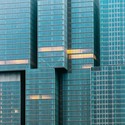
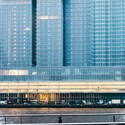
All images are from photographer Richard John Seymour,who caught Rem Koolhaas' recently completed De Rotterdam building on a broodingly foggy morning.
At the opening of the newly constructed De Rotterdam building in his home city, Rem Koolhaas spoke at length about how this "vertical city" was designed to appear scaleless, despite its urban context. More about what Koolhaas had to say about the project and the city, after the break...
London's Tate Britain, a partner gallery to the Tate Modern (who recently appointed Herzog & de Meuron to design a new extension), recently unveiled Caruso St. John's transformation of the oldest part of the iconic Grade II* listed Millbank building. The £45 million project to restore, renovate and reinterpret one of the UK's most important galleries has been met with a largely positive critical response; read the conclusions of The Financial Times’ Edwin Heathcote, The Guardian’s Oliver Wainwright, The Independent's Jay Merrick, the RIBA Journal's Hugh Pearman, and the Architects’ Journal’s Rory Olcayto, after the break…
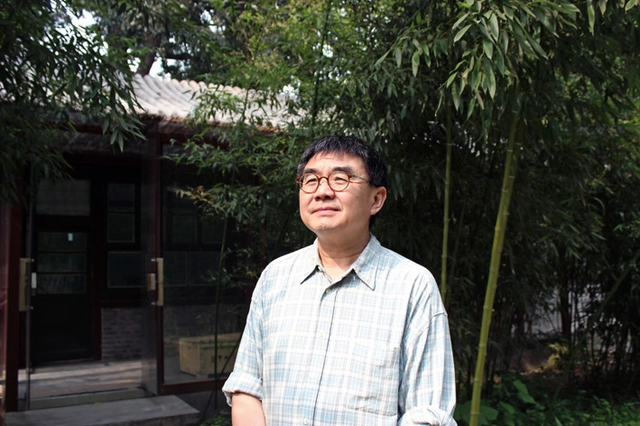
"When you find a piece of stone which is three or four hundreds years old, then you understand the notion of time as more than what we can experience as human beings. At that moment the old thing might be beautiful, it might be ugly. It doesn't matter, but it gives you a sense of profound time, and then you understand your history and ancestors that lived in a different world, different from the one we are in now."-Yung Ho Chang
Located in Beijing’s Yuanming Yuan Park, next to the ruins of the mixed-style Baroque Palace, Yung Ho Chang's office is in an ancient wooden dwelling, surrounded by vegetable gardens grown by the architects of the studio.
In this conversation, Yung Ho, who established China’s first independent architectural office, Atelier FCJZ in 1993, laying the foundation of contemporary practice in China, talks about his story, describing a Beijing which has disappeared as well as the contemporary Beijing and its "New Beijing Sky." He talks about architecture using references from movies, literature, art and artists, describing his approach to architecture in accordance with his philosophy of life.












.jpg?1386258546&format=webp&width=640&height=580)
.jpg?1385617247&format=webp&width=640&height=580)


_Helene_Binet.jpg?1385474415)