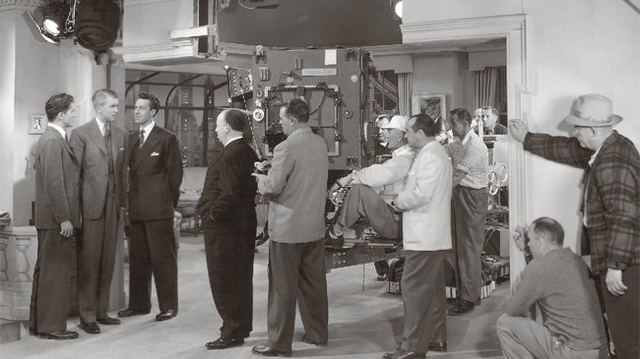
In the films of Alfred Hitchcock, things happen, but the events that gave rise to them are easily forgotten. You quickly forget how A leads to B or, say, by what elaborate means Roger Thornhill ends up at Mt. Rushmore in North by Northwest. But as the French filmmaker Jean-Luc Godard observed, the Hitchcockian cinema compels not with story, but with images—the open-palmed hand reaching for the door, the simulated fall down the staircase, the whorling retreat of the camera from a dead woman’s face. These stark snippets imbue the films with their uncanny allure and imprint themselves in the mind of the spectator much more effectively than any of the master’s convoluted plots.
Read on for more on the role architecture plays in Hitchcock's films
Six public-interest design projects have been announced as this year’s winners of the International SEED Awards, held by the SEED Network, Design Corps, and Parsons The New School for Design. According to the jury, these six are those which most creatively and successfullyaddress the pressing social, economic, and environmental issues of our world today.
See the six SEED Award winning projects, after the break...
Working independently since 1988, Roland Halbe started out shooting commercial architecture, but quickly became one of the most recognized professionals in architecture photography, earning international commissions from architects, agencies and all kinds of media outlets.
In 1996 he co-founded Artur Images, an online archive of architecture and interior images, representing over 200 photographers from all over the world including, of course, himself.
At its peak, thousands passed through its massive, light-filled atrium. Today, Bell Labs Holmdel stands empty, all of its 1.9-million-square-feet utterly without life. An iconic example of the now-disparaged office park, the campus in central Jersey, was shuttered in 2007 and vacated soon after. Years later, it remains in an abandoned, if not unkept state. The grounds are cared for, the floors swept clean, and the interior plantings trimmed, however haphazardly. (That's saying something; in the laboratory's heyday, plastic shrubbery filled its glorious central hall.)
More about the building's future, and more photos by Rob Dobi, after the break
On Friday, a nun gave warning that the Chapel of Ronchamp, considered by many to be one of the key architectural works of the last century, had been vandalized. When police arrived on the scene, they found signs of forced entry: a stained-glass window, one of many executed by Le Corbusier, was broken and a concrete trunk was missing. As Le Monde reports, the intruders had also attempted to gain entry via a door. The overall damage was, according to some, "priceless" because the stained-glass had borne an original illustration by Le Corbusier. An initial assessment from the department of historical monuments found the window to be irreparable.
What does the workplace of the future look like? Shawn Gehle, of Gensler, explains in this TEDx Talk that with over 10 billion square feet of existing office space in North America, we may not even need to envision new buildings. Rather, by "hacking" existing buildings, architects can transform them into something completely new. For more on Gensler's "hacker" philosophy, read our article here.
https://www.archdaily.com/466904/saving-north-america-s-office-spaces-by-hacking-themJose Luis Gabriel Cruz
A rare house from Frank Lloyd Wright's Usonian house period has been saved by the Crystal Bridges Museum in Arkansas. The dramatic rescue plan to disassemble and move the house to a site over 1,000 miles away is required due to frequent flooding of the home's existing site in Millstone, New Jersey. The Crystal Bridges Museum will rebuild and restore the house at a site on their 120-acre grounds.
The Folk Art Museum is most certainly doomed; it may have been doomed from its first appearance. Designed and built to endure, it will soon dissipate in a fog of demolition and fading memory, its lifespan ultimately briefer than a McDonald’s franchise. Looks aren’t everything, I guess.
This raises a lot of questions about permanence, memory, and the spatial character of cities. If The Folk were not in New York, would its status as a landmark building still hold? A particularly New York type of building, more front and slot, it’s a building that is about the street as much as it is about an interior world beyond that street. And losing it will mean West 53rd will be wrought more mega in scale and commercial in vision.
Six US projects have been selected by the American Institute of Architects’ (AIA) for honorably expanding the role of the architect beyond the building and into the realms of urban design, regional and city planning, and community development. These projects will be honored with the AIA’s Institute Honor Awards for Regional and Urban Design at the 2014 National Convention and Design Exposition in Chicago.
After being rejected for appearing too “boxy” and not appealing enough to pedestrians, Related Companies’ revamped Grand Avenue vision has finally won unanimous approval from county supervisors. The $750-million plan, which was abruptly halted back in September when Gensler’s toned-down version was deemed greatly “disappointing” by the city, will now move forward with a more playful (and pricey) design by the project’s original architect, Frank Gehry.
The flurry of criticism that erupted when MoMA announced its plans to demolish the American Folk Art Museum (in its new plans for expansion, designed by Diller Scofidio + Renfro) has yet to settle. After the break, we offer a more complete round-up of the critics' reactions - including Paul Goldberger's of Vanity Fair, Michael Kimmelman's for The New York Times, and more...
Comcast Corporation and Liberty Property Trust has commissioned Foster + Partners to design a 59-story, $1.2 billion mixed-use tower planned to neighbor Comcast’s existing global headquarter in Philadelphia. The 1,121-foot glass and stainless steel building is expected to be the tallest in the United States, outside of New York and Chicago, and the largest private development project in the history of Pennsylvania.
This means that ArchDaily is now reaching every corner of the globe - and in many different formats. From the many lectures and events we attended this year to the launch of our new mobile version (which puts ArchDaily in pockets everywhere), we’re doing everything possible to spread our content - and our mission - around the world.
Which is why the Building of the Year Awards continue to be so important for us. As our audience has grown, so has your collective voice.The Building of the Year Awards are our chance to hear it. This is when you - whether you’re from the smallest town in Africa or the largest city in China - get to identify and recognize the most impactful/meaningful/inspiring project that was published on ArchDaily during the past year. This is an opportunity to tap into our global readership’s collective intelligence; an opportunity for you to judge over 3,500 projects from around the world, according to criteria and priorities that are important to you.
Barcelona-based architect and graphic artistFederico Babina is at it again, this time creating an imaginary “Archibet City” guided by the language of architecture. From Alvar Aalto’s Riolo Parish Church to Zaha Hadid's Library and Learning Centre in Vienna, the collection reimagines 26 famous works of architecture into a set of letters that, as Babina describes, expresses the “heterogeneity of forms and styles” that make up our profession. Each letter is drawn according to the interpretation of an architect’s style, forming part of the cityscape that Babina refers to as “Archibet”.
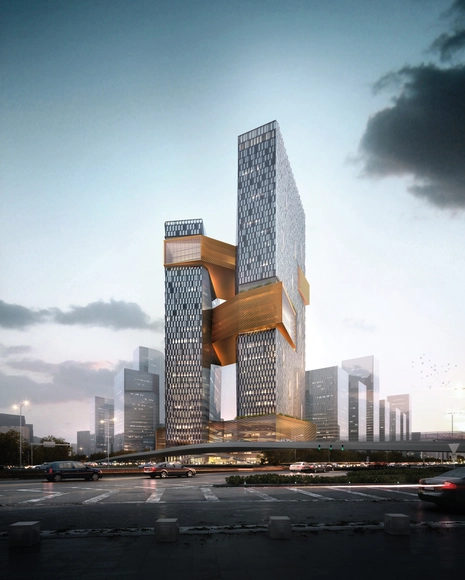
REX has been selected as one of five finalists for a 173,000 square meter proposal located near the equator in Kuala Lumpur, Malaysia. Dubbed as the "Equator Tower," the concept wraps a retractable, PTFE-coated, glass fiber-reinforced sun shade around a slender 80-story tower, blocking direct sun exposure from all four sides.
https://www.archdaily.com/466553/rex-proposes-retractable-facade-for-equator-tower-in-malaysiaJose Luis Gabriel Cruz
Oscar Niemeyer and Lord Norman Foster in 2011. "He was in wonderful spirits—charming and, notwithstanding his 104 years, his youthful energy and creativity were inspirational.". Image Courtesy of Foster + Partners
In this interview, originally published by Metropolis Magazine as "Q&A: Norman Foster on Niemeyer, Nature and Cities", Paul Clemence talks with Lord Foster about his respect for Niemeyer, their meeting shortly before the great master's death, and how Niemeyer's work has influenced his own.
Last December, in the midst of a hectic schedule of events that have come to define Art Basel/Design Miami, I found myself attending a luncheon presentation of the plans for the Norton Museum of Art in Palm Beach, by Foster + Partners. While chatting with Lord Foster, I mentioned my Brazilian background and quickly the conversation turned to Oscar Niemeyer. Foster mentioned the talk he and Niemeyer had shortly before the Brazilian’s passing (coincidentally that same week in December marked the first anniversary of Niemeyer’s death). Curious to know more about the meeting and their chat, I asked Foster about that legendary encounter and some of the guiding ideas behind his design for the Norton.
Eleven projects have been selected to receive the American Institute of Architects' (AIA) 2014 Institute Honor Award for Architecture, an award known as the profession’s high recognition for works in the United States that exemplify excellence in architecture. These projects, and the architects who designed them, will be honored at the AIA 2014 National Convention and Design Exposition in Chicago.
New York City's Times Square has concluded the first redevelopment phase of a permanent pedestrian plaza just in time for last week's New Year's Eve celebrations.
Snøhetta's $55 million redesign — bounded by Broadway and 7th Avenue between 42nd and 47th streets — creates an uninterrupted and cohesive surface, reinforcing the square's iconic role as an outdoor stage for entertainment, culture and urban life.
Learn more after the break...
https://www.archdaily.com/465343/nyc-s-times-square-becomes-permanently-pedestrianJose Luis Gabriel Cruz