Canadian Architecture

  1. ArchDaily
  2. Countries
  3. Canada

Latest projects in Canada

Latest news in Canada

A New Standard for High-Performance, Energy-Generating Facades

 | Sponsored Content

​​The Myron and Berna Garron Health Sciences Complex (SAMIH), at the University of Toronto Scarborough, was shaped by a clear and non-negotiable mandate: at least 20% of the building's energy consumption had to be generated from renewable sources installed on-site. To meet this ambitious requirement, the university partnered early with Mitrex, a manufacturer specializing in building-integrated photovoltaics (BIPV), to explore how solar technology could move beyond the roof and become embedded within the architecture itself—positioning the project within a broader shift toward performance-driven sustainable architecture. The 63,000-square-foot facility houses teaching, research, and clinical training programs dedicated to educating future healthcare professionals. Designed by MVRDV in collaboration with Diamond Schmitt Architects, the project initially followed a conventional path, pairing a restrained facade with rooftop photovoltaic panels.

Hariri Pontarini Architects and Snøhetta to Design New Ontario Science Centre in Toronto

Hariri Pontarini Architects and Snøhetta have been selected to design the new Ontario Science Centre in Toronto. Announced in February 2026, the 400,000-square-foot facility will anchor the site's ongoing transformation through a 220,000-square-foot building defined by a series of scalloped, modular volumes. A central component of the proposal is the physical integration of the existing Pods and the historic Cinesphere via elevated connections and a continuous public promenade. Construction is expected to begin in Spring 2026, with completion anticipated in 2029 as part of a broader waterfront redevelopment strategy.

The 12th Edition of Toronto’s Winter Stations Reveals Images of Five Winning Projects

The annual Winter Stations design competition returns to Toronto for its twelfth edition, once again transforming the lifeguard stations of Woodbine Beach into temporary works of public art. On view from February 16 to March 30, 2026, this year's exhibition is organized under the theme Mirage, inviting participants to examine perception, illusion, and the shifting boundaries between what is seen and what is constructed. Selected from more than 300 international submissions, three winning proposals from Canada, the United States, and a GermanyUkraine collaboration are presented alongside two installations developed by university teams. Installed along the frozen shoreline of Lake Ontario, the projects reinterpret seasonal infrastructure as platforms for spatial experimentation during the winter months.

9 m³ of Survival: Inside the Orion Spacecraft and the Architecture of Space Travel

Subscriber Access | 

It was July 1969, and people on planet Earth were about to witness a historical moment for humanity: the first time a human being stepped on the surface of the Moon aboard the Apollo 11 mission. After this event, NASA landed five more times on the lunar surface, with the last one being Apollo 17 in 1972. Since then, humans have not attempted to return to the Moon until this year, 2026, when they will launch the Orion spacecraft as part of the Artemis II Mission. Planned to set off between February and April 2026, Orion will not yet land people on the Moon, instead it will make a flyby, in order to allow testing of the software and systems. This will set the base for an actual human landing on the Moon's South Pole as part of Artemis III sometime between 2027 and 2028, eventually opening a brand new era in Extraterrestrial architectural design.

Deep Tones and Natural Roots: 22 Shou Sugi Ban Homes Across the US and Canada

Subscriber Access | 

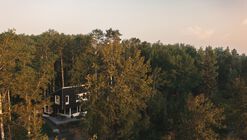
Shou Sugi Ban is a traditional Japanese technique for wood preservation that involves charring the surface of timber to create a protective layer. While its origins are rooted in practical durability, the method has been widely adapted into the modern built environment and shapes a unique and distinctive aesthetic. It is a material of contradiction: it remains bold in its visual language due to its dark tones, yet it simultaneously borrows from and complements its natural surroundings, allowing houses to settle quietly into their sites.

Saving the City Fabric: Blanche Lemco van Ginkel and the Preservation of Old Montreal

Subscriber Access | 

The architectural history of North American cities in the 20th century is often characterized by the pursuit of urban renewal. In the United States, Boston, Portland, and San Francisco are just some examples of when municipal governments prioritized high-speed vehicular infrastructure over the existing urban fabric. In Canada, Montreal would have followed this trajectory if not for the intervention of several figures throughout its history, most notably Blanche Lemco van Ginkel (1923–2022). A Harvard-trained planner and architect who, along with her husband Sandy Van Ginkel, advocated for the preservation of urban heritage while applying the principles of modernist infrastructure.

“Built Environment: An Alternative Guide to Japan” Exhibition in Montréal Examines Resilient Japanese Architecture

The exhibition Built Environment: An Alternative Guide to Japan at the Université du Québec à Montréal's (UQAM) Centre de design will be on view until January 25, 2026. Curated by Shunsuke Kurakata, Satoshi Hachima, and Kenjiro Hosaka, it features a selection of 80 projects from Japan's 47 prefectures, including works by renowned Japanese architects such as 2014 Pritzker Prize laureate Shigeru Ban, Kengo Kuma, the designer of the Museum of Modern Art's renovation in New York Yoshio Taniguchi, celebrated landscape architect and sculptor Isamu Noguchi, and 2019 Pritzker Prize laureate Arata Isozaki. The selection aims to offer a renewed perspective on Japan through innovative buildings, civil engineering projects, and landscape designs. Organized in collaboration with the Japan Foundation and presented with the support of the Consulate General of Japan in Montreal, the exhibition is conceived as a traveling project exploring the resilience of Japanese architecture and infrastructure in the face of natural disasters and climate change.

Historic Materials in the Digital Age: How Digitally Assisted Stone Carving Adds a New Dimension to Heritage Restoration

Heritage restoration has always been an intricate process that requires delicate balancing between preserving the integrity of historic materials while integrating contemporary techniques that can enhance accuracy, efficiency, and resilience. With the restoration process of Parliament Hill in Ottawa, Canada's capital city, this intersection of tradition and technology is now on full display. The East Block, built in 1865, offers a compelling example of how digital tools can support the efforts of heritage restoration and contribute to a centuries-old craft such as stone carving.

Designing Beyond the Formula: Get to Know the Works of 5468796 Architecture in Canada

Subscriber Access | 

Founded in Winnipeg, Manitoba, in 2007 by Johanna Hurme and Sasa Radulovic, and shortly afterward joined by its third partner, Colin Neufeld, 5468796 Architecture was established as an architecture firm whose early work explored the current state of housing in North America. The Canadian studio operates as a collaborative group of approximately 20 designers, where they prioritize the collective value of ideas over individual authorship.

World Architecture Festival 2025: Day One Winners Announced

Subscriber Access | 

The first award winners of the 2025 World Architecture Festival (WAF) have been announced, following Day One of the world's largest international live-judged architectural event, held at the Miami Beach Convention Center in Florida.