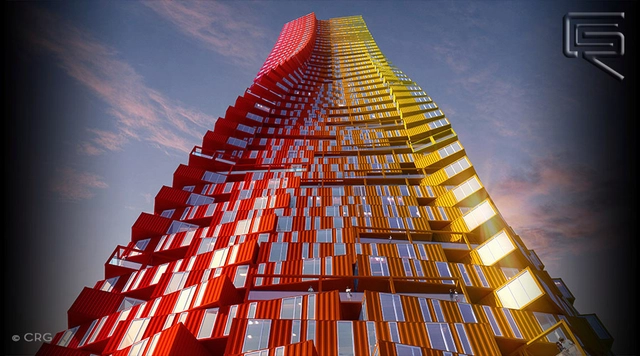
CRG Architects has won third prize in an ideas competition focused on providing temporary housing in Mumbai, India. Set with in the heavily populated Dharavi Slum, CRG's “Containscrapers” propose to house 5,000 city dwellers by stacking 2,500 shipping containers up to heights of 400-meters. If built, the radical proposal would be supported by a concrete structure and offer a range of housing options, from flats to three bedroom residences.
One of the five finalists: "An American Family Portrait" by STL Architects, Chicago. Image Courtesy of The US World War I Centennial Commission
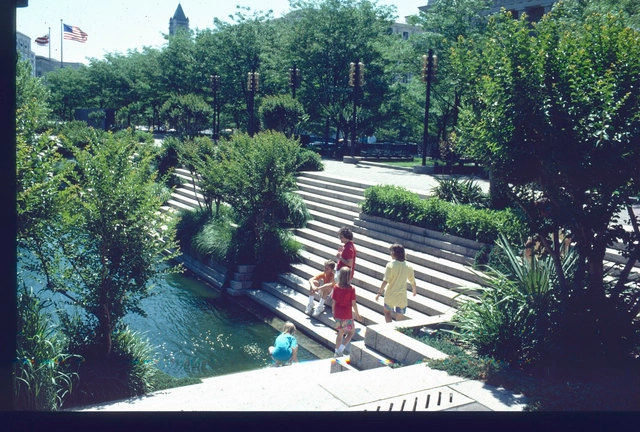
In May, the US World War I Centennial Commission launched its design competition for the redesign of the National World War I Memorial, located in Washing DC. Though some concerns about the fate of Pershing Park, which currently occupies the site, have been voiced, the competition will continue nonetheless, aiming to fulfill the Commission's stated aim "to transform Pershing Park from a park that happens to contain a memorial to a site that is primarily a national World War I memorial, within a revitalized urban park setting with a distinct sense of place."
After cycling through a first stage of entries, the competition has reached its second stage, which entails a public viewing and commentary of the top five designs, before a winner is selected in January 2016.
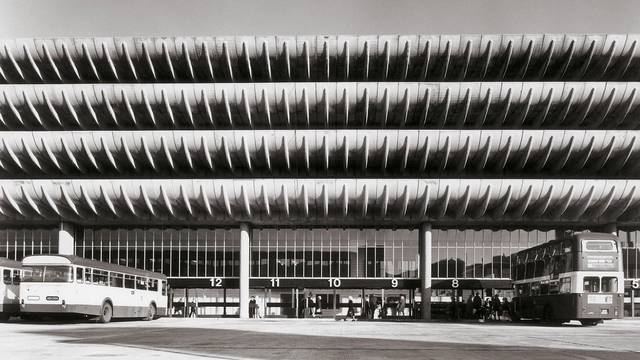
In 2013, following a number of campaigns, a 1969 Brutalist icon in the northern British city of Preston was listed. The future of this bus terminal—one of the largest in the UK and the biggest in Europe when it originally opened—was, until last month, a matter of considerable speculation and debate. This week the results of an international open-call competition for proposals transforming into a new youth centre were revealed, selecting the proposal of New York based practice John Puttick Associates as 'the best of the lot.' The 'lot', however, left something to be desired.
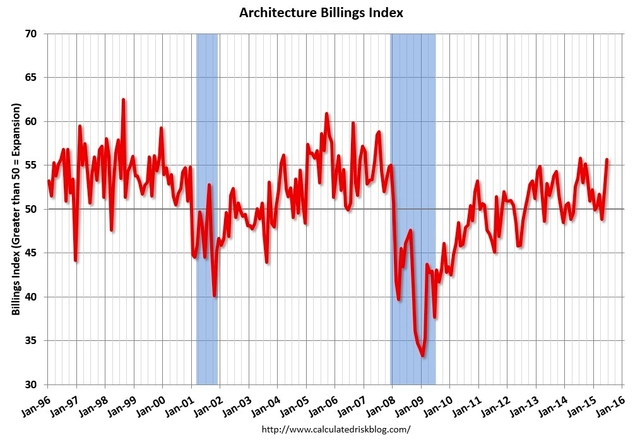
The American Institute of Architects (AIA) has reported a "healthy and sustained" Architecture Billings Index (ABI) for the month of July. Though slightly down from a mark of 55.7 in June, the July ABI score was 54.7, reflecting an increase in design serves within the US. The new projects inquiry index was 63.7, up slightly from a reading of 63.4 the previous month.
A breakdown of regional highlights and foresight from the AIA Chief Economist, after the break.
What do mathematics and your kitchen backsplash have in common? More than you might think: according to recent findings published in The Guardian, mathematicians have had a breakthrough in the world of pentagons, resulting in a new class of mathematically tiling shape. This newly discovered iteration is capable of continuously tiling a surface without gaps, unlike the majority of its similarly five-sided cousins. Known in mathematics as the most elusive tile shape due to its seemingly endless angular possibilities, the pentagon has been the focus of serious scrutiny for over a century.
With the discovery of the fifteenth type of pentagon last month at the University of Washington Bothell, we've decided to compile a list of the most eccentric and intriguing tiles currently available. Dive into the world of wild backsplashes and unorthodox ceramics after the break.
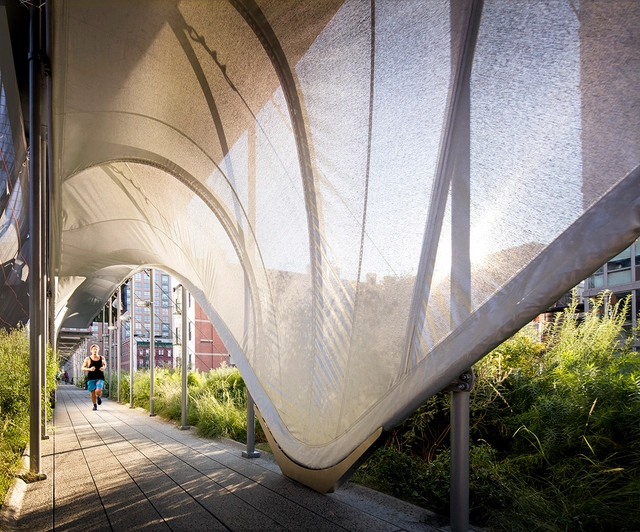
With the construction of their High Line-adjacent residential building 520 West 28th Street, Zaha Hadid Architects have constructed a temporary construction shelter to protect pedestrians in the event of any falling construction materials. However, as is often the case with Zaha Hadid designs, this is a construction shelter unlike any other, serving as a protective shelter but also as an artistic installation.
Named Allongé, the installation is "is inspired by the connectivity and dynamism of movement along the High Line," allowing visitors to the High Line to move through 34 meters (112 feet) of sweeping metallic fabric supported by a curvilinear steel frame, offering a spatial experience that foreshadows the presence of Hadid's building at the site.
The RIBA annually bestows the Jencks Award to an outstanding architect or practice "that has made a recent significant, simultaneous contribution to the theory and practice of architecture." This year the honors go to Herzog & de Meuron.
Selected by a panel of judges chaired by David Gloster (RIBA Director of Education) and which included Charles Jencks, Stephen Hodder (RIBA President and Chairman of Hodder and Partners), Julia Peyton-Jones (Director of the Serpentine Galleries) and Brett Steele (Director of the Architectural Association School of Architecture), Herzog & de Meuron will receive the award on Thursday 29 October at the RIBA in London. In addition, the Swiss architects will receive an honorarium of £1,000 and a certificate.
Since the Moda Center, better known as the Rose Garden, was built next door and became the new host of the Portland Trail Blazers basketball team, the Memorial Coliseum has been in a state of decline. Currently, the building generally only hosts infrequent concerts, as well as minor league hockey. However, Friends of Memorial Coliseum see it as much more than just an outdated venue, which is why since the building was first threatened with demolition in 2009 they've been campaigning for its preservation.
"Every picture tells a story" - at least, that's according to that great philosopher of our time, Rod Stewart. But what about the stories behind the pictures themselves? At ArchDaily we know that a great image requires not only great architecture but also a skilled photographer, so to celebrate World Photo Day we decided to find out more about the most popular images on ArchDaily. We've taken the ten most bookmarked images in My ArchDaily, and contacted some of the photographers to find out more about their images - read on to see the top ten, and to find out the stories behind six of them.
https://www.archdaily.com/772022/world-photo-day-2015-the-10-most-saved-images-in-my-archdailyAD Editorial Team
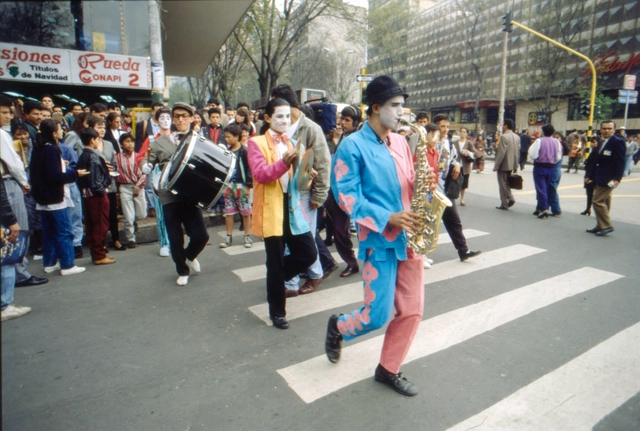
Mimes ridiculing bad-behaviour on the roads in Bogotá
In a recent article for The New York TimesAntanas Mockus, the former Mayor of Bogotá who served two terms in office between 1995 and 2003, discusses what he learnt to be "the art of changing a city." Mockus, a professor of philosophy by vocation, was at times pressured to wear a bullet-proof vest — which he wore with a heart-shaped hole cut over his chest as a "symbol of confidence, or defiance, for nine months." His article discusses how his government tackled Bogotá's "chaotic and dangerous" traffic through a thumbs-up, thumbs-down card system performed by mimes, how they dealt with water shortages, and how they persuaded 63,000 households to voluntarily pay 10% more tax.
Images of Souto Moura Arquitectos' first US project has emerged. Aimed to replace a former gas station at 2715 Pennsylvanian Avenue NW in Washington DC, the five-story red brick and concrete building will feature a ground floor restaurant and eight 2,000-square-foot apartment units with balconies, a gym and penthouse terrace.
As BizJournals reports, the proposal is being pitched by EastBanc Inc. as the new "entrance to Georgetown." The Portuguese architect chose red brick "because it seems to be the most appropriate for this part of the city."
Alongside the release of the American Institute of Architects' (AIA)annual Compensation Report comes a new (free!) Salary Calculator Tool that allows you to compare your income with 17 architectural staff positions - from CEO to Intern 1. You can use the tool to see the overall mean and median salaries throughout the US or by region, and even by firm size (organized by annual firm revenue). Compare your salary here.
The competition, hosted by the United States Federation for the Commemoration of the World Wars and sponsored by the World War I Centennial Commission, received over 350 entries. While these entries did generally follow the guidelines they were given, most of the designs incorporated the complete demolition of the park.
Now, because the park is one of the most significant works of Modernist landscape architect M. Paul Friedberg, with planting plan designs by Oehme, van Sweden & Associates, landscape architecture organizations like The Cultural Landscape Foundation are speaking up against the possibility of demolition.
In a recent article for The Observer, Rowan Moore discusses what he describes as the "quiet revolution in British housing." In compiling a list of practices and collectives from the recent past and present, he has created a compendium of people and organisations who he believes are creating exemplary dwellings in the UK. Noting that the British housing stock is not necessarily in the best shape (a symptom of the 1970s), Moore ultimately offers an optimistic message tinged with words of caution.
View has raised $150 million to fund their specialized Dynamic Glass tints. The new technology automatically responds to outdoor conditions or from a mobile phone, resulting in a reactive tint that reduces heat and glare. This, as the company said in a press release, allows for "greater occupant comfort and energy savings without ever compromising the view." The tinted windows have been installed in more than 100 locations across North America. The funds will be used to accelerate product development.
Taipei 101, once the world's tallest building before losing the title to the Burj Khalifa, has set a new record. As Popular Mechanics reports, the 1,667-foot-tall skyscraper's internal "tuned mass damper" swayed more than it ever has before in last week's Typhoon Soudelor. Also known as a "harmonic absorber," the massive damper moved a full meter from its central position at the tower's top in an effort to keep Taipei 101 upright during the early morning storm's 100 to 145 mph winds.
The weighted ball, measuring 18-feet in diameter and weighing 728 tons, sits on hydraulic cylinders suspended between the 87th and 92nd floors. It was engineered for winds up to 135 mph. Watch the damper (and building) sway in the video below.
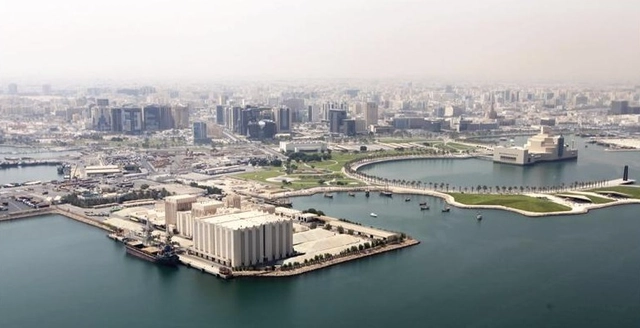
Renzo Piano, David Chipperfield, Sou Fujimoto, Miralles Tagliabue EMBT and ELEMENTAL are among 26 celebrated architects that have been longlisted in an international competition that seeks to transform the Qatar Flour Mills in Doha's Arabian Gulf into a massive "Art Mill." Moving on to the competition's second stage, the remaining architects will now develop site strategies that focus on the mill's connection to the city. The complete longlist includes:











_Nick_Kane_6.jpg?1439884712&format=webp&width=640&height=580)