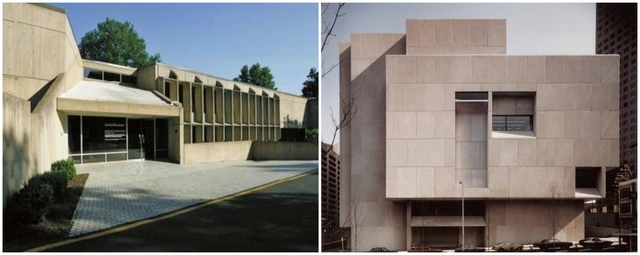
In the past few weeks, the fates of two classic Brutalist buildings by architect Marcel Breuer were determined – with differing results. For the Atlanta Central Library, it was good news, as the Fulton County Board of Commissioners voted unanimously to support the renovation of the building, saving it from the wrecking ball. Meanwhile, the American Press Institute in Reston, Virginia, was not so lucky, as Fairfax County’s board of supervisors voted to tear down the building to make room for a new a townhouse development project.
Architectural Record has released the latest edition of its annual list of the “Top 300 Architecture Firms” in the United States, based on architectural revenue from the previous year (2015). Gensler, which became the first firm to surpass $1 billion in revenue in 2014, held on to the top spot with earnings of $1,181,030,000 in 2015. Los Angeles-based AECOM maintained its number 2 position after a revenue increase of more than 30 percent, making it the largest publicly traded company in the LA area. Perkins+Will continued their steady climb up the list, finishing at number 3.
In this interview, presented in collaboration with PLANE—SITE, Pierre Bélanger, curator of the Canadian contribution to the 2016 Venice Biennale—explains why Canada's practices of mining and extraction should be carefully understood for their architectural implications. Together with his firm OPSYS, Bélanger conceived of a miniaturized experience of an "inverted territorial intervention" so that Biennale visitors could personally experience and relate to "the complex ecologies and vast geopolitics of resource extraction."
https://www.archdaily.com/792555/video-pierre-belanger-explains-extraction-the-canadian-contribution-to-the-2016-venice-biennaleAD Editorial Team
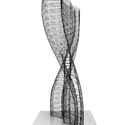
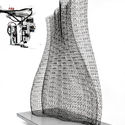
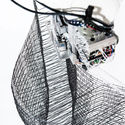
Since 2015, Gramazio Kohler Research has been in the process of developing "Mesh Mould Metal," a project that studies the unification of concrete reinforcement and formwork into a single, robotically fabricated material system. The project is based on their first phase of research, Mesh Mould, which spanned from 2012 to 2014, and developed a robotic extrusion process for a polymer mesh.
Now, as a second phase, Mesh Mould Metal “focuses on the translation of the structurally weak polymer-based extrusion process into a fully load-bearing construction system” by replicating the process in metal. Specifically, the current research delves into the development of "a fully automated bending and welding process for meshes fabricated from 3-millimeter steel wire."
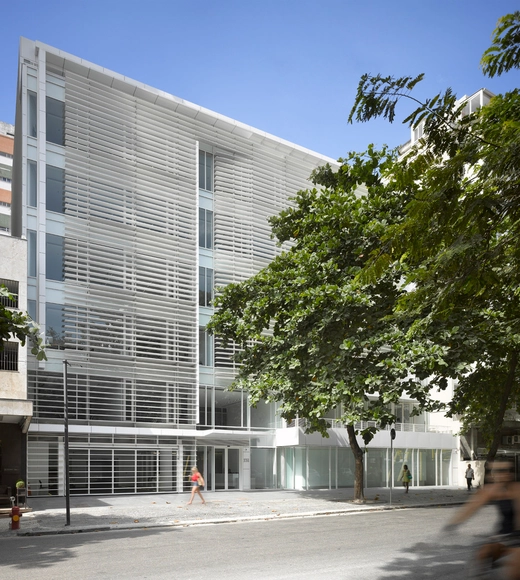
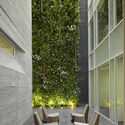
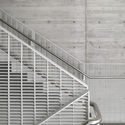
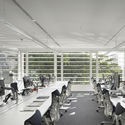
Richard Meier & Partners has completed their first project in South America, a 7-story, sustainable office building in the Rio de Janeiro neighborhood of Leblon. The building will feature concrete, glass and vertical gardens, and will serve as the new international headquarters for top Brazilian investment firm VINCI Partners. The structure consists of open office spaces looking out onto several private interior courtyards and a series of terraces that create a connection with the main urban thoroughfare of Bartolomeu Mitre Avenue.
The Metropolitan Museum of Art has released a 360° video of the recently renovated Met Breuer, the former home of the Whitney Museum designed by Marcel Breuer in 1966 that now houses sections of the Met’s modern and contemporary collections. The video takes you through several areas of the building including the entry, the lobby and the sunken garden courtyard. Orbit around the video to check out the unique apertures of the landmark facade and the finely detailed interiors, featuring the building’s iconic ceiling.
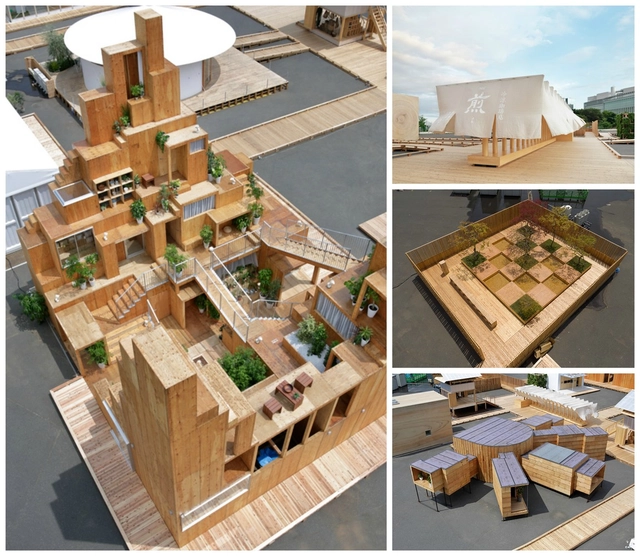
New images from HOUSE VISION Tokyo 2016 have been released as the event opened to the public this past weekend. This year’s theme, “Co-Dividual: Split and Connect / Separate and Come Together,” explores how architecture can create new connections between individuals, and the ways Japanese housing can adapt to cultural shifts through the implementation of technology.
This year’s exhibition features house designs by top Japanese architects including Sou Fujimoto, Kengo Kuma, Shigeru Ban and Atelier Bow-Wow, each paired with a leading company to envision and implement new strategies in housing design.
Continue after the break to see images from the event and the pavilions.
With the opening ceremony of the Rio de Janeiro Olympics fast approaching, the city’s preparations have hit another setback. The main ramp at Marina da Gloria, which will serve as the Olympic sailing venue over the next few weeks, has partially collapsed. The structure was intended for temporary use as the main access point for boats to enter the water. No one was injured in the incident.
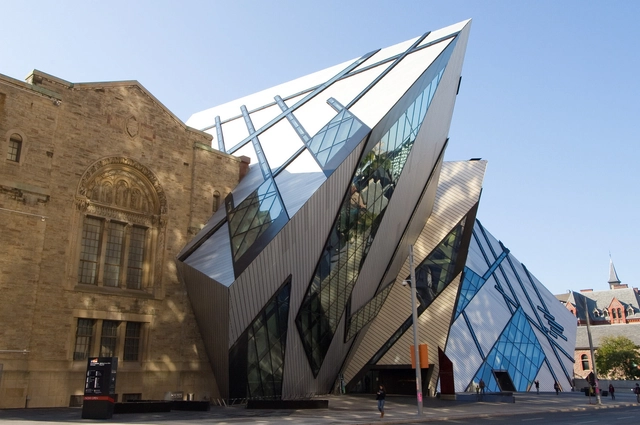
The Royal Ontario Museum extension by Daniel Libeskind, image by The City of Toronto. Image via 99% Invisible
All architects desire recognition of their built work; for their signature design style to be identified, or for the quality of materials and details to outshine those around it. Unfortunately, if every new architectural structure was to insert itself into its context looking to be the star, soon it would become impossible to gauge the civic relevance of the area. Some buildings, such as Daniel Libeskind's Jewish Museum, appear dislocated with due cause, but others stand out for the sake of standing out, turning their back on their rich historical setting.
While there can be no singular strategy for contextual integration, Kurt Kohlstedt argues that a consideration of historical context, whether eventually chosen to acquiesce with or deny, will result in richer and more engaging built environment. In his latest essay for 99% Invisible, Kohlstedt unpacks the myriad ways in which a new building can engage with what was there before, highlighting examples which successfully and unsuccessfully take up the challenge. He acknowledges the difficulty of finding the sweet spot, as many designs are unable to navigate the "fine line between contextual and contemporary."
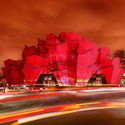
As a token of his love, Russian architect, designer, and writer Vasily Klyukin is presenting the field of architecture with roses, specifically, with his new design, Roses Pavilion.
Inspired by the beauty and presence of the flowers, Klyukin has conceptualized a pavilion made of glass and metal shaped like a bouquet of roses. Here, variations in interior lighting will change the color of the bouquet—whether red, yellow, or a variety of shades—according to desire and mood.
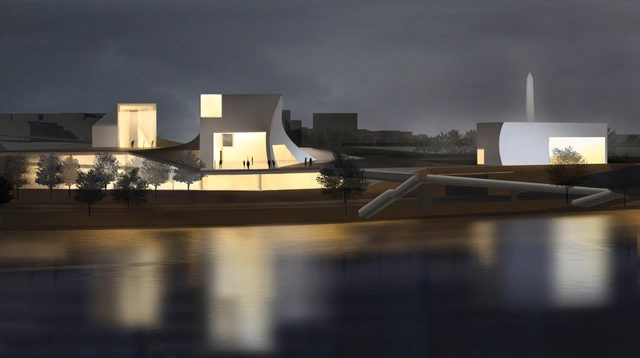
Steven Holl Architects have received the go-ahead for a new pedestrian bridge linking their own Kennedy Center Expansion to the Potomac riverfront. Originally proposed by Kennedy Center architect Edward Durell Stone in 1959, the idea to extend the lively arts program from the center along the waterfront is set to increase the vitality of both existing programs. The bridge approval was one of the last remaining piece of the project, with the majority of the Kennedy Center Expansion already under construction.
This article is part of our new "Material Focus" series, which asks architects to elaborate on the thought process behind their material choices and sheds light on the steps required to get buildings actually built.
Installed last year, the Salling Tower provides a striking, sculptural landmark in Aarhus Docklands. From inside, its deceptively simple counterbalanced form provides a range of ways to look out over the harbor and the city - but from the outside the project's designers, Dorte Mandrup Arkitekter wanted the tower to take on an abstract appearance, referencing nautical themes with its sail-like shape and porthole-like openings all while obscuring the process of its own construction. To do this, the firm created a structure composed entirely of a single steel piece resting on top of its foundations. In this interview, project architect Noel Wibrand tells us about how the project's material choice contributed to the construction process.
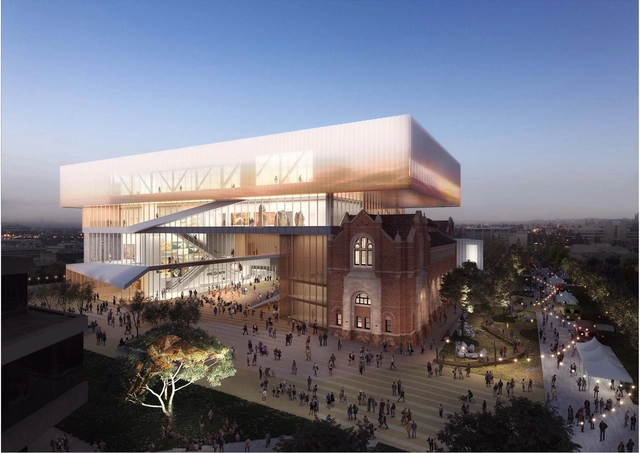
The New Museum for Western Australia. Image Courtesy of HASSEL + OMA
With the contract to design and build the museum in Perth officially awarded to contractor Brookfield Multiplex, HASSELL + OMA have revealed the design for the New Museum for Western Australia. The WA Government commissioned HASSEL + OMA to design the cultural institution in April of this year.
HASSELL Principal and Board Director Mark Loughnan, and OMA Managing Partner-Architect David Gianotten stated: “Our vision for the design was to create spaces that promote engagement and collaboration, responding to the needs of the Museum and the community. We want it to create a civic place for everyone, an interesting mix of heritage and contemporary architecture, that helps revitalize the Perth Cultural Centre while celebrating the culture of Western Australia on the world stage. The design is based on the intersection of a horizontal and vertical loop creating large possibilities of curatorial strategies for both temporary and fixed exhibitions.”
https://www.archdaily.com/792368/hassell-plus-oma-reveal-design-for-new-museum-for-western-australiaAD Editorial Team
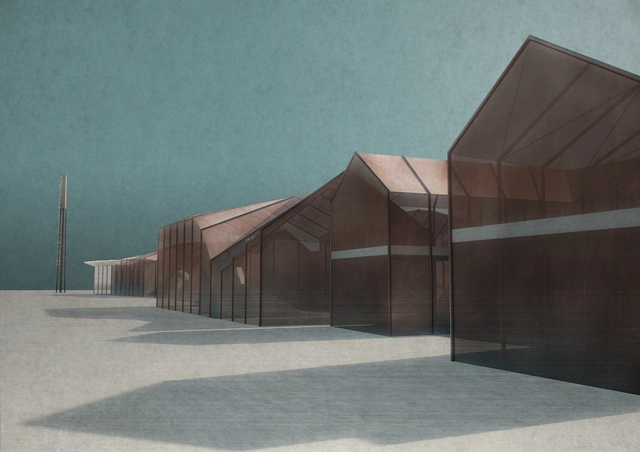
Paris-based firm RE: has recently completed the design for an extension and refurbishment of the Cyprus College of Art in Paphos. With the idea of continuation, rather than radical reimagination, the project extends the existing sculptural wall of the college, creating new carvings and sculptures from a series of hung perforated copper-clad sheds.
Through this design, the cast concrete wall becomes a horizontal core for the building. Furthermore, this space will contain a series of building services, and can become a place of participation, as it may be carved or painted.
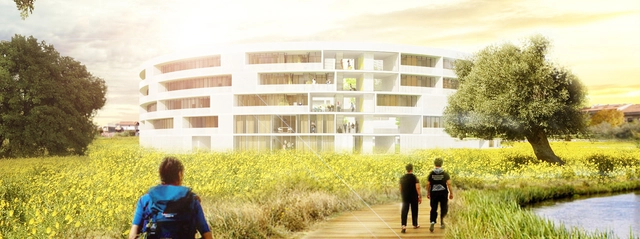
The team of CIRCOLO-A + LINEARAMA has won first prize in the AAA-Architetti Cercasi 2015 competition with its design, EPICICLO. As a mixed-use building, EPICICLO will feature apartments, alternative residences like student and social housing, common spaces, as well as both public and semi-private outdoor spaces.
The design is shaped after a ring so that it is open to the outside and comfortable on the inside. The design takes into account the relationship between public and private, not only creating a gradient from outside to inside but also varying public and private spaces within the building. Similarly, open and closed spaces are alternated, to create "spots of community life and moments of privacy."
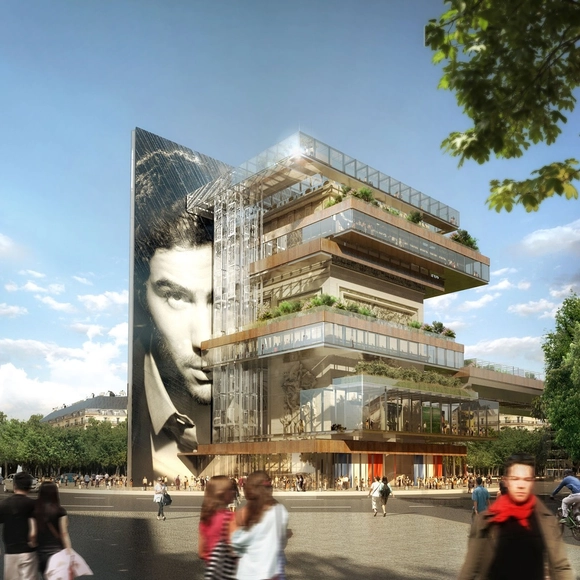
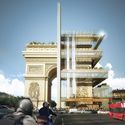
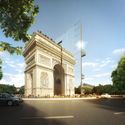
French architect Patterlini Benoit has imagined a mixed-use building to be wrapped around one half of the Arc de Triomphe in Paris. Completed in 1836 as a memorial to the victories of the French armies under Napoleon, Paris’ triumphal arch is one of the most iconic and visited landmarks in France and the world over. But Benoit argues that its status as a tourist destination has removed it from the authentic cityscape that is used by everyday Parisians. His proposal attempts to reclaim the monument for the city by dividing the arch with an enormous mirrored plane – visually competing the monument from one perspective and providing new function from another. In this way, Benoit claims, the structure can be “brought into modernity without denying history.”
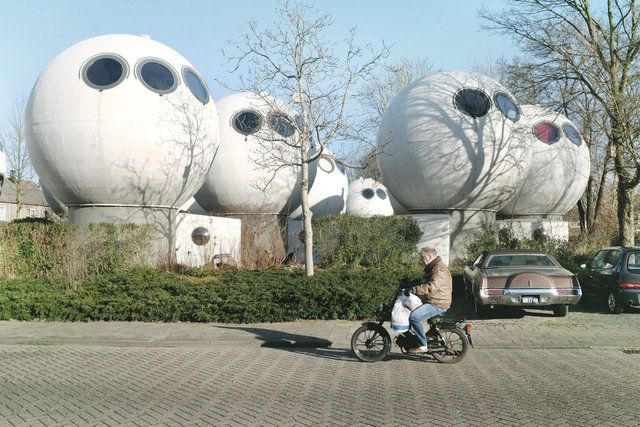
AD Classicsare ArchDaily's continually updated collection of longer-form building studies of the world's most significant architectural projects. Here we've rounded-up ten groundbreaking residential projects from this collection, ranging from a 15th century Venetian palazzo to a three-dimensional axonometric projection. Although some appear a little strange, all have been realised and have made lasting contributions to the wider architectural discourse. You can study residential cubes, spheres and inverted pyramids—plus projects by the likes of OMA, Álvaro Siza, and Richard and Su Rogers—after the break.
https://www.archdaily.com/792326/ad-classics-ten-groundbreaking-residential-projectsAD Editorial Team
Are the rigors and tribulations of architecture school causing serious impacts on students' mental health? A new student survey conducted by Architect’s Journal has found that more than a quarter of architecture students in the UK are currently seeking or have sought medical help for mental health issues related to architecture school, and another 25% anticipate seeking help in the future.
The results have prompted Anthony Seldon, vice-chancellor at the University of Buckingham and a mental-health campaigner, to describe the situation as “a near epidemic of mental-health problems.”








.jpg?1469779437 "Courtesy of Vasily Klyukin")

.jpg?1469824242&format=webp&width=640&height=580)
.jpg?1469824198 "© Torben Eskerod")
.jpg?1469824212 "© Torben Eskerod")
.jpg?1469824271 "© Torben Eskerod")
.jpg?1469824295 "© Torben Eskerod")
.jpg?1469824242)


_(14793276663).jpg?1469806542&format=webp&width=640&height=580)