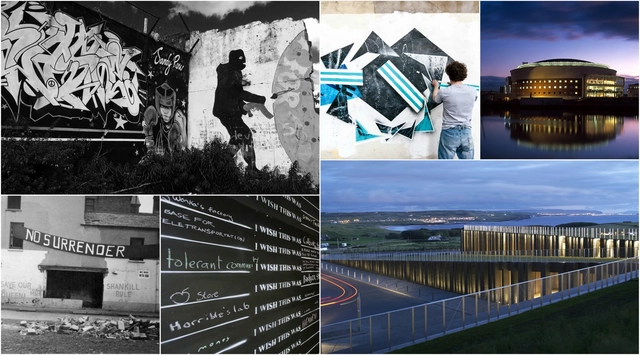
Architecture is often intertwined with political context. This deep connection is especially evident in Northern Ireland, a place of infamously complex politics. The state came into existence as a consequence of war in 1921, when Ireland was partitioned into an independent Irish Free State (now the Republic of Ireland) and Northern Ireland, an industrious region still controlled by Britain. Conflict has since ensued in Northern Ireland between a majority pro-British Unionist population, and a minority, though significant, Irish Nationalist community. The latter half of the twentieth century witnessed a brutal struggle, with over three thousand people killed, thousands more injured, and harrowing images spread across the world.
The turbulence of Northern Ireland’s conflict is played out in the architectural development of Belfast, its capital city. With thirty years of war from the 1960s to 1990s, the architecture of Belfast embodied a city under siege. When the prospect of peace dawned in the 1990s, an architecture of hope, confidence, and defiance emerged. In the present day, with Northern Ireland firmly on a peaceful path, Belfast has played host to a series of bold architectural ideas and landmark public buildings by award-winning architects. With the rich, bitter, emotive history of Northern Ireland viewed through multiple, often conflicting prisms, the architectural development of Belfast offers a tangible narrative of a city which burned, smoldered, and rose from the ashes.






_Hedrich_Blessing_012.jpg?1494276345)







.jpg?1494275506&format=webp&width=640&height=580)



.jpg?1493587707&format=webp&width=640&height=580)