Architecture City Guide: Beijing

Courtesy of Flickr CC License / Sarmu

This week, with the help of our readers, our Architecture City Guide is headed to . has a range of architectural styles, but the three most prevalent are the traditional imperial style (the Forbidden City), the “Sino-Sov” style (boxy structures built between the 1950s and 70s), and lastly the explosion of a modern corporate style that is punctuated with Starchitect buildings like ’s CCTV TV Station HQ. We put together a list of 12 modern/contemporary buildings that we feel provides a good starting point. It is far from complete. There are dozens of other great buildings that are not our list, and we are looking to add to the list in the near future. Please add your favorites in the comment section below so we can add them on the second go around. Again thank you to all our readers who sent in their suggestions and photographs. The city guides would not be possible without your help.

To check out other cities visit our world map or our Architecture City Guide page.
The Architecture City Guide: Beijing list and corresponding map after the break.

Architecture City Guide: Amsterdam

This week, with the help of our readers, our Architecture City Guide is headed to . With its numerous canals, Renaissance architecture, and bike friendly culture, it is hard not to fall in love with . Also, if you love modern or contemporary architecture one could hardly argue against making this city the first stop on a tour of Europe. Our list of 24 buildings hardly does justice to this amazing city, but it will certainly give those less familiar with the city a starting point. We will be adding to our list in the near future, as we didn’t come close to incorporating all our readers’ suggestions. In the meantime add more of your favorites to the comment section below.

The Architecture City Guide: Amsterdam list and corresponding map after the break.

This is Hybrid / a+t research group

Following years of research, a+t publishers presents the first theoretical-practical book on hybrid buildings. Taking its inspiration from the four issues of a+t magazine’s Hybrid series, the book takes a look at the theories and projects which have had the greatest historical importance. prefaces the book with an introduction where he foresees the path which hybrid typologies should take towards the creation of new urban spaces.

Short Listed Firms for Museum of Fine Arts Houston Expansion

The property for the expanded MFAH is vis-à-vis the Audrey Jones Beck Building, designed by Rafael Moneo © MFAH

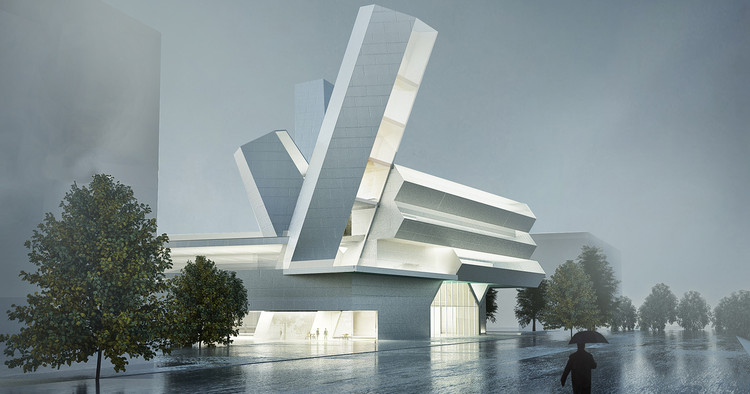
Earlier this week, we shared the news of Steven Holl + BCWH recent commission for the in Virginia.  It seems Holl will also be busy working on a conceptual design for the Museum of Fine Arts Houston as the museum recently announced their short list from ten international architects to three.  In addition to Holl, the museum has selected and Snohetta to submit design proposals for the expansion project.  “This decision marks an important step forward for the future MFAH,” said Richard D. Kinder, chair of the museum’s long-range planning committee. “Even before Rafael Moneo’s Audrey Jones Beck Building opened, in 2000, MFAH director Peter Marzio and the board recognized that it would not be the final step in expanding the MFAH.”

More after the break.

“With the collections now numbering some 63,000 objects—more than half of them works of art created after 1900—the need for a building dedicated to these expanding collections is unquestioned,” continued Kinder.

The three firms will develop concepts for a new building which will be situated on a two-acre and will house post-1990 art.   In addition, the projects must address the needs for a parking garage and integration with the surrounding MFAH buildings.  It is an exciting competition as the new building will be adjacent to the Isamu Noguchi-designed Lillie and Hugh Roy Cullen Sculpture Garden, across from Moneo’s Audrey Jones Beck Building and Mies van der Rohe’s Caroline Wiess Law Building.  We’ll keep you updated with the proposals.

As seen on Bustler.

Institute for Contemporary Art / Holl + BCWH Architects

Courtesy Mark Heitoff

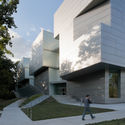
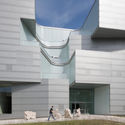
Steven Holl Architects just shared the news that the firm has won the commission for the new for  Commonwealth University with BCWH Architects.  The 32,000 square-foot building will provide gallery spaces for traveling and school exhibits, classrooms, offices, art storage spaces and an auditorium, and accommodate a sculpture garden and a café.   Joseph H. Seipel, Dean of the VCU School of the Arts, exclaimed,  ”We are honored to have Steven Holl, internationally recognized as one the most inspired and significant architects of our time. With Holl leading this endeavor, I am confident the ICA is destined to become an iconic building for VCU and the city of Richmond and will find its place as a prominent example of Steven Holl’s contributions to the history of architecture.”   As the selection process was organized to find an architect-led team, and not a specific design, we will keep you posted on the progress of the project.

Update: Glasgow School of Art / Steven Holl

Courtesy of Architects

Plans for the new School of Art building, designed by Steven Holl Architects in association with JM Architects, received approval from the Glasgow City Council’s planning committee this week.  Site preparations are scheduled for this summer, and work on the new building will immediately follow with construction scheduled to take around two years. The five story building will reside directly opposite of Charles Rennie Mackintosh’s masterful Glasgow School of Art building.

“We are very pleased with the support from the Glasgow City Council Planning Committee. We believe that the new building will be an exciting addition to the Glasgow School of Art and will provide an inspirational environment for the students and the community,” Holl said.

Holl’s design focuses on creating a relationship between the two buildings through attention to architectural elements, such as light, materiality and proportion. The prominence of Holl’s new building has created a lot of dialogue surrounding the design, which was the winning entry in a competition for the Glasgow School Art. Our previous coverage can be found here.

Source: bdonline

Debate Over the Design for the Glasgow School of Art by Steven Holl

Courtesy of Steven Holl Architects

Debate continues on the design for the Glasgow School of Art by Steven Holl Architects in collaboration with Glasgow based JM Architects. Last month William J.R. Curtis shared his critical thoughts on the new extension, referencing the diagrams by Holl as ‘cartoonlike’, the surface choices of ‘monotonous’, and the external volumes as ‘clumsy’. As we all know architecture is subjective and debate should be welcomed, hopefully resulting in a smart discussion focused on providing the best design solutions for a project. A critique of an extension to a building with such importance as Charles Rennie Mackintosh’s , a design that masterfully manipulates light into spaces and skillfully the nature of different materials, is expected. However, this review almost seemed personal and a bit uninformed. Curtis, during his critical rant even asks “where was the client during these intervening months?” referring to the initial announcement and presentation of Holl’s winning design and then later released drawings.

Continuing, “The unsatisfactory state of Holl’s proposal perhaps reveals what may happen when a star architect drops in from another planet and blinds a building committee with the “smoke and mirrors” of popularized phenomenology. Some good old Scottish common sense would have been in order to insist on greater rigor and a more appropriate response to the context.”

Holl took time to respond to Curtis’ article stating, “We welcome criticism as long as it’s based on an accurate understanding of our design. Unfortunately William Curtis’ article is not knowledgeable about our design,” and Holl also shares specifics about both the design material choices for the new extension (his full response following the break).

Hangzhou Normal University Cangqian Performing Arts Center, Art Museum and Arts Quadrangle / Steven Holl Architects

Steven Holl shared with us his winning entry for the Hangzhou Normal University Performing Arts Center, Art Museum and Art Quadrangle in Hangzhou, China.  The pair of buildings, situated on either side of the canal, are the heart of the new campus.  Holl’s concept early on was two balanced forms, one additive as seen in the design of the Performing Arts Center, and one subtractive displayed in the design of the Art Museum.  This dialogue between these two buildings, the utilization of local materials, and the carbon neutral section of the new university provides for a special moment within the campus.

Follow the break for sketches and renderings of this project.

Architects: Steven Holl Architects
Location: , China
Design Architect: Steven Holl, Li Hu, Chris McVoy
Project Architect: Garrick Ambrose, Yichen Lu, Roberto Bannura
Project Team: Human Wu, Guanlan Cao, Francesco Bartolozzi, Michael Rusch, Johanna Muszbek, Maxim Kolbowski Frampton, Nathalie Frankowski, Scott Fredricks, Garrett Ricciardi, Jose Carlos Quelhas, Wenny Hsu
Structural Engineer: China Academy of Building Research (CABR)
Acoustics Consultant: Kirkegaard Associates
Sustainability Consultant: Mathias Schuler (Transsolar)

Five Architects: A North American Anthology

Frampton via Getty Images

If you are in the New York area, Columbia University is organizing a celebration for architect and critic Kenneth Frampton’s 80th birthday. This event, entitled Five Architects: A North American Anthology , is a conference curated by Frampton on Saturday, November 13 running from 10 am – 6 pm.  The five architects will include of New York, Rick Joy of Tucson, John + Patricia Patkau of Vancouver, Stanley Saitowitz of San Francisco and Brigitte Shim + Howard Sutcliffe of Toronto. The diverse group represents a varied body of work which, although quite distinct and different, share certain values, such as a particularly sensitive feeling for the impact of both craftsmanship and climate on the generation of form and a seemingly, equally shared concern for the expressive tactility of material and the articulation of structure under the impact of light.

For more information about the event, visit here.

Is China Architects’ New Dubai?

West Kowloon Cultural District Theater Village from Water © OMA

The latest buzz from is all about the West Kowloon Cultural District, a large performing arts venue incorporating studios, theaters, performance venues, and cultural and public spaces.   We’ve brought you coverage on OMA’s proposal as well as Foster+Partners‘ and Rocco Design Architects‘ schemes, and as the master plan develops, we’ll be sure to bring you the latest updates.  As CNN reported, China has become “an increasingly attractive territory for leading architects.”  And, we couldn’t agree more.  Over the past few months, we’ve seen great projects from Holl emerging in China, such as his Horizontal Skyscraper in Shenzhen, as well as Hadid’s Guangzhou Opera House,  OMA’S CCTV Tower, Vector Architects + CCDIP’s Tianjin Elementary School, and, not to mention,  ’s Flowing Gardens.  Plus, in terms of experimentation, China’s recent Expo 2010 offered the perfect opportunity for architects across the world to demonstrate their newest concepts about space, materials and performance.  This explosion of architecture in the West has brought with it a sense of fresh experimentation of form and analysis of programmatic elements and organization.  Together, the buildings are forming a rich and diverse vocabulary of architecture sprinkled throughout China.   Koolhaas commented to CNN, “I think that any architect today has to be interested in China.”

What do you think of this growing “architectural playground”?

In Progress: Sliced Porosity Block / Steven Holl Architects

© Iwan Baan

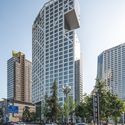
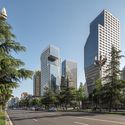
Sliced Porosity Block, CapitaLand ’s new Raffles City in Chengdu, is a hybrid of different functions like a giant chunk of a metropolis. It will be located just south of the intersection of the First Ring Road and Ren Min Nan Road. Its sun sliced geometry results from required minimum daylight exposures to the surrounding urban fabric prescribed by code and calculated by the precise geometry of sun angles.

Architects: Steven Holl Architects
Location: Chengdu, China
Design Architect: Steven Holl, Li Hu
Associate in Charge: Roberto Bannura
Project Architects: Lan Wu, Haiko Cornelissen, Peter Englaender, JongSeo Lee
Project Designer: Christiane Deptolla, Inge Goudsmit, Maki Matsubayashi, Sarah Nichols, Martin Zimmerli
Project Team: Justin Allen, Jason Anderson, Francesco Bartolozzi, Guanlan Cao, Yimei Chan, Sofie Holm Christensen, Esin Erez, Ayat Fadaifard, Mingcheng Fu, Forrest Fulton, Runar Halldorsson, M. Emran Hossain, Joseph Kan, Suping Li, Tz-Li Lin, Yan Liu, Jackie Luk, Daijiro Nakayama, Pietro Peyron, Roberto Requejo, Elena Rojas-Danielsen, Michael Rusch, Ida Sze, Filipe Taboada, Manta Weihermann, Ebbie Wisecarver, Human Tieliu Wu, Jin- Ling Yu
Model Photographs: Iwan Baan
Under Construction Photographs:

Horizontal Skyscraper / Steven Holl / Matthias Wolff

© d.teil

In June, we featured Steven Holl’s latest Horizontal Skyscraper which hovers above a landscaped park in Shenzhen, China. Matthias Wolff, an ArchDaily reader and also a contributor to our Flickr roundups, shared some of his photographs of Holl’s building with us.  Wolff, aka d.teil, shot these images at the complex’s opening this past December, when some of the complex’s components – such as the hotel – were still under construction.  Since the grounds are open to the public, the project will truly affect a large scope of people, both natives and visitors of the area.  Wolff’s photos provide a clear understanding of the building’s varying materiality, as well as its situation within the designed terrain. What do you think of Holl’s project?

Check out more photos after the break.

New Queens Library at Hunters Point / Steven Holl Architects

Pratt Institute by Architects. Photography Andy Ryan

will be the recipient of another Steven Holl project – a new library at the Queens West Development at Hunters Point.  Envisioned as a contemporary “urban forum”, the project will shape public space and create new connections across the Queens West Development, Hunter Points South, and the existing neighborhood of Hunters Point.  Steven Holl states, “We are very pleased with this great commission for an addition to the growing community.  We envision a building hovering and porous, open to the public park.  A luminous form of opportunity for knowledge, standing on its own reflection in the east river.”

More about Holl’s new project after the break.

In Progress: Nanjing Museum of Art & Architecture / Steven Holl


Flickr © vbratone

Special thanks to our reader, Vivian Bratone, for sharing some insight to Steven Holl’s newest museum project with us.  Situated in Pearl Spring near Nanjing, , the museum is only a part of the Chinese International Practical Exhibition of Architecture (CIPEA) complex.  The CIPEA project is a complete collaboration of architects from across the world, from Italy to Japan, and Mexico to Croatia.  Upon completion, the complex will include more than a dozen buildings that will house exhibits for arts and culture.

More about Holl’s project, including a set of Bratone’s images, after the break.

Horizontal Skyscraper / Steven Holl

©

Our friend and architecture photographer, Iwan Baan , just published on his website some of his recently shot images of Steven Holl’s Horizontal Skyscraper in Shenzhen, China .  The project is a long mixed-use complex which includes office spaces, apartments, a hotel and even a public landscape.  Baan’s photos illustrate Holl’s idea that the “building appears as if it were once floating on a higher sea that has now subsided; leaving the structure propped up high on eight legs.”

Complete photoset at Iwan’s website, more images and more about the project after the break.

Simmons Hall at MIT/ Steven Holl

© Andy Ryan -

When Massachusetts Institute of Technology commissioned Steven Holl in 1999 to design a new a dormitory for the school they had one goal in sight: that the spaces around and within the building would stir up interaction among students. While MIT focused on the building’s use and function, Holl aimed to create a memorable building. With MIT’s vision in mind along with Holl’s artistic architectural ideas, the ten-story undergraduate dormitory became a small city in itself with balancing opposing architectural elements, such as solids and voids and opaqueness and transparency.

More on Simmons Hall after the break.

Franz Kafka Society Center / Steven Holl Architects, Marcela Steinbachová (Skupina)

kafka4_065b

Architect: Steven Holl Architects, Marcela Steinbachová (Skupina)
Location: Prague,
Program: Cultural center with exhibition, lecture and concert space, as well as offices and a library
Client: Franz Kafka Society Center
Project year: 2007-2008
Photographs: Andrea Lhotakova

kafka3_069a kafka3_090a kafka4_040b

Knut Hamsun Center / Steven Holl Architects

Hamsunsenteret under construction, 18.july 09

Architect: Steven Holl Architects
Location: Hamarøy,
Program: Historical museum for writer Knut Hamsun including exhibition areas, library, reading room, cafe and 230 seat auditorium
Client: Nordland Fylkeskommune (County)
Project Area: 2,271 sqm
Project year: 1994-2009
Photographs: Ernst Furuhatt &

Hamsunsenteret under bygging, juli2009 _sef7466-copy 180620091723 model

Steven Holl talks with Charlie Rose

YouTube Preview Image

American architect Steven Holl discusses contemporary architecture in with acclaimed interviewer Charlie Rose.

Four “Tropical Skyscapers” Commissioned To Keep Shenzhen Stock Exchange HQ Nice and Shady

Steven Holl Architects‘ winning design from the “4 Tower in 1″ competition calls for a quartet of towers to be built around the brand new Shenzhen Stock Exchange and its surrounding plaza.

The four buildings in the complex have a variety of features typical of environmentally friendly and sustainable structures of recent, and the kind we may see in the future.

Rooftop garden ponds to recycle rainwater, solar tracking screens around the buildings’ exterior and circular footprints for the towers, enabling wide-open social spaces to face the sun. And of course the position of the buildings, arranged in a horizontal linking pattern so they double as giant sun umbrellas for the Stock Exchange. The buildings will be linked by underground rail as well, so the only time you’ll have to venture outside is to partake in all the rooftop garden festivities.