After finishing his Hollyhock House and the Imperial Hotel, Frank Lloyd Wright began to push his ideas concerning patterned concrete blocks. Utilizing the textile block, Wright built four houses – La Miniatura, the Ennis House, the Freeman House and the Storer House – as a way to truly challenge himself, as he explained in Bruce Brooks Pfeiffer and Gerald Nordland’s book, Frank Lloyd Wright: In the Realm of Ideas, “ “What about the concrete block? It was the cheapest (and ugliest) thing in the building world. It lived mostly in the architectural gutter as an imitation of rock-faced stone. Why not see what could be done with that gutter rat? Steel rods cast inside the joints of the blocks themselves and the whole brought into some broad, practical scheme of general treatment, why would it not be fit for a new phase of our modern architecture? It might be permanent, noble beautiful.”
Frank Lloyd Wright
More than a century ago Frank Lloyd Wright, whom we just honored on his birthday last week, designed one of the most famous sacred buildings in the United States, the Unity Temple. It was designed for a Unitarian congregation in 1905 when the architect was 38 years old. Wright himself described the Unity Temple as his “contribution to modern architecture.” The building broke the convention for American and European religious architecture while introducing principles of modern architecture and applying the use of concrete in a daring way for its time.
Read more about Wright’s Unity Temple after the break. read more »
Born this day 143 years ago, Frank Lloyd Wright was an American architect, interior designer, writer and educator. He completed more than 500 works, including his famous Fallingwater House and Guggenheim Musem, and was a leader of the Prairie School movement of architecture.
In 1991, he was recognized by the American Institute of Architects as “the greatest American architect of all time”. As we did last week with Sir Norman Foster, we want to honor Lloyd Wright’s birthday by bringing you every project and article we’ve featured with this amazing architect’s work:
AD Classics: Solomon R. Guggenheim Museum / AD Classics: Frederick C. Robie House / AD Classics: Fallingwater House / Compromises for the Guggenheim / Frank Lloyd Wright at the Guggenheim: From Within Outward / LEGO Architecture, Frank Lloyd Wright Collection

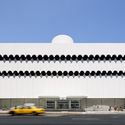
Swelling out towards the city of Manhattan, the Solomon R. Guggenheim Museum was the last major project designed and built by Frank Lloyd Wright between 1943 until it opened to the public in 1959, six months after his death, making it one of his longest works in creation along with one of his most popular projects. Completely contrasting the strict Manhattan city grid, the organic curves of the museum are a familiar landmark for both art lovers, visitors, and pedestrians alike.
More on Wright’s Guggenheim Museum after the break. read more »
Designed and built between 1908-1910, the Robie House for client Frederick C. Robie and his family was one of Wright’s earlier projects. Influenced by the flat, expanisve prairie landscape of the American Midwest where he grew up, Wright’s work redefined American housing with the Prairie style home. According to Wright, “The prairie has a beauty of its own and we should recognize and accentuate this natural beauty, its quiet level. Hence, gently sloping roofs, low proportions, quiet sky lines, supressed heavy-set chimneys and sheltering overhangs, low terraces and out-reaching walls sequestering private gardens.”More on the Robie House after the break. read more »

© Robert Ruschak - Western Pennsylvania Conservancy
In Mill Run, Pennsylvania in the Bear Run Nature Reserve where a stream flows at 1298 feet above sea level and suddenly breaks to fall at 30 feet, Frank Lloyd Wright designed an extraordinary house known as Fallingwater that redefined the relationship between man, architecture, and nature. The house was built as a weekend home for owners Mr. Edgar Kaufmann, his wife, and their son, whom he developed a friendship with through their son who was studying at Wright’s school, the Taliesin Fellowship. The waterfall had been the family’s retreat for fifteen years and when they commissioned Wright to design the house they envisioned one across from the waterfall, so that they could have it in their view. Instead, Wright integrated the design of the house with the waterfall itself, placing it right on top of it to make it a part of the Kaufmanns’ lives.
More information, images, and a short video on Fallingwater after the break.
It seems fitting that since the Guggenheim is currently featuring the works of its designer, Frank Lloyd Wright, we should feature some of the process work of the iconic museum. Well known for its white curving form, it is important to note that the current rendition of the museum is vastly different from Wright’s original ideas. The struggle between the architect and the client (in this case Solomon R. Guggenheim, a wealthy mining entrepreneur) to see eye-to-eye is not something new, however it is interesting to consider whether the renowned museum would still have its status if it were as Wright had originally envisioned: a polygonal structure, partly in blue or perhaps a red-marble structure with long-slim pottery red bricks.
More about the Guggenheim after the break. read more »

This year, we not only commemorate the 50 years of Frank Lloyd Wright’s death, but also the 50 years of the opening of one of his masterpieces: The Guggenheim Museum.
The museum will celebrate with the exhibition Frank Lloyd Wright: From Within Outward, co-organized by the Solomon R. Guggenheim Foundation and the Frank Lloyd Wright Foundation. On view from May 15 through August 23, 2009, the 50th anniversary exhibition brings together sixty-four projects by F.L. Wright, including privately commissioned residences, civic and government buildings, religious and performance spaces, as well as unrealized urban mega-structures. Presented on the spiral ramps of Wright’s museum through a range of mediums — including more than 200 original Frank Lloyd Wright drawings, many of which are on view to the public for the first time, as well as newly commissioned models and digital animations — Frank Lloyd Wright: From Within Outward illuminates Wright’s pioneering concepts of space and reveals the architect’s continuing relevance to contemporary design.
The exhibition takes place between May 15 and August 23, 2009 at the Solomon R. Guggenheim Museum, New York.
You can also visit an online version of the exhibition.
Just in time to commemorate the 50 years of the death of Frank Lloyd Wright, LEGO released two of his master pieces on their architecture series: the Guggenheim Museum (who opened 50 years ago) and the Falling Water House.
These sets were designed with Adam Reed Tucker of Brickstructures, Inc, who also did the Landmark series for LEGO Architecture (Sears Tower, John Hancock Tower, Empire State, Seattle Space Needle).
You can order them at the online store for US$45 (+ shipping).
Seen at The Coolist (thanks Mike!)