In public restroom design, innovation goes far beyond aesthetics—it transforms the entire user experience. One of the most exciting trends today is integrating all functional elements—hand dryers, faucets, soap dispensers, and paper dispensers—behind the mirror.
This approach creates a cleaner, minimalist look while optimizing space and enhancing hygiene. All devices remain fully functional but hidden: users simply place their hands where indicated on the mirror, and the equipment activates automatically—no physical contact required.
Urban renewal is inherently fraught—financially complex, politically exposed, stakeholder-dense, and almost guaranteed to leave someone dissatisfied. Precisely for these reasons, many cities default to inertia rather than risk the upheaval that comes with reworking entrenched urban fabrics, their residences, and their dynamics; once the "sleeping bear" is prodded, unexpected complications tend to multiply.
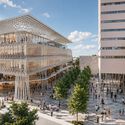
Miyashita Park (Miyashita Kōen), located in Shibuya, Tokyo, crystallizes this dilemma. Its current form—a layered, mixed-use complex balancing commercial activity with a publicly accessible park—emerged from years of negotiation, critique, and recalibration. The result is a distinctive example of a public-private partnership that seeks to align urban amenity, everyday leisure, and economic viability, producing a new piece of city that hosts public life while underwriting its own upkeep.
Two 36-storey residential towers have been completed on Irwell Bank Road in Singapore, featuring a pixelated facade designed by MVRDV. The scheme builds on the modular system developed by ADDP Architects, who designed the buildings using Prefabricated Prefinished Volumetric Construction (PPVC). MVRDV's facade introduces variation across the elevations and marks the locations of the communal green spaces on the 24th floor and the rooftop. Irwell Hill Residences, developed by City Developments Limited (CDL), is MVRDV's debut collaboration on a building in Singapore's urban core.
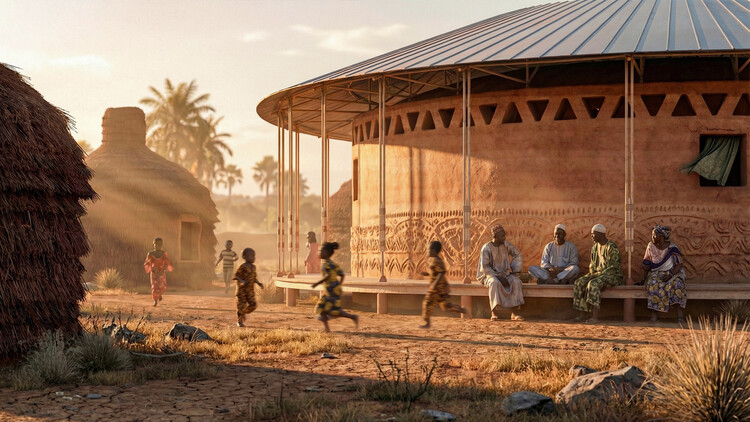
Biblioteca dos Saberes by Kéré Architecture. Aerial view. Render. Image Courtesy of Kéré Architecture
Amid ongoing global discussions on climate adaptation and resilient urban development brought into sharper focus by the outcomes of COP30, this week's architecture news illustrates how cities worldwide are rethinking their built environments. From Venice, where the 19th Architecture Biennale concluded with debates on material use and long-term cultural impact, to international awards foregrounding regenerative and socially responsive design, the conversation around architecture is increasingly intertwined with planetary priorities. Major urban interventions, from Thessaloniki's seafront redevelopment and Rio de Janeiro's new public library, to Abu Dhabi's Natural History Museum and a civic stadium in Birmingham, demonstrate how multiple cities are addressing mobility, heritage, density, and climate resilience. Additional plans, such as Mantua's ecological urban strategy, Utrecht's elevated landscape above transport networks, and Amsterdam Airport Schiphol's redesigned landside mobility system, further reflect a transition toward integrated, people-centred urban frameworks that prioritize environmental performance, public space, and long-term territorial stewardship.
Modernism has a long history in Morocco. Being close to Europe and under French Protectorate rule, it kept pace with architectural developments in the movement. Its relative peace after the Second World War further strengthened its role as some European architects sought a hub for new ideas. Architects in independent Morocco adopted Modernism as they were tasked to build the infrastructure of a new nation. The architect Jean-François Zevaco, born in Morocco to French parents, practiced across these formative periods, developing his own expressive version of modern architecture.
Wang Shu and Lu Wenyu. Image Courtesy of Venice Architecture Biennale
La Biennale di Venezia has announced that architects Wang Shu and Lu Wenyu will curate the 20th International Architecture Exhibition, opening in May 2027. Founders of Amateur Architecture Studio and leading voices in contemporary practice, the duo is known for an approach rooted in craftsmanship, material reuse, and deep engagement with place. Their appointment brings renewed attention to vernacular knowledge, construction cultures, and the social realities shaping architecture today.
In a former 16th-century church in Vicenza, two stories come together: that of Italian Renaissance sacred architecture and that of marble, the ancient material by excellence, reinterpreted here in a contemporary key. In this dialogue between eras, Lithos Design presents Quinte, a double-sided partition wall that transforms marble into a design tool: not just a surface, but a rhythmic and modular element that defines and enhances spaces. An idea designed for interior architects looking for solutions that are both functional and decorative, capable of shaping interiors with precision, elegance, and personality.