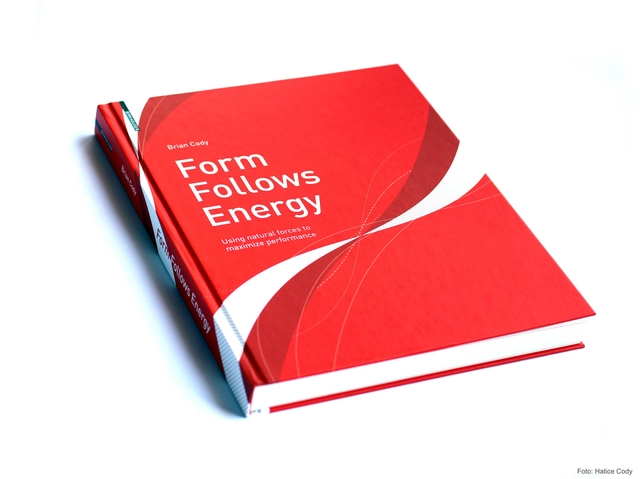
Book cover, Form Follows Energy, Photo: Hatice Cody
Architecture is energy. Lines drawn on paper to represent architectural intentions also imply decades and sometimes centuries of associated energy and material flows. “Form Follows Energy” is about the relationship between energy and the form of our built environment. It examines the optimisation of energy flows in building and urban design and the implications for form and configuration. It speaks to both architectural and engineering audiences and offers for the first time a truly interdisciplinary overview on the subject, explaining the complex relationships between energy and architecture in an easy to follow manner and using simple diagrams to show how
Throughout history, architects have used sketches and paintings to display to their clients the potential outcomes of the projects rattling around their minds. Since Brunelleschi’s adoption of drawn perspective in 1415, architectural visualizations have painted hyper-realistic imaginings of an ideal, where the walls are always clean, the light always shines in the most perfect way, and the inhabitants are always happy.
With technological advances in 3D modeling and digital rendering, this ability to sell an idea through a snapshot of the perfect architectural experience has become almost unrestricted. Many have criticized the dangers of unrealistic renderings that exceed reality and how they can create the illusion of a perfect project when, in fact, it is far from being resolved. However, this is only the natural next step in a history of fantastical representations, where the render becomes a piece of art itself.
Below is a brief history of the interesting ways architects have chosen to depict their projects—from imagined time travel to the diagrammatic.
With its monumental form, swept diagonal lines and elevated concrete walkways, the Issam Fares Institute building at the American University of Beirut by Zaha Hadid Architects emphasizes movement, evoking the speed of contemporary life as it presides over a connecting system of pedestrian walkways. Begun in 2006 and completed in 2014, Hadid’s award-winning concrete and glass building makes a bold statement with its prominent 21-meter, two-story-tall cantilever, which creates a covered courtyard and reduces the footprint of the building to avoid blocking circulation routes. The elevated walkways carry pedestrians through the branches of huge Cypress and Ficus trees, many of which significantly predate the building at 120 to 180 years old.
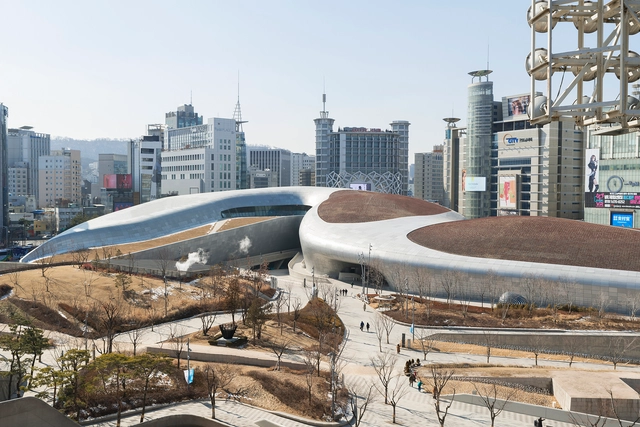
In the bustling streets of Seoul, the Dongdaemun Design Plaza by Zaha Hadid Architects has become a landmark for its atypical architecture. A complex yet effortless building, the Design Plaza encapsulates the energy of the cultural hub in Dongdaemun, an area that has itself earned the nickname of the "town that never sleeps" thanks to its late-night fashion market.
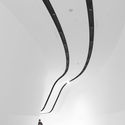
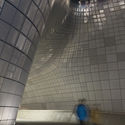
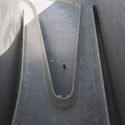
Investigating the building's twists and turns, Andres Gallardo has photographed the structure's fluid compositions. Although his photographs display little human presence, the building itself expresses the activity that occurs throughout day and night. Beneath the walkable park on the roof, Dongdaemun Design Plaza includes large global exhibition spaces, a design museum, 24-hour retail stores and a media center, among many other facilities that intertwine across the levels.
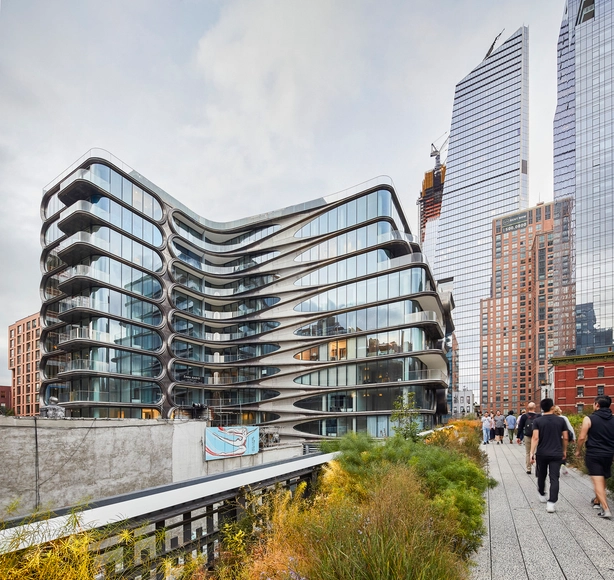
In a recent video published byMetropolis Magazine, Ed Gaskin, a senior associate at Zaha Hadid Architects, takes us on a comprehensive tour of ZHA's 520 West 28th Street, the late architect's only project in New York City. The video describes the project's interesting relation to the adjacent High Line, as well as taking us through the lobby, courtyard and inside the residential units of the building.
On a hillside forest outside of Moscow, amongst 65-foot-high (20-meter-high) pine and birch trees, sits the only private house to be designed and built by Zaha Hadid in her lifetime. With a form defined by its natural surroundings, the Capital Hill Residence is divided into two components, one merging with the sloping hillside, and another “floating” 72 feet (22 meters) above ground to unlock spectacular views across the Russian forested landscape.
The building was the subject of the season premier of "Impossible Builds," which profiles "the creation of some of the world’s most ambitious, complex and technologically advanced construction projects."
Described by the show as "one of the most complex skyscrapers ever to make it off the drawing board," the 62-story tower features a unique glass fiber reinforced concrete exoskeleton – a system never before seen at this scale.
The show is now available to watch in its entirety online. Check it out below!
Thinking broadly of architecture, the masterpieces of the past inevitably come to mind; buildings constructed to withstand the passage of time, that have found an ally in age, cementing themselves in the history of humanity. Permanence, however, is a hefty weight to bear and architecture that is, due to its program, ephemeral should not be cast aside as "lesser-than."
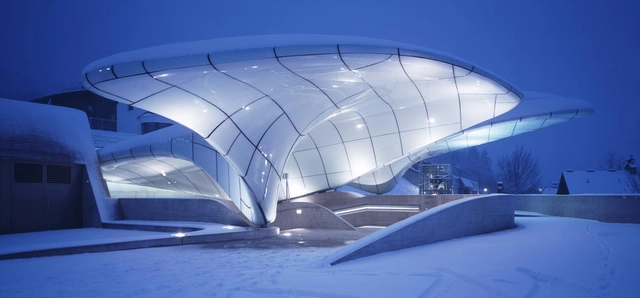
For 10 years this December, Zaha Hadid’s Hungerburgbahn have graced the built environment of Innsbruck, Austria. Since its conception, over 4.5 million passengers have visited one of the four train stations connecting them from downtown Innsbruck to the Norkette Mountain to Hungerburg.
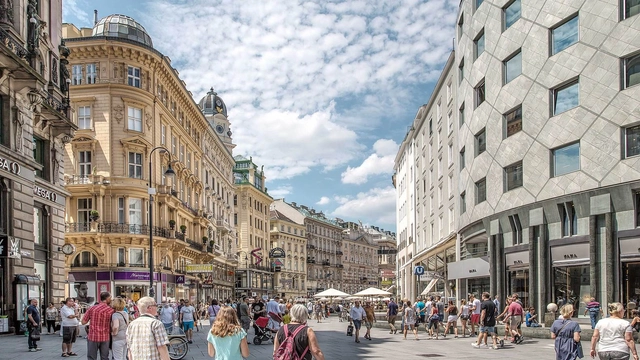
Brimming with architectural innovation, Vienna stands at the crossroads of Europe. Its location between north and south, east and west has always made it open to new ideas, even as the city carefully groomed its signature refinement and grace.
This short essay was written by Elizabeth Darling and Lynne Walker, the curators of AA XX 100– a multi-media project celebrating the centenary of women in London's Architectural Association (1917-2017).
Established in 2013, the AA XX 100 project was initiated to tell the story of women at the AA, with the aim of commemorating the centenary (this year) of their admission to the school with an exhibition, book, and international conference. When the project began we didn't know the names of the first students but, four years on, we do, and in telling their story—and that of the generations of women who followed them—we see that their history is at once a history of the AA and architectural education, as well as a history of British and world architecture across the 20th and 21st Centuries.
https://www.archdaily.com/883572/paving-the-way-celebrating-a-centenary-of-women-at-londons-architectural-associationArchitectural Association (AA)
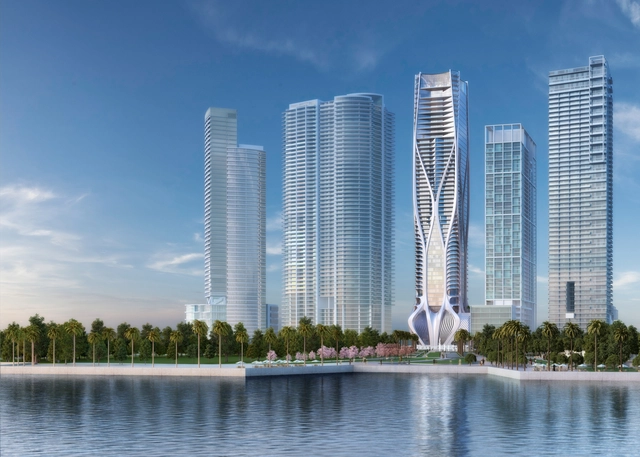
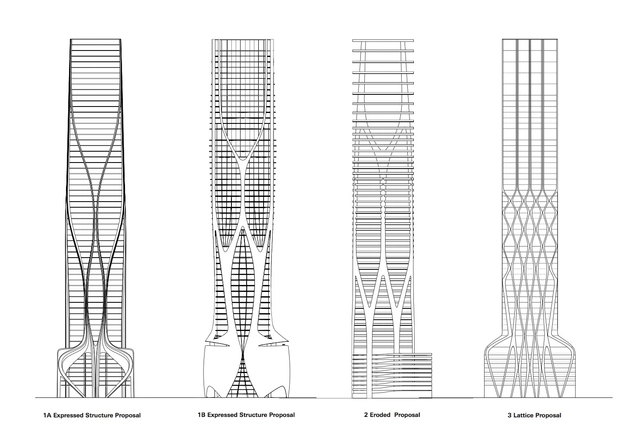
As Zaha Hadid Architects’ 1000 Museum residential tower in Miami continues toward its December 2018 completion date (tracked by this nifty countdown clock), the computer drawings for the structure have been revealed, showing the complex structure in section, elevation and detail.
Construction of the 62-story skyscraper is getting close to topping out as it rises past its neighbors on Biscayne Bay.
Check out the drawings below as well as the latest interior and exterior renderings in the gallery at the bottom of the page.
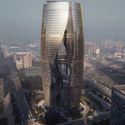
Zaha Hadid Architects have released new photos showcasing the ongoing construction progress of Leeza SOHO, a mixed-use office tower in Beijing's Lize Financial Business District. This twisting, contorted structural skeleton, which weaves together two separate sections of the tower and visually fuses them, will house the world's tallest atrium, rising the full height of the building.
Zaha Hadid in front of the Heydar Aliyev Center. Image via Google Doodles
The latest Google Doodle, on display today on Google's homepage in many countries around the world, honors the late Zaha Hadid on the 13th anniversary of her acceptance of the Pritzker Prize. The highest honor in the architectural profession, Hadid became the first woman to be selected as a winner in 2004.
With construction now well underway on One Thousand Museum in Miami, one of Zaha Hadid's largest projects to be completed posthumously, Curbed has reported that the 62-story tower will be the subject of an upcoming Discovery/PBS documentary covering the creation of complex structures from around the world. Titled “Impossible Builds,” the program will highlight the building’s unique glass fiber reinforced concrete exoskeleton.
Google Earth is no longer a clunky, data-intensive desktop or mobile application. As of today, one of the tech-giant's flagship (and unrivalled) products has been relaunched as a widely accessible web application for Google Chrome. This means that anyone can now access the full Google Earth product, free of charge, without having to install software or download mobile applications.
https://www.archdaily.com/869445/architecture-takes-center-stage-with-google-earth-relaunchAD Editorial Team
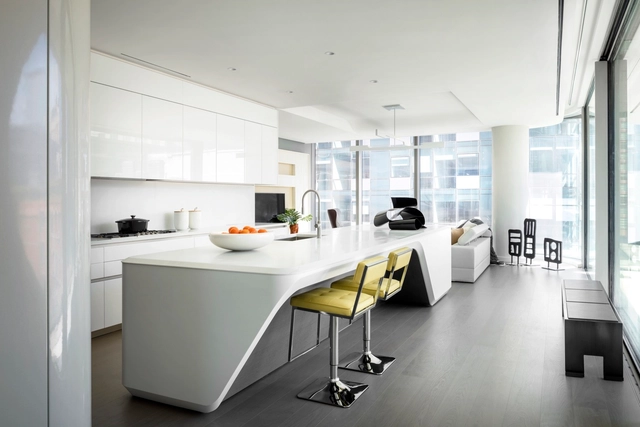
As Zaha Hadid’s 520 West 28th approaches completion, photos of the apartment interiors have been revealed for the first time. Shared by developer Related Companies, the images show two of the building’s first completed residences: the massive 4,500-square-foot Unit 20 and the more modest 1,700-square-foot Unit 12. The two units feature the interior built-ins and finishes designed by Hadid alongside interior design schemes envisioned by Jennifer Post and West Chin, respectively.




.jpg?1526579450)
.jpg?1526579373 "© Bahaa Ghoussainy")
.jpg?1526578916 "© Bahaa Ghoussainy")
.jpg?1526579342 "© Bahaa Ghoussainy")
.jpg?1526578946 "© Bahaa Ghoussainy")
.jpg?1526816206)



.jpg?1523378770&format=webp&width=640&height=580)
.jpg?1523378338 "Courtesy of OKO Group")

.jpg?1523379487 "Courtesy of OKO Group")
.jpg?1523379556 "Courtesy of OKO Group")
.jpg?1523378770)

_(2).jpg?1510571993&format=webp&width=640&height=580)


.jpg?1502251528 "© Yicheng Yang (SOHO China)")