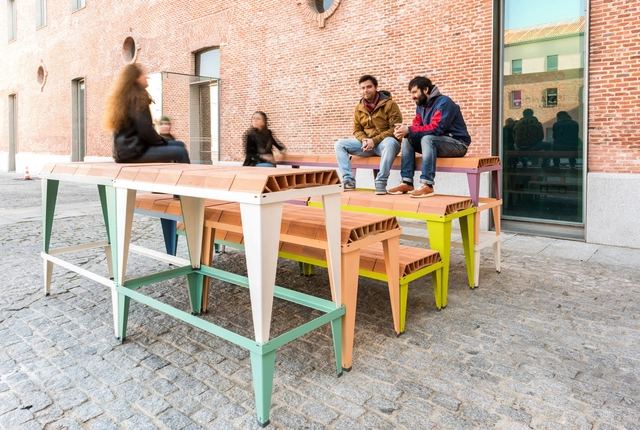
In 1855 the German machinery manufacturer Carl Schlickeysen issued the patent he had recently created, the "Universal Patent Brickmaking machine", the first machine created to manufacture bricks by extrusión as an industrial process.
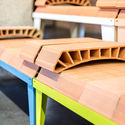
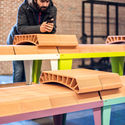
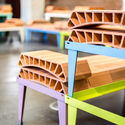
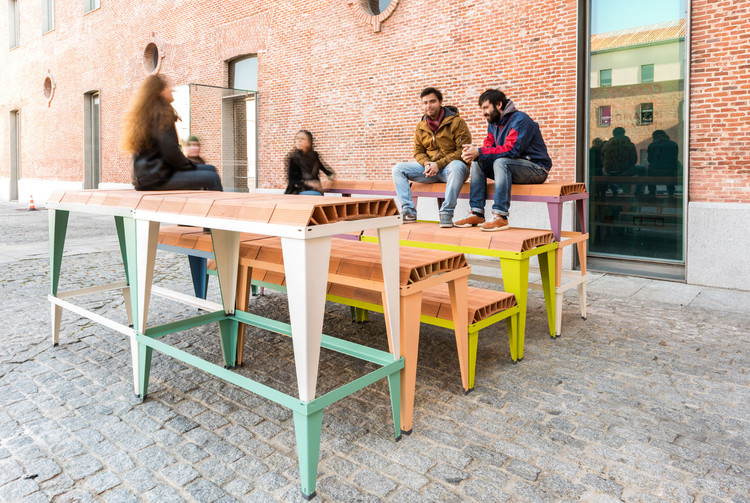
SCHLICKEYSEN is a modular furniture system based on two types of modular metal supports and standard-sized ceramic curved vaults. All kinds of settings can be configured from the combination of these three elements; picnic tables, continuous benches, grandstands, topographies, and many more typologies can be achieved by just stacking the metal supports and using the ceramic vaults as a horizontal supporting surface.
Construction has officially begun on Vessel, the 15-story tall staircase sculpture designed by Heatherwick Studio that will serve as the centerpiece of New York’s massive new Hudson Yards development. To build the structure, 75 individual units are being prefabricated by Cimolai S.p.A. in their Monfalcone, Italy facility, then shipped to New York where they will be assembled on site. These first 10 of these pieces have now completed their 15-day overseas journey, with the remaining pieces scheduled to arrive on-site and put into place over the coming year.
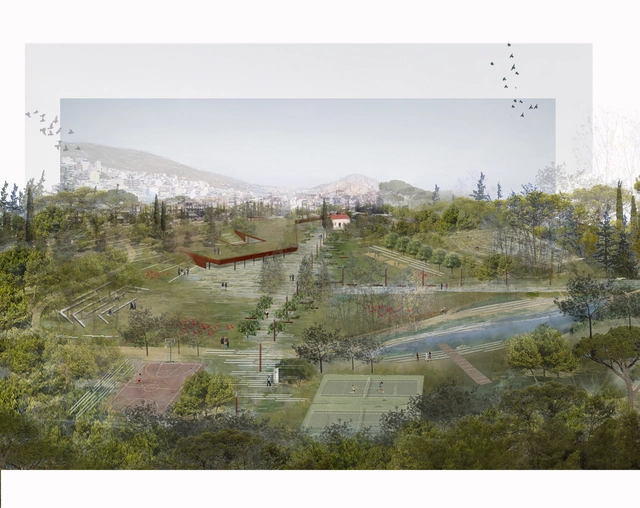
A competition for the transformation of a former cemetery in Nikea, just west of central Athens, has been won by Greek firm Topio7, with a proposal that creates a revitalized public park as a result of “a mutual osmosis between the park and the city”. A number of green buffer zones – “the elastic limit” – are utilized to frame a procession-like journey from the bustle of the city to the calm of the park’slandscape.
Highlighting the importance of the site’s previous use, the architects explain that the “main objective of the project is the creation of an open, accessible public space, a contemporary urban park with ecological-bioclimatic character, with special emphasis on the social dimension and the site’s memory.”
The way we spend time and the things we spend time doing are constantly changing. New technologies enable us to interact in different ways. They also tend to replace older forms of social interaction for better or worse. How can future public spaces facilitate new forms of social interactions?
The importance of public spaces in urban life is an issue that has been apparent since ancient Greece and is still with us today. Opportunities to meet and exchange ideas in these spaces are able to influence how the inhabitants participate in the development of their city, and occur in greater instances when public spaces are accessible to everyone.
However, in modern societies, the strategic role of these spaces has been limited. According to The City Fix, a blog on sustainable urban planning, one of the main reasons for this is the overabundance of automobiles. In fact, according to one study by the Brazilian Institute for Energy and the Environment, 70% of public spaces in urban centers are taken up by roadways and other spaces for cars, while car owners make up only around 20 to 40 percent of the city’s population.
How can public spaces be recovered to promote urban life? We discuss three important factors below.
Go to any medieval European city and you will see what streets looked like before the advent of the car: lovely, small narrow lanes, intimate, and undisputedly human-scale. We have very few cities in the US where you can find streets like this. For the most part what you see is streets that have been designed with the car in mind—at a large scale for a fast speed. In my native San Francisco, we are making the streets safer for walking and biking by widening sidewalks, turning car lanes into bike lanes, and slowing down the cars. We are working with the streets we have; a typical San Francisco street is anywhere from 60 to 80 feet (18 to 24 meters) wide, as compared with a medieval, pre-car street which is more like 10 to 20 feet (3 to 6 meters) wide.
As an urban designer, I work on lots of projects where we take large parcels of land and subdivide them into blocks by introducing new streets. These new streets are a rare opportunity to take a fresh look at the kinds of car-oriented roads that we are used to, and instead try to design streets that prioritize the safety and comfort of pedestrians. These projects give us a chance to design streets that are just for people. Imagine that we made these people-only streets into narrow, medieval-style lanes that are intimate and human-scaled. But even as we try to design streets that might not ever see a single car, we find that the modern street design has become so much more than just places for walking or driving. There are therefore a number of things for socially-minded designers to consider, beyond the commonly talked about pedestrian-car dichotomy.
https://www.archdaily.com/867390/4-important-things-to-consider-when-designing-streets-for-people-not-just-carsKristen Hall
Vision Zero is an initiative that started in Sweden in 1997 when the country began implementing a series of road safety measures to reach their goal of zero deaths from traffic accidents. As a result, the country managed to reduce the number of deaths to 3 people per 100 thousand inhabitants.
Since then the plan has been adopted by different cities and has inspired the creation of various organizations that are looking to make our streets a safer places. One of them being the Vision Zero Network that brings together traffic engineers, health professionals, local leaders, and policy makers.
“Public space is the new backyard,” says Hamish Dounan, Associate Director of CONTEXT Landscape architects. “Great landscape architecture projects can actually get people out of their apartments and going for walks. It can get them engaging in a social way,” adds Shahana Mackenzie, CEO of the Australian Institute of Landscape Architects (AILA). Trends to activate public spaces are increasing in popularity around the world; urban parks and gardens, vibrant street places, wider pedestrian walkways, cafes with outdoor seating. So during the 2016 International Festival of Landscape Architecture held in Canberra during October 2016, Street Furniture Australia launched a pop-up park in the underused urban space of Garema Place, in collaboration with AILA, the ACT Government and In The City Canberra. The aim of the pop-up park was to create a small social experiment, “to test the theory that the fastest and most cost-effective way to attract people is to provide more places to sit.” In addition to moveable furniture, the design by CONTEXT Landscape architects included bright colors, additional lighting, a lawn, free Wi-Fi and bookshelves as techniques to make Garema Place more inviting.
The process and results of the pop-up park were documented in a report by Street Furniture Australia, with some impressive results: before the #BackyardExperiment, 97% of people were observed to just pass through Garema Place without stopping, and 98% of the people who did stop in the space were adults. During the 8 days of the experiment, the number of passersby increased by 190% as people chose to walk through Garema Place instead of taking other routes. In addition to this, 247% more people stayed at the place to sit and enjoy the pop-up park and surrounding area. There was an incredible 631% increase in children at the park, double the number of groups of friends, close to a 400% increase in the number of couples and almost 5 times the amount of families. With the numbers as evidence for the success of the #BackyardExperiment, here is a summary of the elements used to evoke such a positive response. Simple, cost-effective and relatively easy to implement, these interventions are an attractive “cocktail” for any underused urban space.
“Who would’ve thought a parking garage could be so interesting?”
In this video aired by the Louisiana Channel, Kathrin Susanna Gimmel and Jan Yoshiyuki Tanaka, both co-founders of Copenhagen-based firm JAJA Architects, explain the ideology behind the “Park ‘n’ Play” parking garage. Bright red, atop the 24-meter high car park, sits a playground which, in combination with a rooftop garden, provides a unique public setting offering sought after views of the Copenhagen harbor. Watch the video for more insight into JAJA’s design methodology and how the playground helps redefine roles of public space and usage while integrating into a historical urban identity.
https://www.archdaily.com/804825/watch-how-jaja-co-founders-of-park-n-play-are-redefining-public-spaceOsman Bari
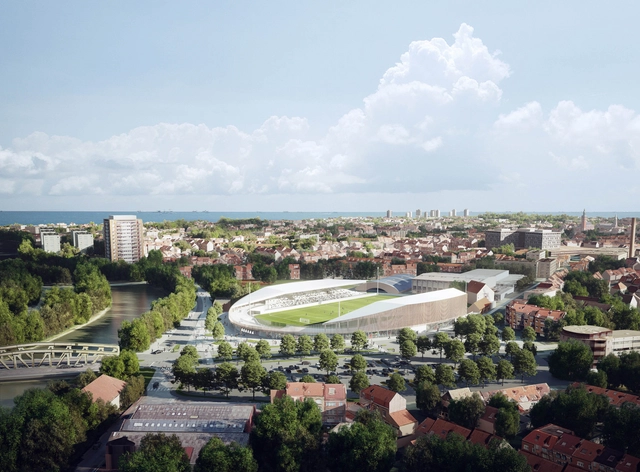
The stadium is located in the heart of Dunkirk. Image Courtesy of Viktor Fretyán
The SOCKEEL + OLGGA consortium have won a competition to design the new Tribut Stadium in Dunkirk, France. The historic stadium, in a prominent location on a canal bank in central Dunkirk, will be transformed into a 5,000 seat stadium seeking to maximize inclusiveness and accessibility.
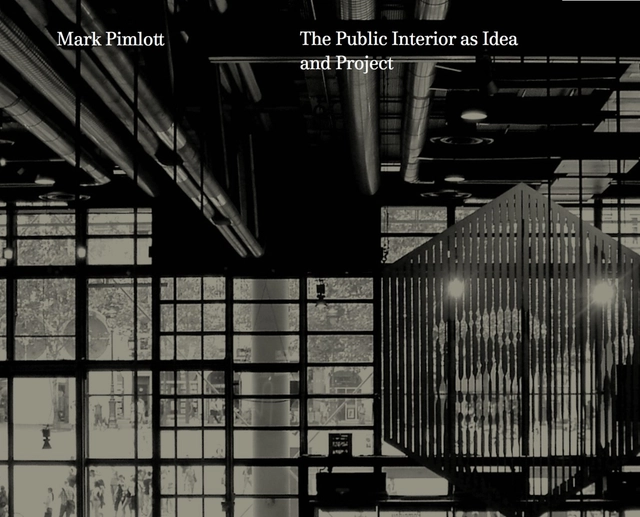
In this article, which originally appeared on BD, Nicholas de Klerk (a London-based Associate Architect at Aukett Swanke) reviews The Public Interior as Idea and Project – a new publication by the Netherlands-based Canadian artist, architectural historian and educator Mark Pimlott.
Mark Pimlott's new book, The Public Interior as Idea and Project (2016), expands on prior publications, notably Without and Within (2007). In this earlier book, Pimlott explored the concept of a ‘continuous interior’—examining repetitive spaces which share characteristics—for example, shopping malls and airports, and which, collectively, set about the urbanisation of the American territory.
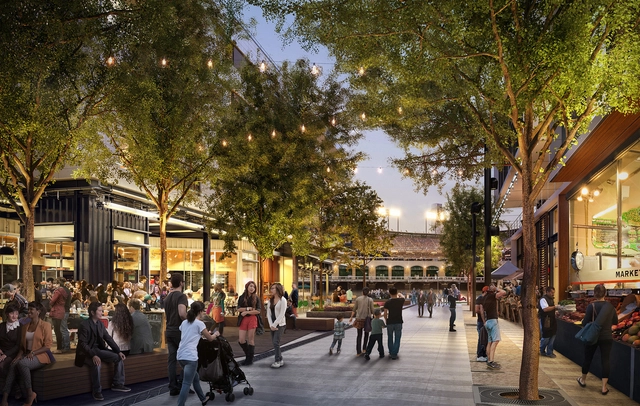
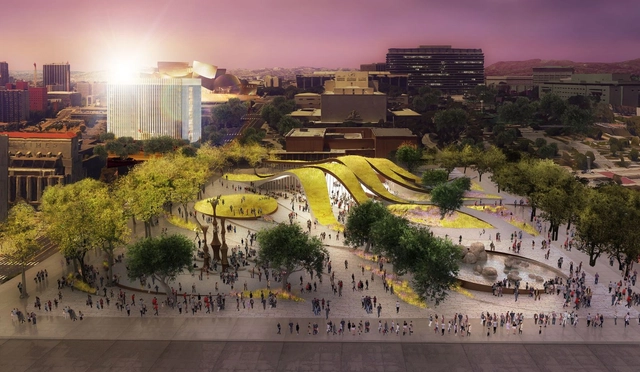
Los Angeles-based practice Brooks + Scarpa has revealed their proposed design for the FAB Park competition, which sought schemes for a new $12 million public park situated at First and Broadway in Downtown LA.
The FAB (First and Broadway) Civic Center Park aims to capitalize on the city’s diverse character and encourages strong communal activity among members of the public, through the inclusion of unique spaces for food, art and socializing.
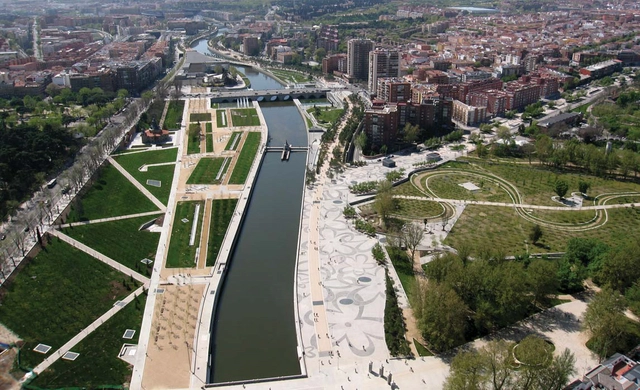
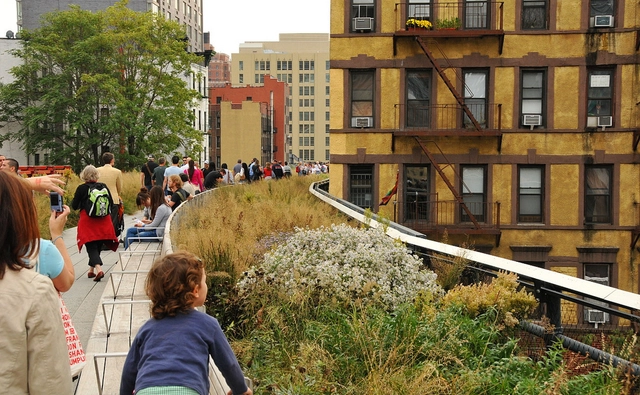
Building a highway in a city is often thought of as a solution to traffic congestion. However, the induced demand theory has shown that when drivers have more routes, they choose to continue using this medium instead of using public transport or a bicycle, and as a result, congestion doesn’t decrease.
As a result, some cities have chosen to remove spaces designated for cars and turn what was once a highway into urban parks and less congested streets.
Here we have six examples, some have already been completed, while a few are still under construction. To the surprise of some, most of the projects are in the US, which reflects that American designers are looking into further studying European transport policies.
The idea of revitalizing a public space by bringing improvement that brings people together should not generate suspicion or fear. However, specific examples of places that have seen the cost of living greatly increase after their revitalization have been creating paradoxes. After all, does this "new villain" called gentrification have any relation to placemaking?
The answer, unfortunately, is yes. Although it's not a direct relation of cause and effect, it is impossible to deny the tenuous line between the two concepts. By definition, gentrification, or "ennoblement," refers to the social, cultural, and economic improvement of a neighborhood or, on a larger scale, of an entire region. Placemaking is the process of planning quality public spaces that contribute to the well-being of the local community. The concepts may be similar, but the methods and consequences of the two are very different.
The Nolli Map made history when it was created in 1748, largely because of its focus on public spaces. With it, Giambattista Nolli highlighted the fact that public places don’t exclusively exist in the forms of streets and parks, but also in enclosed spaces. Yet the importance of our communal areas is constantly being undermined. Our public areas exist to promote inclusion and equal opportunities, but despite that they are being forgotten and abandoned, debilitating their ability to bind communities together.
Given that the main goal of Studio Gang’s newly released, free, downloadable booklet, Reimagining The Civic Commons has been to “help communities everywhere activate their civic commons,” then, it is unsurprising that the booklet includes graphic maps reminiscent of Nolli’s visual aim. The booklet, which arose from work funded by the Kresge Foundation and Knight Foundation, focuses on the advancement of 7 types of “existing assets”: libraries, parks, recreation centers, police stations, schools, streets and transit. Since the start of Studio Gang's research, a larger, $40 million initiative has begun—funded by the JPB Foundation, The Knight Foundation, The Kresge Foundation and The Rockefeller Foundation along with a multitude of local donors—with plans taking shape in Philadelphia, Chicago, Detroit, Memphis and Akron. The graphic guide is designed to offer adaptable, cost-effective and flexible approaches to these spaces, so that it can be implemented over time and in a variety of different communities. Read on for our summary of the report’s 7 strategies for improvement.
During the IV International Congress in Pamplona, organized by the Architecture and Society Foundation, we had the opportunity to speak with Bjarke Ingels about his approach to theme "Architecture: Climate Change." The founder of BIG told us about the importance of clean technology and how these technologies must be integrated into architecture. He asserts that new industrial projects must also break from traditional paradigms and question established concepts in order to be reintegrated into communities as clean, attractive and multi-use spaces. Ingels suggests that clean technologies holds exciting possibilities for public spaces.
TAB 2015 installation Body Building by Sille Pihlak and Siim Tuksam. Image by Tõnu Tunnel
Tallinn Architecture Biennale 2017 is announcing TAB 2017 Urban Installation Programme Open Call, offering emerging architectural talent the opportunity to design and build an experimental wooden folly in the heart of Tallinn. The international open two-stage competition is challenging participants to develop creative designs for a temporary outdoor installation, making innovative use of the fabrication capacities with the Estonian wooden house manufacturers.
promote synergy between emerging designers and industry.
Videos
Interior View of the Vessel. Image Courtesy of Forbes Massie-Heatherwick Studio
UPDATE: We've added a video of Thomas Heatherwick explaining the design of "Vessel," after the break!
Thomas Heatherwick is bringing a new public monument to New York City. Today, Heatherwick Studio revealed the first renderings of “Vessel,” a 15-story tall occupiable sculpture comprised of 154 intricately interconnecting flights of stairs that will serve as the centerpiece of the new Hudson Yards development in west Manhattan.