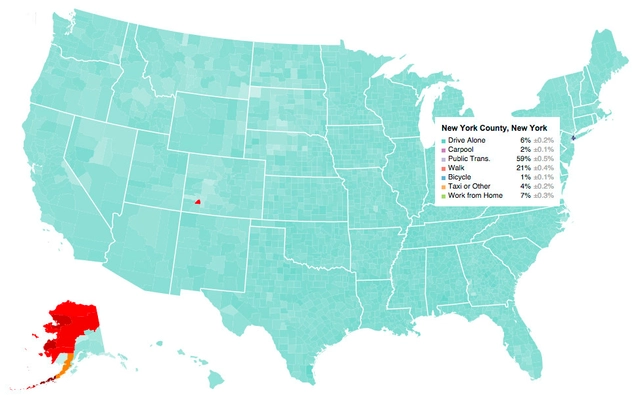
Interactive: How Americans Get to Work. Image Courtesy of flowingdata.com
In the US, most people drive alone to work. This isn’t surprising, considering car culture has been a staple of American life since the end of World War II. However, with the potential of high speed rails making way in California and the push for public transit in many other states, it will be interesting to see how this map may (or may not) change over the next decade.
When it comes to discussing informal housing, it's usually cities in developing nations that take the spotlight - however, as revealed by SITU Studio's contribution to MoMA's Uneven Growth exhibition, issues of informal housing are indeed present in cities across the spectrum of development. In this interview, originally posted on Arup Connect as "Inequality and informality in New York," Sarah Wesseler speaks to SITU Studio principle Bradley Samuels about their unconventional proposal to address an issue that is frequently overlooked in New York city policy.
Uneven Growth: Tactical Urbanisms for Expanding Megacities, a newly opened exhibit at New York’s Museum of Modern Art, focuses on the complex relationship between urbanization and inequality. Over the 14-month period leading up to the launch, six interdisciplinary teams explored how these issues are playing out in different parts of the world, each developing an architectural response for a specific city.
Architecture firm SITU Studio (together with Cohabitation Strategies [CohStra]) was tasked with studying its home city, New York. (Arup transport planner Michael Amabile also consulted with the team.) We spoke with SITU principal Bradley Samuels about the project.
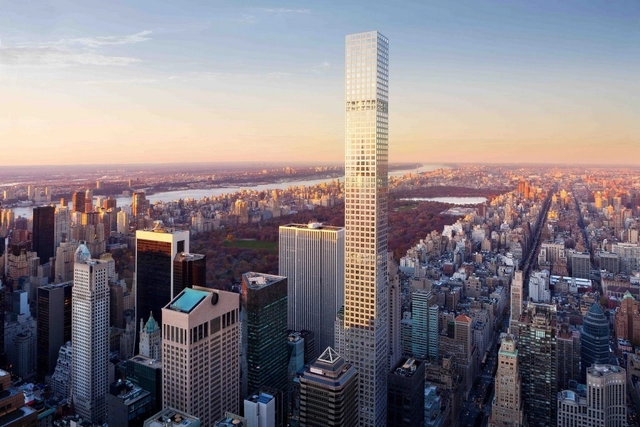
As uncovered by Curbed, construction workers at Rafael Viñoly's 1,396 foot (426 meter) tall 432 Park Avenue were served with a full stop work order last week by the New York City Department of Buildings, after an 8 foot (2.4 meter) long section of steel pipework was dropped from a construction hoist on the building's 81st floor.
To mark the 10th anniversary of the topping out of New York City's Hearst Tower, Lord Foster returned in order to narrate a short film shedding new light on the building with the aid of camera drones. The 46 storey building - which is integrated into a 6 storey base brick structure designed by Joseph Urban in 1928 - was "one of the most sustainable buildings of its time." Now, ten years later, this footage captures spectacular new views of the main atrium.
Two winners have been announced for the fifth annual cycle of New York’s “City of Dreams” competition: the “Billion Oyster Pavilion” by locally-based BanG Studio and “Organic Growth” by Izaskun Chinchilla Architects of Madrid and London. Pending approvals and fundraising, both pavilions will be assembled on Governors Island and open to the public for the summer 2015 season. The winning pavilions, after the break.
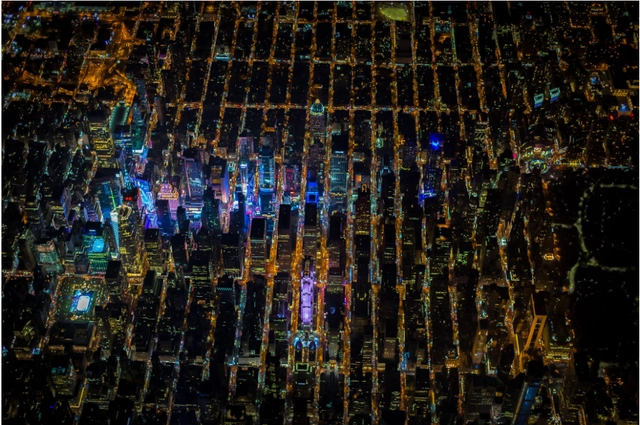
Something he has “dreamed of capturing for decades,” Pulitzer Prize-winning photographer Vincent Laforet has released a stunning set of images that captures his hometown of New York in a way that has never before been seen. Taken from a nauseating 7500-feet above the city, Laforet’s “Gotham 7.5K” series reveals the unrelenting, pulsating energy that radiates from the Big Apple’s city grid.
All the images and the making-of video, after the break.
Videos
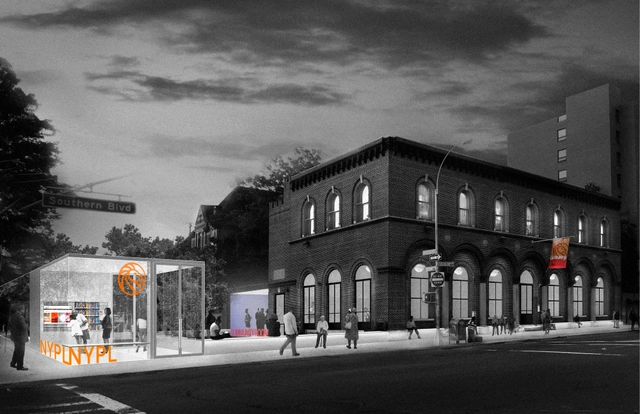
Hunts Point Library concept. Image Courtesy of Andrew Berman Architect, Library Development Solutions, Neil Donnelly, AEA Consulting, Auerbach Pollock Friedlander
There are 207 branch libraries in the city of New York, each providing a number of services to city residents. From the simple lending of books to adult technical literacy classes, these institutions are as vital as they were before the advent of the internet, and their attendance numbers prove it. Between the years of 2002 and 2011, circulation in the city’s library systems increased by 59%. Library program attendance saw an increase of 40%. In spite of this, library funding was cut by 8% within this same timeframe, which has made it difficult to keep many of the system’s buildings in good repair. To spark interest and support from city leaders, The Architectural League, in collaboration with the Center for an Urban Future, instigated the design study Re-Envisioning New York's Branch Libraries.
Sponsored by the Charles H. Revson Foundation, the study is the effort of five design teams chosen by the League. These teams - including MASS Design Group and SITU STUDIO - were charged with proposing exciting new library designs that follow the League’s themes of “integrating libraries into the city’s housing and community development goals, reconfiguring libraries to meet community needs, and developing new ideas for expanding the impact of branch libraries.” The teams presented their work at a January 4th symposium. See each of the proposals, as well as video footage of that symposium, after the break.
In a film for the BBC Magazine, Spanish architect Santiago Calatrava talks through his designs for the new St. Nicholas Church - the only non-secular building on the 9/11 Memorial site. The building, which broke ground last year, has been described by Calatrava as a "tiny jewel" for lower Manhattan, comprising of a white Vermont marble shrine sat beneath a translucent central cupola that is illuminated from within. The new church, of Greek Orthodox denomination, replaces a church of the same name which was destroyed during the attacks of 9/11. It is sited close to its original location on 130 Liberty Street, overlooking the National September 11 Memorial park and museum. With the building set to open in early 2016, Calatrava discusses the key conceptual ideas and references behind its unique, controversial design.
On the occasion of Ideas City 2015, the biennial Festival created to explore the future city and to effect change, Storefront for Art and Architecture, along with the New Museum and the New York City Department of Transportation, is launching a competition for the design and construction of an outdoor structure—a work of "Street Architecture" that facilitates new forms of collective gathering and engagement with the city.
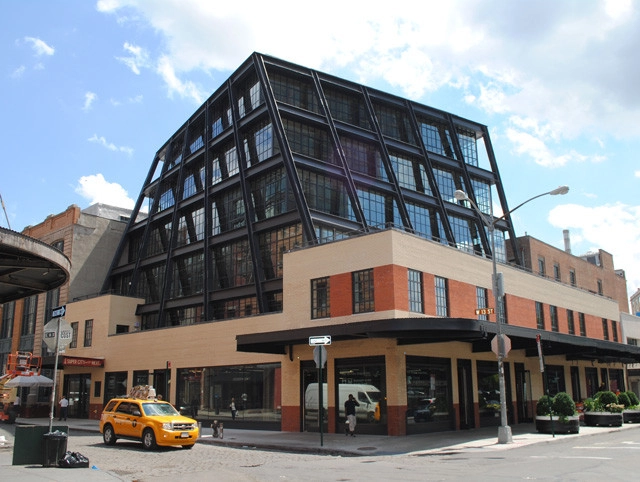
837 Washington Street. ImageImage via New York YIMBY
For many architects, the chance to make an impression on the landscape of New York City is a sign of distinction, an indication that they have "made the big time." But it's not just architects who have this desire: for decades, the city's big industrial players have also striven to leave their mark. However in this article, originally posted on New York YIMBY as "How New York City is Robbing Itself of the Tech Industry’s Built Legacy," Stephen Smith examines where it's all gone wrong for the city's latest industry players.
Strolling through the streets of Manhattan’s business neighborhoods, you can pick out the strata of the city’s built commercial heritage, deposited over generations by industries long gone. From the Garment District’s heavy pyramidal avenue office towers and side street lofts, dropped by the garment industry in the 1920s, to the modernist towers like Lever House and the Seagram Building, erected on Park and Fifth Avenues during the post-war years by the country’s giant consumer goods companies, each epoch of industry left the city with a layer of commercial architecture, enduring long after the businesses were acquired and the booms turned to bust.
But 50 or 100 years into the future, when our grandchildren and great-grandchildren stroll through the neighborhoods of Midtown South that are today thick with technology and creative firms, they are not likely to find much left over from the likes of Facebook or Google. There will be no equivalent of Grand Central or Penn Station, Terminal City or the Hotel Pennsylvania, left over from the early 20th century railroad tycoons, or SoHo’s cast iron buildings, developed by speculators seeking to feed the growing textile and dry-goods trades of the late 19th century. Perhaps unique among New York’s large industries, the tech and creative tenants that have become the darlings of the current market cycle are leaving very little behind for future generations to admire.
https://www.archdaily.com/582049/why-are-there-still-no-built-traces-of-new-york-s-tech-industryStephen Smith
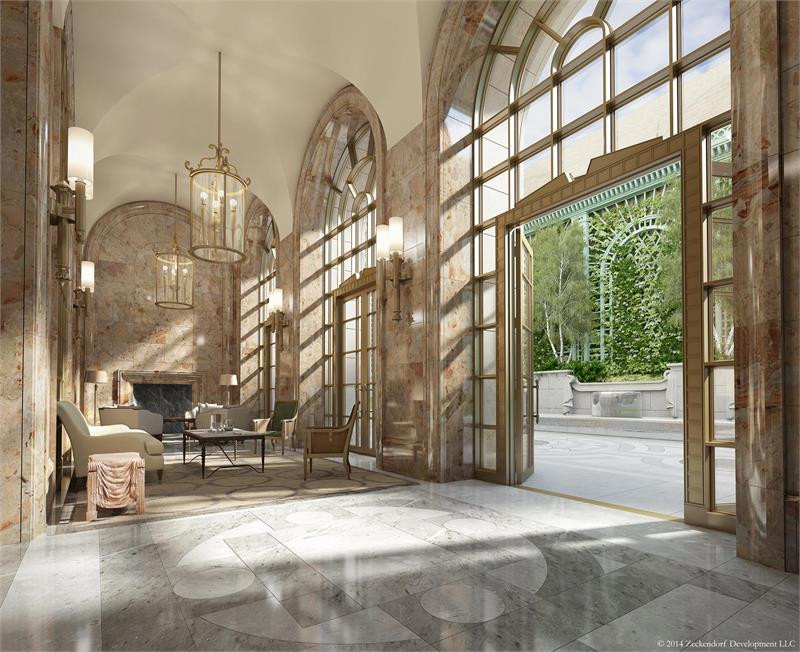
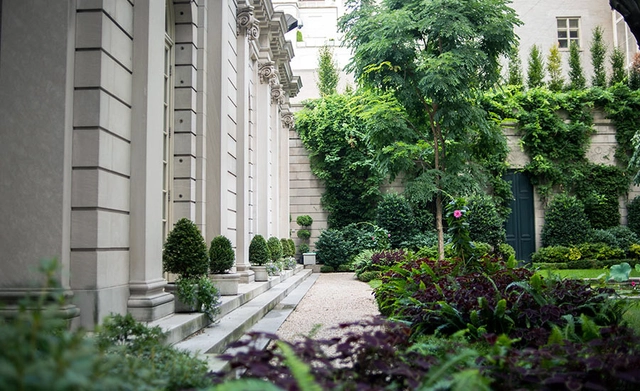
Robert A.M. Stern‘s 520 Park Avenue has already been called “the next 15 Central Park West,” and like its Stern predecessor, 520 is an ultra-luxury development with a stately façade wrapped in stone. Set to be completed in 2016, it will rise 51 stories high, but contain just 31 units, one of which is the $130 million penthouse, the city’s most expensive apartment. And though most of the attention has been on “the greatest apartment on the Upper East Side,” the fanfare has now shifted to the first batch of interior renderings for the building.
520 Park’s full website is now live, and not surprisingly, the residences have classic layouts, impressive Central Park views, and a host of high-end amenities.
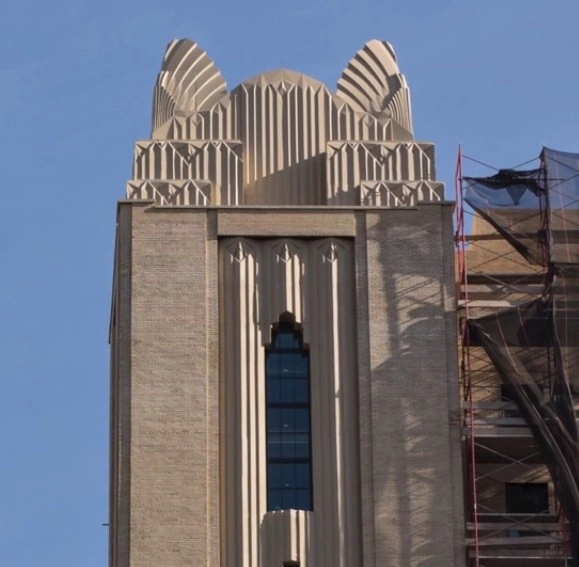
In some projects, preservation isn't just about retaining what's there, but also about putting back an element that has been forgotten to history (not always, though). This was the case at the Stella Tower in Manhattan, where as part of the building's recently completed condo conversion, JDS Development Groupand Property Markets Group, along with architects CetraRuddy have reinstated the dramatic Art Deco crown of Ralph Walker's 1927 design.
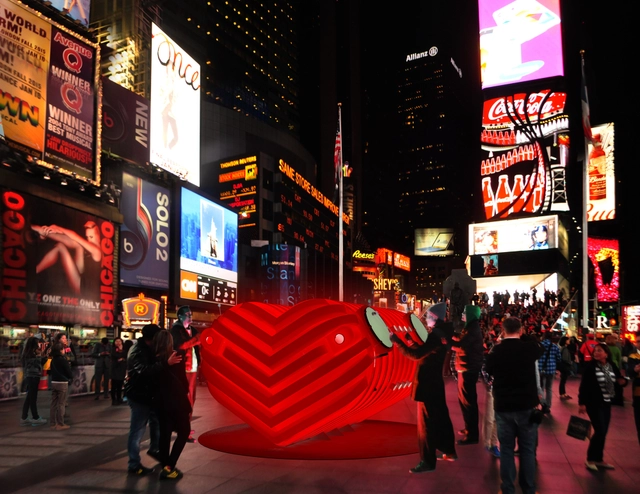
Come February 9, New York City will be celebrating the opening of its seventh annual Valentine’s Day installation in Times Square. As part of Times Square Alliance’s heart design competition, Brooklyn- based and Venezuelan-born firm Stereotank will be constructing a heart-beating urban drum in hopes that it will bring together New Yorkers through music.
This year there was a cultural shift that saw landscape architecture and its practitioners achieve an unprecedented level of visibility and influence.
This year the single most notable development came courtesy of the New York Times architecture critic Michael Kimmelman who wrote: "Great public places and works of landscape architecture deserve to be treated like great buildings."
Landscape architecture and architecture on equal footing. Let that sink in.
https://www.archdaily.com/577280/2014-a-great-year-for-landscape-architectureCharles A Birnbaum
SHoP Architects have revealed a mixed use proposal to pedestrianize New York City’s historic Seaport District. Extending the Manhattan grid out into the waterfront, the scheme seeks to harmonize pedestrian infrastructure and increase access to the shoreline, while proposing a 500-foot luxury residential tower by developer Howard Hughes Corporation that would jut out into the harbor. More about the proposal, after the break.
American Museum of Natural History. Image Courtesy of Wikipedia
Chicago’s Studio Gang Architects have been selected to design a new Center for Science, Education and Innovation for the American Museum of Natural History in New York. Named after its largest donor, the $325 million Gilder Center will include 218,000-square-feet of existing and new space. It is slated to open on Columbus Avenue at 79th Street on the west side of the Museum campus, in conjunction with its 150th anniversary in 2019–2020.
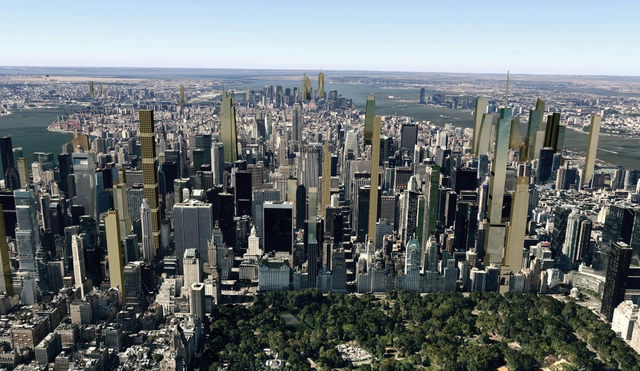
View above Central Park looking south towards “Billionaire's Row” towers, with Midtown towers in background and various Financial District and Downtown Brooklyn Towers in far background. Image Courtesy of CityRealty
What would a city owned by the one-percent look like?
New renderings for CityRealty get us part way there, illustrating how Manhattan may appear in 2018. The defining feature will be a bumper crop of especially tall, slender skyscrapers piercing the skyline like postmodern boxes, odd stalagmites, and upside-down syringes. What they share in common is sheer unadulterated scale and a core clientele of uncompromising plutocrats.
https://www.archdaily.com/577034/why-new-york-shouldn-t-be-a-city-for-the-one-percentJoshua K Leon