Foster + Partners will detail its vision of life on Mars and the Moon at the UK’s Goodwood Festival of Speed 2018. Forming part of the festival's Future Lab event, the vision will be presented through a range of models, robotics, and futuristic designs exploring the future of life in space.
The firm's showcase will include a virtual reality experience, allowing visitors to explore the inside of a proposed state-of-the-art habitation pod.
https://www.archdaily.com/897677/foster-plus-partners-to-present-vision-of-life-on-mars-at-uks-goodwood-festivalNiall Patrick Walsh
“The Next Architecture” Award (Episode I): Smart Tree: Future Life in a Vertical Community
Background Subject to the issue of Great City projecting the situation of China’s mega cities, the block for this competition is given the motif of “Smart Vertical Community,” which seeks creative and smart ideas and solutions to high-rise buildings in terms of efficiency, flexibility, and diversity by echoing values of communication, public service, knowledge exchange, networks, and management.
Stretching over one mile (1.5 kilometers), the cable car links the two thriving residential districts of Amsterdam-West and Amsterdam-Noord through a system of three slender pylons and two stations. The cable car has been designed to accommodate a future third station depending on the pattern of growth for surrounding districts.
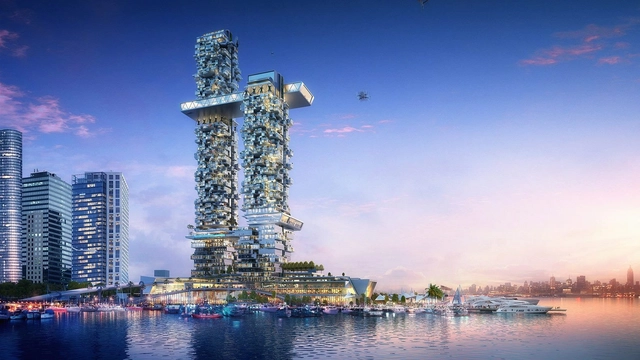
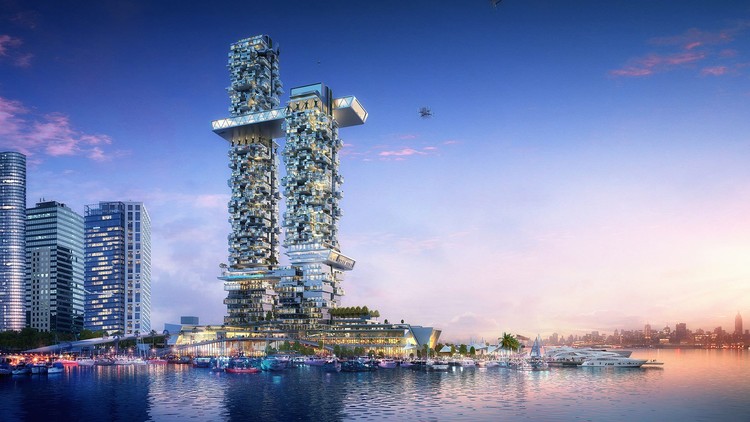
Humphreys and Partners, a Dallas-based architecture firm, presented a vision of future residential living at the 2018 International Builders’ Show earlier this year. Tackling current issues of affordable housing, sustainable design and how technology is changing the way we live, their futuristic vision Pier 2: Apartment of the Future consists of two soaring skyscrapers on the Manhattan waterfront.
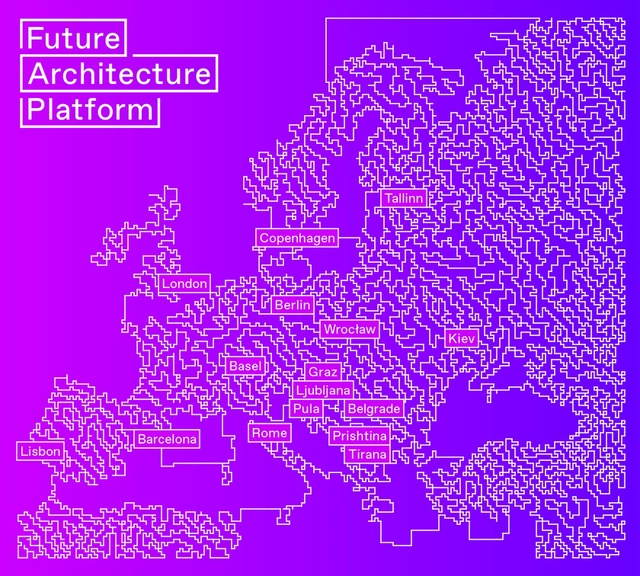
The members of Future Architecture have selected 21 ideas out of more than 200 submissions in this year's open call for ideas. The winners will be invited to the two days Matchmaking Conference in February at the Museum of Architecture and Design (MAO) located in Ljubljana, where they will present their submissions and earn a chance to participate in the conference’s series of events.
Check out the list of winners and their proposals after the break.
Videos
Songdo in South Korea is perhaps the most complete realization yet of the smart city concept. Image Courtesy of Cisco
In order to be successful in any field, professionals must stay ahead of the curve—though in architecture nowadays, technology progresses so quickly that it’s difficult to be on the front lines. Virtual Reality can transport architects and their clients into unbuilt designs and foreign lands. Smart Cities implement a network of information and communication technologies to conserve resources and simplify everyday life. Responsive Design will give buildings the ability to be an extension of the human body by sensing occupants' needs and responding to them.
With the technology boom, if architects want to stay in the game they will inevitably have to work alongside not only techies but scientists too. Neuroscientist Colin Ellard works “at the intersection of psychology and architectural and urban design.” In his book, Places of the Heart: The Psychogeography of Everyday Life, Ellard examines how our technology-based world impacts our emotions and behavior to try to figure out what kind of world we should strive to create.
Videos
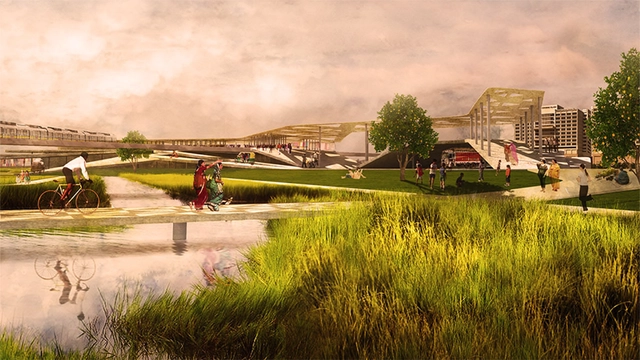
Shahadra Park proposes to bring life back to part of the Yamuna River. Situated in-between dense urban fabric, this highly vegetated, expansive mandi creates a new ground over the drains. Courtesy of UVA School of Architecture / Brittany Duguay
The University of Virginia’s School of Architecture Dean Ila Berman recently announced her intention to launch the NEXT CITIES INSTITUTE, an interdisciplinary design and research platform focused on the rapidly changing dynamics of global urban futures. With an aim to forecast and shape the vital urbanism of this century, the NEXT CITIES INSTITUTE will be a university-wide initiative, led by the School of Architecture and coalescing expertise throughout the University of Virginia, with partners in its Schools of Law, Leadership and Public Policy, Engineering, and Arts and Sciences. Dean Berman spoke about the NEXT CITIES INSTITUTE, its mission, and how it will transform the way students of architecture and its related fields will approach the design of future cities.
Future cities have captured our imaginations for centuries. From Thomas F. Anderson’s 1900 vision for a Future Boston, through Le Corbusier’s 1924 Ville Radieuse, to modern ‘future-proof’ cities such as Songdo, South Korea, architects and town planners have considered how cities will respond to the movement of people, capital, technology, and ideas.
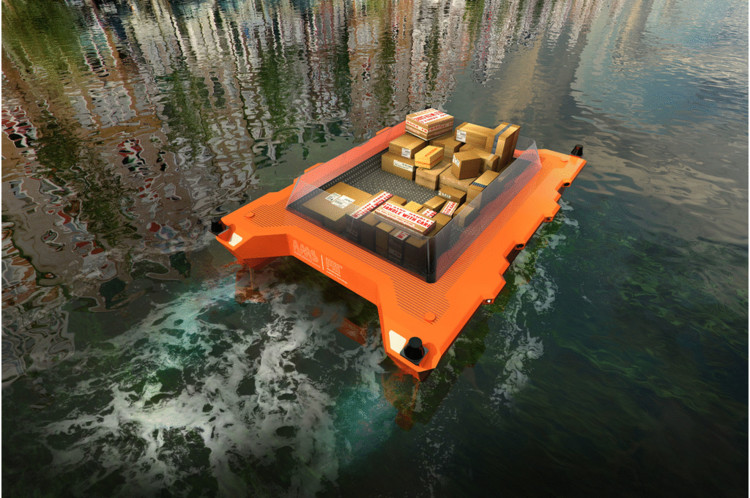
Today, groups such as the Senseable City Laboratory at MIT have been created with the goal of suggesting ideas for the city of tomorrow. Through a technique known as ‘Futurecraft’, the Senseable City Lab places the designer in a possible future environment and asks them to generate design proposals which could enhance daily life. As we are about to see, some of their ideas would make heads turn even in a galaxy far far away.
One general trend in today's Information Age involves the absolute transmutation of downtime into productivity or engagement of any kind, however meaningless. We hear it all the time: we have lost our ability to be still. However, as a team at Ennead Lab has observed, some of the same technologies that are causing this shift in routine also have the potential to open new, empty pockets of time in our daily lives, and affect the built spaces with which we interact.
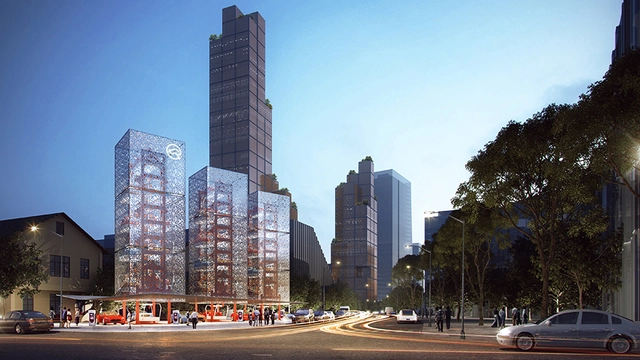
Tasked with designing an electric car charging station for a development in Shanghai, Ennead realized that the five hours required to fill up a single standard charge necessitate a place for customers to wait. In an article on Metropolis Magazine, they show that the promise of transportation-less people to stick around in one place for such a period of time opens up a host of possibilities for what could fill the latency period; the Shanghai project, however, focuses on the opportunity to create a civic space. The team has imagined the modern "gas station" as a vertical charging tower that calls upon the functionality of urban parking elevators in the 20th century, this time clad in reflective silver to serve as a beacon for customers in search of a charge. Rather than standalone charge-park towers, the projects are integrated into a system that encourages patrons to walk to neighboring zones to eat, shop, and socialize while they wait.
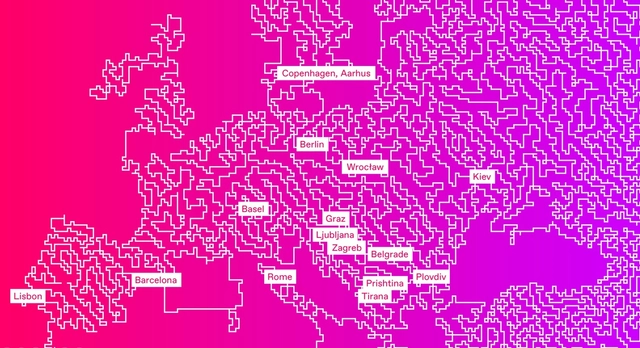
Following a second call for ideas from the Future Architecture Platform (MAO), a total of 337 ideas by 594 authors from 56 countries were submitted and distributed for public vote. 14,381 valid votes were logged by the organisation, and Assembling Narratives by Danai Toursoglou Papalexandridou (Greece) was chosen the favorite. She is one of a further 24 selected creatives who will be invited to participate at the Matchmaking Conference in late February at the Museum of Architecture and Design (MAO) in Ljubljana.
https://www.archdaily.com/804502/future-architecture-platform-reveals-2017-laureatesAD Editorial Team
.jpg?1530807729&format=webp&width=640&height=580)

.jpg?1529322837&format=webp&width=640&height=580)
.jpg?1529322827 "Courtesy of Plompmozes")
.jpg?1529322882 "Courtesy of Plompmozes")
.jpg?1529322837 "Courtesy of Plompmozes")
.jpg?1529322845 "Courtesy of Plompmozes")
.jpg?1529322837)




.jpg?1511989021&format=webp&width=640&height=580)