This article is the ninth in a series focusing on the Architecture of the Metaverse. ArchDaily has collaborated with John Marx, AIA, the founding design principal and Chief Artistic Officer of Form4 Architecture, to bring you monthly articles that seek to define the Metaverse, convey the potential of this new realm as well as understand its constraints. In this feature, architect John Marx interviews Peter Hirshberg, chairman, and Anna Fedorova, principal at the Maker City Project.
Limited resources are becoming an increasingly common challenge in architecture. Today, regardless of the region, projects are affected by the availability of resources, which are now compounded by environmental considerations. This situation, far from being restrictive, prompts us to explore new possibilities in how we conceive the built environment. In this context, it is crucial to understand that resources are not only limited to the economy but also include technological, material, and spatial aspects. Thus, we can enhance our creativity and efficiency by broadening our considerations when approaching architectural design and its challenges, doing more with less.
At the community level, the challenge becomes even more significant when we consider that our projects must not only be designed to overcome these "constraints," but also to positively impact their communities. Therefore, contemporary projects must present different strategies to overcome limited resources and materials depending on the context, always aiming to achieve a positive impact and become powerful and ingenious proposals while democratizing access to architecture.
https://www.archdaily.com/1016682/community-growth-through-architecture-maximizing-limited-resources-for-positive-impactEnrique Tovar
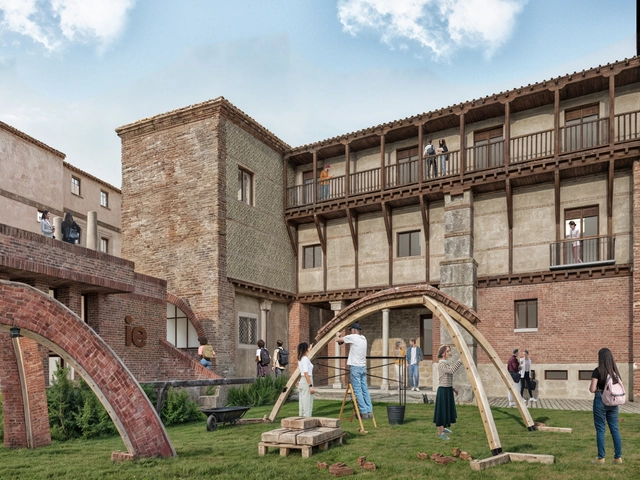
IE University has just announced the establishment of a new Creative Campus to be inaugurated in 2025 in Segovia, Spain. Situated within the historic Palacio de los Condes de Mansilla, this new campus will serve as an extension of the IE School of Architecture and Design. Developed to become an Innovation Hub, the project spans more than 5,000 square meters and boasts a Fab Lab, construction workshops, biomaterials, textile research laboratories, experimentation spaces, digital fabrication classrooms, and an exhibition venue. The amenities are designed for creative minds from different disciplines to collaborate, fostering a platform that provides real solutions for different challenges.
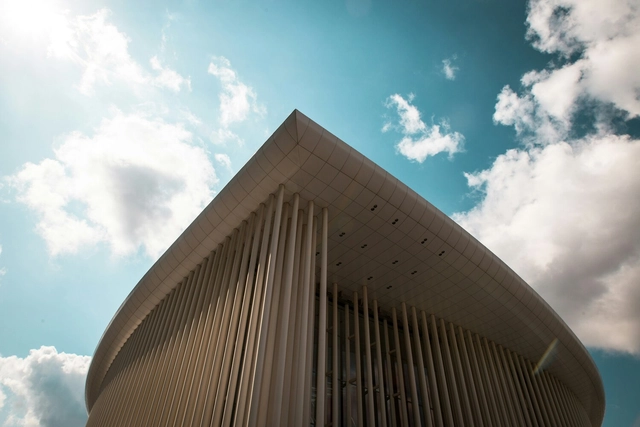
For those seeking remarkable architecture in Europe, Luxembourg stands as a special destination not to be missed. Nestled between Belgium, France, and Germany, this pint-sized country packs a punch with its rich history, stunning landscapes, and vibrant architecture. Small, yet culturally rich, Luxembourg offers a delightful array of architectural wonders waiting to be explored. From ancient castles to modern marvels, Luxembourg’s diverse architectural landscape promises a journey through time and style.
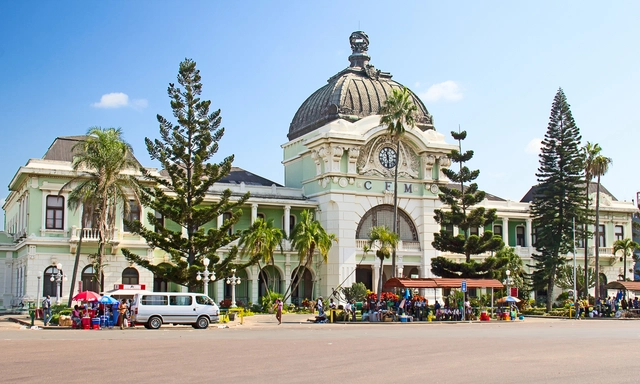
There’s a well-known catchphrase – “Cape to Cairo” – that has spawned numerous books and piqued the imagination of countless travellers of the African continent. The phrase’s origins are of imperial nature, birthed out of an 1874 proposal by English journalist Edwin Arnold that sought to discover the origins of the Congo River. This project was later taken up by imperialist Cecil Rhodes, who envisioned a continuous railway of British-ruled territories that stretched from the North to the South of the continent.
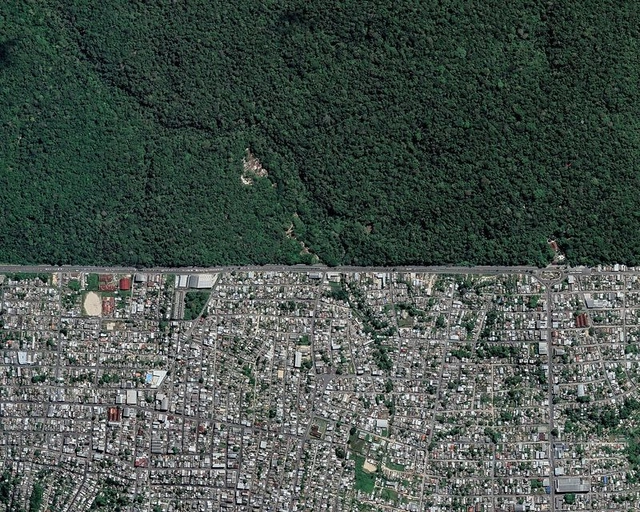
Google Earth and Maxar Technologies, organized by Adriano Liziero (@geopanoramas)
The world has its eyes on the Amazon. Geographical data about this vast territory, spanning 6.74 million square kilometers across eight countries in Latin America, is constantly featured in national and international media. Headlines often highlight its sheer magnitude as the largest tropical rainforest in the world, home to 10% of the planet's biodiversity, and responsible for 15% of the Earth's freshwater. However, little attention is paid to what transpires beneath its canopy, on the ground where people live.
Videos
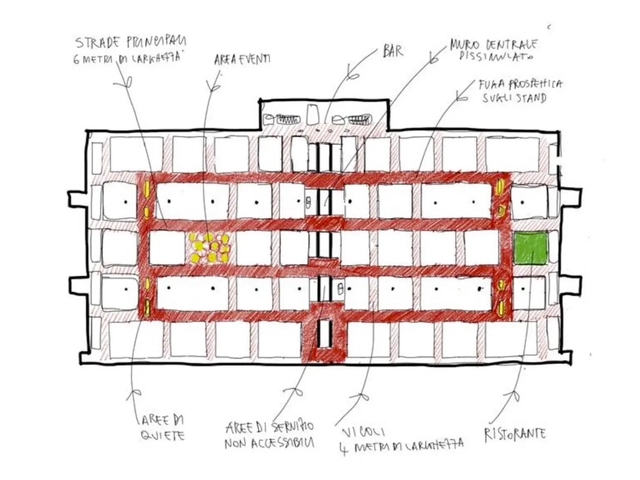
Concept redesign routes Salone del Mobile.Milano - Ph. Cristian Catania, Lombardini22. Image Courtesy of Salone del Mobile.Milano
The 62nd edition of the Salone del Mobile at Rho Fiera brought together designers, architects, producers, and prominent figures from the design realm. With more than 1950 exhibitors, the six-day event, running from April 16 to 21, 2024, emphasized conviviality, well-being, and sustainability. Designed with a human-centric approach, incorporating neuroscience principles to enrich visitor interaction, Salone del Mobile is revolutionizing the future of fairs.
On-site during the event, ArchDaily had the opportunity to speak with Cristian Catania, Senior Architect and Project Director for Reinventing Fairs at Lombardini22, responsible for revamping Salone, about the primary changes in the fair’s layout and the implementation of neuroscience approaches in conceptualizing the exhibition spaces.
The 3rd edition of Shaping the City, a forum on sustainable urban development, took place in Venice between November 24-25, following successful events in Chicago and New Orleans. Organized by the European Cultural Centre, this forum was running in parallel to the 2023 Venice Architecture Biennial exhibition, Time Space Existence. The event, hosted at Palazzo Michiel del Brusà in Cannaregio, brings together global urban planners, architects, academics, and politicians. Notably, Japanese architect Kengo Kuma was among the experts invited to explore the intersection of nature and the built environment in Japanese architecture.
Over two days, the conference set out to explore crucial themes such as education, urban commons, displacement, nature integration, and the future of architecture media, a subject discussed during a panel talk attended by ArchDaily’s managing editor, Christele Harrouk. While on-site in Venice, the ArchDaily team sat down with Kengo Kuma to discuss his unique approach to nature-inspired and site-specific designs.
In June 2023, the planet experienced its hottest month on record. In Iran, the heat index reached a staggering 66.7 degrees Celsius, pushing the boundaries of human endurance. This alarming trend is not an anomaly. It is a stark reminder that temperatures will continue to rise as climate change intensifies.
Scientists are linking the rise to human-induced climate change and the El Niño phenomenon. Additionally, the natural warming of Pacific Ocean waters is being further intensified by global warming.
Art can be a catalyst for architects to see the built environment through a different lens. It provides a unique opportunity to delve into the viewpoints of trained architects who have transitioned into the visual arts and artists who explore cities and their inner workings through their personal stories.
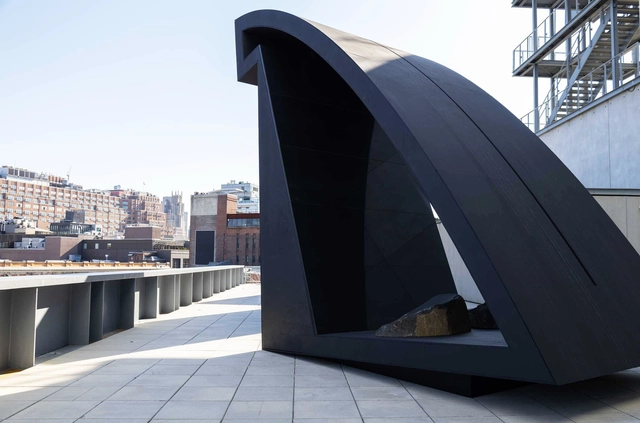
Located in New York City, the Whitney Biennial is considered the most important and longest-running survey of contemporary art in the United States. Along with the Venice Biennale, it is considered one of the world's most important recurring art exhibitions. This year's theme, "Even Better Than the Real Thing," delves into concepts of identity and bodily autonomy, amplifying the voices of those historically marginalized. This includes looking at stories that study the connection between personal narratives and growing feelings of precariousness surrounding the constructed world. These are artists from this year's Whitney Biennial touching on topics related to architecture and cities.
Milan stands as a beacon of mainstream fashion and economic vitality, drawing visitors from around the globe. As Italy’s second most populous city, it serves as the stage for some of the world’s premier fashion and design events. To kick off the 62nd edition of Milan Design Week, we partnered with Felt to create an interactive map highlighting some of the city’s most iconic tourist attractions, as well as contemporary landmarks designed by renowned local and international architects such as Aldo Rossi,Gio Ponti,Stefano Boeri, Mario Cucinella, Zaha Hadid, Grafton Architects, Herzog & de Meuron, and Foster and Partners, amongst others.
https://www.archdaily.com/1015736/discover-milans-architectural-gems-with-this-interactive-city-guideArchDaily Team
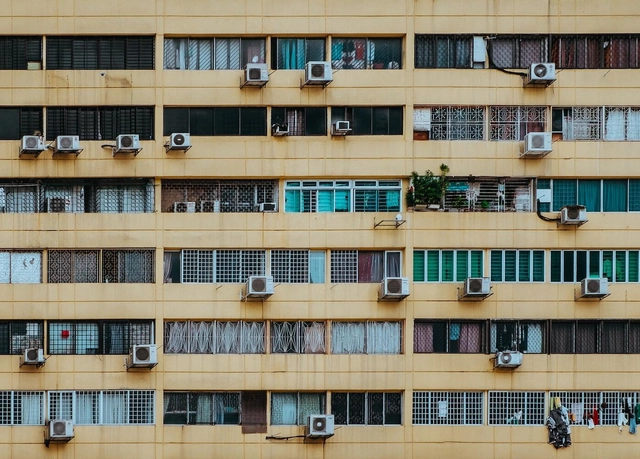
Between now and 2050, worldwide installation of cooling appliances, like air conditioning, is projected to triple, resulting in a twofold increase in energy consumption. This reliance on such devices, often seen as exacerbating global warming, poses a paradox: how can we fightrising temperatures in cities while simultaneously contributing to them through our dependence on these solutions?
CityMakers, The Global Community of Architects Who Learn from Exemplary Cities and Their Makers, is working with Archdaily to publish a series of articles about Barcelona, Medellin, and Rotterdam. The authors are the architects, urban planners, and/or strategists behind the projects that have transformed these three cities and are studied in the "Schools of Cities" and "Documentary Courses" made by CityMakers. On this occasion, Victor Restrepo, Coordinator of CityMakers in Medellin, presents his article "Medellin: A Case Study".
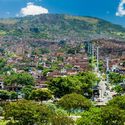
Medellín stands as an inspiring example for many cities worldwide. It is a city that transitioned from deep collective fear to hopeful enthusiasm for urban and social life characterized by quality and coexistence. The city's crisis has always been associated with violence and drug trafficking. However, this crisis is more structural and profound, it responds to many more factors, some of which are associated with the accelerated growth of its population, as in many Latin American cities.
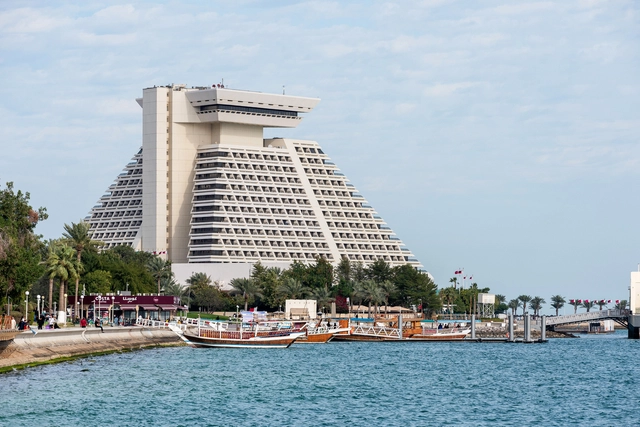
As part of the Design Doha 2024 Biennial, Glenn Adamson and Péter Tamás Nagy present the exhibition “Colors of the City: A Century of Architecture in Doha” investigating the architectural evolution of the capital of Qatar based on multiple global influences that characterize it. Running until March 30, 2024, the exhibition offers a journey through Doha's architectural history featuring various styles such as Classicism, Art Deco, and Modernism, contemplating the Qatari adaptations of these styles developed by architects from Europe, America, the Middle East, and South Asia.
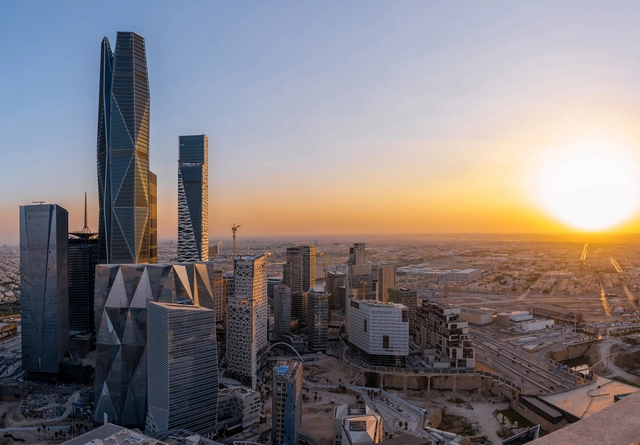
PIF Tower, Riyadh, Saudi Arabia Photo: Bader Otaby. Image Courtesy: The International High-Rise Award 2022/23
The future Saudi tower designed by Foster + Partners is expected to reach a staggering height of two kilometers. This multibillion-dollar project, towering twice as high as the current record holder, the Burj Khalifa in Dubai, will dominate the skyline of Riyadh, accommodating offices, residences, and entertainment spaces. It forms part of a development program led by Saudi Arabia, driven by the vision of Crown Prince Mohammad bin Salman to establish the country's presence through ambitious, large-scale projects. While these super-tall towers symbolize visibility and global recognition, they face criticism for their extravagant construction costs and environmental impact.
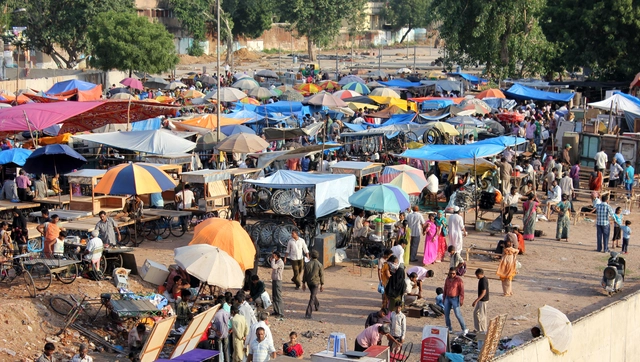
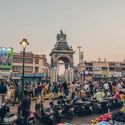
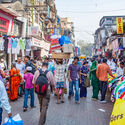
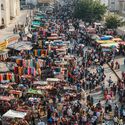
India's urbanscapes are characterized by a negotiation between the formal and the informal; permanence and impermanence. Structured amidst the concrete high-rises and planned neighborhoods, makeshift markets and bazaars form the core of city life. Often composed of sustainable structures, these transient commercial hubs exhibit a form of rudimentary architecture that spreads its roots deep in India's cultural and economic traditions.
The heart of India's informal urbanism lies in its public marketplaces and roadside bazaars that have existed for centuries. These urban zones have a history, believed to have originated from the era of traveling merchants and imperial trade relations. Today, these environments have evolved into dense labyrinths of impermanent shelters made from recycled tin sheets, tarpaulin canopies, and wooden poles. These bazaars organically transform neighborhoods into a choreographed chaos of vendors, goods, and the common public. Weekly markets are usually massive in scale and are set up every few days only to disappear again.
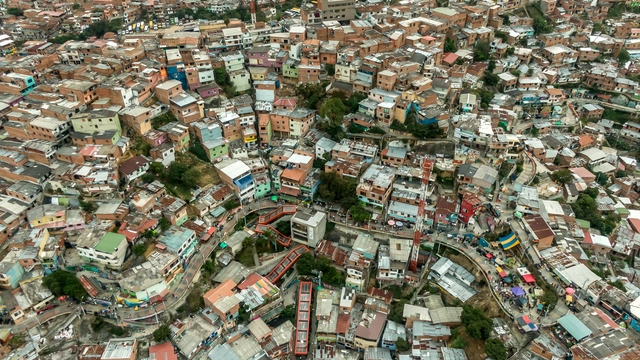
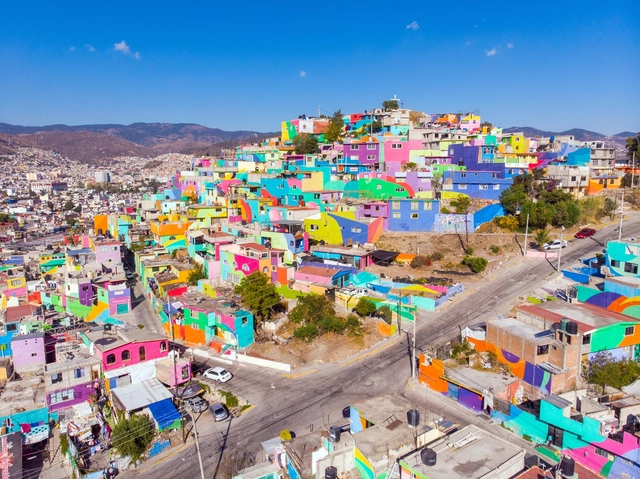
In the perception of many, the favela embodies contradictory and opposed representations. For those outside its boundaries, the favela is frequently associated with crime, poverty, or illness. Yet, it is also regarded as the aesthetic embodiment of a nation, serving as the birthplace of culturally renowned elements worldwide, such as samba in the case of Brazil.
CityMakers, The Global Community of Architects Who Learn from Exemplary Cities and Their Makers, is working with Archdaily to publish a series of articles about Barcelona, Medellin, and Rotterdam. The authors are the architects, urban planners, and/or strategists behind the projects that have transformed these three cities and are studied in the "Schools of Cities" and "Documentary Courses" made by CityMakers. On this occasion, Jaume Barnada, coordinator of the award-winning Climate Shelters project in Barcelona schools and speaker at the "Schools of Cities", presents his article "Barcelona, the public place as a synonym for the adaptation of the built city."
Cities are dense, built spaces in which pavements have been efficiently imposed on the natural soil. Cities like Barcelona have almost 75% of the land paved and waterproof. Without a doubt, it is an excess to reverse at a time of climate emergency, where we must reconnect with nature. Oriol Bohigas [1] told us that good urbanization had paved the squares of Mediterranean cities and that no one wanted to live in a mudhole. I'm sure he was right. Also, he taught us that the green and, consequently, the natural soil had to have dimension and especially an urban position. Squares are squares and parks are parks, and each space has a type of project. Today, concepts are too frequently confused when urbanizing public places and consequently, we find projects that blur the model.