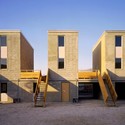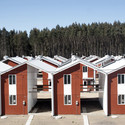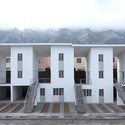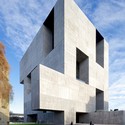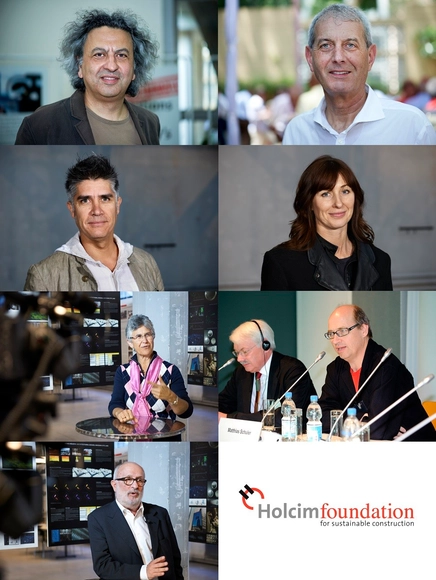
The Holcim Foundation has announced the global jury for the 2015 Holcim Awards, its triennial prize which encourages architects, planners, engineers, project owners and students to share their projects and visions that "go beyond conventional notions of sustainable construction."
The 2015 prize is the Holcim Foundation's fourth cycle, and this year will feature a total prize fund of $2 million - a significant increase on their 2012 prize fund of $300,000. To oversee the awards, they have recruited independent experts of international stature, including the Deans of the Harvard Graduate School of Design and ETH Zurich, and Alejandro Aravena of Chilean practice Elemental.
Read on after the break for the full list of jurors and more on the prize
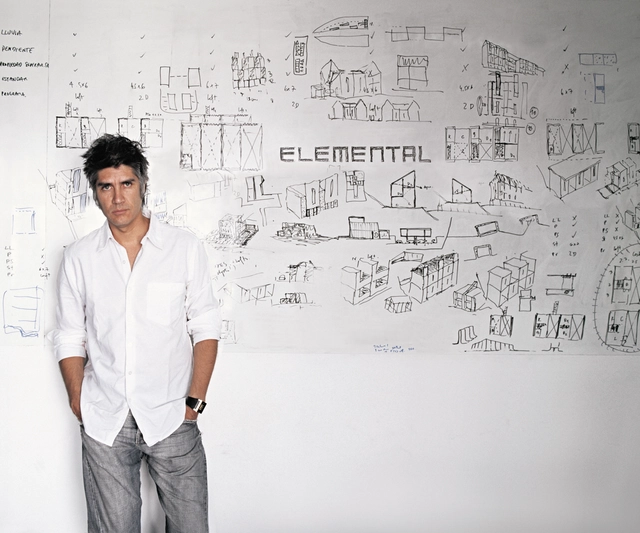
The following is Alejandro Aravena's response to the Shigeru Ban's Pritzker win. Aravena is the executive director of the firm ELEMENTAL S.A and a member of the Pritzker Jury who selected Ban as this year's Pritzker Laureate.
Shigeru Ban has expanded the field of architecture in unexpected ways. He has proved that the inspired artist and the skilled designer is not inevitably condemned to work for a privileged elite, but that innovation can take place while working for the majority, particularly those historically underserved, forgotten or neglected. In order to do that, he redefined the approach to deal with difficult, urgent and relevant challenges, replacing professional charity by professional quality. Ban has shown that no matter how tough the circumstances or scarce the means, good design far from being an extra cost carries the added value of sharp efficiency, power of synthesis and an uplifting feeling.
At a lecture he delivered in April this year at the 4th Holcim Forum 2013 in Mumbai, Pritzker Jury member and Chilean architect Alejandro Aravena approached sustainability from an unconventional angle. The key to achieving the "Economy of Sustainable Construction" (the title of this year's Holcim Forum), Aravena claims, requires two things: "in this generation, more psychiatrists; in the next generations, more breasts."
ArchDaily’s Architecture App Guide will introduce you to web and mobile apps that can help you as an architect: productivity, inspiration, drafting, and more.
3D computer modeling has become a ubiquitous tool in architecture and design, but - even now - there’s no real solution to the problem of easily displaying or sharing models. An exciting new tool, however, might just change this. It’s called Sketchfab, and it displays 3D models natively in the browser - no plugins necessary, and no need to download to your desktop. A resource like this allows any viewer or reader to glimpse into the future of publishing and communicating architecture online.
Users sign up for Sketchfab and upload models directly in 27 native 3D formats (including .3ds, .stl, .kmz, .dwf, .lwo and others); these models can then be embedded anywhere. Not only will this allow architects to showcase finalized projects, but designs can be followed as they evolve and change. It will be particularly valuable in the remote review process that occurs between the architect and 3D visualizers. And Sketchfab’s platform has an integrated comment and like system to foster discussion and critique.
This past weekend, we were invited to celebrate the 50th anniversary of the Panton chair and other Vitra creations at their showroom in the Meatpacking District in Manhattan. The showroom was buzzing with people socializing and viewing the different designs on the showroom’s staggered levels. We were especially excited to see Alejandro Aravena’snovel “Chairless“, a strap of fabric that is a way to eliminate the need for the traditional chair, and yet allows the person to become the integral part of the furniture. Inspired by the Ayoreo Indians who sit on the ground with a tight strap around their back, Aravena developed this concept to produce a seating device that relieves the spine and legs. “It is obvious that many things have evolved since the beginning of time and that progress has accumulated in our lives in the form of sophisticated needs and desires. But it is also true that there are many things and needs that haven’t changed much since our origins and they can still be satisfied in an extremely simple way: sitting comfortably on the ground is one of them,” explained Aravena.
Urban Age Public Debate Series presents “Architecture as Investment, New Forms of Social Equity”, with ELEMENTAL‘s Executive Director Alejandro Aravena.
Aravena has been in practice since 1994 and since 2006 has also served as Executive Director of ELEMENTAL S.A., a “Do Tank” for the design and implementation of urban projects of social interest and public impact. His work includes the Mathematics Faculty, the Medical Faculty, the computer facility “Siamese Tower,” and the Architecture School at the Universidad Católica, Santiago, Chile; House for a Sculptor; House in the Pirehueico Lake; new residence and dining halls for St. Edward’s University in Austin, Texas; children’s workshops and training facilities for Vitra in Weil am Rhein, Germany; a Villa in Ordos, Inner Mongolia; and social housing and urban projects for Elemental. In 2009, Aravena was appointed a member of the Pritzker Prize Jury.
He has received several awards, including Silver Lion at the XI Venice Biennale, 1st Prize in the XII and the XV Santiago Biennale, the Erich Schelling Architecture Medal 2006 (Germany), finalist in the Mies van der Rohe Award (2000), top 10 finalist in the Iakhov Chernikhov Prize 2008 (Moscow), and finalist in the Global Award for Sustainable Architecture 2008 (Paris).
Tickets are required for admission to League programs. Tickets are free for League members; $10 for non-members. Members may reserve a ticket by e-mailing: rsvp@archleague.org. Member tickets will be held at the check-in desk; unclaimed tickets will be released fifteen minutes after the start of the program. Non-members may purchase tickets online here.
For more information, click here. All the lectures after the break.