"An avid yachtsman," Frank Gehry has designed his first yacht. As Esquire reports, the traditional larch wood sailboat boasts titanium and red accents with windows clad in warped lattice work. "Foggy," as it's named (an acronym for Frank Owen Gehry), was designed for Gehry's friend and developer Richard Cohen. Gehry collaborated with naval architect Germán Frers, who was charged with keeping Gehry's design practical. "Don't let me go too crazy," Gehry told Frers. "The boat has to work."
Since the Los Angeles Timesbroke the news that the LA River Revitalization Corp has enlisted Gehry Partners to lead a new master plan effort for the Los Angeles River, there have been a slew of negative responses: the Friends of the Los Angeles River have refused to endorse the Gehry effort, reactions collected by the Architects Newspaper ranged from skeptical to angry, and Alissa Walker at Gizmodo did not mince words when her headline declared “Frank Gehry is the Wrong Architect to Revitalize the Los Angeles River.” These responses raise real and legitimate concerns - progress on the LA River has been years, if not decades, in the making. There is already a master plan, prepared by Mia Lehrer and Associates, and the US Army Corps of Engineers approved a plan to restore 11 miles of the river, known as Alternative 20, just this past July. There are worries that this new effort could threaten the current approvals and funding.
Frank Gehry is an easy target for criticism. His buildings can be polarizing, and his detractors are quick to seize on any defect. Details are trickling out slowly, but a recent presentation to reporters revealed that the plan would eventually identify locations for parks and real estate developments, as well as establish a unified design theme for future improvements such as pedestrian and bicycle paths. For his part, Gehry has emphasized the water reclamation aspects of the project - an especially timely subject in drought-stricken California. And in an interview with Frances Anderton on KCRW’s “Design and Architecture,” Gehry was quick to clarify, “It’s not a building, I’m not doing a building!”
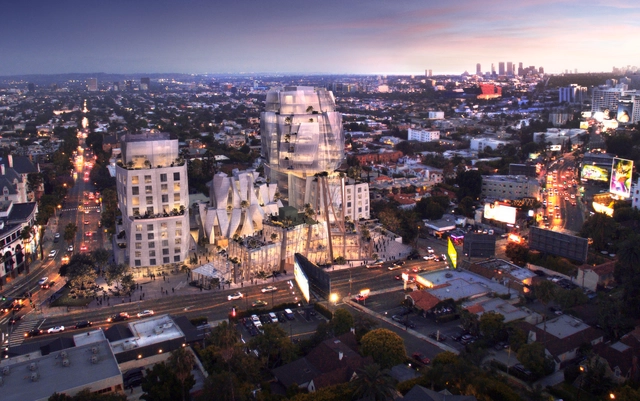
Gehry Partners, alongside Townscape Partners, has unveiled plans to redefine the "gateway" to California's Sunset Strip. A cluster of five distinct, Gehry-esque structures, the mixed-use proposal is one of several design alternatives that have been proposed by Townscape for the site. If built, it would include two residential buildings, featuring a mix of rental and for-sale apartments, along with retail, entertainment programs, and public gathering spaces.
Frank Gehry is said to be "quietly" working on a masterplan for the Los Angeles River in California. Prematurely announced by the Los Angeles Times, the City's mayor Eric Garcetti has confirmed the news, saying Gehry is producing "a master plan, in the truest sense of the word,” pro bono.
“To have the [Frederick Law] Olmsted of our time focusing on this, I think, is extraordinary,” Garcetti said, according to the Los Angeles Times.
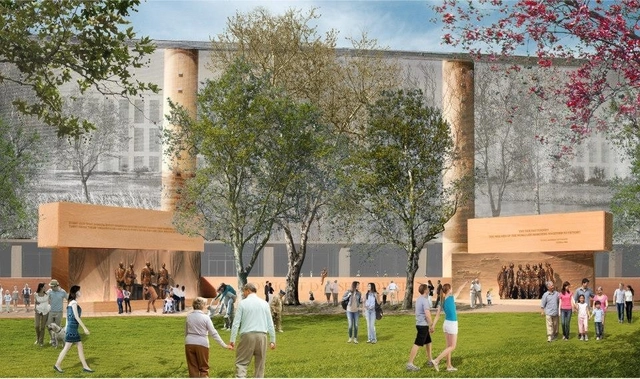
"The resulting Dwight D. Eisenhower Memorial design satisfies the goals of the seven design principles established for this site in 2006 by the NCPC to preserve and enhance the unique character of this site and establish a new green space within the context of L’Enfant’s plan for Washington D.C.," said the NCPC in their final report. You can read the report in full, here.
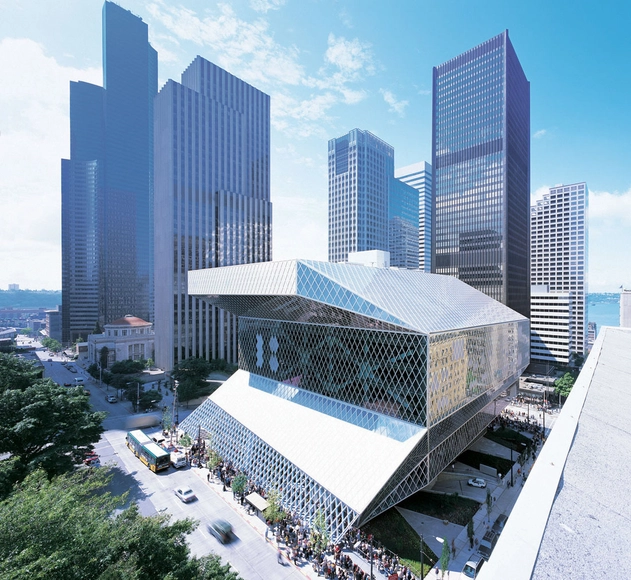
Bjarke Ingels worked on the Seattle Central Library during his time at OMA. Image Courtesy OMA
The world of architecture is small. So small in fact, that Rem Koolhaas has been credited with the creation of over forty practices worldwide, led by the likes of Zaha Hadid and Bjarke Ingels. Dubbed “Baby Rems” by Metropolis Magazine, this Koolhaas effect is hardly an isolated pattern, with manifestations far beyond the walls of OMA. The phenomenon has dominated the world of architecture, assisted by the prevalence and increasing necessity of internships for burgeoning architects.
In a recent article for Curbed, Patrick Sisson dug into the storied history of internships to uncover some unexpected connections between the world's most prolific architects. With the help of Sisson's list, we've compiled a record of the humble beginnings of the household names of architecture. Where did Frank Gehry get his start? Find out after the break.
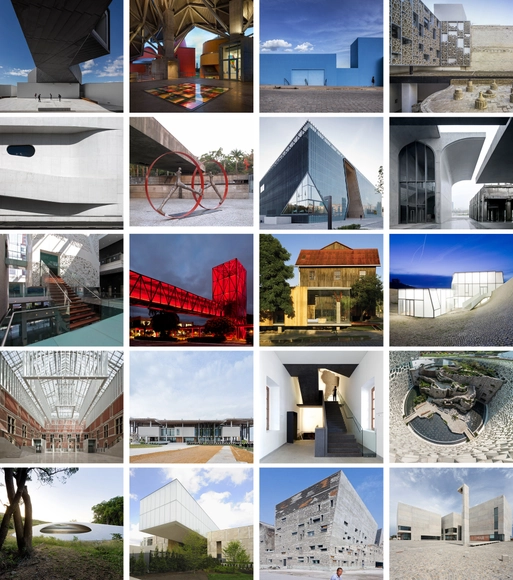
In honor of International Museum Day we’ve collected twenty compelling museum projects. In this round up you’ll find a truly global selection; from Wang Shu's Ningbo Historic Museum in China and Tod Williams + Billie Tsien's Barnes Foundationin Philadelphia to Monoblock's Contemporary Art Museumin Buenos Aires, see all of our editors’ favorites after the break!
https://www.archdaily.com/631994/archdaily-editors-select-20-more-amazing-21st-century-museumsAD Editorial Team
Early building model inside the completed headquarters. Image via Mark Zuckerberg
After Facebook began its move into its new Frank Gehry-designed headquarters last week, Facebook founder Mark Zuckerberg has praised his architect for his work. In a post on his personal Facebook page yesterday, Zuckerberg shares the story of how Gehry he initially turned down Gehry's request to design the project, saying that "even though we all loved his architecture... We figured he would be very expensive and that would send the wrong signal about our culture."
But Frank Gehry persisted, saying that he would match any bids the company received. As a result, Zuckerberg has now praised Gehry - in a somewhat uncharacteristic description of the architect - for being "very efficient."
Read Zuckerberg's full statement, after the break.
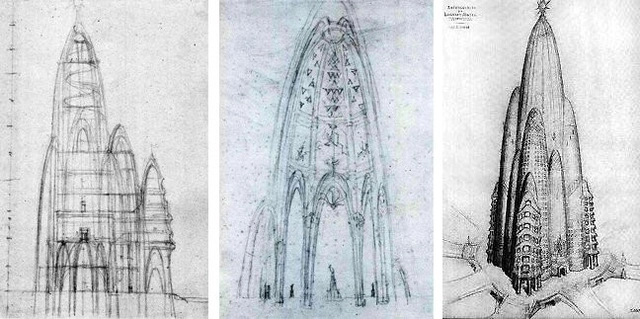
Sketches by Gaudí on the left, with Joan Matamala's drawing of the building on the right. Image Courtesy of 6sqft
Ever since its unprecedented skyward growth in the late 19th and early 20th centuries, Manhattan has been an icon of construction all over the world, with recent estimates concluding that the island contains some 47,000 buildings. However, as with all construction, completed projects are just the tip of the architectural iceberg; Manhattan is also the home of many thousands of unloved, incomplete, and downright impossible proposals that never made it big in the Big Apple.
Of course, the challenges of New York are indiscriminate, and even world-renowned architects often have difficulties building in the city. After the break, we take a look at just three of these proposals, by Antoni Gaudí, Frank Lloyd Wright and Frank Gehry, courtesy of 6sqft.
The wait is over; premiere dates for the highly anticipated film The Competition have been released. The first documentary ever to focus on the tense process of architectural competitions, The Competition captures a fascinating account on how five world renowned architects – Jean Nouvel, Frank Gehry, Dominique Perrault, Zaha Hadid and Norman Foster – “toil, struggle and strategize to beat the competition.” The premise is based on a nearly forgotten, 2008 competition for a new National Museum of Art of Andorra, a small Pyrenees country nestled between Spain and France, which has yet to be realized.
Above is a never-before-seen clip of Frank Gehry discussing project economics with the competition jury. Watch the official trailer and see if The Competition is premiering in a city near you, after the break.
An overlooked strip mall at the corner of Sunset and Crescent Heights boulevards will soon be replaced by a mixed-use, walkable community designed by Frank Gehry. Known to be the “gateway to the Sunset Strip,” the West Hollywood site will be comprised of 249 apartments, restaurants, retail storefronts and a central plaza - all within "an environmentally sensitive building that complements and contributes to the historic architecture in the neighborhood.”
“Frank Gehry’s deep understanding of the property, its history and the context will elevate the project to the iconic and timeless status that it deserves,” said Townscape partner and project developer Tyler Siegel.
February 17 is Mardi Gras, or “Fat Tuesday,” traditionally a Catholic holiday that celebrates the last night of indulging in guilty pleasures before participating in the penitential season of Lent. Celebrated around the world with elaborate parties, parades, dancing, and other frivolities, its festivities are most famously celebrated within the United States today in the city of New Orleans, Louisiana, the site of the first American Mardi Gras.
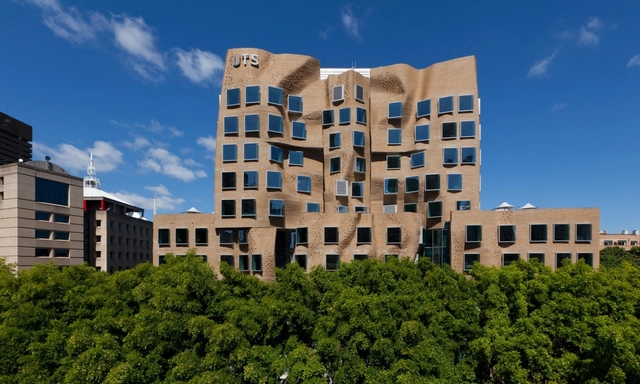
Last week, Frank Gehry inaugurated his first building in Australia, with the formal opening of the Dr Chau Chak Wing Building at the University of Technology in Sydney (UTS). As his first in the country, the building therefore offers an opportunity for a whole new corner of the world to weigh in with their opinions on the polarizing style of the world's foremost love-him-or-hate-him architect.
The resulting media flurry has provided a number of entertaining responses, both positive and negative. After the break, we round up some of the most amusing.
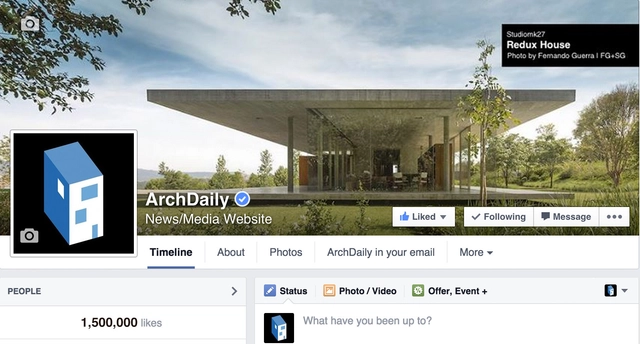
Over the past 14 months our Facebook fans have grown from 1 million to 1.5 million (), and as always our mission continues to be to post the best, latest and most relevant architecture news and projects. But, we couldn’t do it without your help (#thankyou). By liking, commenting and sharing our posts you’ve helped create a vibrant online community, spanning the globe. From the US to India, Brazil and Thailand, you (our fans) are constantly providing unique perspectives and cultural insight. When Frank Gehry lifted his finger and declared that 98% of everything that is built is pure shit, over 9,000 of you shared the post, more than 1,000 commented and as a result the post reached close to 3 million people worldwide.
To celebrate our new milestone on Facebook, we’ve rounded up the #Top10 Facebook Posts from the past 14 months, based on the number of people reached (as calculated by Facebook). From World Cup-related architecture to undulating staircases see the Top 10 Posts after the break.
"Architecture is suffering a crisis of confidence,” stated Shubow in his recent Forbes article. “It is never easy to admit that one is mistaken, still worse that one’s god has failed. It is all the harder when one’s false worldview has been the justification for one’s high social rank. But the growing crisis of confidence is a sign that a cherished dogma will finally be abandoned: The superiority of the architect to the common man.”
Frank Gehry presents the National Center for Social Action Through Music project
With Venezuelan President Nicolás Maduro in attendance, Frank Gehry presented the model for the future National Center for Social Action Through Music building in Lara state. The project is Gehry’s second in Latin America, following the recently inaugurated Biomuseo in Panamá.
To be located in Barquisimeto, Venezuela’s fourth most populated city, the National Center for Social Action Through Music forms part of the National Network of Youth and Children’s Orchestras and Choirs of Venezuela, more commonly known as “El Sistema.” Founded in 1975 by orchestra director José Antonio Abreu, El Sistema is now funded by the government and provides musical training and education for children from impoverished backgrounds. The Adjkm-designed Simon Bolivar Complex for Social Action is also part of El Sistema.
In just three short years, Frank Gehry’s 450,000-square-foot Guggenheim Abu Dhabi will open. More than 12 times the size of Frank Lloyd Wright’s Guggenheim New York, the expansive $800 million museum will showcase 1960s art from around the world within an asymmetrical mountain of plaster blocks and self-cooling translucent cones. Anticipating its completion, the New York Times sat down with Gehry to hear the story behind the building’s design. Watch the full interview with Gehry, here.







 ), and as always our mission continues to be to post the best, latest and most relevant architecture news and projects. But, we couldn’t do it without your help (#thankyou). By liking, commenting and sharing our posts you’ve helped create a vibrant online community, spanning the globe. From the US to India, Brazil and Thailand, you (our fans) are constantly providing unique perspectives and cultural insight. When