Ningbo Historic Museum / Wang Shu, Amateur Architecture Studio
22
Feb 2009
By Nico Saieh — Filed under: Museums and Libraries , Selected , China, Iwan Baan, Stone, Wang Shu Architect

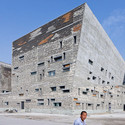
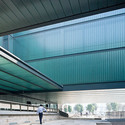
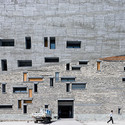
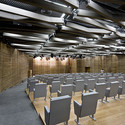
Iwan Baan shared with us one of the latest works he photographed, the Ningbo Historic Museum designed by Wang Shu, Amateur Architecture Studio.
An amazing stone work, more pictures after the break:


98 comments »
Argly!! sham of the chinese Architector
A perfection finale of foolish bureaucracy and overconfident Architector cooperateing.
excellent architecture…it looks as if it has been there for ever…very architecural in terms of making use of local building typologies and materials.
Wow this is very impressive. I thought this was in a desert. it has the quality of an ancient wall. Zumthor has spiritual followers in China !
Ankhu,ud better improve your poor English spelling first.
hehe I see^^
amazing. the stone work is just amazing
The outside walls are just amazing, like archeological layers unfortunately the inside simply looks like it belongs to another building. I also wonder if a timber deck is suitable for that type of architecture. No comment about the site implantation…Where is the site?
The outside walls are just amazing they look like archeological layers. Unfortunately the inside simply looks like it belongs to another building. I also wonder if a timber deck is suitable for that type of architecture. No comment about the site implantation…Where is the site?
Quite busy, Not sure if this is a very Chinese, looks like a deformed work of Zumthor. If so then it is not too original…
WTF are you talking about One, never heard of the Great China Wall ? just Google it and you will understand.
GREAT WALL OF CHINA.
Well I see. Huuumm.. Does this wall also have Profilit horizontal glass and sloping concrete walls? These two elements creates uniw=que feature of this building. I would rather love to see thins building ONLY with this wonderful mason wall.
Daria um bom exemplar para o próximo filme de guerra das estrelas | Would make a good exemple for the next movie of stars wars
It’s amateur thats for sure. Doesn’t know what it wants to be.
hi christina I would like to meet you and kwon more about your impressions.
Antonio
Very nice building indeed; it is quite refreshing to see Chinese architects reinventing an almost pastoral style of architecture in such contrast to Europe – it is the New Vernacular style!
It’s hideous. Sticking to the outside, the use of divergent materials is appealling in historic buildings, since they depict different moments in construction, different constraints, stories… here, they are purely cosmetic, like a permanent costume for an historic reenactment. I find quite illustrating of the quality of the building (and the designer’s intention) the simple fact that no interior picture show the purpose of the windows in the surface. Pure Bang!chitecture. Zumthor’s spiritual followers? try Zumthor’s esthetics’ followers instead. Amateur ones.
Some harsh criticism for a project we have only seen very selected photos for and no text…
I can say that it appears that too much is happening for a site with little or no context… But I would like to hear something about the method of deployment for materials.
And Arman… is it hideous because of the factors you state or purely as a matter of your own aesthetic sense?
I like this one, the using of materials for the walls are outstanding, not like other that occasionally use the masonry as walls
Just Great! Before i saw it was Wang Shu, before i saw it was in China, i had my eye stuck on the glimpse of picture i had in my mail box and recognized this as a great project! This guy is great and with few other chinese architects will save China from crap! Amazing poetry to see how he reused the beautiful walls that you can find in the small villages surrounding Ningbo. In those villages, people reuse old materials to dress their walls with colored patchwork while respecting the old building techniques! Those villages are exemplary in the way they offer renewed dwelling in preserved typologies! I guess here, Wang Shu’s interpretation is both a reaction to the program and the climate and also a reaction of protection against the more agressive environnement of this aweful urban planning. I can tell you that to get to this point of creativity on a public building in China it asks a lot of persecerence and fighting spirit! I don’t know how this guy negociates with his clients but obviously he convinced some persons in Ningbo after the Modern Art Museum and the sustainable Villas projects. I hope i can meet him soon!
Amazing! Timeless and solid between sparkling new cardboard architecture.
It’s quite beautiful.
I love those ancient looking texture marrying the very sharp geometric shapes.
I don’t mind the interior except the escalator and the ceiling.
I wish, the site was in the middle of the desert where people have to take half day or whole day to travel to see the building…well…just my thought…
It seems like the landscape work is not quite finished, yet.
But, don’t you think, the landscape is too flat and squre for the design of the building? I wish, they designed mounds with different elevations.
The walls are just fabulous and transmit a sense timeless.But i find the building in all to be extremely incoherent. From the ouside it looks like a less minimal zumthor..in the inside courtyard it looks like mansilla e tuñon and on the inside it looks like something from oma with that horrible ceilling and mechanical staircases…silent and sober on the outside..loud and fashionable on the inside…i don’t know…either the architect is young or he needs phycoanalisis to find out his architectural personality…
typically there’s some laziness in this type of post:
very little text, not drawings and only promotional photos with only one interior shot… lets try a bit harder guys
I find it amazing and slightly bizarre on first inspection, like some hybrid of modern architecture and a medieval castle. I think the external treatments are unforunately overdone (the 10 different types of finish\pattern randomly applied in a weird collage effect) which clashes with the peacefulness that monolithic stone would normally achieve. The interiors seem quite impressive.
great concrete – great to see some bamboo shuttering used to such great effect
by the way Richie, Aalto used many different types of brick for his summer house and it is seen as work of genius – because this is in chine made and designed by Chinese people it is bizarre?
Impressive work-reflects the great spirit of western education and the lost of far-eastern architecture tradition
no doubt of good architects completing their architecture education in Europe and emigrating back to their native country with a lot of imported knowledge, a good transition of actual western Architecture
Gerson:
Wang Shu was fully educated in China.
Same story with another rising chinese star, Urban China’s Jiang Jun. You don’t need Columbia to be a rockstar.
Roadkill: I think you have to consider in the case of the aalto summer house the scale of the project. A strategy employed on the scale of a house may not be as effective on a huge complex. Just looking at the first photo, it’s hard to imagine being able to touch or place your glass on the masonry work 40 ft in the air… which is part of the enjoyment of the Aalto.
It is an interesting comparison though… did not think of it myself.
looking good….the selection of materials and their use is really nice.
fascinating architecture! east meets west! old meets new!
beautiful and subtle blending of materials and colors! I just can’t take my eyes off!
I was going to make the same comment as Ian in response to Roadkill, i.e. the scale of the Alto house is so much smaller that the effect is very different. Also, the brick styles in the Alto house were done in a very subtle way, whereas the contrast in stone patterns on this exterior is quite drastic. I don’t think it’s necessarily a bad effect, I just find the end result sort of cluttered or chaotic looking and I think the building might be better if a simpler approach had been taken.
At first glance it has to be said the building looked a little ugly. However, once your eyes adjust you begin to pick up some of the brilliance of the design such as the slanting walls etc. I also think the landscape makes the building look less “clumsy” than it would maybe appear in a more intimate setting.
its just a cold building. Its more like a monument, than a place to meet.
it’s quite special.
The dark grey and yellow part of the wall, as you see in the picture, are made of tiles (瓦,in Chinese) which used in the roof of traditional Chinese houses. The rest of the wall are made of stones and grey bricks. All these surface martirial are widely used in Southen China. Inside the building also reminds me of Longtang or Hutong (弄堂). Very Southen China.
However, I don’t like the steel ceiling and wooden floor, I think cement is better choice.
I think it would be better if there are less inclines, windows and trees…
horrible….
Takes courage to undertake such a design.
I think it is…magnificent.,
wow…
it’s a very specially idea,but the surface of the building is a little complex…..
the complex wall reminds me of my old house in the countryside ; ~
Wang got the ancient materials such as bricks &red tiles used which we chinese meet every day many years ago.
He keeps the precious memory well . As a chinese we really need this special thoughts , so maybe this building was kind of urgly but its meaningful to those who actually use it , i dont wanna have a mess of morden buildings surrounding such an old town Ningbo
Forgive me for my poor English!
Oh my god, it looks so beautiful!
I’ve never given this a try, but I think it’s about time I do.
Why the f++ everyone has to mention about Zumthor when something similar appearance shows? Study the history !!
wow. the dry stack style walls are history in and of themselves. bravo.
“One of the most experimental and outspoken architects of China, Wang Shu, born 1963, surprised the world at the 2006 Architectural Biennale Venice with the Chinese contribution “Tiles Garden: A Dialogue Beyond City, Between an Architect and an Artist” in which he presented an installation of a sea of grey Chinese tiles, crossed by a bamboo bridge. Those tiles, thousands of them, came from demolition sites in China, where old structures were being replaced by new building complexes. Wang Shu shows how recycled and familiar materials (tiles and bricks) can be used in very contemporary architectural projects. He is referring to large scale demolition so common everywhere nowadays in China and how to keep up traditional modes of living in a rapidly changing context. At the moment, he is constructing five highrises of 100 m height each at Hangzhou, where traditional floorplates of two level housing with courtyards are stacked on top of each other. Wang Shu is Professor and Head of the Architecture department at China Academy of Art, Hangzhou.”
By the way, I see a similar approach working almost anywhere where stone, or earth for that matter, was used in traditional architecture.
an archaic-looking fortressy (yet intelligently laid out) structure like this would also work magic if anyone dared to put it in the middle of a capitol of the so-called First world.
For those interested in knowing more about this building and its architect, we just published “Local Hero | Wang Shu”, an interview by Bert de Muynck with Wang Shu (Amateur Architecture Studio) that was published in MARK Magazine#19. The interview took place in December in the then recently completed Historic Museum in Ningbo. Wang Shu talks about the above Historic Museum and explains his design philosophy by going deeper in some of his recent constructions like the Contemporary Art Museum (Ningbo), Five Scattered Houses (Ningbo), the Historic Museum (Ningbo), Xiangshan Campus (Huangzhou) and the Ceramic House (Jinhua).
http://movingcities.org/movingmemos/amateur-architecture-studio-publication/ [post]
http://movingcities.org/interviews/local-hero-an-interview-with-wang-shu/ [interview]
The urban context in the perspective view is touchy…i think the whole conceptual idea is strong…
Amazing and very brave. I love the use of various finishes on elevations. Great project. Very appealing.
WTF
A tomb with many coffins?
well done!
incredibly beautiful and inspiring project
i like it :)
massive building – but i like the breaks on the facade – and the different stone-layout
Where is this beautiful building? I’m moving to Ningbo soon and I’ve searched all over the internet in English and Chinese for the address, but to no avail. Please someone tell me where it is.
Its prefect matching the local material and culture….just like it….
By the way, Hey, Moving Cities, do u know where can get the MARK Magazine in China? if u know that pls sent the address in my mail goblock@qq.com Cheers!
Great piece!!!It actually tells what it is from outside!!!it have that historic feel to it and its a HISTORIC museum!!!!!!!
ey um working on designing a historic museum n need plans and sections of this.If any1 knows any thing that could help,send it through please….
There is something wrong with it. Maybe looks like some ancient ruins but maybe like some worthless garbage. It may therefore be beautiful or really ugly. It’s somehow questinable.
Looks like a very beautiful pile of rubbish :)
外牆好像是回收的建材?
Would be 1000% better if it includes some green creeping up the facade…
that will pull itself away from the Zumthor stony look…
he is my favorite chinese educated architect.
absoluteley stunning, a modern day wonder
Links to this article »