1. ArchDaily
  2. Architecture Education

Architecture Education: The Latest Architecture and News

Colin Fournier, Co-Founder of Archigram, Passes Away at 79

British architect and planner Colin Fournier, co-founder of conceptual architecture studio Archigram and Professor of Architecture and Urbanism at the Bartlett School of Architecture, has passed away at the age of 79. Fournier was best known for his co-design of the Kunsthaus Graz in Austria, also known as the "Friendly Alien." This project, completed together with Sir Peter Cook, is celebrated as one of the most distinctive cultural landmarks of its time. For his contributions to this work, Fournier was awarded Austria's Goldener Ehrenzeichen medal in 2005, a recognition of his impact on the architectural landscape.

Colin Fournier, Co-Founder of Archigram, Passes Away at 79 - Image 1 of 4Colin Fournier, Co-Founder of Archigram, Passes Away at 79 - Image 2 of 4Colin Fournier, Co-Founder of Archigram, Passes Away at 79 - Image 3 of 4Colin Fournier, Co-Founder of Archigram, Passes Away at 79 - Image 4 of 4Colin Fournier, Co-Founder of Archigram, Passes Away at 79 - More Images

The Second Studio Podcast: An Interview with Michael Tyre of Amenta Emma Architects

The Second Studio (formerly The Midnight Charette) is an explicit podcast about design, architecture, and the everyday. Hosted by Architects David Lee and Marina Bourderonnet, it features different creative professionals in unscripted conversations that allow for thoughtful takes and personal discussions.

A variety of subjects are covered with honesty and humor: some episodes are interviews, while others are tips for fellow designers, reviews of buildings and other projects, or casual explorations of everyday life and design. The Second Studio is also available on iTunes, Spotify, and YouTube.

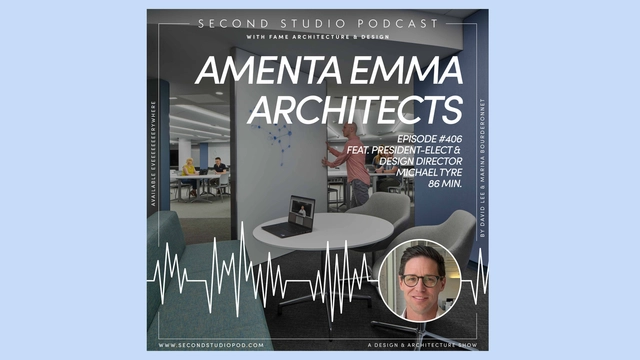
This week David and Marina of FAME Architecture & Design are joined by Michael Tyre, President-Elect and Design Director of Amenta Emma Architects to discuss his childhood interests; education and early career; neurodiversity in design; the Smith College Young Classroom project; fixed variation vs segregation design model; the shift from ego-driven design to co-creation; reframing social discourse to create inclusive spaces; and more.

“Architecture Schools Are Responsible for Educating the Whole Student:” In Conversation with Michael Monti

This article was originally published on Common Edge.

The vast majority of practitioners I've known over the years seek well-trained graduates who are ready on Day One to be productive employees. But that's not all an architectural education needs to deliver. Michael Monti—who for the past 20 years has served as executive director of the Association of Collegiate Schools of Architecture (ACSA), which represents 5,000 architecture faculty teaching more than 30,000 students—stresses that architectural education needs to rest on strong foundation of shared values and ethics in order for graduates to make meaningful contributions to what he describes as a "civilized life," promoting the dignity, freedom, health, and well-being of the people who interact with architecture every day.

“Architecture Schools Are Responsible for Educating the Whole Student:” In Conversation with Michael Monti - Image 1 of 4“Architecture Schools Are Responsible for Educating the Whole Student:” In Conversation with Michael Monti - Image 2 of 4“Architecture Schools Are Responsible for Educating the Whole Student:” In Conversation with Michael Monti - Image 3 of 4“Architecture Schools Are Responsible for Educating the Whole Student:” In Conversation with Michael Monti - Image 4 of 4“Architecture Schools Are Responsible for Educating the Whole Student:” In Conversation with Michael Monti - More Images

Top-Rated Universities for Studying Architecture in 2024, According to QS World Rankings

QS, Quacquarelli Symonds World University Rankings, has announced the annual list of the top universities to study Architecture and the Built Environment in the year 2024. The ranking evaluates over 1,500 institutions from over 100 locations. The evaluation system has been updated this year to include new metrics such as sustainability, employment outcomes, and international research networks.

The top three contenders, the Bartlett School of Architecture, MIT, and Delft UT, have maintained their ranking from 2023, with ETH Zurich showing a slight decrease from an equal third position to the fourth. In the sixth position, Harvard University stands out as the top university for employer reputation in this subject. Among the top 10 universities, Politecnico di Milano had the greatest advancement in rankings, moving from the 10th position last year to the 7th.

Top-Rated Universities for Studying Architecture in 2024, According to QS World Rankings - Image 1 of 4Top-Rated Universities for Studying Architecture in 2024, According to QS World Rankings - Image 2 of 4Top-Rated Universities for Studying Architecture in 2024, According to QS World Rankings - Image 3 of 4Top-Rated Universities for Studying Architecture in 2024, According to QS World Rankings - Image 4 of 4Top-Rated Universities for Studying Architecture in 2024, According to QS World Rankings - More Images

Transforming Architectural Education with Augmented and Virtual Reality

Subscriber Access | 

The discipline of architecture has undergone considerable change, primarily driven by advancements in the application of technology. Architects, long viewed as the futurists of the constructed world, are now utilizing progressive techniques and resources and expanding the use cases of technologies such as Augmented Reality (AR) and Virtual Reality (VR). This transition extends beyond professional practices into architectural education, bringing opportunities to redefine the approach of architects toward their craft.

Transforming Architectural Education with Augmented and Virtual Reality - Imagen 1 de 4Transforming Architectural Education with Augmented and Virtual Reality - Imagen 2 de 4Transforming Architectural Education with Augmented and Virtual Reality - Imagen 3 de 4Transforming Architectural Education with Augmented and Virtual Reality - Imagen 4 de 4Transforming Architectural Education with Augmented and Virtual Reality - More Images+ 2

BAM Ranking 2023: Top International Master's Programs in Architecture Revealed

The annual BAM ranking of International Master’s Programs in Architecture aims to assist architects and students in identifying the top international Master’s programs globally. Assessing programs from various leading architecture schools, it evaluates degrees through a comparative approach developed by a panel of 15 professors and international experts. For this edition, different Architecture and Built Environment programs have been selected to be part of the BAM Ranking 2023, and 18 Universities worldwide were featured in the 2023 edition of the BAM Ranking.

Similar to the past few years, Harvard University, Columbia University, and Universidad Politécnica de Madrid maintained their position at the top of the ranking. MIT has made the list with two programs, one focused on urbanism and the other on design. Moreover, Tsinghua University in Beijing, China, made the list with their English Program for Master in Architecture. The ranking also features TUDelft (Netherlands), TUM (Munich), and TUBerlin (Berlin) in Europe.

QS World Rankings Selects Best Universities to Study Architecture in 2023

QS- Quacquarelli Symonds World University Rankings just announced the 2023 top universities to study Architecture and the Built Environment. The index rates over 1,400 schools and covers a total of 54 disciplines, grouped into five broad subject areas, based on five indicators "to effectively reflect their performance, taking into account academic reputation, employer reputation, and faculty research".

In this edition of the 2023 Architecture/ Built Environment category, UCL dethrones MIT, which stayed in the first position for three consecutive years. MIT came second, while both the Delft University of Technology and ETH Zurich took third place. The Manchester School of Architecture makes its first debut in the top 5, followed by Harvard, the National University of Singapore, and Tsinghua University in China. Berkeley moved to ninth position and Politecnico remains a non-mover at 10, for the third year.

“Each Project Is Like a Small City to Me” in Conversation With Glenn Sestig

Whether an apartment building, house, storefront, office interior, or restaurant, Glenn Sestig’s architecture consistently reveals itself in tidy fragments of robust and determinately monumental geometry that tends to evoke urban qualities. His austere facades, colonnades, stair landings, and even reception desks and shelf displays appear to be quite hefty and substantial. And, in fact, every project, be it a small boutique or gallery, starts with rigorous planning – visual primary and secondary axes get established, circulation flow is laid out, and major anchors are identified before the architect moves on to addressing the appropriate materials, surfaces, and details. Every space is architecture first; its program and appearance will fit into it.

“Each Project Is Like a Small City to Me” in Conversation With Glenn Sestig - Image 1 of 4“Each Project Is Like a Small City to Me” in Conversation With Glenn Sestig - Image 2 of 4“Each Project Is Like a Small City to Me” in Conversation With Glenn Sestig - Image 3 of 4“Each Project Is Like a Small City to Me” in Conversation With Glenn Sestig - Image 4 of 4“Each Project Is Like a Small City to Me” in Conversation With Glenn Sestig - More Images+ 17

2022 Best Architecture Master Programs According to the BAM Ranking

In order to help architects and students to get to know the best International Master’s available in the world, BAM’s annual ranking compares and evaluates programs, from the best schools of architecture, through a comparative and objective methodology, developed by 13 international experts. For the 2022 edition, different Master’s Degree Programs from the recent QS Ranking – Architecture / Built Environment have been selected to take part in BAM’s Ranking.

Similar to previous years, in 2022, Harvard and Columbia maintained their leading positions in first and second place. MIT made a comeback to the list with two master's programs, in the fourth position, the Master of Science in Architecture Studies in Urbanism (SMArch Urbanism), and in the sixth position, the Master of Science in Architecture Studies in Design (SMArchS Design). Universidad Politécnica de Madrid and ETH Zurich were both ranked third, offering the best master’s program in Europe. Pontificia Universidad Católica in Chile occupied the 18th position, presenting a top master's degree in South America, followed closely in the 20th position by the Universidade de São Paulo.

Top Universities for Architecture in 2022, According to QS World Rankings

The annual QS- Quacquarelli Symonds World University Rankings has announced the 2022 top universities. Covering 51 different subjects, the index rates universities across the globe according to academic reputation, employer reputation, and research impact. With few changes to the top 10 in the 2022 Architecture/ Built Environment category, MIT remained in the first position, for the third consecutive year, also topping the charts for the general QS World University Rankings.

Delft University of Technology in the Netherlands took the second place while UCL, in the United Kingdom, came third. ETH Zurich, Harvard, and the National University of Singapore (NUS) maintained fourth, fifth, and sixth place. The Manchester School of Architecture was upgraded to seventh position this year, moving the University of California, Berkeley (UCB) to eighth place and the Tsinghua University in Beijing, China to the ninth. Politecnico di Milano, in Italy, remains a non-mover at 10.

Vocabulary of Basic Architecture Terms

Subscriber Access | 

Like other professions, Architecture and Urbanism often revolves around its own language. What may seem like a basic term for professionals in the field, can often sound completely strange or meaningless to those starting their studies or who are curious about the field. For this reason, we created a small glossary with some words that are important to expand your vocabulary and contribute to a future discussion about your project.

"Cultural Identity is Central to Architecture": In Conversation with Lesley Lokko

Subscriber Access | 

Questioning the new now, especially with the new challenges of Covid-19, around the world, cities are advocating for structural change and collective action. Berlin questions, an annual, multi-day conference and a platform for transdisciplinary dialogue, in its 2021 edition “Metropolis: The New Now”, tackled the immediate present, creating a place for debate. Dedicated to local solutions to global challenges, the event took on a hybrid format, at various locations in Berlin and online, resembling the world we live in.

ArchDaily had the chance to meet up with Lesley Lokko, architect, academic, and novelist at Berlin Questions, to discuss her talk “Africa as the lab for the future”, her visions for the future of architecture education and the future of big cities on a social, cultural and urban level.

Architecture as a Heterogenous Practice: What is to be an Architect Around the World

Subscriber Access | 

Although architecture itself is universal, the day-to-day practice still varies across the world, influenced by a wide range of factors, from the professional requirements and responsibilities of an architect, the local environment, history and building customs, to local priorities and challenges. In a hyper-connected world, where architecture seems to become more uniform, how do local contexts and characteristics shape the built environment? This article taps into the commonalities and the variations within the architecture profession.

Top Architecture Master Programs 2020 According to BAM

The Best Architecture Masters (BAM) platform presented the third edition of its ranking of the best postgraduate architecture programs in the world.

Based on a list of different postgraduate study programs from the best architecture schools selected in the QS Ranking by Subjects – Architecture / Built Environment, these were evaluated by 11 educational-performance indicators and 41 sub-indicators in relation to the teaching approach, the opportunities they offer, and the programs themselves.

NCARB Releases 2020 Numbers Featuring First Results on Equity, Diversity, and Inclusion

The ninth edition of the National Council of Architectural Registration Boards’ (NCARB) annual report has been released, in the midst of new challenges due to the COVID-19 pandemic, highlighting major information about the architecture profession in 2019. Focusing on different parameters, such as licensing, education, experience, and demographics, the study explores the evolution and transformation of the field, encompassing also findings on equity, diversity, and inclusion.

The Architecture of Labor: Working Conditions and the New Normal

Subscriber Access | 

Labor gives rise to design. As the aggregate of physical and mental effort used in the creation of goods and services, labor is tied to both what we create and our process. In a field shaped by production, architecture and design depend on labor from a broad range of professionals. But as workers increasingly put in longer hours and traditional measures of security change, questions of labor practices have arisen amid broader conditions of contemporary work culture. 
ArchDaily's Ultimate List of Advice for Incoming Architecture Students

Subscriber Access | 

Architecture school. You’ve heard the myths - the legends of all-nighters and innovation, of unmatched workaholism and love for the profession. Perhaps you know what you want – to solve the great urbanization problem, to create the next sustainable wonder-gadget, or maybe just to start your own firm and show the architectural world how it’s done. Maybe you have no idea what you want to do, drawn to architecture by the romance, the larger-than-life scale. Maybe you’re an artist who wants a job when they graduate. A hometown hero, you’re about to be thrown into a classroom of the best, possibly for the first time in your life. You’ll be surrounded by the brightest in engineering, problem solving, writing, drawing and a host of other skills. Anxious and excited, you stand ready at the doors of architectural education, hungry for innovation and ready to share and learn from others. Stepping inside that first day, you prepare yourself for the best - and most difficult times of your life so far.

To prepare you for the strange beast that is architecture school, shed light on what is fact and fiction, and give you some peace of mind, we at ArchDaily have prepared a list of advice for all incoming architecture students. There is no other education in the world quite like an architectural one, and we hope that this list can help prepare you for its unique wonders and challenges. The advice below is meant to ease the transition into school as much as possible – but be warned, nothing can compare to experiencing the real deal. Read them all after the break.

ArchDaily's Ultimate List of Advice for Incoming Architecture Students - Image 1 of 4ArchDaily's Ultimate List of Advice for Incoming Architecture Students - Image 2 of 4ArchDaily's Ultimate List of Advice for Incoming Architecture Students - Image 3 of 4ArchDaily's Ultimate List of Advice for Incoming Architecture Students - Image 6 of 4ArchDaily's Ultimate List of Advice for Incoming Architecture Students - More Images+ 13

9 Lessons For Post-Architecture-School Survival

Subscriber Access | 

We’ve already talked about this. You’re preparing your final project (or thesis project). You’ve gone over everything in your head a thousand times; the presentation to the panel, your project, your model, your memory, your words. You go ahead with it, but think you'll be lousy. Then you think just the opposite, you will be successful and it will all be worth it. Then everything repeats itself and you want to call it quits.  You don’t know when this roller coaster is going to end. 

Until the day arrives. You present your project. Explain your ideas. The committee asks you questions. You answer. You realize you know more than you thought you did and that none of the scenarios you imaged over the past year got even close to what really happened in the exam. The committee whisper amongst themselves. The presentation ends and they ask you to leave for a while. Outside you wait an eternity, the minutes crawling slowly. Come in, please. The commission recites a brief introduction and you can’t tell whether you were right or wrong. The commission gets to the point.

You passed! Congratulations, you are now their new colleague and they all congratulate you on your achievement. The joy washes over you despite the fatigue that you’ve dragging around with you. The adrenaline stops pumping. You spend weeks or months taking a much-deserved break. You begin to wonder: Now what?

The university, the institution that molded you into a professional (perhaps even more so than you would have liked), hands you the diploma and now you face the job market for the first time (that is if you haven’t worked before). Before leaving and defining your own markers for personal success (success is no longer measured with grades or academic evaluations), we share 9 lessons to face the world now that you're an architect.