Former Head of Content. Prior to assuming her role at ArchDaily, Becky worked as an editor for leading architecture firms OMA/AMO, BIG (Bjarke Ingels Group) and Reiser + Umemoto. She also worked as an editor for Princeton University School of Architecture and Harvard University's Graduate School of Design. She holds degrees from Princeton University, Harvard University and the School of Visual Arts.
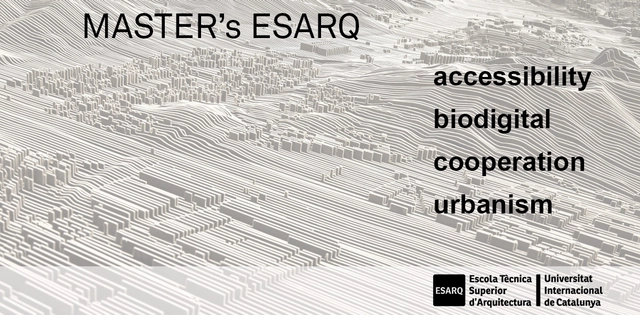
ESARQ-UIC has a teaching method based on a scalar approach which covers building to landscape design, incorporating all areas of knowledge. This allows the school to produce highly competitive professionals, who are multifaceted, innovative, committed and entrepreneurial and are also able to act as leaders when facing new challenges.
To learn more about the Master and Postgraduate programs offered at UIC, read on...
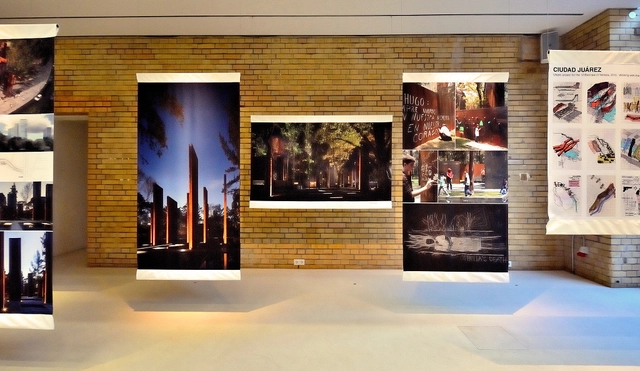
From Architecture Forum Aedes. The exhibition "Building in the Metropolis MX" presents selected works from the Mexican studio Gaeta-Springall Architects. In their working process right through to realisation, architectural elements such as form, material and function serve a larger and more complex system: the City. Julio Gaeta, Luby Springall and their team take great care over designing the envelope in order to generate possible interactions through the porosity of the exterior skin. Here they set particular store by intelligent systems and technologies as the longevity and durability of the building lies in its efficiency and sustainability. Gaeta-Springall Architects dedicate themselves to space as an entirety, which they see as the “true stage of life”. For them, "Building in the Metropolis MX" means the linking of architectural, urban and social elements. It is here that they see their everyday work. After curating this year’s Mexican pavilion “Condemned to be modern” at the Venice Biennale, the presentation at Aedes is the second exhibition in Europe for Gaeta-Springall architects, already highly regarded in their home country.
For more information about the exhibition, head over to exhibition's site.
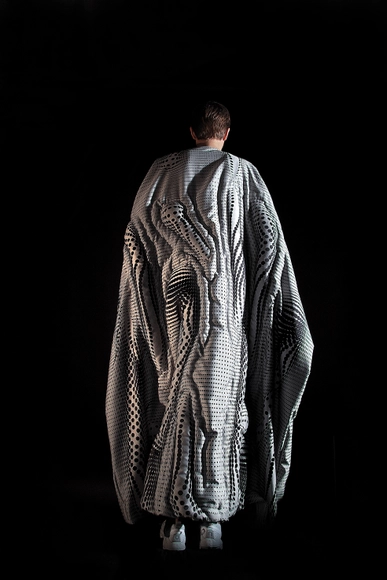
The Austrian firm Coop Himmelb(l)au has designed a wacky quilted coat that blocks electronic surveillance. With pockets to protect your collection of phones and tablets, the Jammer Coat was commissioned for the Workwear exhibition at the Triennale in Milan.
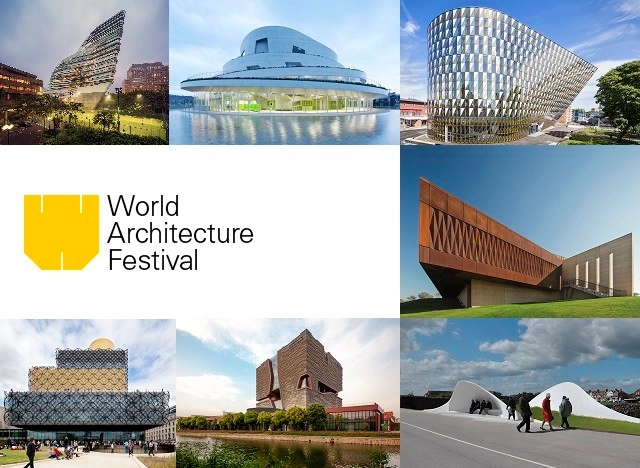
The World Architecture Festival has announced the shortlist for its 2014 awards, with almost 300 projects competing in the world's largest architectural awards program.
The shortlisted projects will be presented live by the architects to international judging panels. After this, the winning projects in each of the 27 categories will go on for the World Building or Future Project of the Year award, judged by the festival's 'super-jury': Richard Rogers, Rocco Yim, Julie Eizenberg, Enric Ruiz Geli and Peter Rich.
This year's festival, hosted once again at the Marina Bay Sands in Singapore, will take place from the 1st - 3rd of October, when the winning projects will be announced. You can book your festival pass here - and read on after the break for the full shortlist.
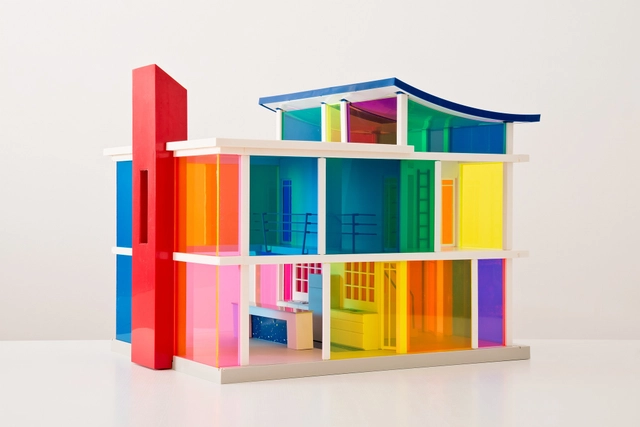
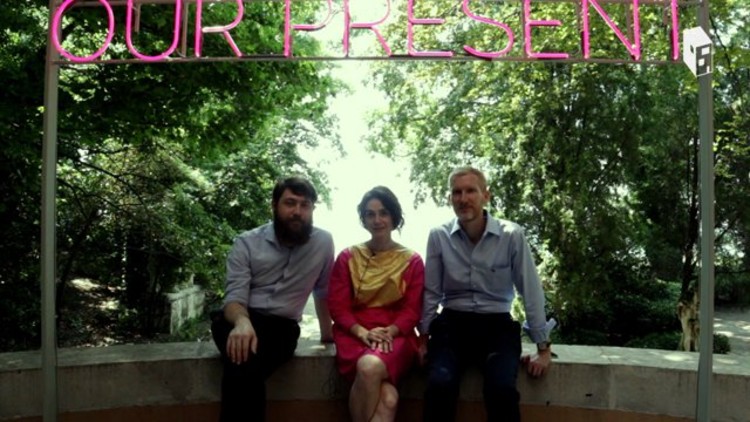
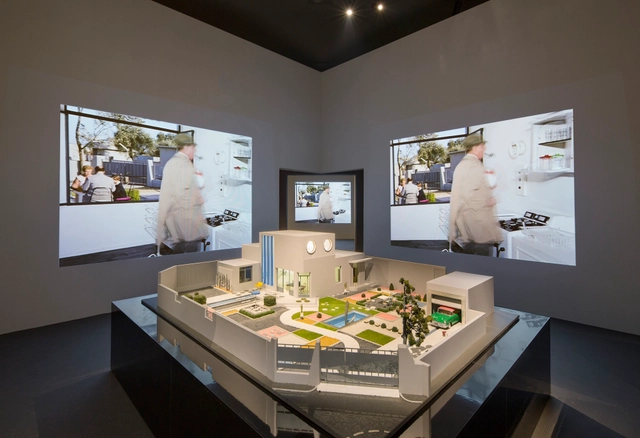
On the morning that France accepted a Special Mention for its exhibition "Modernity: Promise or Menace?" at the Venice Biennale, Curator Jean-Louis Cohen spoke to us about the questions raised within, on, and around the walls of the French Pavilion. Standing in front of a model of the farcical Villa Arpel from Jacques Tati's famous film "Mon Oncle," Cohen explained that France didn't just absorb modernity (as Rem Koolhaas proposed) but that France inspired modernity, providing different expectations, promises and, as the title suggests, menaces.
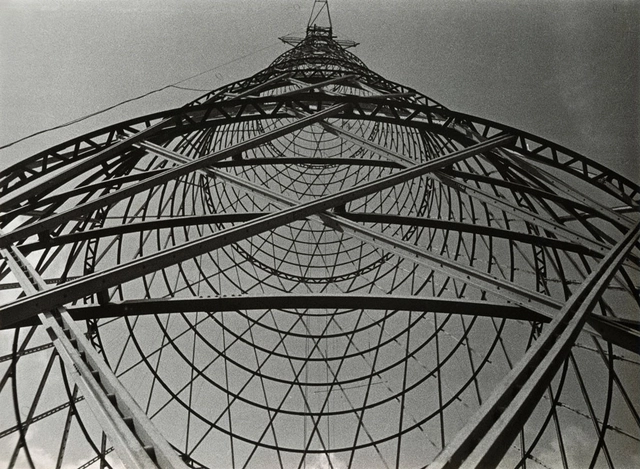
Despite severe corrosion, with almost 70% of one its six sections “thoroughly corroded” according to the government, Vladimir Shukhov’s 1922 radio tower has never been restored. Earlier this year, a large group of international architects petitioned the government to save the tower, one of only 20 or so of Shukhov’s 200 towers still standing in Russia. Now Moscow’s government has put the fate of the landmark tower to a public vote.
Until July 6 Moscovites can use the “Engaged Citizen” app to support one of four actions: hold an open competition to restore the tower, move the tower to a new location, move it to its historic location on Shabolovka street, or invent a new solution.
A new exhibition in Germany looks at the history of the architectural model in contemporary art. It begins with a legendary model by Charles Simonds, covers the 1990s with Ludger Gerdes, Hermann Pitz and Thomas Schütte, and ends up in the present day with Alicia Framis, Hinrich Sachs and Carlos Garaicoa.
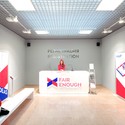
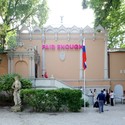
The Russian Pavilion at the 2014 Venice Biennale is selling the most important architectural ideas from Russia. Curators Anton Kalgaev, Brendan Mcgetrick, and Daria Paramonova selected twenty ideas that offer solutions to contemporary architectural issues and designed the pavilion as a commercial fair. It's even got generic furniture and salespeople manning the booths.
They talked to us about their project Fair Enoughand why their contribution to the Biennale is a market where Russia's originally socialist ideas are sold as updated "products."
Check out the full curatorial statement, flip through the 160-page pavilion catalog, and see a full gallery of images after the break.
Held annually in Singapore, the WAF annually recognizes the world's most amazing architecture projects (you can learn more here). They have announced an impressive line-up of prominent architects who will speak at the World Architecture Festival in October, including:
Few Constructivist projects made it through the World Wars, but if you're looking for those that did, you'd be wise to travel to Yekaterinburg, Russia. With over a dozen complexes, the city probably has the world's biggest collection of Constructivist buildings—and it's definitely the only place with a hotel in the shape of a hammer and sickle.
The fascinating video above by Ural Life and Culture tours the city and surveys the elements common to Constructivist buildings. Yekaterinburg was a laboratory for Constructivist architects who started building there soon after the movement was founded in Moscow in 1921. Architects from all over the Soviet Union, Poland, and Germany designed 4-5 story apartment blocks and office towers to replace single story wooden houses. The Soviets also introduced new typologies like public baths, kindergartens, and a 14-building secret police complex called the "Little Town of Cheka Officers," with covered passages so residents could walk between buildings indoors.
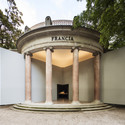
This year's French Pavilion stood out as one of the best pavilions in the Giardini, communicating a clear, engaging thesis and receiving a Special Mention from the jury.
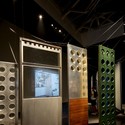
Curator Jean-Louis Cohen poses four questions throughout four galleries, demonstrating the contradictions that fill the story of modernity and architecture in France. The ambivalent responses of architecture to the original promise of modernity is shown through the juxtaposition of a continuous cinematographic montage (playing simultaneously throughout all four galleries) and large-scale objects.
Watch an excerpt from Teri Wehn Damisch's film and read the curator's statement after the break. For a virtual tour of the space designed by Paris-based firm Projectiles, follow this link. And make sure to keep an eye out for our video interview with curator Jean-Louis Cohen (coming soon).
Before starting down the arduous path of the life of a designer, those who have been there before you will insist on one thing: you must be passionate about what you do. Music brought Nathanael Balon to California, where he ended touring with his neighbor Sonny Moore (you probably know him as Skrillex). But 40 days into his second world tour he woke up wishing he were doing something else. Nathanael dreamed of building.
His desire to "build beautiful things" culminated in the creation of WoodSmithe, a company that designs and constructs retail environments, window displays and trade-show booths. Get a glimpse into Nathanael's courageous move in the short video above and read on to find out about a group of people who have made bold decisions to follow their dreams.
The awards ceremony for the 14th International Architecture Exhibition have just wrapped and the results are in!
Rem Koolhaas, the director of the Biennale, Paolo Baratta, president of the Biennale, and the jury presented the awards for Lifetime Achievement and International Participations. The jury recognized that the Biennale was a tremendous opportunity to produce and share knowledge about modernity -- especially praising its role in uncovering and dissecting new areas of influence in the architecture world.
The Golden Lion for Best National Participation went to Korea for "Crow's Eye View: The Korean Peninsula" The jury cited Korea's "extraordinary achievement of presenting a new and rich body of knowledge of architecture and urbanism in a highly charged political situation."
Chile received the Silver Lion for a National Participation for "Monolith Controversies". The jury said, "Focusing on one essential element of modern architecture - a prefabricated concrete wall- it critically highlights the role of elements of architecture in different ideological and political contexts."
The Silver Lion for best research project in the Monditalia section went to Andrés Jaque/Office for Political Innovation for "Sales Oddity. Milano 2 and the Politics of Direct-to-home TV Urbanism."
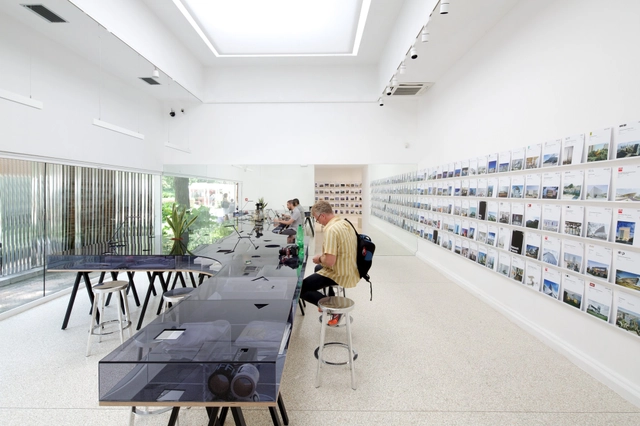
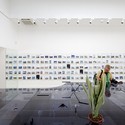
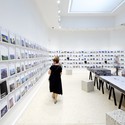
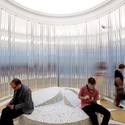
To kick off our coverage of the Venice Biennale, we're bringing you photos of OfficeUS -- the United States' contribution to the national exhibitions organized under the theme of "Absorbing Modernity." The pavilion houses both a repository of information about the history of architectural firms in the US (with a focus on the US's role in exporting architecture) and serves as the base of operations for a new architectural firm that was created solely for this year's biennale. The research, collected into booklets, lines the walls of the space. While visitors mill around the pavilion, the members of OfficeUS work at specially designed tables. The output and deliverables of the office will be determined as the Biennale progresses. We also got the chance to speak to the organizers, so stayed tuned for video interviews with the curators and designers of the US Pavilion (coming soon!). For now, however, read on to the see the curator's statement on the exhibit.
From the Organizers. Europe is currently experiencing a paradigm shift from national to urban identities. As its boundaries become increasingly blurred, each city is claiming an identity of its own. Europe is predominantly urban, and the condition of the European city is related to a stratification of architectures, functions and events which, palimpsest-like, shape a compact, complex understanding of the urban experience that embraces its architectonic heritage, industrial development, social housing, archaeological sites, modern infrastructure and the cities rebuilt after WW2.
The globalisation process began with the emigration of artists and architects during WW1, and continuing with the exodus due to the rise of the Nazi Party in Germany and the start of WW2. In this sense, Europe acted as a transmission device, the key node in a complex process of emission and assimilation. Today we live in a liquid reality whose theme is permeability, a reality in which professionals and intellectuals can move across porous borders.
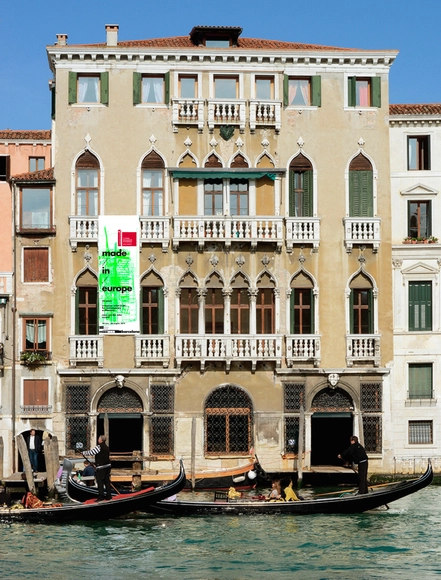
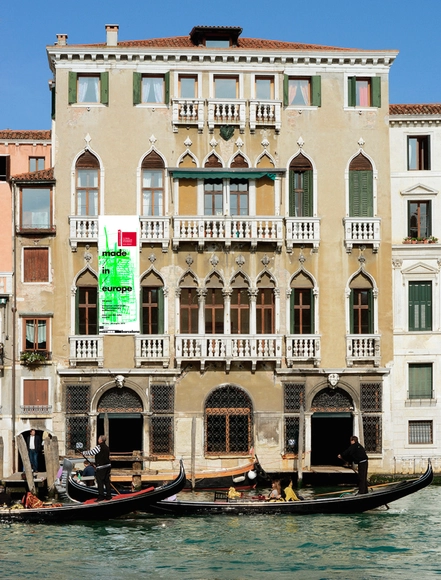
Palazzo Michiel. Image Courtesy of Fundació Mies van der Rohe
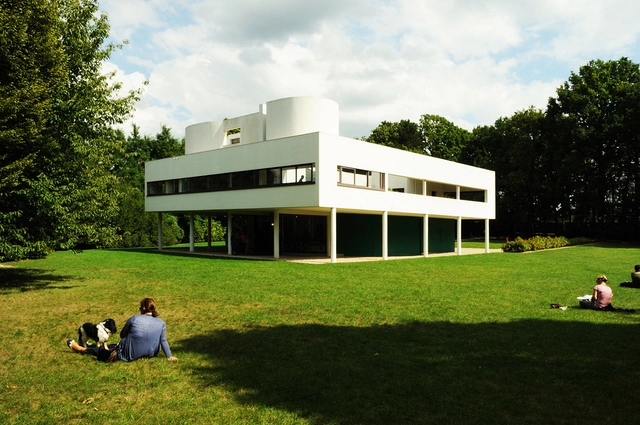
"Is there a distinguishing feature in European architecture beyond the fact that it is 'Made in Europe'?" This question (and others) will be answered in an exhibition which highlights the archives of the European Union Prize for Contemporary Architecture – Mies van der Rohe Award. Coinciding with the 2014 Venice Biennale, The European Commission and the Fundació Mies van der Rohe present “Made in Europe.” Showing a unparalleled and unique examination of the development in architecture over the past 25 years, the exhibition will draw on material from Europe's largest collection of documents (more than 2,500 projects and 230 original models) on contemporary architecture.
Giovanna Carnevali, director of the Fundació Mies van der Rohe, explained “This raw archive is physical evidence of time. It has the potential for multiple interpretations: different “histories” are made possible, illustrating the richness and the evolution of national architectures.”








.jpg?1402138225)