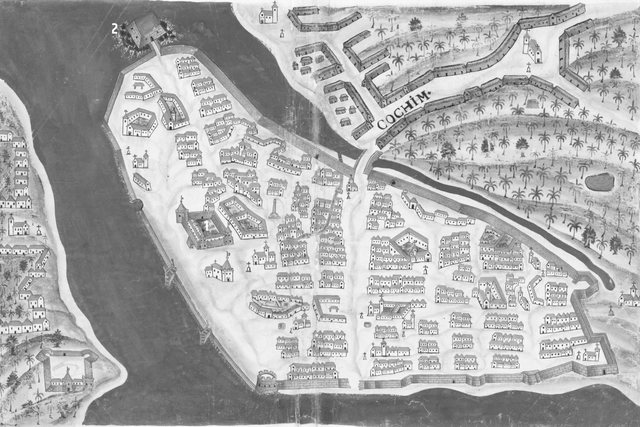
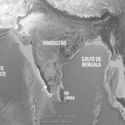
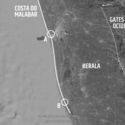
The following text contributes to the debate on a topic crucial to understanding the Portuguese presence in the world: urbanization processes. Focusing on the landscape of Cochin as a case study, we seek to build alternative pathways for thinking about “Portuguese” cities around the globe and their relations with the diverse agents and cultures with whom the Portuguese interacted during their overseas activities across practically the entire planet. Amid this sea of options, the choice of Cochin is guided by two main aspects.
First, Cochin was the first location where the Portuguese established a solid foothold in the Indian Ocean, in the early sixteenth century. While the Portuguese had previously accumulated a wealth of experience on the West African coast and the Atlantic islands, the same could not be said of the Indian Ocean: Cochin served as the first permanent laboratory of the Portuguese experience on Asian shores. In this context, the case allows us to analyze how the Portuguese accommodated themselves to an unfamiliar environment, as well as to debate their strategies and instruments.



















.jpg?1607605629 "Studio Saint Hilaire / Antonio Armando de Araújo - Arquitetura e Design. Photo © Evelyn Müller")