At this year's Biennale, "Reporting from the Front," MIT will have an unusually widespread presence. Ten full-time and visiting faculty, six alumni, and a handful of other MIT-affiliates (many invited by curator Alejandro Aravena himself) will contribute to over 15 installations, including "Rwanda Droneport," a full-scale earthen masonry shell designed by Norman Foster, which will serve as a small airport for drones delivering supplies to inaccessible areas of Rwanda, and "Courtyard House Plug-In," a prefabricated building system designed to be inserted into Beijing's dilapidated courtyard houses. To discuss MIT's significance on the architectural stage today, we spoke with the Dean of MIT's School of Architecture and Planning, Hashim Sarkis, who, it was recently announced, will also serve on the Biennale jury.
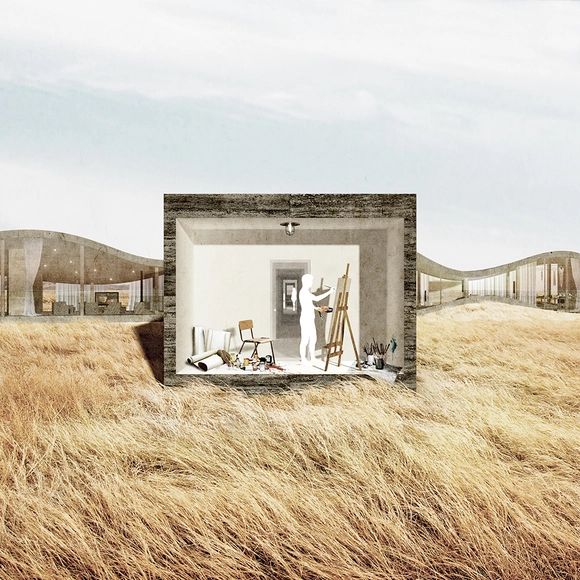
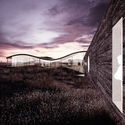
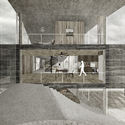
What do we mean when we say that our homes are “extensions” of ourselves? To put it more precisely, can a home be an extension of more than one person’s sense of “self”? And what happens when a single building is expected to be a home for two very different people? These are the questions asked in the project “Home at Intersection” by Netherlands-based architect Yushang Zhang.
Developed as a personal project in Zhang’s spare time Home at Intersection is, at its heart, as much a story told through architecture as it is an architectural design. The story chronicles the relationship of two young lovers as they embark upon a new chapter in their life together, building and then inhabiting their dream home. But much more than that, the project investigates themes of individuality and social bonds, using architecture as a medium to understand our hidden emotions.
Located in the arid desert of the San Rafael Valley, Arizona, Casa Caldera by DUST is a unique object in the vast landscape. In this video, architects Jesus Robles and Cade Hayes explain their project as viewers are taken on a vivid tour of the building and site. The camera moves through the desert, unveiling the house gradually, as one would truly experience it.
“One of the unique things about Casa Caldera is the experience of the approach,” Hayes says. “Two hours of travel are actually part of the experience of arriving. It isn’t until you are 20, 30 feet from the house that you get a good look.”
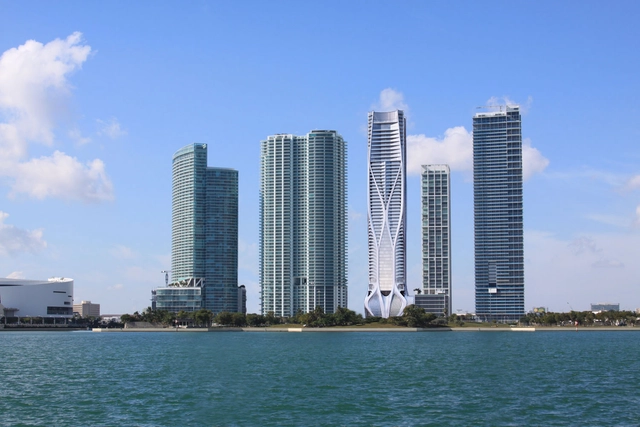
One Thousand Museum, the Zaha Hadid-designed skyscraper in Downtown Miami, has unveiled new interior renderings, including communal spaces designed by the architect. The 62-story tower, which began construction in December of 2014, will contain only 83 residences, consisting of a two-story duplex penthouse, four townhouses, eight full-floor residences, and 70 half-floor units. Overlooking the Pérez Art Museum by Herzog & deMeuron, the soon-to-be-completed Patricia and Phillip Frost Museum of Science by Grimshaw Architects, and the American Airlines Arena by HOK & Arquitectonica, One Thousand Museum tilts the scales in luxury residences from a market historically centered on Miami Beach to Miami’s rapidly densifying Downtown.
Though it was once an essential element of all classical structures, the frieze has largely been left behind by architects looking for contemporary façade systems. But at the recently-opened addition to the Kunstmuseum Basel, designed by Swiss architects Christ & Gantenbein in collaboration with design group iart, the frieze returns with an eye-catching, technological twist, as hidden pixels within the facade light up to display moving images and text to those below.
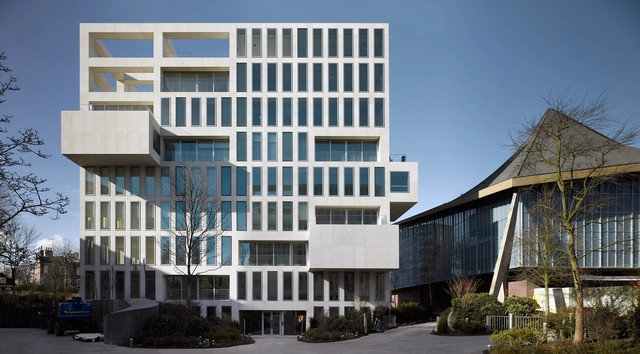
This week, OMA has unveiled their latest project in London, Holland Green. Working alongside Allies & Morrison, the firm has created three new luxury residential buildings on a site of significant cultural importance: the former home of the Commonwealth Institute, designed by Sir Robert Matthew, one of the founding partners of RMJM. As a result, OMA and Allies & Morrison’s Holland Green project involved much more than just adding fuel to the fire of London’s booming luxury residential market—it also involved an extensive conversion to the original 1962 Commonwealth Institute exhibition hall, funded through the scheme’s profitable residential offering, to prepare the heritage building for its new tenants the Design Museum.
ArchDaily spoke with Reinier de Graaf, the partner in charge of the project at OMA, to discuss the development’s social aspirations, the challenges of the London context, and the story behind the project.
In terms of memorialization, being selected to represent your country as the face of a banknote is one of the highest honors you can achieve. Even if electronic transfer seems to be the way of the future, cash remains the reliable standard for exchange of goods and services, so being pasted to the front of a bill guarantees people will see your face on a near-daily basis, ensuring your legacy carries on.
In some countries, the names of the faces even become slang terms for the bills themselves. While “counting Le Corbusiers” doesn’t quite roll off the tongue, a select few architects have still been lucky enough to have been featured on such banknotes in recent history. Read on to find out who the 15 architects immortalized in currency are and what they’re worth.
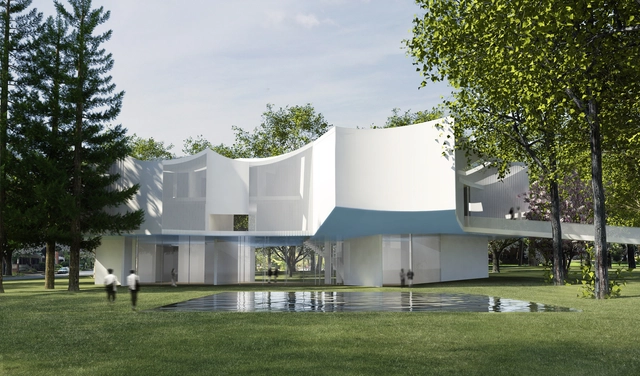
Exterior, Day View. Image Courtesy of Steven Holl Architects
Steven Holl Architects has been commissioned by Franklin & Marshall College, in Lancaster, Pennsylvania, for a new Visual Arts Building and Quad, promoting a future for the arts on the campus. Inspired by the trees that will surround the building, Holl calls the project a “pavilion on the park,” in a design compared to a kite in the trees. The project was announced by President Daniel R. Porterfield during F&M’s commencement on May 7, after Holl and Senior Partner Chris McVoy presented their concept to the College Board of Trustees two days prior.
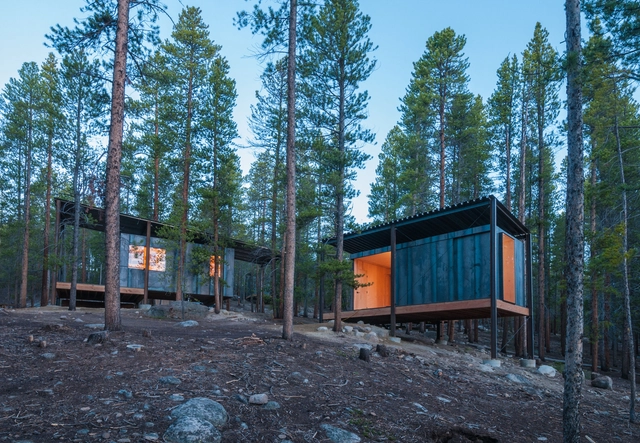
The process of carrying out a project from start to finish includes many different variables, from determining the users' needs to figuring out how best to set up the work site. The latter are an important part of determining the project logistics as well as its design criteria. Colorado Outward Bound Micro Cabins emphasize this process, using a planning logic that takes into account the design of a minimally-sized living unit under extreme conditions as well as the execution of the assembly in a short time and in a place of difficult access.
Virtual Reality (VR) is about to change architecture forever, meaning that every firm needs to decide how it’s going to respond to those changes. That may sound like hyperbole, but 3D imaging and the benefits computers brought to the field pale in comparison to what VR brings.
Computer-generated images are, in many ways, an updated version of the hand-drawn renderings of the past. VR takes viewing models to a whole new level. Based on existing design software, it allows you to take 3D models and experience them in amazing new ways. So if your firm is thinking about whether or not to invest in VR technology now, here are a few reasons why you should stop considering and start changing how your architecture firm functions.
In his recent article, Nick Axel puts forward a compelling argument for the (re)distribution of city-space according to use value: kickball trophies and absentee owners out, efficient use of space in. Distributing urban space according to use certainly makes sense. Along with unoccupied luxury condos that are nothing more than assets to the 1% and mostly empty vacation apartments, expelling (rarely accessed) back-closets to the suburbs frees more of the limited space in cities for people to actually live in.
As an architect, no matter how much support you have got, you always feel you are fighting by yourself. – Zhang Ke
The recent turning point experienced by the Chinese economy will probably be treated in future studies as the sign of a new coming era in China. The slowest growth rate in 25 years has already caused profound echoes in the architectural field. As one of the three Chinese participants in the central exhibition, “Reporting from the Front,” at the 2016 Venice Architecture Biennale, in this interview architect Zhang Ke discusses his insight into the architectural front line in China, reflecting on architects’ social responsibilities and his vision of tomorrow’s Chinese architecture.
Gillespie, Kidd & Coia's celebrated St Peter's Seminary—once voted Scotland's best modern building—has for too long been a victim of fate, left to decay after it was abandoned just 20 years after its completion. Fortunately, plans are well underway to restore the building. This article, originally published by Metropolis Magazine as "Ruin Revived," explains how even in its ruined state, the dramatic brutalist structure is already showing its value as a cultural destination.
Modernist architecture, it used to be said, was inadequate because the machined materials of modern buildings wouldn’t lend themselves well to picturesque ruination. What, minus the taut skins of glass and plaster, could these stark, boxlike carcasses possibly communicate to future generations?
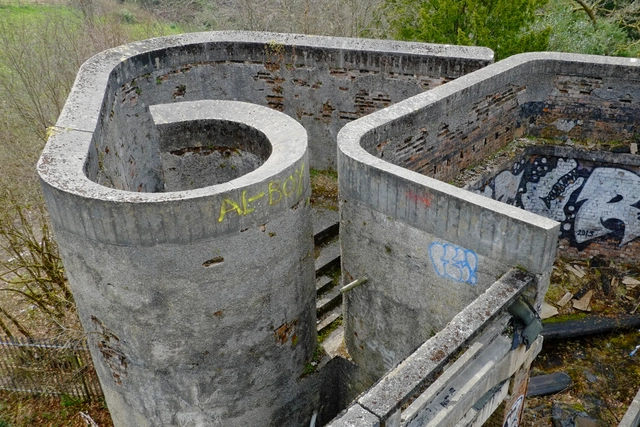
St. Peter’s Seminary in Cardross, Scotland, is a forceful rejoinder to that jibe. Built in 1966 and abandoned 20 years later, the seminary has settled into a state of pleasing decrepitude. Glass and plaster are long gone. The concrete remains largely intact but stained, spalled, and spoiled. Entire roofs and staircases have caved in. The only fresh signs of life are the aprons of graffiti draped all over the “interiors.” Yet, the sense of the place lingers, its noble forms still remarkably assertive—jutting forth from the dense surrounding forest—and optimistic.
This article is part of our new "Material Focus" series, which asks architects to elaborate on the thought process behind their material choices and sheds light on the steps required to get buildings actually built.
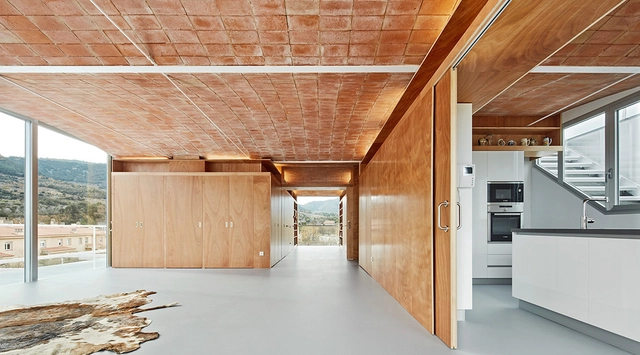
In the Catalan countryside, on the outskirts of the small town of Alforja, sits an incongruous sight: among the scattered stone masia houses is a structure of steel and glass, a resolutely rectilinear box among the traditional housing forms. But once inside the OE House, designed by Fake Industries Architectural Agonism and Aixopluc, one realizes that the building is not so different to its neighbors after all: on the upper floor, the roof incorporates a system of ceramic vaults taken almost directly from traditional vernacular design. This feature then combines with plywood and OSB to create a truly eclectic material pallette. We spoke with the design's architects, David Tapias of Aixopluc and Cristina Goberna and Urtzi Grau of Fake Industries Architectural Agonism, to find out what lay behind these unusual material choices.
https://www.archdaily.com/786897/material-focus-oe-house-by-fake-industries-architectural-agonism-plus-aixoplucAD Editorial Team
In August of last year, many of the most precious landmarks of the ancient city of Palmyra were damaged or destroyed by the forces of ISIS in a violent, iconoclastic attempt to send a message to the rest of the world. Since the UNESCO World Heritage Site was recaptured in March, the question in the architectural preservation community has been how to rebuild and preserve the buildings. That process will begin, of course, with a thorough assessment of the damage.
Shortly after Palmyra was recaptured Iconem, a French company which specializes in the digitization of archeological sites, arrived in Palmyra to lead the survey. In partnership with the Syrian DGAM (Direction Générale des Antiquités et des Musées), Iconem was granted access to the city to survey the damage to the temples of Bel and Baalshamin, the Monumental Arch, the Valley of Tombs, and the museum—all sites which are of the most cultural value and therefore were the greatest targets of ISIS's violence.
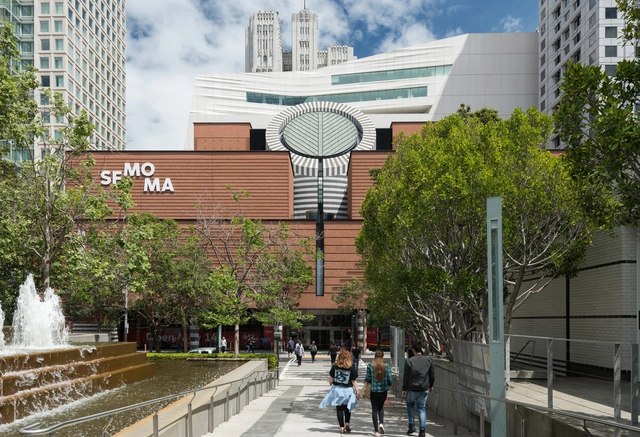
Shoehorned into the narrow space behind Mario Botta’s 1995 building, the Snøhetta-designed new wing of the SFMOMA was forced to go where few museums have gone before: up. Rising 10 stories into the San Francisco skyline, the new building nearly triples the amount of existing gallery space and adds a new entrance into what is now one of the world’s largest buildings dedicated to modern art. As the museum is set to reopen to the public May 14th, the critics' takes are rolling in. Did the restrictive site inspire a unique design solution or limit the creative possibilities of the project? Read on to find out.
Once a photograph is uploaded to social media, it ceases to be part of one’s private archive and becomes public property – as well as an object of study for researchers. There have been many attempts to study photographs on the scale of "Big Data." Take, for example, the numerous and well-publicised projects by Lev Manovich’s Big Data Lab. Evidently, using the results of one study of the huge online archive of photographs to make conclusions about society at large, is not necessarily a good idea. It’s fair to say that our society is not evenly represented online: a 19-year old woman may be posting her selfies daily, but it doesn’t mean that same goes for a sixty-five year old man. That said, we can learn a lot about cities and their inhabitants from the results of studies such as these.
Perhaps the most enduring appeal of Star Wars for its fans is not simply its compelling storyline or its dramatic space battles - it is instead that this universe is, in fact, a universe, with all the complexity and depth that entails. One of the best ways to reveal that depth is through architecture, which offers the most visually striking combination of history, culture and technology available. As a result, the Star Wars universe is littered with a huge variety of fascinating architecture, from ancient temples to futuristic floating cities.
Today is the most holy day in the Star Wars fanatic’s calendar, and thanks to pages like Star Wars Architecture on Facebook and Wookieepedia, we’re celebrating the event with seven of the most interesting, astonishing and iconic architectural structures from the franchise. Enjoy, and May the 4th be with you.














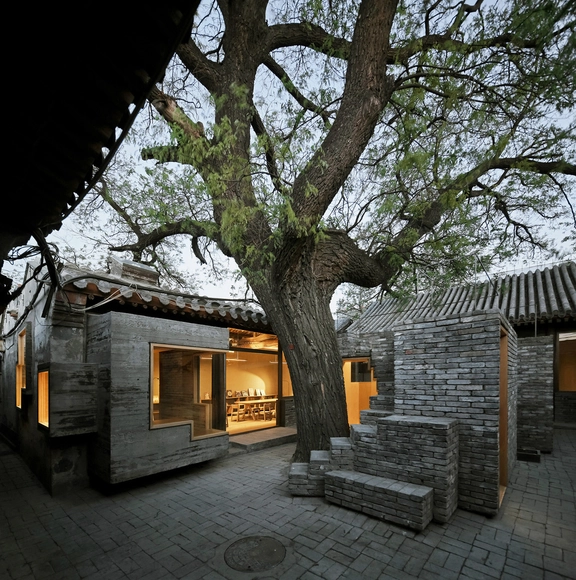
.jpg?1462728830 "Micro-Hutong. Image © Zhang Mingming")
.jpg?1462728774 "Micro-Hutong. Image © Shengliang Su")








_on_view_in_the_Evelyn_and_Walter_Haas__Jr._Atrium_at_the_new_SFMOMA__photo_%C2%A9_Iwan_Baan__courtesy_SFMOMA.jpg?1462453791 "© Iwan Baan")