Indonesian Architecture

Capital Jakarta

Language Indonesian

Area 1,904,569 km2

Population 255,461,700

The architecture of Indonesia is defined by its diversity of culture and geography. Similar to many eastern countries that were invaded and colonized by westerners, the influences in Indonesian architecture come from a variety of locations. This page explores the architecture of the islands, including the emerging urban city of Jakarta, through projects, news, and events that show the wide assortment of design styles developing in Indonesia architecture.
  1. ArchDaily
  2. Countries
  3. Indonesia

Latest projects in Indonesia

Latest news in Indonesia

Jakarta Becomes the World’s Most Populous City, According to New UN Data

Jakarta has become the world's most populous city, according to the World Urbanization Prospects 2025 released by the United Nations Department of Economic and Social Affairs (UN DESA). Using an updated and harmonized method for defining urban areas, the report estimates Jakarta's population at nearly 42 million, placing it ahead of Dhaka, which is about 40 million, and Tokyo, 33 million. The revised ranking illustrates how updated measurement criteria and continued demographic growth are reshaping understandings of urban scale in Asia and globally.

From Bangkok to Florence: 6 Unbuilt Public Space Projects Rethinking Community, Ecology, and Urban Identity

Subscriber Access | 

Public spaces remain some of the most dynamic sites for unbuilt architectural experimentation, revealing how cities and architects can imagine accessibility, gathering, and civic identity. In this curated Unbuilt edition, submitted by the ArchDaily community, the selected proposals examine parks, pedestrian corridors, cultural landscapes, and open-access urban environments that invite people to meet, move, rest, and participate in collective life. Rather than treating public space as leftover terrain, these projects position it as essential infrastructure—shaping urban health, memory, and social interaction.

Bauhaus Earth Transforms Disused Car Park into Bamboo Community Pavilion in Bali, Indonesia

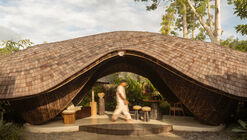
Bauhaus Earth is a Berlin-based non-profit organization working toward a systemic transformation of the built environment. Its mission includes transitioning to bio- and geo-based materials, reusing existing buildings, and restoring ecosystems. Together with the Bamboo Village Trust, a philanthropic financial vehicle, and Kota Kita, a participatory urban design organization, Bauhaus Earth has developed BaleBio, a bamboo pavilion designed by Cave Urban and rising above Mertasari Beach in Denpasar, Bali. The pavilion transforms a disused car park into an open community meeting space, offering a counterpoint to the city's tourism-driven coastal development. Designed as a regenerative building, BaleBio stores carbon instead of emitting it, challenging the extractive construction model that is replacing traditional wood and bamboo craftsmanship with concrete structures across the island.

Hybrid Craft: 5 Pedestrian Bridges Reimagining Natural Materials across Asia

Subscriber Access | 

Transcending their role as mere infrastructure, bridges have long served as powerful architectural statements. This expressive potential is now being explored with renewed vigor across South-East Asia, where a growing number of architects are re-evaluating traditional materials. By championing wood and bamboo, these designers are creating distinctive structures that integrate local craftsmanship with contemporary needs, resulting in landmarks that are both functional and deeply rooted in their landscape.

Libraries as Urban Acupuncture: Small Interventions, Big Impact in Asia

Subscriber Access | 

In traditional Chinese medicine, acupuncture works through strategically placed needles that trigger healing throughout the entire body. Urban planner Jaime Lerner's concept around targeted architectural interventions find success in China as well as neighboring countries in Asia, where localities are revitalized through simple interventions. Libraries, specifically, are bringing in social, cultural, and economic transformation to the continent.

The Garden City Movement in Asia: Evolution and Modern Legacies

Subscriber Access | 

Ebenezer Howard's verdant visions for cities have spread eastwards, far beyond his British roots. In the 1900s, city planning welcomed the Garden City Movement as a champion of good design - a response to Western industrial urbanization. Soon, Asian cities conceived their archetypes, juggling local constraints in climate and density. Designs and development, from colonial-era experiments to contemporary mega-projects, have embraced and reinvented Howard's vision well into the 21st century.

Crossing Hemispheres: Thatched Roofs from America to Asia

Thatching is a traditional building technique that has been reinterpreted in different ways in contemporary projects, allowing its value to continue to endure over time. As well as being a culturally and historically valuable technique, given its presence in humanity for centuries, it also has a number of other constructive advantages, such as its great environmental value, as it is an accessible renewable material.

Aga Khan Award for Architecture 2025 Announces 19 Shortlisted Projects from 15 Countries

The Aga Khan Award for Architecture (AKAA) has announced the 19 shortlisted projects for its 2025 cycle. Selected from a pool of 369 nominations, these projects will compete for a share of the USD 1 million prize, one of the most significant awards in the field. The shortlist was determined by an independent Master Jury composed of nine members: Azra Akšamija, Noura Al Sayeh-Holtrop, Lucia Allais, David Basulto, Yvonne Farrell, Kabage Karanja, Yacouba Konaté, Hassan Radoine, and Mun Summ Wong. The Jury will meet later this summer to review on-site evaluations and select the final recipients of the 16th Award Cycle (2023–2025).

From the Cliffs of Saudi Arabia to the Vineyards of Santorini, Discover 8 Unbuilt Hotel Proposals from the ArchDaily Community

Subscriber Access | 

Hotels are increasingly being designed as more than just places for accommodation. As expectations around travel shift, architects are approaching hospitality projects as opportunities to explore ideas of context, experience, and identity. Whether integrated into remote landscapes or inserted into dense urban environments, these proposals examine how architecture can shape the guest experience through spatial organization, material selection, and connection to place. The hotel becomes a framework not only for rest, but for interaction with the surroundings, with others, and with the design itself.

The Colonial Legacy of Concrete in the Global South

Subscriber Access | 

Concrete towers dominate the skylines of Asian and African cities - looming edifices embodying development. With access to the tools and materials of industrial modernity, the Global South steps onto the world stage showcasing its bounty. Yet, at the depths of rising ambitions, the construction material speaks to colonial legacies and extractive economics that result in power imbalances in the geopolitical sphere. A climate crisis on the horizon only intensifies the complicated relationship between building materials, sustainability demands, and sovereignty of many countries.