Things at Architecture for Humanity were shaken up with the departure of co-foundersCameron Sinclair and Kate Stohr. Resiliency became the new sustainability. China suddenly became defined less for its adventurous architecture and urbanism and more for its darker, smoggier flipside. My hometown, Los Angeles got a few more bike lanes, some big plans for its concrete river, plus a new Bloomberg-esque mayor with attendant sustainability tsar. There were people complaining about architecture and telling us why they left the profession. Kanye got attacked for daring to tell us why he likes architecture, and then architecture loved talking about Kanye for weeks on end until we just wanted architecture to shut up about Kanye. Poor Kanye. There are so many things we could say were key in 2013. It’s been a great year. And there were also a lot of fantastic buildings.
In this article, originally posted on Grasp as "We Are All Ethical Hackers!", Kasper Worm-Petersen demonstrates how design has the ability to make the abstract tangible and create desirable activities. When that ability is used to promote sustainability and improve the state of the world great things happen and we all get a chance to become ethical hackers.
There are enough big issues to tackle in the world today. The financial crisis and the climate crisis seem almost insurmountable. And as our old habits are keeping us from adapting to the new circumstances there is a need for viable alternatives to our current way of living. At the Design for Smart Growth event held by the Global Agenda Council on Design and Innovation some interesting and promising solutions were presented. And they all had design as a key component.
The Danish Minister of the Environment Ida Auken set the scene when she discussed her engagement in environmental policies, “I was so frustrated with the image of environmental policies. That green was someone who hated life... I really want to flip it around and see how we can get people to actually want to live in a sustainable way. How can we make them desire it? And that is where designers come in. It is as easy as that.”
Read on to find out how we can be "ethical hackers" after the break.
Modernism and socialism formed the powerful spacio-political tandem of the 20th century that shaped much of the urban and rural environments of Central and Eastern Europe, including Estonia and its capital Tallinn. Those environments are still there - like fossils of paradigms, one declared dead, the other exiled. Today we consider them as nothing more than a collection of somewhat interesting material substances or formal oddities - after all, we would rather like to believe this era is not relevant to us today. But is there more to those fossils that we’re not examining?
The architects and researchers that were brought together by the Tallinn Architecture Biennale raised interesting discussion and questions that showed how much intertwined history (in this case, the 1960s to the 1980s) and historical ideas are still with us today, especially in a world where freedom might be just as illusional as it was back then.
Architectural street gang and provocateurs, On the Road, named (I would like to think anyway) for Jack Kerouac’s novel of same name, and let’s just say that is the origin (since I happen to like that book), and the decentralized dérives of this Los Angeles crew remind me of Jack’s edit-as-you-go-or-do-not-edit-as-it-may-be writing style, if he even had a “style” (which is questionable), are at it again, or were just last month for their program, “West of LaBrea / 20131117 / 10-4pm” in which these rebellious, anti-establishment “architects” (some may not be licensed and therefore cannot actually go by the official title according to legal precedents in this here United States of America but you all know what I mean wink wink) once again find themselves out in the streets bombing the architectural establishment, which by the way is critical for the history of Los Angeles architecture, and by doing so have once again reminded us that architecture can be about play and a healthy dose of transgression, though no laws were broken during the making of #OtR3, as it is being called, that I can tell....
The Yeezus Tour, Kanye West’s solo tour, which coincides with his sixth studio album, Yeezus, kicked off in Seattle, Washington on October 19, 2013 and ends in Toronto, Canada on December 23, 2013.
The show is theatrical, cinematic and operatic in its structure. It merges together all of Kanye West’s interests in the the visual and performance arts, creating a powerful experience that transcends the concert format.
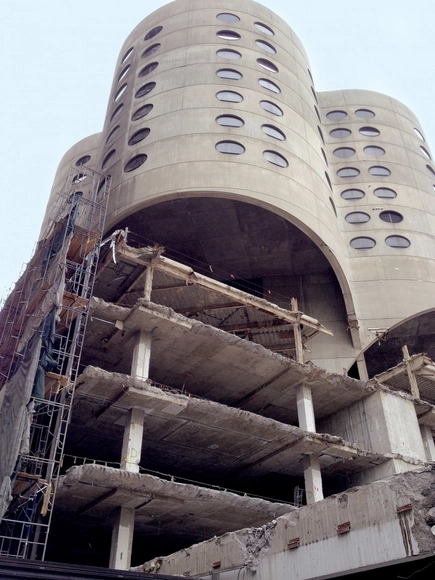
This article by Fred A Bernstein originally appeared in Metropolis Magazine as "Worth Preserving". Bernstein tracks the preservation battles fought, won and lost in 2013, unearths their root cause (money), and questions: was preservation better off in recession?
“It’s the old adage: location, location, location,” says Linda Dishman, executive director of the Los Angeles Conservancy. Dishman isn’t talking real estate, but historic preservation. In California, a midcentury house on a modest lot may find a buyer willing to maintain it. But the same modernist house on a large lot in Brentwood or Pacific Palisades, is practically wearing a “tear me down” sign. (How does a 1,200-square-foot house stand a chance in a neighborhood where 12,000 is the new normal?) “Small houses on large lots are the greatest concern,” says Dishman.
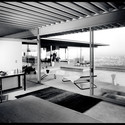
The Conservancy won a victory this year when ten of the surviving Case Study Houses—including the celebrated Stahl House by Pierre Koenig—were added to the National Register of Historic Places. But listing doesn’t stop the houses from being demolished—it simply triggers additional reviews before bad things can happen to good buildings, the kind of red tape that doesn’t always deter the super-rich. Money, especially big money, can be the enemy of preservation.
Read on about preservation's fight with big money after the break.
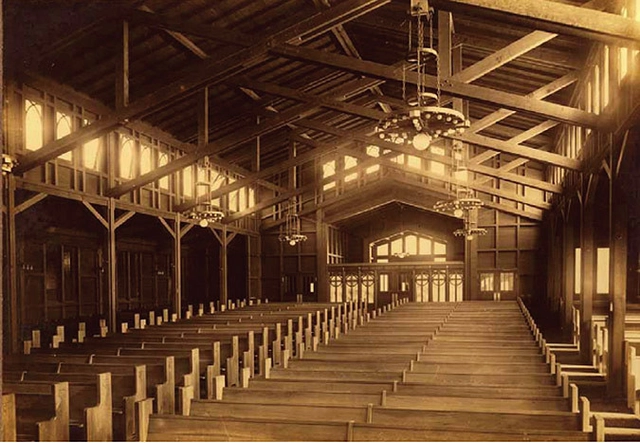
The recent announcement that Julia Morgan has posthumously received the 2014 AIA Gold Medal, the AIA’s top honor, while positive and inspirational, raises some important questions concerning the recognition and advancement of women in the profession. She is the first woman, living or dead, to receive the honor in the award’s 106-year history. From 1907 to 2012, all recipients have been men.
It seems Morgan was destined to be first. She was the first female graduate of the École des Beaux-Arts in Paris (1902) and the first woman to obtain an architecture license in California. She is known principally as architect of the extravagant and stunning Hearst Castle in San Simeon, California and the designer of over 700 buildings.
In this article, originally published in Indian Architect & Builder, architect and writer David Robson pens an intimate and personal account of the life and work of Geoffrey Bawa – an incredible architect with an un-paralleled legacy in Sri Lanka and south-east India.
Ten years have rolled by since Geoffrey Bawa’s death and fifteen since ill-health forced him to hang up his tee-square. It's time to take stock: what was his legacy? How were his ideas disseminated? What influence has he had? What were his qualities? Who was Geoffrey Bawa?
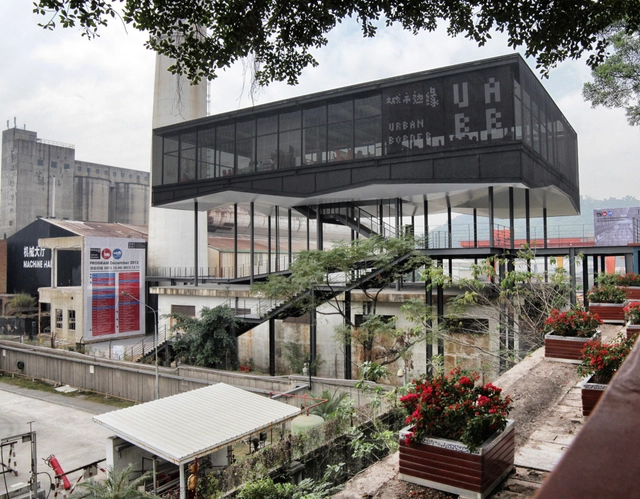
Now in its 5th edition, the Bi-City Biennale of Urbanism / Architecture (UABB) is the only biennial exhibition in the world to be based exclusively on the themes of urbanism and urbanization. The Biennale is co-organized by Shenzhenand Hong Kong, two of the most intensely urban cities in the world, where political and economical contexts have shaped unique urban dynamics.
A few days ago we had the chance to attend the opening of the Shenzhen Biennale, curated by Creative Director Ole Bouman together with Academic Directors Li Xiangning and Jeffrey Johnson. The Biennale, focused on “Urban Borders,” is split between two venues that will be open until Feb 28th, 2014.
Right next to the Shenzhen Ferry Terminal, where thousands of people commute every day between Hong Kong, Macau and Chinese cities along the Pearl River Delta, the Border Warehouse displays a series of projects -including the national pavilions- that deal with border issues, from projects that mediate Shenzhen and Hong Kong; the 3,154km long border between Mexico and the US, to transit stations and border checkpoints designed by contemporary architects. Participating include Enrique Walker, Juerguen Mayer, Aterlier Bow Wow, Joseph Grima, Teddy Cruz, Abalos + Sienkiewicz, MAD, among many others.
"Cities are filled with numerous – and at first sight invisible – borders. Between rich and poor, between ethnic groups, between high and low, between dense and sprawl, in short, between center and periphery. But who and what define these borders?" -- Ole Bouman
But perhaps the most interesting part of the Biennale takes place at the main venue: The Value Factory.
More information about the Value Factory and a complete photo report after the break:
In an era of heavily marketed brands, relentless advertising and all pervasive social media, just how far should architects market themselves to stand out from the crowd? Laura Iloniemi, expert in architecture media, explores the tricky issue of how practices can use marketing without losing integrity.
Marketing companies and publicists working for architects have certainly adapted to increasingly hard-nosed commercial trends. They have embraced, for example, the latest trade shows, no matter how brash, along with high-profile international property conferences and moneymaking awards events (with apparent relish), hoping to place their clients in front of new, and ever more commercial, audiences.
But marketing folk sell only what they know from their own experience - experience that may or may not be relevant to architectural practice. If they do not have an intuitive or trained eye for architecture itself, or a feel for its rightful place in our culture, they can never produce a worthwhile strategy for ensuring its true relevance in society.
Videos
Manuel Dominguez's Very Large Structure. Image Courtesy of Poliedro
This Article by Avinash Rajagopal originally appeared in Metropolis Magazine as "Five Compelling Works of Architecture Fiction". Rajagopal argues in favor of the often dismissed genre of 'architecture fiction', giving five recent examples of the best the field has to offer.
As far as we know, the writer Bruce Sterling coined the term “architecture fiction,” in 2006. He was referring, of course, to speculative projects in which architects use ideas for the built environment to express themselves in a way that’s analogous to how storytellers use words. It’s a longstanding architectural tradition. Sterling cites the polemic work of the 1960s British group Archigram; the canon includes Lebbeus Woods’s drawings from the two decades that followed and Greg Lynn’s digital imaginings (one of which accompanied a short story by Sterling, in Metropolis’s 2003 Fiction Issue).
In the last few years, we have seen a groundswell in the genre. The usual reason given to explain the profusion of these fictitious works is that the recession made it hard for young architects to find “real” work, but there are probably other factors at play. Ethical concerns are back in the zeitgeist for a contradictory generation that’s equally into Occupy Wall Street, iPhones, and hipster shops selling single-source coffee. Their utopias and dystopias are more easily imagined with 3DS Max and Photoshop, and far more quickly disseminated online. All of this has made for some pretty rich storytelling.
Commenters on blogs still rail about the “uselessness” of architecture fiction. To answer them would be akin to mounting a defense of the short story—one surely could, but it would be a self-defeating exercise. The very nature of fiction is to be less bothered with usefulness than with possibility. In that spirit, here are five recent projects that I found compelling, in both imagery and the stories they attempt to tell.
Using Australia as her focus, Marissa Looby, in a recent article for the Australian Design Review, argues that the disappearance of architectural styles, combined with the proliferation of various guidelines and building codes, has created a new breed of architect: The New Radical Pragmatist. Her article "The New Radical Pragmatist (On Validation)" is reprinted here.
The Architectural Review (December, 1955) first published Reyner Banham’s epochal and pivotal article, ‘The New Brutalism’, in which the critic pointed to the rise of a new architectural style. He also described an influx of -isms that were becoming increasingly conspicuous to the discipline, stemming from the then contemporary model of an art historian and their influence on the architectural historian-as-observer of the architectural profession. Banham incisively suggested that any proposition of the term ‘new’ has an unequivocal relationship to the past, so much so that in advocating for a new -ism an architectural theoretician must defend their claim with historic fact. Ironically, Banham acknowledged that even ‘The New Brutalism’ title derived from The Architectural Review’s analysis of the International Style in the postwar article, ‘The New Empiricism’. He stated: “[the] ability to deal with such fine shades of historical meaning is in itself a measure of our handiness with the historical method today, and the use of phrases of the form ‘The New X-ism’ – where X equals any adjectival root – became commonplace in the early 1950s in fourth year studios and other places where architecture is discussed, rather than practised.”
In Modernism’s attempt to dissolve spatial boundaries with transparency, the material used - glass - is all too often dematerialised. In contrast, the New York-based designer James Carpenter is interested in multiple readings of glass - beyond transparency.
As Carpenter explains: “People approach light in relationship to architecture. It is that the light is the means by which the architecture is revealed and the architecture is basically defined by the way the light enters the space. I tend to think actually from the opposite direction where the light itself is what informs the architecture. The architecture is in service of light rather than the other way around.”
From the window of an airplane it's all too plain that apartheid has been deeply written into the South African landscape. Even the smallest town appears as two distinct towns. One features a spacious grid of tree-lined streets and comfortable houses surrounded by lawns. The other, its shriveled twin, some distance away but connected by a well-traveled road, consists of a much tighter grid of dirt roads lined with shacks. Trees are a rarity, lawns non-existent. This doubling pattern appears no matter the size of the population: here, the white town; over there, the black township. -- Lisa Findley, “Red & Gold: A Tale of Two Apartheid Museums.”
There are few systems of government that relied so heavily upon the delineations of space than the Apartheid government of South Africa (1948-1994). Aggressively wielding theories of Modernism and racial superiority, South Africa’s urban planners didn’t just enforce Apartheid, they embedded it into every city - making it a daily, degrading experience for South Africa’s marginalized citizens.
When Nelson Mandela and his party, the African National Congress, were democratically elected to power in 1994, they recognized that one of the most important ways of diminishing Apartheid’s legacy would be spatial: to integrate the white towns and the black townships, and revive those “shriveled twin[s].”
As we remember Mandela - undoubtedly the most important man in South Africa’s history - and ponder his legacy, we must also consider his spatial legacy. It is in the physical, spatial dimensions of South Africa’s towns and cities that we can truly see Apartheid’s endurance, and consider: to what extent have Mandela’s words of reconciliation and righteous integration, truly been given form?
As we celebrate the 25th anniversary of Arup’s New York office, we’ve spent the past few months talking with people inside the firm and beyond about the future of the city. We asked them to come up with blue-sky ideas about the New York of 2050 without worrying too much about financial or political feasibility. Circumstances can change a great deal over almost four decades, after all, and tomorrow’s constraints might look very different than today’s. We then worked with graphic designerJosh Levi to synthesize and visualize the results — view the large version here. Our main goal: to spark conversations about long-term priorities for the city and possible ways to achieve them.
What would you add to the list? How would you change it?
“Architecture is created, 'invented anew,' by each man who attempts her, who roams her space, climbs a stair, rests on a balustrade, lifts his head to look, open, close a door, who sits down or gets up and makes intimate contact with - and at the same time create 'forms' in - the space [...] This intimate, fiery, contact, that which was perceived by man at the beginning, is today forgotten. Routine and communal places made man forget the natural beauty of "moving in space," of his conscious movement, of those little gestures…” -- Lina Bo Bardi
We're celebrating the life and work of renowned Italian-Brazilian architect, Lina Bo Bardi, who would have turned 99 today.
Discover more about this icon and proponent of humanist modern architecture, after the break...
Destruction of Pruit-Igoe. Image Courtesy of US Department of Housing and Urban Development
This article by Chris Knapp, the Director of Built-Environment Practice, originally appeared on Australian Design Review as "The End Of Prefabrication". Knapp calls for the end of prefabrication as a driver for design, pointing out its century-long failure to live up to its promise, as well as newer technology's ability to "mass produce difference".
Prefabrication – there is not another word in the current lexicon of architecture that more erroneously asserts positive change. For more than a century now, this industrial strategy of production applied to building has yielded both an unending source of optimism for architecture, and equally, a countless series of disappointments. This is a call for the end of prefabrication.





.jpg?1388522487&format=webp&width=640&height=580)