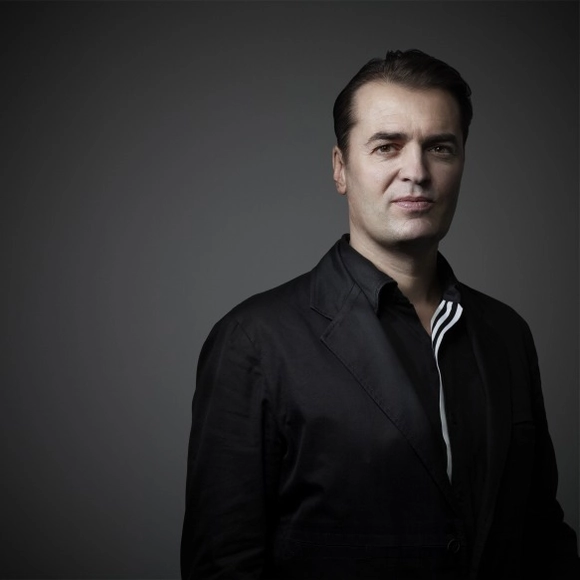
The course that Vincent Van Duysen has covered since 1990 shows a great consistency and a coherent design vision. From the start, he has focused on making a profile for himself with the design of a number of retail projects. This focus was no coincidence. Van Duysen has said on many occasions that if he had not had the opportunity to study architecture he would undoubtedly have pursued a career in fashion. It is therefore unsurprising that after his studies in Sint Lucas Gent he moved to Milan, a city renowned as one of the world capitals of design and fashion. In Milan he became convinced that a designer should not only express a concept as clearly as possible, he should also pay attention to every significant detail.
Past, Present, Future is an interview project by Itinerant Office, asking acclaimed architects to share their perspectives on the constantly evolving world of architecture. Each interview is split into three video segments: Past, Present, and Future, in which interviewees discuss their thoughts and experiences of architecture through each of those lenses. The first episode of the project featured 11 architects from Italy and the Netherlands and Episode II is comprised of interviews with 13 architects from Spain, Portugal, France, and Belgium.
The goal of the series is to research these successful firms and attempt to understand their methods and approaches. By hopefully gaining a clearer picture of what it means to be an architect in the 21st century, the videos can also serve as inspiration for the next generation of up-and-coming architects and students as they enter the field.
What happens when the sensor-imbued city acquires the ability to see – almost as if it had eyes? Ahead of the 2019 Shenzhen Biennale of Urbanism\Architecture (UABB), titled "Urban Interactions," ArchDaily is working with the curators of the "Eyes of the City" section at the Biennial to stimulate a discussion on how new technologies – and Artificial Intelligence in particular – might impact architecture and urban life. Hereyou can read the “Eyes of the City” curatorial statement by Carlo Ratti, the Politecnico di Torino and SCUT.
Practicing architects live and die by zoning regulations. We begin routine projects by reading ordinances and calling local officials to reassure clients that their desired outcomes will be possible under current land-use laws. If we’re lucky, the project will be built without troublesome variances and hearings before stony-faced zoning boards. Increasingly, however, what seemed straightforward and responsible 15 years ago is today considered controversial enough to merit a public hearing, and perhaps the assistance of high-priced attorneys. Often, the issue is protecting the “rights” of nearby homeowners, who see their property values threatened by any new development.
https://www.archdaily.com/920231/its-time-to-end-the-reign-of-single-family-house-zoningMark Alan Hewitt
European children spend approximately 200 days a year at primary school. Even though the academic year in most parts of the world is not as long as in Europe, the place where children and adolescents spend the most time, following their own homes, is usually in educational institutions. These can be places for learning, playing and socializing, and as sad as it may be, they can also be safer places for children living in environments of abandonment, hunger, and violence, providing them with opportunities and even meals. A United Kingdom-wide survey found that the differences in physical characteristics of classrooms accounted for 16% of the variations in learning progress over the course of a year. In other words, the better a classroom is designed, the better children perform academically. According to the study, the factors that most affect children are sunlight, indoor air quality, acoustic environment, temperature, the design of the classroom itself and the stimulation within it.
Design:ED Podcast is an inside look into the field of architecture told from the perspective of individuals that are leading the industry. This motivational series grants unique insight into the making of a successful design career, from humble beginnings to worldwide recognition. Every week, featured guests share their personal highs and lows on their journey to success, that is sure to inspire audiences at all levels of the industry. Listening to their stories will provide a rare blueprint for anyone seeking to advance their career, and elevate their work to the next level.
In this episode of Design:ED Podcast, Patrik Schumacher — the company director and Senior Designer for the esteemed Zaha Hadid Architects — sits down to discuss the future of parametric design, the early days of Zaha Hadid Architects, and how the firm is continuing the legacy of Zaha Hadid after her passing in 2016.
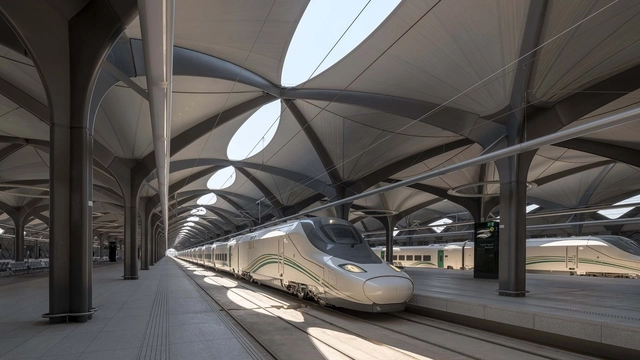
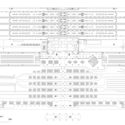
Train stations are usually complex programs since they must not only solve the departure and arrival of trains but also respond to the circulation of its users, provide certain services and be a connecting space between the transport systems of a city. Architects from different parts of the world have developed different solutions to this program. Below you can find 10 examples of train stations, their floor plans and sections.
Between Shanghai’s crowded meat markets, bundles of wires, vivid neon lights, and dense smogs, lie the historic ‘Shikumen’ lane houses. Built between the end of the 19th century and World War II, these houses were inspired by French and British Colonial and Art Deco styles and the Chinese ‘Hutong’ housing style. But time for these aged ornate structures is running out, as all the Shikumen lane houses across Shanghai are being torn down.
As part of his Shanghai Streets series, photographer Cody Ellingham has set out on a mission to freeze time and capture these historic streets before they are completely demolished and forgotten.
This checkout experience gets playful and functional with a colorful combination of Wilsonart® Commercial Laminate and fingerprint-resistant Traceless™ Laminate.
World leading engineered surfaces manufacturer shares three trends influencing next-generation decorative surfaces
For years, interior surface designers have drawn inspiration from their environments in order to create delightful and innovative engineered surfacing materials specified in architectural spaces. From familiar and traditional to futuristic and contemporary, design inspiration can be found all around structures, elements, and styles that surround us every day.
What happens when the sensor-imbued city acquires the ability to see – almost as if it had eyes? Ahead of the 2019 Shenzhen Biennale of Urbanism\Architecture (UABB), titled "Urban Interactions," ArchDaily is working with the curators of the "Eyes of the City" section at the Biennial to stimulate a discussion on how new technologies – and Artificial Intelligence in particular – might impact architecture and urban life. Hereyou can read the “Eyes of the City” curatorial statement by Carlo Ratti, the Politecnico di Torino and SCUT.
First, let me declare my unambiguous aversion to the envisioned future in which “any room, street or shop in our city can recognize you, and autonomously respond to your presence.” Despite this, can I see any positive potentials in pervasive systems of urban surveillance and response?
As an architect turned user experience (UX) designer I have many strong opinions about both my former and my current profession. But in short, I am now enjoying greener pastures, getting the fulfillment I expected while studying architecture but the profession didn’t provide.
Many like-minded architects ask me when and why I decided to transition into software. This puts me in the unusual position of praising the initial skill-set achieved by studying architecture, while promoting departure from it. That said, I have a very abstract definition of architecture, and believe if you have the interest to pursue any other design discipline, you’ll be successful. This guide is intended for those driven and curious architects who are looking for a change.
Many references to historic architecture are still being used in contemporary projects. Whether it is ancient building techniques, use of material, or the relationship between architecture and nature, the past remains prominent.
Iranian architecture firm NextOffice blurred the boundaries between indoors and outdoors, and used historic Iranian architecture elements to create the contemporary Guyim Vault House.
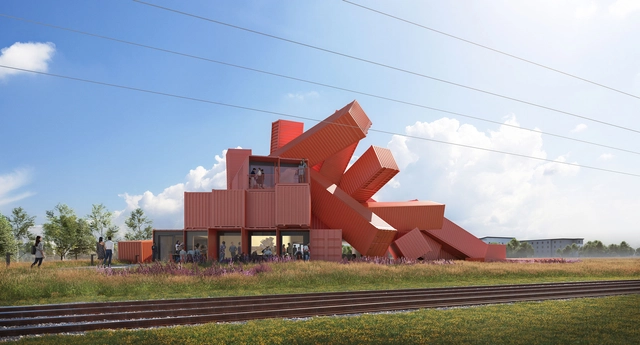
The showpiece of a planned new development at Edinburgh Park will be UK-artist David Mach’s first-ever building, named “Mach 1” by the project’s developers and investors, Parabola. Working with Stirling Prize-nominated architects Dixon Jones, Mach’s building will be created from over 30 shipping containers - but not in the modular, linear method to which shipping container buildings typically lend themselves. Instead its sculptural shape is meant to draw attention to the new quarter and catch the public’s eye, especially those traveling by on the nearby tram.
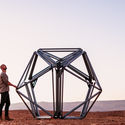
In the Negev Desert of Israel, SAGA Space Architects are collaborating with D-MARS to build a Mars Lab Habitat that will simulate the conditions of living in a confined space on the hazardous surface of the red planet. The laboratory structure they’ve designed is an addition to D-MARS' existing Mars simulation habitat and will be part of a larger experiment. This habitat will serve as a prototype for a longer mission scheduled for 2020.
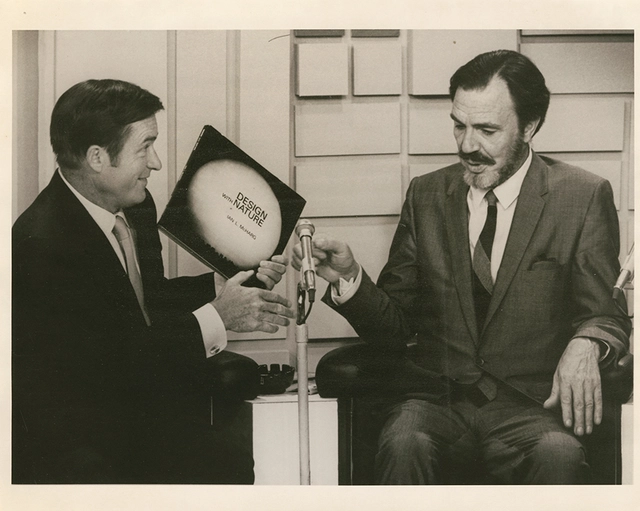
McHarg promoting his book in 1969. Image Courtesy of the Architectural Archives, University of Pennsylvania
Fifty years have passed since the publication of influential landscape architect Ian McHarg’s book, Design With Nature in 1969. Throughout the United States, an environmental movement was taking place, into the center of which McHarg’s book was thrust. The 1970s and ‘80s were a time of much landmark legislation surrounding ecological concerns, and McHarg argued that landscape architecture alone was able to integrate all the disparate fields involved.
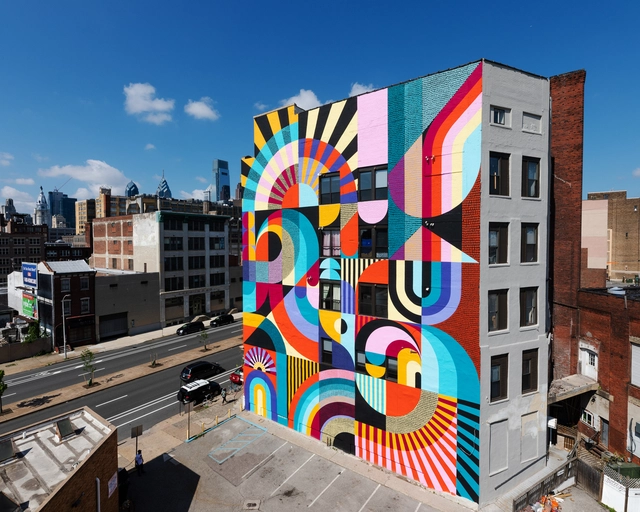
If a painting can trigger its viewers' emotions with just one observation, imagine the impact of a building-sized mural on an entire city.
Baltimore-based artists Jessie Unterhalter and Katey Truhn found a way to enhance people’s lives through art by adding visual playfulness to public spaces. Since 2012, they have been working on sculptures and large-scale murals, curving around building corners and spilling them onto the ground. The artistic duo explored themes of movement and symmetry by experimenting with bold color combinations, patterns in nature, and woven textiles.
Take a look at some of the lively murals created by Jessie and Katey that transform public spaces into colorful experiences.
Past, Present, Future is an interview project by Itinerant Office, asking acclaimed architects to share their perspectives on the constantly evolving world of architecture. Each interview is split into three video segments: Past, Present, and Future, in which interviewees discuss their thoughts and experiences of architecture through each of those lenses. The first episode of the project featured 11 architects from Italy and the Netherlands and Episode II is comprised of interviews with 13 architects from Spain, Portugal, France, and Belgium.
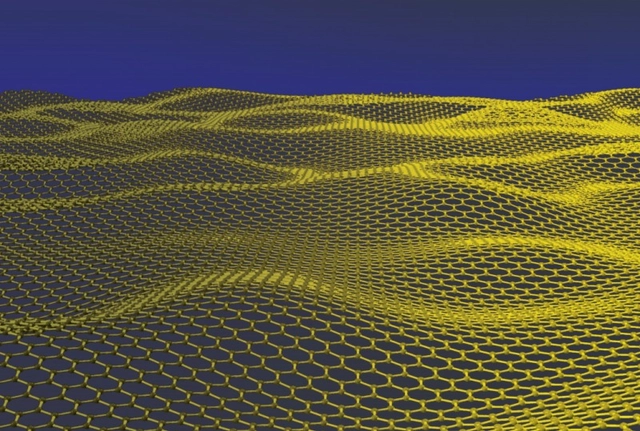
Ever since Manchester University first isolated Graphene in 2004, it has been widely referred to by its properties as a promising material through diverse research that focuses on reaching a range of uses in the most varied industries. Graphene is known to be one of the strongest materials known to science due to its composition of a single carbon atomic layer in a hexagonal mesh. It is also one of the finest materials known to mankind, 200 times stronger than steel yet 6 times lighter. Plus, it is an excellent heat and electricity conductor, aside from its interesting light absorption qualities. When combined with other elements, including gases and metals, it can produce different new materials with highly superior properties.




.jpg?1562247588)


.jpg?1560778703&format=webp&width=640&height=580)