This bizarre looking creature is the world's first relocatable research facility. Located on the Brunt Ice Shelf in Antarctica, the Halley VI Research Station was officially opened on Tuesday, more than one hundred years after Captain Robert Falcon Scott’s Antarctic expeditions.
More on the building and its uncommon features after the break...
After an “arduous” public review and a heated debate over affordable housing, New York’s City Council has unanimously awarded final approval to BIG’s tetrahedral-shaped West 57th apartment building in Manhattan. As reported by Crain’s New York Business, a compromise has been made to include 173 affordable housing units within the 32-story, 750-unit residential building and the neighboring industrial building that will be converted into 100 additional rental apartments. As you may recall, the community board and Councilwoman Gail Brewer initially threatened to “torpedo the project” if the apartments were only made affordable for a 35 year period. However, Durst apparently won them over by contributing one million dollars into an affordable housing fund.
"The good news, which is the matra of my office and community board No. 4, is there will be, yes, by law, 35 years of income-restricted affordable housing," stated City Councilwoman Brewer, who represents the area.
When applying “major surgery” to a beloved, 20th century “masterpiece”, you’re going to face some harsh criticism. Such is the case for Norman Foster, as the legendary British architect has been receiving intense backlash from New York’s toughest critics for his proposed renovation to the New York Public Library. First, the late Ada Louise Huxtable exclaimed, “You don’t “update” a masterpiece.” Now, the New York Time’s architecture critic Michael Kimmelman claims the design is “not worthy” of Foster and believes the rising budget to be suspect.
More on Kimmelman's critique and Foster’s response after the break...
Organized by International Art Consultants (IAC) and supported by The Royal Photographic Society, the Architect’s Eye competition has been celebrating and encouraging architects’ passion for photography since 2007. Now, in its fourth edition, UK architects are challenged to submit photos into two distinct categories: Architecture and Place and Architecture and People. The former focuses solely on the aesthetics of the architecture and places it creates, while the latter explores and celebrates the interaction of people with the environments created by architects. There are no restrictions on which buildings qualify for the competition.
With an intention to attract and impress viewers with his massive scale, Hehas been selected as winner of the 2013 Young Architects Program (YAP) MAXXI in Rome, an annual competition that promotes and supports young and emerging architects in collaboration with MAXXI Architettura, MoMA/MoMA PS1 of New York, Constructo of Santiago and, for the first time, Istanbul Modern, Turkey.
Turin-based studio bam! bottega di architettura sostenibile, designed He as a grandiose and buoyant installation that transforms the concrete MAXXI facade and expansive piazza into a visual spectacular, while offering a shady escape from the Summer heat.
New York-based SCAPE/Landscape Architecture has beat out 4 national/international firms, including JDS Architects, to design a Masterplan for the Town Branch Commons, a two-mile linear stretch of green space that will connect the eastern and western sections of downtown Lexington, Kentucky. The Competition has garnered attention for its interesting challenge: to bring the Town Branch Creek, a river which has been underground for over 100 years, to the surface.
Jeff Fugate, President and COO of the Lexington Downtown Development Authority, which sponsored the competition, noted that “The [five-person] jury had five excellent choices, but SCAPE clearly was above the competition.” Aaron Betsky, the director of the Cincinnati Art Museum and the jury chairman also explained the choice: “As a jury, we felt inspired and excited by the breath of the designers’ vision, while we felt confident that they would be able to implement their plan."
Kate Orff, founder of SCAPE, notes that the firm is looking forward to working with the community to make the vision a reality: “SCAPE is so thrilled to be a part of this exciting initiative to revive Town Branch, make new connections downtown, and improve the quality of life in Lexington. We’ve been inspired by the realities and conditions on the ground and by the potential of water to inform the design of new urban landscapes.”
Find out more about the Masterplan, after the break...
In 2006, Dr. Behrokh Khoshnevis, professor at the University of Southern California, introduced the world to Contour Crafting: the idea of applying Computer Aided Design and 3D Printing to homes and eventually larger buildings. As Dr. Khoshnevis explains in this TED Talk, Contour Crafting uses a giant 3D printer that hangs over a designated space and robotically builds up the walls of that building with layers of concrete. The robot can paint the walls and tile surfaces and even knows to construct plumbing and electrical wiring as it goes (Dvice). The idea is that by automating the construction process - one of the only processes humans still do largely by hand - homes will be cheaper and more quickly erected, with significantly lower labor costs. More importantly, Khoshnevis believes that Contour Crafting is essential to creating a more "dignified" architecture by eliminating slums in developing countries and aiding areas in the immediate aftermath of a natural disaster.
Today, President Barack Obama announced his intent to appoint five individuals to key Administration posts, including architecture’s very own Michael Graves, stating: “These fine public servants both bring a depth of experience and tremendous dedication to their new roles. Our nation will be well-served by these individuals, and I look forward to working with them in the months and years to come.”
The five individuals include:
Vinton G. Cerf - Member, National Science Board, National Science Foundation
Marta Araoz de la Torre - Member, Cultural Property Advisory Committee
Michael Graves - Member, Architectural and Transportation Barriers Compliance Board
Laurie Leshin - Member, Advisory Board of the National Air and Space Museum
Lynne Sebastian - Member, Advisory Council on Historic Preservation
AECOM has announced 'Unslumming Kibera' as winner of the fourth annual Urban SOS competition.
The student competition received submissions from 118 universities in 41 countries. Three projects were shortlisted for a presentation to a panel of judges in New York on Jan 16.
Read about the finalists and their projects after the break
San Rocco have been announced as the recipients of the inaugural Icon Award for Emerging Architectural Practice of the Year.
However, San Rocco is not your typical architectural practice. Departing from the traditional model, San Rocco is a collaboration of firms with different disciplines; Instead of buildings, they are known for their publishing projects.
Today, six months after the laser light extravaganza that marked the completion of The Shard in London, the controversial glass tower celebrated its official opening to the public. Architecture enthusiasts and residents were welcomed to join the mayor of London 244 meters above the capital on the 72 floor observation deck for the official ribbon cutting.
Designed by Italian architect Renzo Piano, the 310 meter needle-point structure is currently the tallest in Western Europe. The two million square meter mixed-use development offers ample office space, restaurants, a five-star shangri-la hotel and residences.
For the past several years the Chicago Park District and the City of Chicago have been working on appropriate uses for Northerly Island, a 91-acre man-made peninsula in Chicago, Illinois. The lakefront site branches off from Museum Campus, a section along Lake Michigan that is home to the Field Museum, Shedd Aquarium, and Adler Planetarium. Serving as an expansion to these cultural programs, Studio Gang Architects have created an innovate design that integrates educational, cultural, social, and recreational activities into Northerly Island.
Read more about Northerly Island's future after the break!
Celebrating those who transform urban problems into creative solutions since 1987, the biennial Rudy Bruner Award (RBA) has announced the 2013 finalists. The prize aims to illuminate the complex process of urban placemaking by seeking out often overlooked urban exemplars whose existence heightens the richness and diversity of American cities.
In celebration of their achievement, one $50,000 Gold Medal award and four $10,000 Silver Medals will be awarded to the finalists in May.
With many museums worldwide seeking to extend, to accommodate larger collections, Athens-based Oiio Architecture Office have asked: “What if we decided we needed a little more of Guggenheim?”
Their solution is to stretch Frank Lloyd Wright’s original building skywards, by continuing its iconic ramp, creating an additional 13 floors.
Daniel Libeskind is among three semi-finalists competing to design the Ohio Statehouse Holocaust Memorial in Columbus. The privately funded memorial will be built south of the Ohio Statehouse on the grassy 10 acre Capitol Square, just east of the Scioto River.
Foster + Partners, in conjunction with the European Space Agency (ESA), has undertaken a study to explore the possibilities of using 3D printing to construct lunar habitations on the moon's southern pole (where there is near perpetual sunlight). The firm has already designed a lunar base that could house four people, and has begun to test the structure in a vacuum chamber that echoes lunar conditions.
The shell of the base, which has a hollow closed cellular structure inspired by natural biological systems, should be able to protect potential inhabitants from "meteorites, gamma radiation and high temperature fluctuations." According to Xavier De Kestelier, Partner at Foster + Partners, the firm is "used to designing for extreme climates on earth and exploiting the environmental benefits of using local, sustainable materials – our lunar habitation follows a similar logic."
The study will also address the challenges of transporting materials to the moon, and is investigating the use of lunar soil, known as regolith, as the potential building matter.
More details from Foster + Partners' Press Release, after the break:
The overall winner of the Prize, as well as the 'special mention' award for best emerging architect, will be announced in May, with an award ceremony on June 6th at the Mies van der Rohe Pavilion in Barcelona, Spain. See all 5 finalists, after the break...
Grimshaw Architects are the latest practice to add their voice to the debate surrounding the capacity problem of London’s airports. Their innovative proposal, entitled ‘London: Hub City’, bucks the trend of recent ‘superhub’ proposals, which are frequently suggested as a solution to the problem.
Instead of creating a large ‘airport hub’ on a single site separated from the city, Grimshaw’s design prioritizes construction of new express lines by creating a ‘City Hub’ that allows passengers to transfer between London’s existing airports via the city center. The benefit being that expansion could be spread amongst its four existing airports incrementally, as needed, instead of being concentrated on the construction of one ‘super-hub’.
More on Grimshaw's aviation proposal for London after the break.
Praised for his masterful blends of architecture and engineering, yet criticized for rarely sticking to a budget, Valencia-native Santiago Calatravais no stranger to controversy. His latest project making headlines is the largest landmark in Valencia and the second most-visited cultural complex in Spain: the City of Arts and Sciences.
Karakusevic Carson and David Chipperfield have been announced as the “preferred bidder” for a pair of residential towers the East London district of Shoreditch. As reported on BDOnline, the £25 million project at Colville Estate will rise up to 14 and 20 stories high to replace the existing 1950‘s low-rise buildings. This will be the second and last phase of the largest council-backed housing development in London and the first UK mass housing project for Chipperfield.
Although the 2012 London Olympics concluded last August, RIBA president Angela Brady and New London Architecture chairman Peter Murray continued to lead a fierce campaign against the strict International Olympic Committee (IOC) rules that forbid architectural practices who contributed to the design and construction of the venues from promoting their work. Months later, a compromise has finally been met and the architects will now allowed to discuss their contributions freely.
Brady said: “The majority of architects and designers we were standing up for in the campaign were young small businesses who just wanted to be able to promote their work. It’s great that they are now able to speak freely about their contribution.”
Steven Holl Architects have been selected to design a new, 60,000 square foot addition to the prestigious John F. Kennedy Center for the Performing Arts in Washington D.C. The $100 million project, which will be lead by Steven Holl and senior partner Chris McVoy, is envisioned as three connected pavilions clad in translucent Okalux, glass, and Carrara marble, the material used on the original 1970s building.
Located mostly below grade on the south side of the existing facility, the protruding structures will be embedded within a lush landscape of public gardens. To the west, one pavilion will extend over the Potomac River, offering an outdoor stage at the water’s edge. The expansion will compliment the existing performance center with new classrooms, rehearsal and multipurpose rooms, along with lecture and office space. Both the new and the old will be directly connected underground and through the main plaza. A formal design will be refined and announced in the coming months.
More images and information on the Kennedy Center expansion after the break.
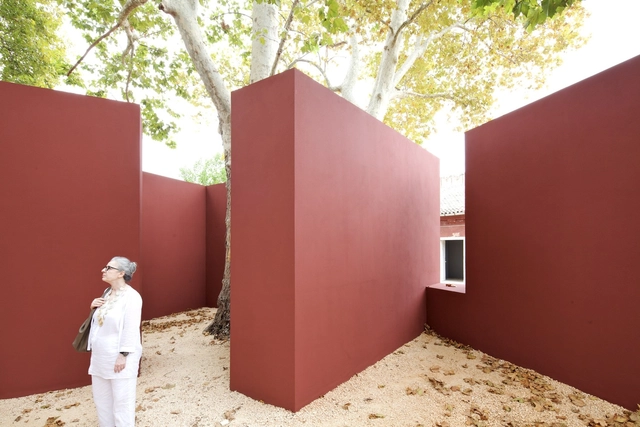
“Recognized by all for its efficiency,” the pavilion that Álvaro Siza designed for last year’s Venice Bienniale of Architecture will remain on display and be utilized as “additional space” by the new curators in 2014 and 2016.