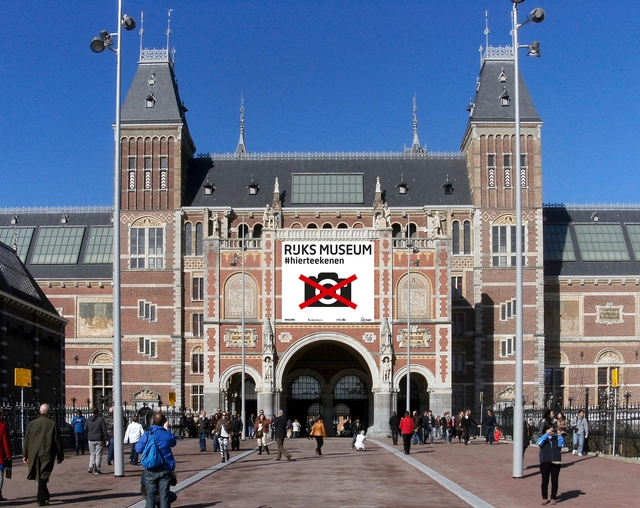
Amsterdam's Rijksmuseum, which was recently renovated and restored by Cruz y Ortiz, have launched The Big Draw campaign, encouraging visitors to ditch the camera and pick up a pad and pencil. Under the tagline 'You See More When You Draw', the Dutch national museum want to "help visitors discover and appreciate the beauty of art, architecture and history through drawing" as a counter to what they describe as an often "passive and superficial experience" when seen through the lens of a smartphone.
CEMEX has announced both the international and national winners of its XXIV Building Awards during a ceremony held in Mexico City. A total of 637 projects competed in the National Edition across 13 categories, while 36 projects competing across five categories participated in the international awards.
This year’s Building Awards honor the best architecture and construction projects built during 2014 that use concrete technologies in creative and innovative ways with a focus on sustainability and social well-being.
In addition to honoring the best projects each year, CEMEX also recognizes an architect or engineer “whose contributions in the world of construction have been valuable and left great lessons to society” through the Lorenzo H. Zambrano Lifetime Achievement Award. This year Rafael Moneo was selected as the recipient of the Lifetime Achievement Award for “his invaluable architectural expressions and his contribution to education and construction both in Spain and abroad.”
View the 2015 Building Award Winners after the break.
Since 1957, the Middle East Center at St. Antony's College has been the University of Oxford's facility for research and teaching on the Arab world, Iran, Israel and Turkey. Over the years, the center's world-class archive has grown exponentially, leading to the commission of Zaha Hadid Architects to expand its facility; the recently completed Investcorp Building doubled the center's library and archive space, while delicately integrating a new 117-seat lecture theater into the college's restricted site.
Honoring its success and "vital role" in the community, the Investcorp Building has been selected as a winner in the OxfordPreservation Trust Awards' New Building category - now in its 38th year.
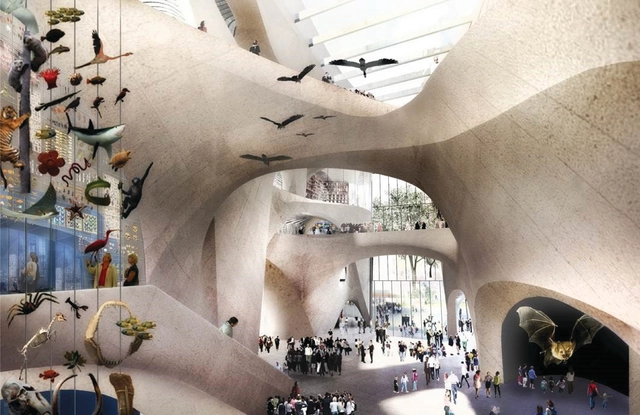
A conceptual design by Studio Gang was unveiled today as the preferred expansion to the American Museum of Natural History (AMNH) in New York. The proposed building, named the Richard Gilder Center for Science, Education, and Innovation, aims to host an array of public exhibition space as well as become a premier "active scientific and educational institution" that enhances connections with the existing Museum and encourages exploration amongst its users.
“We uncovered a way to vastly improve visitor circulation and Museum functionality, while tapping into the desire for exploration and discovery that are emblematic of science and also part of being human,” said Jeanne Gang, founder of Studio Gang. “Upon entering the space, natural daylight from above and sightlines to various activities inside invite movement through the Central Exhibition Hall on a journey towards deeper understanding. The architectural design grew out of the Museum’s mission.”
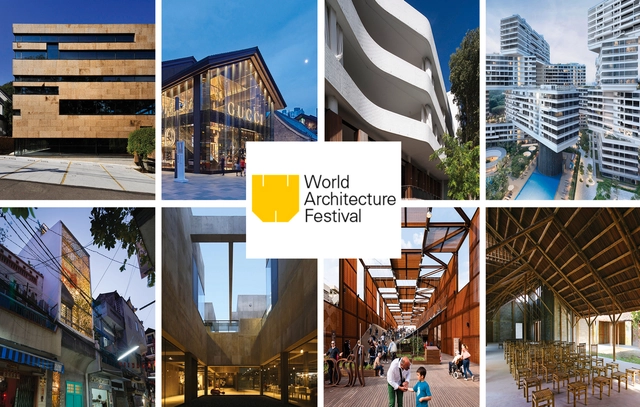
World Architecture Festival, the world's largest international architectural event, has today announced the second of two sets of category winners for 2015.
The 14 winners from day two of the festival will go on to compete against the winners of day one to receive the title World Building of the Year. The projects will be presented in front of a Super Jury, which includes Manuelle Gautrand, Sou Fujimoto and Peter Cook.
Check out the Day 1 winners here and view the Day 2 winners after the break.
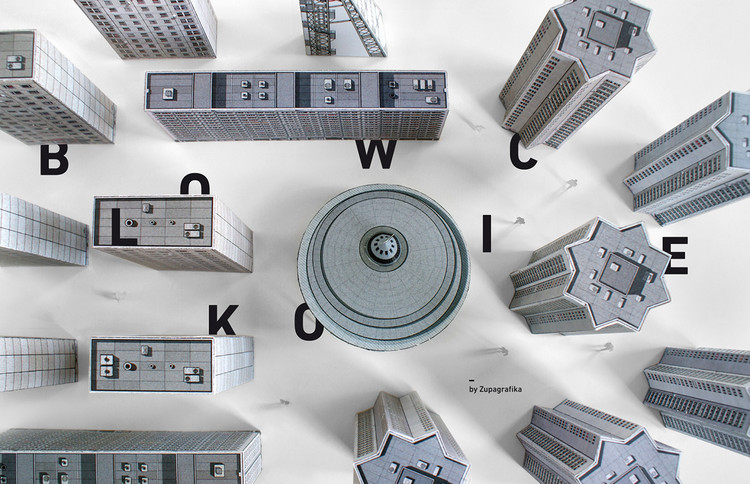
Inspired by the architecture of the Upper Silesian Industrial Region, Blokowice features modernist and brutalist buildings from the 1960-80s. The collection includes the Spodek and Superjednostka, two iconic buildings from the city center, Osiedle Gwiazdy, a characteristic star-shaped estate, Osiedle Odrodzenia, prefabricated panel blocks from the outskirts of the city, and the controversial Katowice railway station building that was demolished in 2011.
The Royal Institute of British Architects (RIBA) have made 90,000 unique images from their visual archive available online. Architecture.com/images (also known as RIBApix) hosts the world's largest collection of 16th century drawings by Palladio, as well as drawings by Sir Christopher Wren, Erno Goldfinger, Augustus Pugin, Denys Lasdun, and Edwin Lutyens. In addition, many original London Underground station designs sit alongside collections of some of the world’s leading photographers, including John Maltby, Edwin Smith, Henk Snoek, John Donat, Dell & Wainwright, Martin Charles and Tony Ray-Jones.
"The debate linked to a more responsive architecture, connected to nature, has been growing since the 1960s," explains Irina Shaklova in her description of her IaaC research project Living Screen. "Notwithstanding this fact, to this day, architecture is somewhat conservative: following the same principles with the belief in rigidity, solidity, and longevity."
While Shaklova's argument does generally ring true, that's not to say that there haven't been important developments at the cutting edge of architecture that integrate building technologies and living systems, including The Living's mycelium-based installation for the 2014 MoMA Young Architect's Program and self-healing concrete made using bacteria. But while both of these remain at the level of research and small-scale experimentation, one of the most impressive exercises in living architecture recently was made with algae - specifically, the Solarleaf facade developed by Arup, Strategic Science Consult of Germany (SSC), and Colt International, which filters Carbon Dioxide from the air to grow algae which is later used as fuel in bioreactors.
With Living Screen, Shaklova presents a variation on this idea that is perhaps less intensively engineered than Solarleaf, offering an algae structure more in tune with her vision against that rigidity, solidity, and longevity.
Landscape architect Cornelia Hahn Oberlander has won the 2015 Margolese National Design for Living Prize for her impact on Canadian cities. The School of Architecture and Landscape Architecture at the University of British Columbia, who awards the annual $50,000 prize, chose Oberlander for her "breathtaking, poetic, unforgettable, charged with meaning, and above all, Modernist" designs that have made "outstanding contributions to the development or improvement of living environments for Canadians of all economic classes."
Hong Kong- and Beijing-based Büro Ole Scheeren is expanding with the opening of two new offices in Berlin and Bangkok. As its founder, German architect Ole Scheeren says, the expansion will extend the practice's range of work with projects in Europe and North America. "Büro Ole Scheeren’s Berlin studio will act as a European base for work across the western hemisphere, while Büro Ole Scheeren in Bangkok, together with its subsidiary HLS, is charged with the further design development and construction supervision of the MahaNakhon tower, soon to be completed as Thailand’s tallest skyscraper," says the practice.
World Architecture Festival, the world's largest international architectural event, has today announced the first of two sets of category winners for 2015.
OMA/Buro Ole Scheeren, Populous, and a21 studio are among the first set of category winners of The World Architecture Festival’s (WAF) 2015 awards. Announced today during the festival’s opening, the winners of the categories will go on to compete on Friday for the title of the World Building of the Year 2015.
Held at the Marina Bay Sands in Singapore from November 4-6, this year’s festival is centered on the theme 50:50, in honor of Singapore’s upcoming 50th anniversary as an independent country. In addition to hosting the world’s largest architectural awards program, WAF also features three days of conferences, architect-led city tours, documentary screenings, live crit presentations and networking opportunities.
View the full shortlist here, and see which 14 built and future projects took home awards after the break.
With a “well-balanced” proposal, according to the jury, Spanish firm Rafael de La-Hoz Arquitectos has been selected to design the new corporate headquarters for Spanish soccer team Real Madrid.
Carried out in collaboration with building company Ferrovial Agromán, the winning proposal aims at “unifying all services, modernizing administrative offices and, more generally, addressing the challenges of the future,” according to the firm.
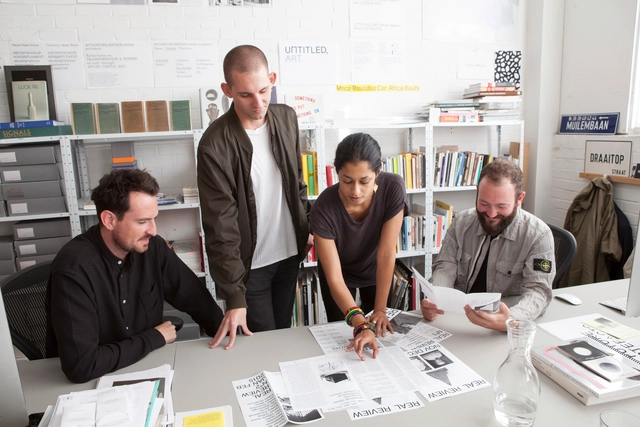
Last month a Kickstarter campaign launched by the Real Estate Architecture Laboratory (REAL)reached its funding target: the Real Review, an independent bi-monthly magazine which intends to "revive the review as a writing form" to a general readership within the architectural sphere, will soon be a reality. ArchDaily sat down with editors Jack Self and Shumi Bose to discuss how the project came into being and what this—the flagship publication of REAL—will look like when its first issue is published in early 2016.
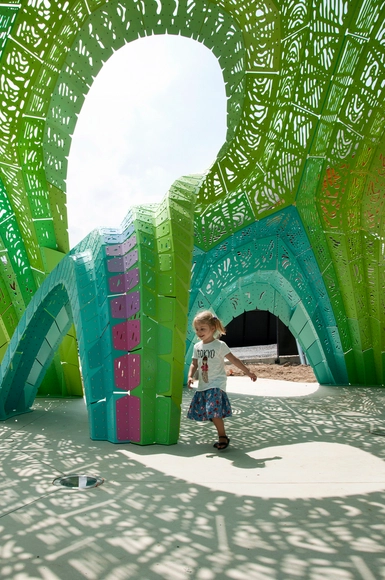
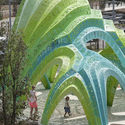
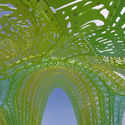
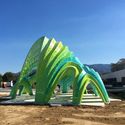
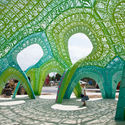
MARC FORNES & THEVERYMANY have completed "Pleated Inflation" a new permanent installation located in Argeles-Sur-Mer, France. Following in the footsteps of projects such as their "Vaulted Willow," the design is the latest in what they term their "structural shingle" group of projects, made up of pleated aluminum sheets which - thanks to the firm's computational design technique - simultaneously serve as the project's structure, enclosure, and its primary architectural component.
Commissioned as part of the French 1% Artistique program by the Region Languedoc Roussillon, the project serves as an informal amphitheater for the students at Lycée Christian Bourquin, "bringing together structural performance and spatial experience" with its "ornate shadows cast from porous structural pleats." Read on for more images and the full description from the architects.
The World Monuments Fund has released its 2016 World Monuments Watch list of 50 cultural heritage sites at risk in 36 countries around the world. The list, in its twentieth year, seeks to identify sites “at risk from the forces of nature and the impacts of social, political, and economic change,” and direct financial and technical support towards them.
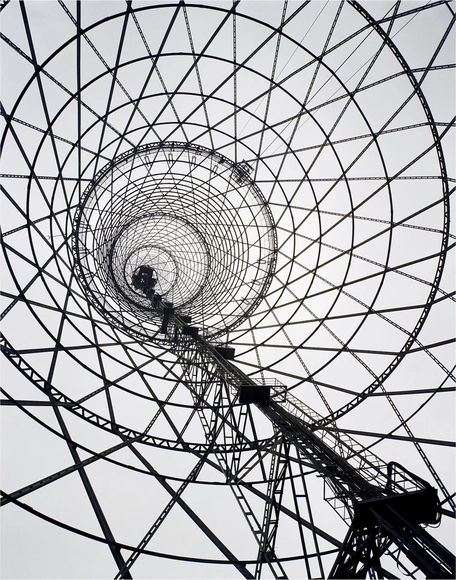
The 2016 list includes the entirety of post-earthquake Nepal, an underwater city, the only surviving quadrifrons arch in Rome, and a structurally significant hyperboloid tower, among others. The Fund even featured an “Unnamed Monument” on the list, in honor of all sites at risk of damage from social and political instability around the globe.
Learn more about some of the featured monuments, after the break.
In an exclusive half-hour interview with Lord Norman Foster, Monocle's editor-in-chief Tyler Brûlé discusses matters of urban planning and "big-thinking emerging economies" with "one of the world’s most innovative and revered architects." Foster, who turned eighty years of age this year, has been the recipient of some of the world's most prestigious architecture awards – from the Pritzker Prize, the Stirling Prize, the AIA Gold Medal and the Prince of Asturias Award (Spain). Over the years, Foster's practice have become world-renowned experts in high-density transit design (namely, airports) – a focus of Brûlé's questioning.
Thomas Heatherwick's controversial Garden Bridge in London has regained popular support amongst officials after a significant cut in funding. The Transport for London (TfL) – the authority in charge of the Garden Bridge program, which was approved last year – has reduce the amount of taxpayer money from £30 to £10 million, alleviating concerns over public cost. Now, all that's needed for the project to start construction is an approved amendment to the site's lease in Lambeth. It is expected to break ground next year, despite lingering concerns over maintenance costs and use restrictions.
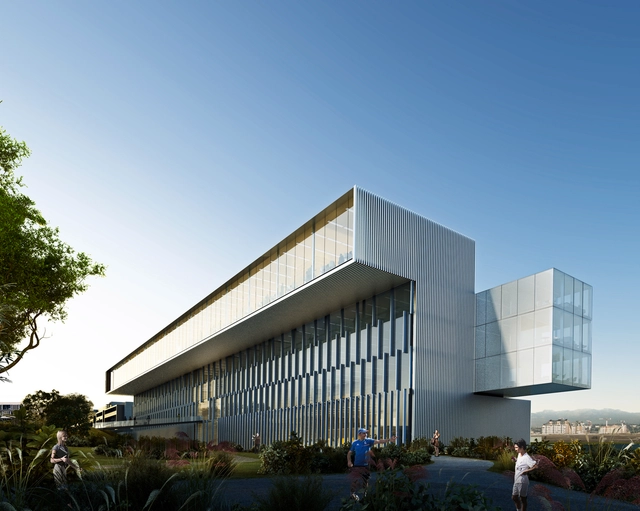
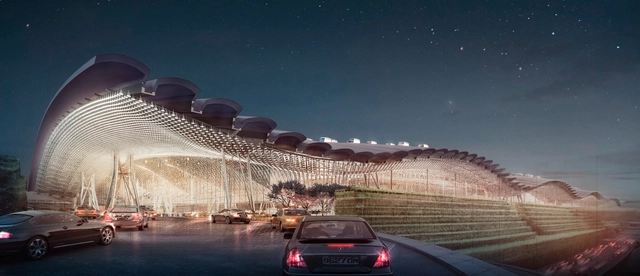
Rogers Stirk Harbour + Partners (RSHP) has won an international competition to expand the Taoyuan International Airport - Taiwan's largest airport, formally known as Chiang Kai-shek International Airport. Their winning scheme for the airport's new Terminal 3 building won the jury over for its "outstanding and innovative planning and design and highly efficient circulation," according the airport's official press release.
"The most compelling feature of their design is an interior experience that fluctuates and moves up and down to reflect changes in the users," said the report.
Iwan Baan was twelve years old when he received his first camera and, "within a week, [he] had traded it in for a better one." He is one of the most well-known and highly sought after architectural photographers in the world, recognised for shooting cities from above and for always highlighting people (occupation) in his images. In a short interview with Jonathan Glancey Baan is the first to state that he "doesn't know much about architecture" — something which has not inhibited his ability to produce some of the most successful photographs of the built world, and how we design, construct and occupy it.
A wide range of projects were awarded, with three new categories of awards this year: the John Scott Award for public architecture, the Sir Ian Athfield Award for housing, and the Sir Miles Warren Award for commercial architecture.
Find out which 28 projects won New Zealand’s most prestigious architecture awards, after the break.
German mechanical company ThyssenKrupp, in collaboration with Microsoft, has launched its newest innovational elevator, MAX. Together, the companies have created an elevator that could create time savings for elevator passengers “equivalent to 108 centuries of new availability in each year of operation."
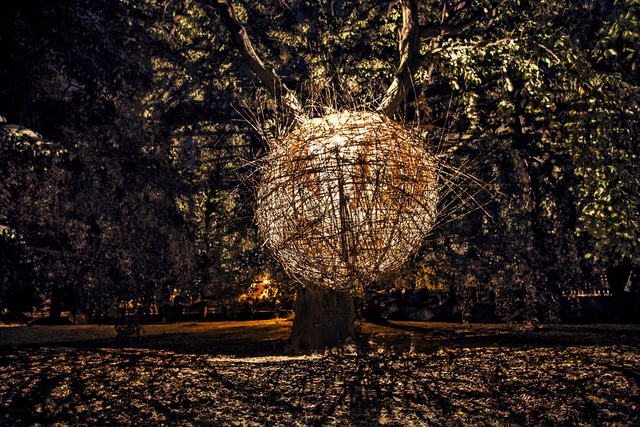
Over the course of two days, architect Jan Tyrpekl created The Nest, an experimental structure built without any investors, sponsors, assignment, or project documentation in Strančice, in the Czech Republic. Made of about $120 USD worth of Osier Willow wood, The Nest perches in a park in the designer’s hometown, interlaced between tree branches, so as not to damage or affect the tree.
As the Milan Expo 2015 comes to a close, the winners of its best pavilions are being revealed. Wolfgang Buttress' UK Pavilion has taken top honors being named the exhibition's "Best Pavilion for Architecture & Landscape." A crowd favorite, the pavilion caught the attention of the world with it's mesmerizing (and photogenic) "beehive" made of 169,300 individual aluminium components that allowed visitors to experience the life of a bee.








_RIBA_Collections.jpg?1446712899&format=webp&width=640&height=580)






_ThyssenKrupp.jpg?1446175229&format=webp&width=640&height=580)