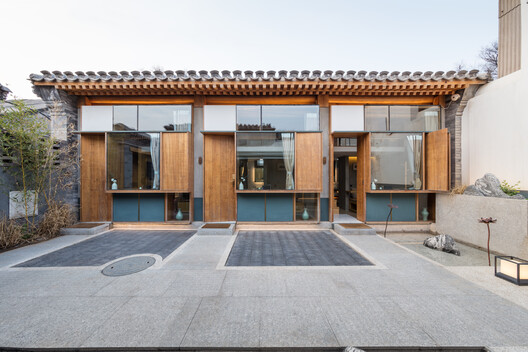
Situated in one of the fastest-developing regions over the past decade—the southern part of China, including Hong Kong and the Greater Bay Area—urban growth has been driven by an overwhelming wave of commercial ambition. Projects here are often designed for maximum density, height, and efficiency, resulting in developments of enormous scale that can easily span several acres. Prioritizing transit-oriented development, these complexes frequently take the form of sprawling malls built directly above major transportation hubs. Designed to disorient and prolong foot traffic to encourage economic activities, these mega-structures have become commonplace in cities like Hong Kong and Shenzhen.
While this typology of megastructures offers clear advantages—economic efficiency, high development returns, and convenience for transit users—it almost invariably ignores its urban context and environment. These developments often turn a blind eye, deliberately so, to their environmental footprint and the city's walkability. At such overwhelming scales, the human walking experience is diminished, if not outright neglected. Pedestrians become interiorized—trapped within the insulated world of these complexes.

At first glance, they may appear beneficial: air-conditioned, clean, and equipped with amenities such as resting areas and restrooms. But one begins to wonder—do these places even have windows? Within them, time of day becomes indiscernible; without a phone or watch, even the sense of time disappears. Context, orientation, and environmental awareness are lost.
Related Article
Interior Courtyards: An Effective Strategy to Improve Space Quality in 15 Residential ProjectsDesigning Relief: Courtyardism as a Response to Overscaled Urbanism
"Courtyardism"—the title of Wang Weijen Architecture's (WWA) recent exhibition—presents a critical counterpoint to the prevailing development trends in the Greater Bay Area. It re-centers architecture around principles that have often been sidelined in the pursuit of speed, scale, and economic efficiency. The exhibition rigorously examines the fundamental questions at the heart of architectural practice: How do we negotiate the balance between interior and exterior space? How can we accommodate high-density development while maintaining environmental awareness? And how do we preserve walkability, bodily scale, and spatial clarity within today's increasingly oversized structures?
Spanning more than a decade of work across the region, the exhibition surveys WWA's built projects, with a focus on institutional campuses, as a means of grounding these questions in practice. It confronts essential concerns of architecture—scale, materiality, and, most critically, the relationship between buildings, the human scale, and their environment.
Through sustained research and design, these inquiries ultimately converge on the idea of the courtyard. As both spatial strategy and conceptual device, the courtyard introduces purposeful emptiness—voids that mediate between inside and outside, structure and landscape. They offer rhythm and relief within dense architectural volumes, much like silence brings cadence and depth to music. In WWA's work—especially in educational and institutional projects—the courtyard becomes a design agency for restoring human scale, climatic responsiveness, and contextual awareness. It suggests an alternative future for the region's potential development: one that prioritizes openness over enclosure, environmental continuity over isolation, and renewal over repetition.
Courtyardism explores the courtyard as a cross-cultural prototype which can be developed into a multi-layered three-dimensional system of architectural urbanism, and can be developed into a sectional design method for establishing effective spatial strategies. - Wang Weijen Architecture
Spatial Hierarchies: How Courtyards Organize, Orient, and Humanize
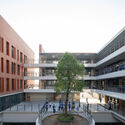
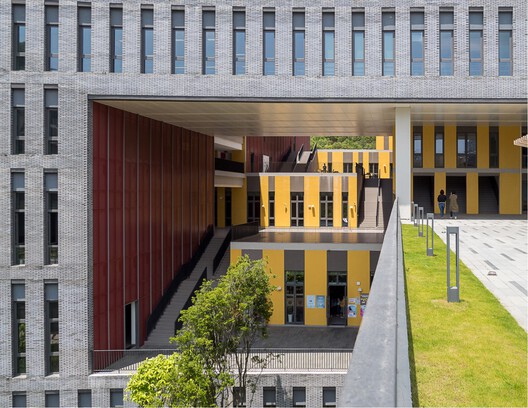
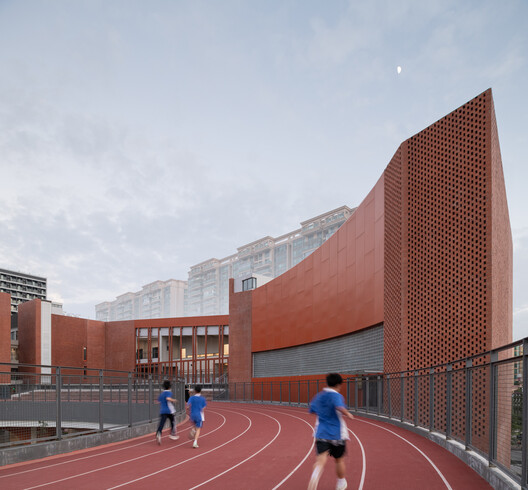
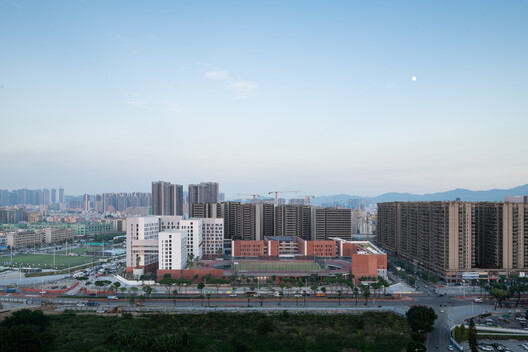
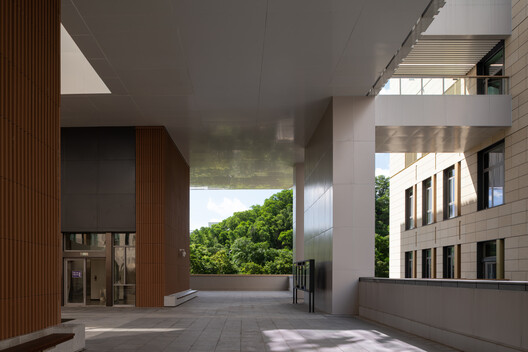
In WWA's Shenzhen Fuhai Middle School, the idea of the courtyard is translated across multiple scales, becoming both a spatial and conceptual framework for the campus. At the largest scale, a running track doubles as a courtyard, anchoring the site and organizing the surrounding building masses. Medium-sized courtyards, articulated through grand staircases and sectional shifts, serve as public spaces that connect different levels of the school. These stair-courtyards offer more than just circulation: they introduce moments of civic life, encouraging gathering, interaction, and layered movement. At the smallest scale, pocket courtyards emerge as architectural incisions—breakout spaces that frame, contain, and celebrate environmental qualities on a more intimate level.
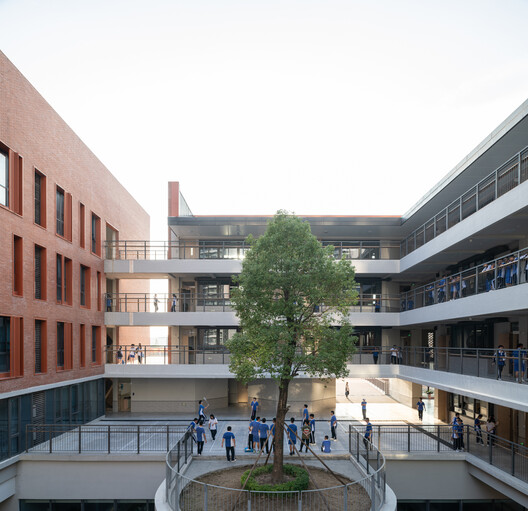
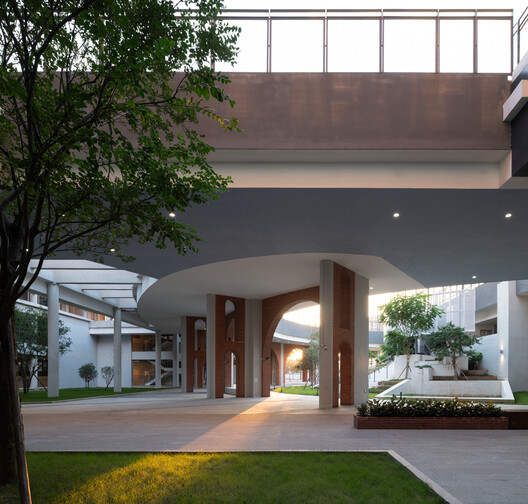
Beyond being literal in form, this calibration of small, medium, and large courtyards reveals a thoughtful sensitivity to scale, movement, and program. Each scale corresponds to a different rhythm of campus life: the large running track supports the most active and dynamic engagement; the medium-scale stair spaces invite slower, more deliberate circulation and civic pause; and the smallest courtyards foster quiet, reflective, and passive use. In this way, the design moves beyond mere formal or scalar exploration, instead integrating program, activity, atmosphere, and user behavior into a coherent and responsive spatial strategy. The result is a campus deeply attuned to interior and exterior relationships, bodily scale, and environmental context.
This approach stands in stark contrast to the surrounding urban fabric. Around the school, repetitive, high-density towers rise from an oversized podium that combines commercial and community uses. These developments lack variation in scale, ignore orientation and context, and remain disconnected from both the landscape and city. They embody a kind of self-contained, monolithic logic—dense, uniform, and indifferent.
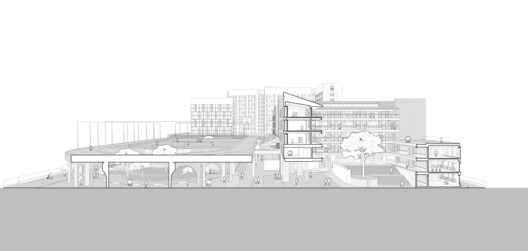
Against this backdrop, Courtyardism becomes a quiet but powerful rebuttal. Through spatial variety, thoughtful programming, and careful modulation of human scale, WWA's design offers an alternative model—one that prioritizes porosity over enclosure, layered density over focused density, and movement over static mass. It offers a hopeful vision for urban development in Southern China: one in which void and solid, hardscape and softscape, interior and exterior coexist in balance, promoting a more sustainable, ecologically responsive, and human-centered built environment.
Chinese University of Hong Kong / Wang Weijen Architecture + Rocco Design Architects Associates + Gravity Partnership
Curating the Void: An Exhibition that Also Thinks Like a Courtyard
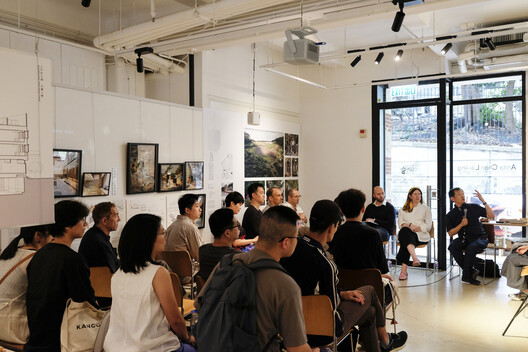
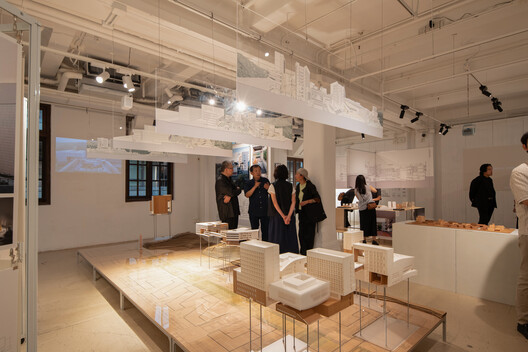
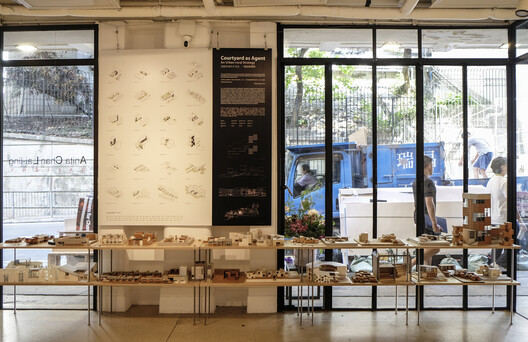
The exhibition in Hong Kong, held at the Fringe Club, offered a carefully curated glimpse into Wang Weijen Architecture's ongoing research into the courtyard typology and its design iterations across diverse project contexts. Showcasing the studio's deep commitment to physical modeling as a core design tool, the exhibition presented a series of sectional and plan-based studies that explored the courtyard across varying programs, sites, and tectonic conditions. The street-facing façade of the venue was lined with two stacked rows of physical models, emphasizing not only the office's rigorous investigation into courtyard typologies with physical modelling but also the adaptability of the idea itself. The message was clear: there is no one-size-fits-all courtyard. Each iteration must be reinterpreted and re-evaluated in response to the specific context, program, and environmental conditions of the project.
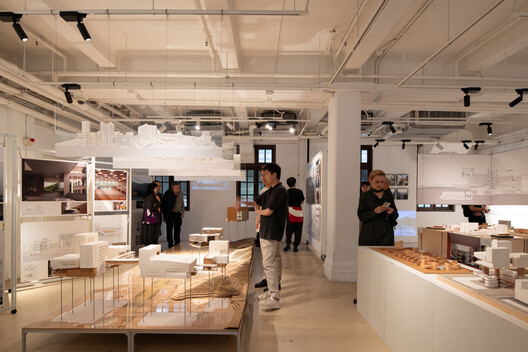
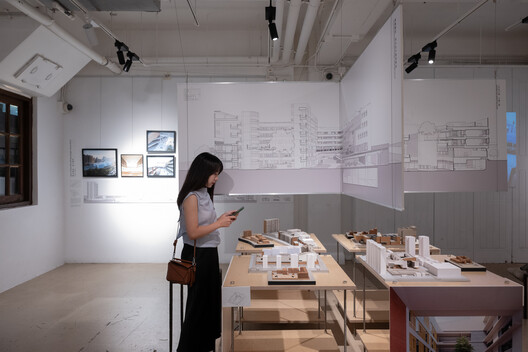
Where the courtyard may often be thought of as a plan-based or horizontal strategy—concerned primarily with massing, edge conditions, and spatial thresholds—WWA's exhibition offered a fresh perspective by elevating the courtyard into a three-dimensional, sectional inquiry. Large, detailed sectional drawings were suspended from the gallery ceiling, creating a layered spatial reading that emphasized verticality, depth, and activity within the courtyard of each project. These sections demonstrated how the courtyard could serve as a generator of diverse spatial experiences, rather than merely a passive void.
Mirroring the layered transparency and spatial complexity found in the firm's built work, the exhibition design itself was immersive and multivalent. Drawings, objects, models, photos, and videos were presented not as isolated elements, but as interdependent layers—tied together by carefully composed negative space. What initially appeared scattered revealed itself, upon closer inspection, as a cohesive spatial experience. Just as the courtyards in WWA's projects unfold differently depending on where and how they are viewed, the exhibition offered multiple vantage points for interpretation and rediscovery. It invited visitors to engage with WWA's work through the very logic of "Courtyardism": through layered observation, shifting perspective, and spatial interplay.
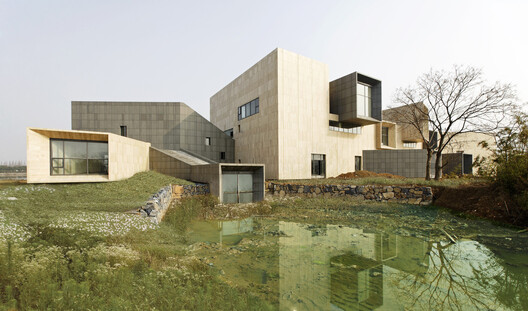
Xixi Wetland Art Village / Wang Weijen Architecture
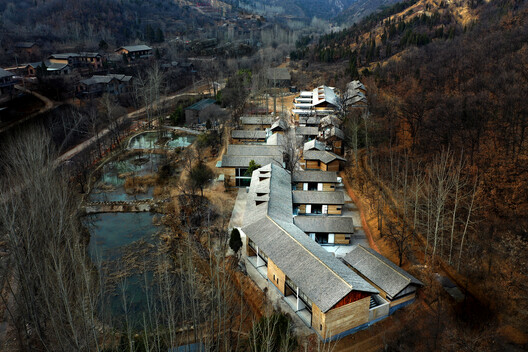
Valley Retreat / Wang Weijen Architecture
Courtyards as Climate: Building with Light, Air, and Earth
In cities like Hong Kong, there's a common saying that children may grow up without ever setting foot on real grass. Though clearly an exaggeration, the expression underscores a deeper concern: the risk that rapidly developing cities, in their pursuit of short-term economic gains, may neglect the importance of the natural environment in humans' daily lives, sacrificing opportunities to engage with the urban landscape beyond the confines of air-conditioned interiors.
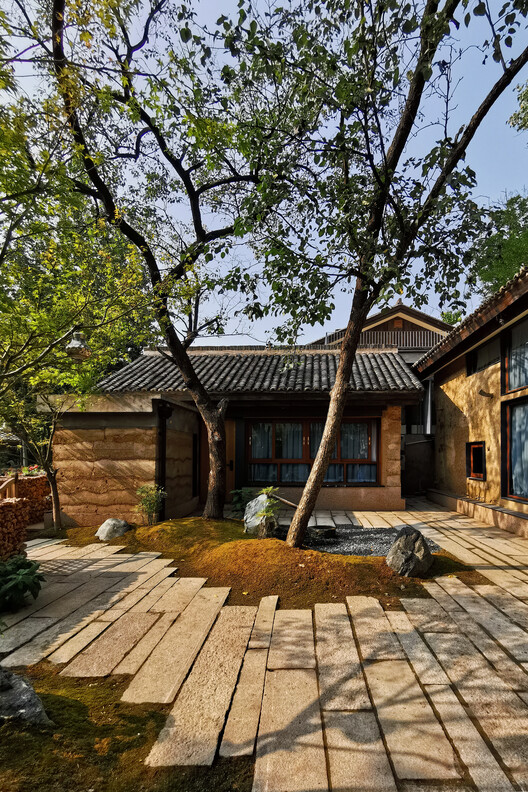
Through the design of courtyards, WWA proposes a more balanced, environmentally attuned model of urban development—one that is deeply rooted in site awareness and human scale. What makes the courtyard strategy particularly powerful is its adaptability: it works across typologies and scales, from intimate residential retreats, such as WWA's Valley Retreat, to expansive university campuses, such as the Chinese University of Hong Kong Campus Shenzhen. "Courtyardism" offers a compelling alternative—potentially less reliant on mechanical cooling systems, more in sync with natural ventilation, daylight, and the rhythms of the landscape.
At a time of economic deceleration and rethinking of growth, the exhibition arrives as a timely reflection. It prompts us to reconsider how we build—not just for density or efficiency, but with nature, with climate, with context, and with care for the human body and the ground beneath our feet.