Lego House Update

legg4

Last month, we featured a post about James May, a toy fanatic (and presenter of the television show James May’s Toy Stories), that built a house using bricks. The house was complete, but unfortunately, it’s now demolished after a deal to sell it didn’t quite go well.

Because the home didn’t have planning permission on its site, the builder was hoping to find a buyer to transport the house elsewhere. LEGOland theme park showed interest, but the high cost of transportation didn’t make seem like a good deal. The 3.3 million LEGO bricks used to build the home will be donated to charity once the home is teared down.

Seen at designboom. More images of James May with the completed house and demolition process after the break.

University of Northampton / Alison Brooks Architects

Avenue masterplan 005

Alison Brooks Architects, one of the leading talents in the , was awarded first prize for their master plan for the .  The two stage master plan will play a vital role in enabling the university to meet both the need for short term accommodations and longer term plans for future growth.  “The School of the Arts embraces new technologies in a dynamic cross-discipline mix that will drive our vision for a creative technologies campus. I believe the chosen proposal will provide a powerful statement which captures and projects our collective values and ambitions,” explained Paul Middleton.

More about the master plan after the break.

10 Hills Place / Amanda Levete Architects

1252601872-388-090716-gf-02

Architect: Amanda Levete Architects
Location: ,
Project Director: Ho-Yin Ng
Project team: Gidon Fuehrer, Chris Geneste, Soren Aagaard, Alan Dempsey – Project Architect, John O’Mara, Michael Mitchell
Client: Clarendon Properties
Main Contractor: Powells Group
Façade: Frener & Reifer
Interiors: Windsor Workshop Ltd.
Constructed Area: 14,220 sqm
Project year: 2007-2009
Photographs: Gidon Fuehrer

1252601859-388-090716-gf-01 1252601898-388-0371-a 1252601908-388-9891 1252601918-388-p1000313

Toy fanatic builds a house from LEGO

1251733080-lego

I guess you could build a house with practically any material. But I never thought you could actually build one from LEGO pieces. So James May, a toy fanatic from the surprised me, by building a real house from one of my favorite toys as a child.

The two-story Lego palace is located in the middle of a vineyard and has a working bathroom. James used bricks pieced together by 272 Legos. Over three million bricks were used so that’s about 816 million Lego pieces. Quite an amazing job.

Seen at Geeksugar. More images after the break.

London 2012 Olympic Stadium / Populous

1251302752-approach-small

The Beijing 2008 Olympics happened less than a year ago, but the preparations for the next games in already started. Beijing’s Bird’s Nest made quite an impression for everyone who enjoyed the 2008 Olympics so Populous faced a difficult challenge in designing the Olympic Stadium for London 2012. The new stadium will be complete summer 2011 and will host 80,000 spectators during the Games. More images and architect’s description, after the break.

RIBA Stirling Prize Shortlist 2009

1251126620-portadaThe Shortlist for the RIBA Stirling Prize 2009 has been announced. The six shortlisted schemes were chosen from a midlist of 22 RIBA Award 2009 winners.

The 2009 winner will be announced at the 2009 Dinner on 17 October 2009 at Old Billingsgate, .

You can see the six chosen schemes after the break. For more information, click here.

Duckett House / John Pardey Architects

John Pardey Architects sent us this great second house on the village of Burley, . The concept was based on the idea of creating a building that respects the nature of vernacular buildings by avoiding a single form in favour of what may be seen as an assemblage of forms, akin to the typology of farm buildings.

Tina Manis Associates selected to design Art Fund Pavillion

The Lightbox and Tent has selected Brooklyn‐based Tina Manis Associates from among a group of five finalists to design The Art Fund Pavilion.

The Pavilion will initially appear as part of Tent London’s exhibit at the London Design Festival 2009 before taking up residence at The Lightbox as an annual summer pavilion and gallery space. The structure is to be engineered and constructed by Facit and funded by the Lightbox Museum’s £100,000 Art Fund Prize 2008.

More images and architect’s description after the break.

Art Pavillion / Cre8 Architecture

Our friend Pierre Forissier, from Cre8 Architecture, shared with us their entry for the Art Fund Competition London 2009.

“Panelion” was selected as an exception entry and will be exhibited at The Lightbox London.

More images and architect’s description, after the break.

Foster, Hadid, Gehry, Nouvel, Piano and more against Prince Charles

A group of ten architects, including Norman Foster, Zaha Hadid, and Frank Gehry, signed a letter criticizing Prince Charles for talking against the construccion of luxury houses in Chelsea Barracks, .

Prince Charles is against the modern design with glass and steel used by architects in the Chelsea district, and wants them to use a more traditional design using stones and bricks. The Sunday Times also said that Prince Charles showed his concern to Qatar’s royal family, owner of the site.

The design was developed by Richard Rogers, member of the House of Lords and known for projects like Heathrow’s Terminal 5, the Millenium Dome in London and the European Court of Human Rights. Rogers, with the other ten architects, accused Prince Charles of taking advantage of his royalty position to attack the architectural plans of the site.

This isn’t the first time that Prince Charles enters the architectural debate, strong supporter of Leon Krier’s New Urbanism.

Full text of the public letter to Prince Charles:


THE Prince of Wales’s intervention over the design of the former Chelsea Barracks site deserves more reasoned comment. It is essential in a modern democracy that private comments and behind-the-scenes lobbying by the prince should not be used to skew the course of an open and democratic planning process that is under way.

Proposals by Richard Rogers’s practice for the developers Qatari Diar were recently submitted for planning to Westminster city council. The scheme has been adapted and changed in response to comments from Westminster’s planning officers and extensive local consultation. Statutory bodies such as the Commission for Architecture and the Built Environment and the Greater London Authority have also been consulted. Westminster’s planning committee will meet and shortly deliver its verdict.

Its members should be left alone to decide whether the Rogers’s scheme is a fitting 21st-century addition to the fabric of London. The developers have chosen carefully in selecting the best architect for the sensitive project. Rogers and his team have played their part in engaging with the democratic process. The prince and his advisers should do the same. The process should be allowed to take its course; otherwise we risk condemning this critical site to years as an urban blight.

If the prince wants to comment on the design of this or any other project, we urge him to do so through the established planning consultation process. Rather than use his privileged position to intervene in one of the most significant residential projects likely to be built in London in the next five years, he should engage in an open and transparent debate.

Lord Foster, Foster and Partners, London, Pritzker Prize 1999
Zaha Hadid, Zaha Hadid Architects, London, Pritzker Prize 2004
Jacques Herzog and Pierre de Meuron, Pritzker Prize 2001
Jean Nouvel, Jean Nouvel Architectes, Paris, Pritzker Prize 2008
Renzo Piano, Renzo Piano Building Workshop, Genoa, Pritzker Prize 1998
, Gehry Partners, Los Angeles, Pritzker Prize 1989
Sir Nicholas Serota, Commissioner, CABE 1999-2006
Richard Burdett, London School of Economics
David Adjaye, Adjaye Associates, London
Deyan Sudjic, Director, Design Museum, London

Architecture as Investment, a public debate with Alejandro Aravena

Urban Age Public Debate Series presents “Architecture as Investment, New Forms of Social  Equity”, with ELEMENTAL‘s Executive Director .

The challenge to provide affordable housing is a global issue. At a time when market forces are eclipsing architecture’s social value, ELEMENTAL’s pioneering housing is transforming urban communities in Latin America.

Chilean architect Alejandro Aravena is a Professor at the Universidad Católica de Chile and Executive Director of ELEMENTAL, a ‘do tank’ addressing questions outside the traditional realm of architecture.

The debate will take place Monday 27 April, between 18:30 and 20:00 in the Sheikh Zayed Theatre, New Academic Building, LSE.

Presented with support from the Cities Programme at the LSE and Monocle magazine.

SANAA’s Serpentine Pavillion Design First Image

A month ago, we announced that architects Kazuyo Sejima and Ryue Nishizawa, of the leading Japanese practice SANAA, were chosen to design the Serpentine Gallery 2009, in the UK. Yesterday, released the first rendering of their design.

SANAA: “The pavilion is floating aluminum, drifting freely between the trees like smoke. The reflective canopy undulates across the site, expanding the park and sky. Its appearance changes according to the weather, allowing it to melt into the surroundings. It works as a field of activity with no walls, allowing views to extend uninterrupted across the park and encouraging access from all sides. It is a sheltered extension of the park where people can read, relax and enjoy lovely summer days.”

Seen at Bustler.

National Wildflower Centre International Competition won by Ian Simpson Architects

Ian Simpson Architects with Adams Kara Taylor Engineers and Hoare Lea Engineers has been announced as winners of the competition to design a new innovative, architecturally striking educational, conference and seed production complex at the National Wildflower Centre in Knowsley, part of the Liverpool City Region which is intended to be one of the first buildings in the country to be rated BREEAM “Outstanding”.

Seen at bustler. Images of the other five shortlisted practices, after the break.

Le Corbusier: The Art of Architecture

Easily regarded as one of the most adroit architects of 20th century, Le Corbusier was a relentless designer, urban planner and writer dedicated to industrializing almost every city he came across.

This spring The Barbican’s colossal multi-arts venue – is hosting an all-encompassing showcase of Le Corbusier’s work, a survey which will include an abundance of original models, interior settings, drawings, furniture, photographs, films, tapestries, paintings, sculpture and books designed and written by the architect himself. More of a celebration than an exhibition, the festivities include concerts, films, guest speakers and a photo competition all in his honor.

Seen at coolhunting.

Lant Street / Dow Jones Architects

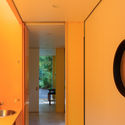
A great factory reconversion by British practice Dow Jones Architects with a great mixture of , and concrete.

Architect’s description and more images after the break.

SANAA to design Serpentine Gallery Pavillion 2009

The Serpentine Gallery is delighted to announce that the Serpentine Gallery Pavilion 2009 will be designed by architects Kazuyo Sejima and Ryue Nishizawa, of the leading Japanese practice SANAA. Sejima and Nishizawa’s Pavilion will be the architects’ first built structure in the UK and the ninth commission in the Gallery’s annual series of Pavilions, the world’s first and most ambitious architectural programme of its kind. The Pavilion will open in July on the Serpentine Gallery’s lawn, where it will remain until October.

Julia Peyton-Jones, Director, and Hans Ulrich Obrist, Co-Director, Serpentine Gallery, said: “It is our dream come true to be working with world-leading architects Kazuyo Sejima and Ryue Nishizawa of . Their work will be a wonderful addition to the Pavilion series, the only commission of its kind worldwide that annually gives preeminent architects their debut in this country and brings the best of contemporary architecture to for everyone to enjoy.”

For more information, go to the Serpentine Gallery official website, here.

Bermondsey Bike Store: Bike parking by Sarah Wigglesworth Architects

The London architecture firm Sarah Wigglesworth Architects have finished a bike store in Bermondsey, London. The structure can store 76 bikes in two levels, using a system designed by bicycle rack producers Josta.

The building is constructed from 13 portal frames, clad externally with triangular, stainless-steel panels and internally with translucent, -reinforced plastic (GRP) sheeting. The structure will provide secure shelter for residents and workers in the Bermondsey Square area.

Photos by Mark Hadden Photography. More images, after the break.

Competition finalists: Imperial War Museum North Exterior Design

The Imperial War Museum North in Manchester, England, was designed by Daniel Libeskind and completed in 2001. The museum was mainly sorrounded by a plain exterior, occupied by a parking lot. The canal-side building is planning a new design landscape and collected proposals from several firms in a competition. The entries have come to five finalists, from which the final design should be chosen this March.

The finalists are:

KLA ()
White arkitekter ab (Sweden)
Patel Taylor (UK)
Topotek 1 (Germany)
Field Operationes (US)

Seen on designboom. The proposals, after the break.

The house of Clay and Oak / Dow Jones Architects

British practice Dow Jones Architects sent us this house renovation with a good use of .

More images and drawings after the break.

Antony House / Fraser Brown MacKenna Architects

Architects: Fraser Brown MacKenna Architects
Location: , England
Client: The Peabody Trust
Design team: Fraser Brown MacKenna Architects; Ellis & Moore (Structural Engineering); Max Fordham LLP (Building Services)
Contractor: Sandwood Construction
Design year: 2001-2005
Construction year: 2006-2007
Photographs: James Morris

Garden Museum / Dow Jones Architects

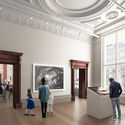
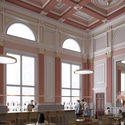
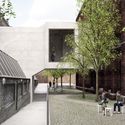
In October 2007, Dow Jones Architects won an architectural competition to redesign the museum. The competition brief asked for a new gallery space where temporary exhibitions could be housed in secure and environmentally-controlled conditions.

Text description and more photographs and drawings after the break.