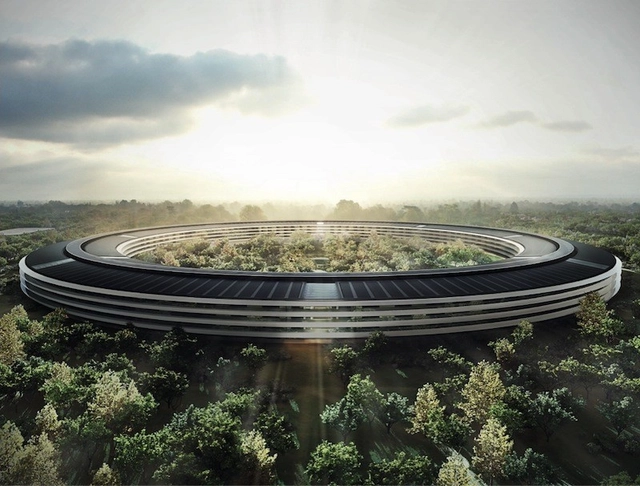
It has been a long road for Foster + Partners's team since first taking on the design for Apple's new campus in 2009. Four years later, despite the criticism and budget concerns, plans for Apple’s corporate headquarters have been approved by Cupertino’s planning commission. A recent video from the Cupertino City Council reveals some insight into the design decisions, including statements by Sir Norman Foster. As Foster states in the video, CEO Steve Jobs called him "out of the blue" in 2009 and said, "It's Steve: Hi Norman, I need some help."
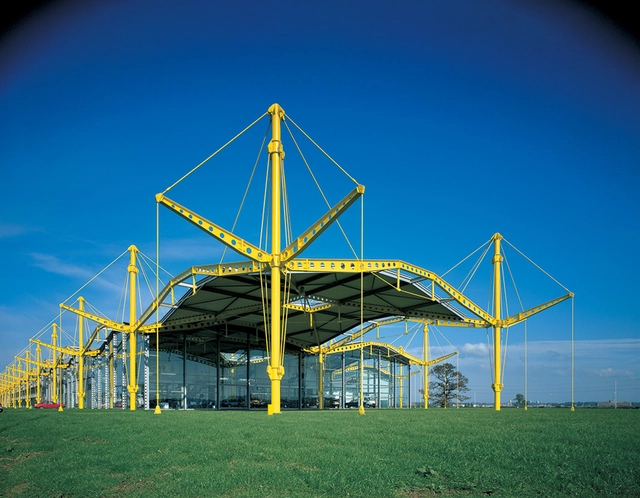
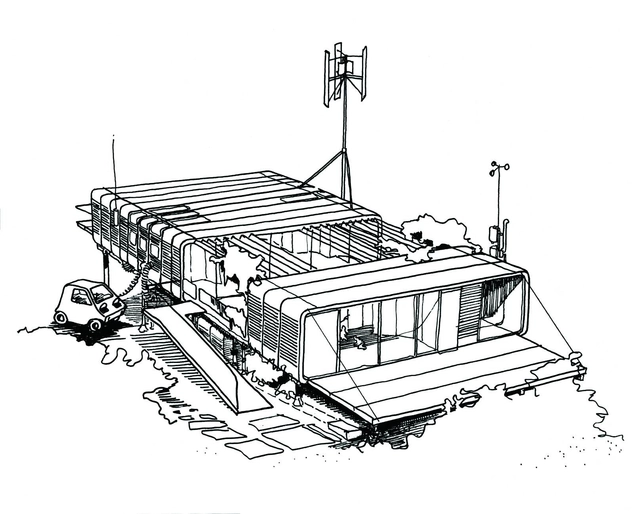
Four post-war buildings, including the Spectrum Building by Norman Fosterand Capel Manor House by Michael Manser, have been elevated to the Heritage List by the UK's Architecture and Heritage Minister Ed Vaizey. Upon announcing the news, the Minister commented that in spite of England's "fine and wonderful built heritage it's sometimes forgotten that we have many outstanding modern buildings too." His listings show that "architecture in this country is very much alive and well in the modern world."
“Architecture is too complex to be solved by any one person.”
Richard Rogers is an architect who understands the significance of collaboration. As a man with an intense social mind and a thirst for fairness in architectural and urban design, Rogers’ substantial portfolio of completed and proposed buildings is driven by the Athenian citizen’s oath of “I shall leave this city not less but more beautiful than I found it.”
In honor of his success, London’s Royal Academy (RA) is currently playing host to a vast retrospective of Richard Rogers’ work, from his collaborations with Norman Foster and Renzo Piano, to the large-scale projects that define Rogers Stirk Harbour + Partners (RSHP) today. The RA’s extensive exhibition has been condensed into a series of motifs that have defined his architectural work, punctuated by memorabilia which offer personal insights into how Rogers’ career has been shaped by the people he’s worked with and the projects that he has worked on.
Continue after the break for a selection of highlights from the exhibition.
When applying “major surgery” to a beloved, 20th century “masterpiece”, you’re going to face some harsh criticism. Such is the case for Norman Foster, as the legendary British architect has been receiving intense backlash from New York’s toughest critics for his proposed renovation to the New York Public Library. First, the late Ada Louise Huxtable exclaimed, “You don’t “update” a masterpiece.” Now, the New York Time’s architecture critic Michael Kimmelman claims the design is “not worthy” of Foster and believes the rising budget to be suspect.
More on Kimmelman's critique and Foster’s response after the break...
On the advice of English Heritage, architecture minister Ed Vaizey has listed Norman Foster’s first major public building: the 1977 Sainsbury Centre at the University of East Anglia, Norwich, in the United Kingdom. According to BDOnline, the popular public art museum, which houses the collection of Lord and Lady Sainsbury, was granted grade II* protection for its innovative engineering, fine design, historic association, flexibility and group value. Its revolutionary design features an innovative, prefabricated modular structure that is cleverly designed to allow for subsequent extension.
Vaizey described: “Norman Foster’s design for the Sainsbury Centre is recognized around the world as a high point of the British ‘high-tech’ movement and, by any standards, a modern classic.”
I was deeply saddened to learn of the death of Oscar Niemeyer. He was an inspiration to me – and to a generation of architects. Few people get to meet their heroes and I am grateful to have had the chance to spend time with him in Rio last year.
Norman Foster is undoubtedly one of the most influential architects of our time. Since establishing his award-winning practice in 1967 – originally titled Foster Associates – the Pritzker Prize laureate has grown Foster + Partners into an international powerhouse, with project offices in more than twenty countries.
For the 13th Venice Biennale, Norman Foster was invited to create two exhibitions. On the one hand, there’s Central Pavilion, “Hong Kong and Shanghai Bank HQ”, specifically commissioned by David Chipperfield, which presents how a public space, created by physically lifting a tower to make a space at its base, has been used by people over time.
On the other hand, we find“Gateway.” Located at the beginning of the Arsenale, it is one of the first spaces the public encounters at the Biennale. In this installation, viewers are presented with an intense dose of images and words, representing different types of buildings and spaces, criss-crossed with the names of the architects, designers and planners that have influenced our built environment over the years.
We had the chance to interview Norman Foster, who tells us more about “Gateway” in this video. Full interview coming tomorrow!
‘What is proposed is like a monstrous carbuncle on the face of a much loved and elegant friend.”
It’s easy to see why British Architects get their hackles raised when it comes to Prince Charles. The oft-quoted gem above, said in reference to a proposed extension to the National Gallery in 1984, is one of hundreds of such Architectural criticisms Prince Charles has made over the years. Which wouldn’t matter of course, if, like any average Architectural layman’s opinions, his words didn’t have much weight.
His do. They’ve resulted in the intervention, squelching, and/or redesign of at least 5 major plans over the last twenty years. But let’s not write off Charles just yet.
The 2012 RIBANorman Foster Travelling Scholarship has been awarded to Thomas Aquilina of Edinburgh School of Architecture and Landscape Architecture, part of the University of Edinburgh. He will be granted £6,000 to develop his proposal, ‘Material Economies: recycling practices in informal settlements along African longitude 30ºE’ , which takes the scholarship’s theme of resources and addresses recycling in informal African settlements. More information on the award after the break.
The announcement instigated a flurry of analyses and criticisms over the meaning of the design for the world – the Zen-like significance of the circle, the role of architecture in this technologically-driven age, the legacy and hubris of Jobs – but produced very little discussion over its meaning for the company itself.
Meanwhile, months before news of the “spaceship” landed, another internet giant was searching the California landscape for its own space to call home. Still very much under-wraps, the new Googleplex will be the first time Google builds a workplace completely from scratch. [2]
These projects will be the Magnum Opuses, the ultimate physical representations, of the two most influential Tech companies in the world, and the two share striking similarities. So let’s clash the plans of these two titans and take another look at Apple 2 – but this time in the light of Google – and see what they can tell us about these companies’ futures.
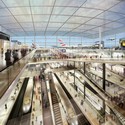
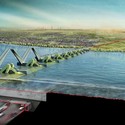
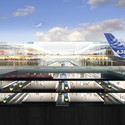
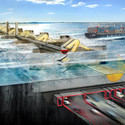
Foster + Partners, Halcrow and Volterra, the team behind the Thames Hub proposal, welcomed reports yesterday that the government will be considering a Thames Estuary Airport when it launches its consultation to discuss options for retaining the UK’s aviation hub status. The proposal, which includes a comprehensive environmental management strategy, is capable of being privately funded and built within 16 years. Estimations for the capital costs include: a new £20 billion, 150 million passenger estuary airport; £20 billion, four track orbital rail line and utilities spine; £6 billion barrier crossing and tidal power generation that will power the airport with green energy; and an additional £4 billion for improving infrastructure.
On behalf of the team, Norman Foster stated, “We welcome reports that the government is considering the case for an estuary airport, and the extra airport capacity that it can provide, when it consults in March on options for retaining the UK’s aviation hub status as part of the nation’s aviation strategy.”
Our friends from architectural videos told us about this video of Norman Foster‘s Humanitas, Oxford University Lecture which took place on November 28th. The lecture considers ‘Heritage and Lessons’ where Foster encourages us to imagine how differently we might understand the modern world if we could travel back in time. We would discover that the cathedrals, the castles and the viaducts that form our ‘heritage’ were once new themselves and were seen as quite alien at the time; and that many of the landscapes we revere as ‘natural’ were in fact shaped subtly by man — some the outcome of the Industrial Revolution itself. We would also find that many of the challenges we face now have been met before.
Thames Hub continues to make progress since Foster + Partners revealed the proposal in early November. The £50bn project includes a £20bn high-speed Orbital Rail line around London; a new £6bn Thames Barrier and crossing; and a £20bn international Estuary Airport, with annual capacity for 150 million passengers. Comprehensive environmental management strategies have been made in order to minimize the impact of development and create significant opportunities for new wildlife habitats.
The future potential to build and realize the concepts of the human mind lie just there, within the potential of the human mind. For years the architectural world has been struggling to keep up with the ability of pen-to-paper and the recent advents in NURB surface computer modeling, algorithmic and parametric architecture. This in-return has led to the building and technology industry playing catch-up with the recent advances in 3D architectural visualizations. In fact, as computer-aided design invaded these practices in the 1980s, radically transforming their generative foundations and productive capacities, architecture found itself most out-of-step and least alert, immersed in ideological and tautological debates and adrift in a realm of referents severed from material production.
Norman Foster has launched proposals for the Thames Hub as “An Integrated Vision for Britain”. The self-funded collaboration between Foster + Partners, Halcrow and Volterra has produced a detailed, holistic vision for Britain’s future development of infrastructure.
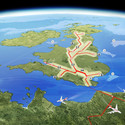
The rapidly population growth and evolving global economy has put pressure on UK’s aged infrastructure. The study describes the Spine, which will combine rail, energy, communications and data throughout the entire length of the UK. The Spine is supported by the proposed Thames Hub, introducing a new river barrier and crossing, an international airport, and a shipping and rail complex.
The Thames Hub plans to maximize Britain trade links with the rest of world, stimulate job creation, and boost the economies of the Midlands and the North by providing direct connections to the cities and markets of Europe.
Continue reading for more detailed information and images.
In the summer of 2009, we shared Foster + Partners and URS Corporation spaceport project in New Mexico. The structure, which is the first spaceport in history, will host commercial operations by private space travel companies, such as Virgin Galactic. Today, we are sharing an update of the project as the Spaceport enjoyed its dedication ceremony a few days ago. Designed to meet LEED certification, The 110,000-plus square foot facility will feature energy-efficient techniques such as earth-tubes that will pre-condition the air to reduce HVAC costs by 50-70%. The architects explained, “The sinuous shape of the building in the landscape and its interior spaces seek to capture the drama and mystery of space flight itself, articulating the thrill of space travel for the first space tourists.”