1. ArchDaily
  2. Modern Architecture

Modern Architecture: The Latest Architecture and News

Antidote to Modernism: Feifei Feng's Bespoke Intervention on Slab Housing in Jinan

Modernism was a stylistic evolution meant to jettison the baggage that had moored culture to habits and historicism. But it was more than an architectural style: it was a new and universal way of life meant to eradicate variability, to relish in the ease of sameness and reproducibility. It’s easy to be seduced by Modernism when you’re talking about motel rooms, or Starbucks, or your shirt size at a favorite store, all instances where replication is reassuring. But the movement’s biggest advocates, governments and developers, pushed the style to its extreme in large housing blocks - a typology long out of fashion in the United States, but which continues to be de rigueur in countries intent on achieving rapid economic expansion and concentrating its populations in urban regions.

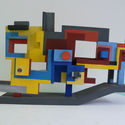
Look at an aerial photograph of the periphery of any Chinese city and you will see the monotony of towers that rise out of the ground like modules on a silicon circuit board. Viewing drabness with cautionary eyes, designer Feifei Feng’s project "Urban Playhouse: A Communal Drama in Seven Acts," proposes a series of interventions, or "acts," on a field of four and six-story slab housing buildings in Jinan, China, adding social spaces ("follies") that are intended to regenerate the spontaneity and theatricality of living in close quarters.

Antidote to Modernism: Feifei Feng's Bespoke Intervention on Slab Housing in Jinan - FacadeAntidote to Modernism: Feifei Feng's Bespoke Intervention on Slab Housing in Jinan - FacadeAntidote to Modernism: Feifei Feng's Bespoke Intervention on Slab Housing in Jinan - FacadeAntidote to Modernism: Feifei Feng's Bespoke Intervention on Slab Housing in Jinan - FacadeAntidote to Modernism: Feifei Feng's Bespoke Intervention on Slab Housing in Jinan - More Images+ 7

Exhibition at Chicago's Graham Foundation to Examine African Modernism

new exhibition opening later this month at Chicago's Graham Foundation seeks to explore the complex history and legacy of modernist architecture in sub-Saharan Africa during the 1960s and 1970s. Architecture of Independence: African Modernism will feature nearly eighty buildings in commissioned photographs by Iwan Baan, Alexia Webster, and Manuel Herz. Alongside archival material, the exhibition "imparts a new perspective on the intersection of architecture and nation-building in Ghana, Senegal, Côte d’Ivoire, Kenya, and Zambia and investigates some of the most compelling yet under-studied examples of 1960s and 1970s architecture worldwide."

These Drone Photographs Reveal the Hidden Geometries of Late Soviet Modernism

Subscriber Access | 

Though the ahistorical dogma of modernism would seem a perfect fit for the Soviet Union’s mandated break with traditions, the architectural history of the USSR was somewhat more complex. Stalin’s neoclassically-inflected socialist realism superseded the constructivist heyday of the early Soviet Union, only to be replaced by a return to modernism under Khrushchev, facilitated by an opening to the West. Architectural photographers Denis Esakov and Dmitry Vasilenko recently used a drone to capture photographs of several landmark structures of the Khrushchev-era return to modernism, focusing on how these aerial views reinforce their rational geometries and regimented forms. Until the recent advent of satellite imagery and commercially available drones, these were views that were only ever seen by the architects, and the officials who reviewed the plans. Even so, the photographer notes that these methodical forms must have been very attractive to the state officers tasked with implementing Khrushchev’s mandated aesthetic.

The photographs, taken in and around Moscow, include works by several prominent Soviet architects. Leonid Pavlov’s long career spanned the full spectrum of state-sponsored architectural styles, starting as a constructivist, and moving into more historicist designs under Stalin, before emerging as one of the Soviet Union’s most prominent post-war modernists. Similarly, Yuri Platonov’s work received extensive state recognition, earning him the title of “People’s architect of the USSR,” as well as awards such the Silver Medal of the Arts Academy of the USSR, the USSR State Prize, and the State Prize of Russia.

These Drone Photographs Reveal the Hidden Geometries of Late Soviet Modernism - Image 6 of 4These Drone Photographs Reveal the Hidden Geometries of Late Soviet Modernism - Image 7 of 4These Drone Photographs Reveal the Hidden Geometries of Late Soviet Modernism - Image 8 of 4These Drone Photographs Reveal the Hidden Geometries of Late Soviet Modernism - Image 9 of 4These Drone Photographs Reveal the Hidden Geometries of Late Soviet Modernism - More Images+ 28

Atelier 2B's "Soft in the Middle" Rethinks Modernism for An Age of Collaboration and Sharing

In his book We Have Never Been Modern, philosopher Bruno Latour concludes that an inability to make humanity and nature inherently separate is one of Modernism’s most misguided tropes. Thus, contemporary designers that hope to riff on or have continuity with modernism must understand that architecture, even at its most aestheticized, is not hermetically sealed off from the outside world - and that therefore modernism is not a plateau of design, but another base camp on the road to further refinement.

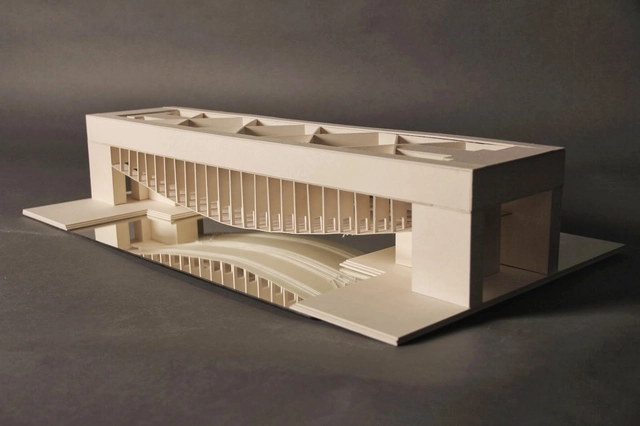
In Chicago, the city where Modernism reached both its metaphoric and physical peak, Atelier 2B, a team of Yewon Ji, Nicolas Lee, Ryan Otterson, recently shared the top-five prize of the Chicago Architecture Foundation's ChiDesign Competition (part of the Chicago Architecture Biennial) for their project Soft in the Middle: The Collaborative Core. Indebted to the legacy of Mies and the International Style, Atelier 2B proposed a Modernist-tower-redux that (externally at least) is composed of three stacked rectangular volumes bisected with terraces, set back from the street by a large public plaza. The project brief called for “a new center for architecture, design and education,” in a competition judged by critics including Stanley Tigerman, David Adjaye, Ned Cramer, Monica Ponce de Leon, and Billie Tsien.

Atelier 2B's "Soft in the Middle" Rethinks Modernism for An Age of Collaboration and Sharing - Facade, CityscapeAtelier 2B's "Soft in the Middle" Rethinks Modernism for An Age of Collaboration and Sharing - Facade, ChairAtelier 2B's "Soft in the Middle" Rethinks Modernism for An Age of Collaboration and Sharing - Facade, ArchAtelier 2B's "Soft in the Middle" Rethinks Modernism for An Age of Collaboration and Sharing - StairsAtelier 2B's Soft in the Middle Rethinks Modernism for An Age of Collaboration and Sharing - More Images+ 3

Video: Bird's Eye View of Brasília's Tesourinhas

Subscriber Access | 

Drone Brasília has shared with us a brief video filmed by a drone that gives a bird’s eye view of a signature feature of Brasília -- the “tesourinhas,” the so-called cloverleaf interchange that the city’s highways form.

In just thirty seconds the video shows the scale of the space, marked by cars traveling through the wide avenues, which themselves are projected onto an expansive green plane.

Build Your Own Paper Models of Polish Modernist Buildings

Build Your Own Paper Models of Polish Modernist Buildings - Featured Image
© Zupagrafika

After the successes of their London and Warsaw series, Zupagrafika has released another collection of paper cutouts called Blokowice based on the city of Katowice in Poland.

Inspired by the architecture of the Upper Silesian Industrial Region, Blokowice features modernist and brutalist buildings from the 1960-80s. The collection includes the Spodek and Superjednostka, two iconic buildings from the city center, Osiedle Gwiazdy, a characteristic star-shaped estate, Osiedle Odrodzenia, prefabricated panel blocks from the outskirts of the city, and the controversial Katowice railway station building that was demolished in 2011.

Build Your Own Paper Models of Polish Modernist Buildings - Image 1 of 4Build Your Own Paper Models of Polish Modernist Buildings - Image 2 of 4Build Your Own Paper Models of Polish Modernist Buildings - Image 3 of 4Build Your Own Paper Models of Polish Modernist Buildings - Image 4 of 4Build Your Own Paper Models of Polish Modernist Buildings - More Images+ 14

What Can Piketty Teach Us About Architecture?

Last year, Thomas Piketty's Capital in the Twenty-First Century took the world of economics by storm. His historical analysis and critique of the capitalist system fed perfectly into the wider narrative being constructed in the wake of the global financial crisis. But what lessons does Piketty hold for architects? In an article for The Architect's Newspaper, OMA partner Reinier de Graaf examines the way that the development of architecture in the 21st century mirrored that of economics, as the design of buildings became simultaneously a symptom and a cause of trends in capital. Read the full article - including de Graaf's question for the architects of the 21st century - here.

Modernism Memorial: A Funerary Monument for the Death of Modernism

Modernism Memorial: A Funerary Monument for the Death of Modernism - Featured Image
Courtesy of Archstudies.gr

Archstudies.gr and DeCorbuziers, in partnership with the School of Architecture of the National Technical University of Athens, have announced their international student competition to design a conceptual funerary monument for the death of Modernism.

With this year marking the 50th anniversary of Le Corbusier’s death, the team of organizations is seeking “contemporary interpretations concerning multidisciplinary approaches over Modernism and specifically over Le Corbusier’s work, while [exploring] possible themes and directions of the memorial representation” in present day. Designs should emphasize commentary, rather than a tribute to Le Corbusier.

What Does Germán Samper See When He Draws?

Subscriber Access | 

Hiding out from the gentle Bogotá rain, a cat with turquoise eyes and a black and white coat prowls along the ledge of an office hidden in the midst of lush vegetation. A large window with a wooden frame filters the light and illuminates the interior: a desk, hundreds of books, manila folders, and backlit pictures. Sitting comfortably in his chair, 91-year-old Colombian architect Germán Samper takes a pencil, presses it to the surface of a sheet of paper, and begins to explain everything he is saying by drawing for us in the most clear and simple manner possible.

Whether he's giving instructions on taking a taxi in Bogotá or explaining the recent modifications to the historic Colsubisdio citadel, Samper -- a master of Colombian architecture -- can express ideas on paper with an ease that makes us think that drawing might be very simple, but it's really just a great trick.

Perseverance is key and Samper knows this from experience. "I don't understand why architects don't draw more if it is truly a pleasure," he ponders.

After the break, a conversation with Germán Samper and a series of unedited sketches by the Colombian architect.
Zaha Hadid: “Niemeyer Had an Innate Talent for Sensuality”

The first woman to receive the Pritzker Prize in 2004, Iraqi architect Zaha Hadid tells newspaper El País that she was fortunate as a child to have traveled with her parents and seen some of the world’s most impressive works of architecture and engineering feats.

Awed by the Mosque of Cordoba, Hadid says that the contrast between the darkness and the marble of the central church left a lasting impression, making this one of her favorite works to this day. 

Symposium: "Modernism" / Dallas Architecture Forum

Leo Marmol is one of the world’s leading authorities in the restoration of iconic Mid-Century Modern and International style residences, including the Kaufmann House by Richard Neutra in Palm Springs, considered one of the most important residences of the 20th Century. His firm also incorporates those timeless concepts into new architecture, including product design exemplifying these design elements. Marmol will overview his firm’s landmark restoration projects, and discuss how the firm integrates Mid-Century design elements into their new construction and pre-fab projects, producing award-winning residences.

Lamenting the Loss of Hotel Okura, One of Tokyo's Modernist Gems

The news last year that the Hotel Okura, often described as one of Tokyo´s "Modernist gems," was to be demolished was met with widespread disappointment across the board. Built in 1962 under the design direction of Yoshiro Taniguchi, Hideo Kosaka, Shiko Munakata, and Kenkichi Tomimoto, the hotel has long been considered a significant architectural landmark in the Japanese capital. With only a week to go until the hotel checks out its last guest, Monocle—having been granted exclusive access—have shared with us a film to capture "the gracious ways of this much-loved building."

Gallery: Tour Chandigarh Through the Lens of Fernanda Antonio

Subscriber Access | 

Gallery: Tour Chandigarh Through the Lens of Fernanda Antonio - Image 1 of 4Gallery: Tour Chandigarh Through the Lens of Fernanda Antonio - Image 2 of 4Gallery: Tour Chandigarh Through the Lens of Fernanda Antonio - Image 3 of 4Gallery: Tour Chandigarh Through the Lens of Fernanda Antonio - Image 4 of 4Gallery: Tour Chandigarh Through the Lens of Fernanda Antonio - More Images+ 56

Le Corbusier and Pierre Jeanneret built sublime works amidst the unique landscape of Chandigarh, at the foothills of the Himalayas. They gave the city a new order, creating new axises, new perspectives and new landmarks. Built in the 1950s and early 1960s, the buildings form one of the most significant architectural complexes of the 20th century, offering a unique experience for visitors.

Architect and photographer Fernanda Antonio has shared photos with us from her journey throughout the city, capturing eight buildings and monuments, with special attention given to Le Corbusier’s Capital Complex. View all of the images after the break.

What Will the Future Hold for SOM's Modernist Arena in Portland?

Built in 1960 and designed by Skidmore, Owings, and Merrill, the Veterans Memorial Coliseum in Portland—a modernist gem on the National Register of Historic Places—could soon face destruction, as the city council prepares to take a vote deciding between restoration or demolition.

Since the Moda Center, better known as the Rose Garden, was built next door and became the new host of the Portland Trail Blazers basketball team, the Memorial Coliseum has been in a state of decline. Currently, the building generally only hosts infrequent concerts, as well as minor league hockey. However, Friends of Memorial Coliseum see it as much more than just an outdated venue, which is why since the building was first threatened with demolition in 2009 they've been campaigning for its preservation.

What Will the Future Hold for SOM's Modernist Arena in Portland? - Image 1 of 4What Will the Future Hold for SOM's Modernist Arena in Portland? - Image 2 of 4What Will the Future Hold for SOM's Modernist Arena in Portland? - Image 3 of 4What Will the Future Hold for SOM's Modernist Arena in Portland? - Image 4 of 4What Will the Future Hold for SOM's Modernist Arena in Portland? - More Images+ 5

NYT Style Magazine Explores the Cultural Reasons Behind the Demolition of Japan's Hotel Okura

About a year ago, it was announced that Hotel Okura, one of Tokyo’s best-known modernist landmarks, was headed for demolition. With the impending demolition date of the hotel, deemed a “beautiful orphan child,” set for this September, an article from T: The New York Times Style Magazine’s upcoming Women’s Fashion issue looks at Japan's "ambivalent — and unsentimental — relationship with its Modernist architecture."

Open Call: Chandigarh Unbuilt Competition to Complete Le Corbusier's Capitol

Online international competition organizer archasm has launched its “Chandigarh Unbuilt: Completing the Capitol” ideas competition, which seeks designs to finalize and complement Le Corbusier’s Capitol Complex in ChandigarhIndia.

Three buildings at the complex have been built according to Le Corbusier’s plans—the Secretariat, Assembly Hall, and High Court—but the fourth and final building, called the Museum of Knowledge, has yet to be conceptualized.

Calvin Seibert Sculpts Impressive Modernist Sandcastles

Subscriber Access | 

“I always had an affinity for architecture which I attribute to growing up in a neighborhood and town that was constantly under construction. Our house was the first on the block. I think that in a way I was more interested in the abstractness of the foundations and the initial framing then in the completed structures themselves. Things I made back then had that incompleteness about them. As I became more aware of architecture in the wider world Brutalism was one of the styles of the moment. Looking at architecture magazines as a child and seeing hotels in French ski resorts (Marcel Breuer at Flaine) made of concrete suited my sensibility, I was hooked.”

For New York-based Calvin Seibert, sandcastles are more than just a fun summer hobby. Using a paint bucket, homemade plastic trowels, and up to about 150 gallons of water he creates spectacular modernist sandcastles. Read on after the break for an interview with Seibert and to see more photos of his work.
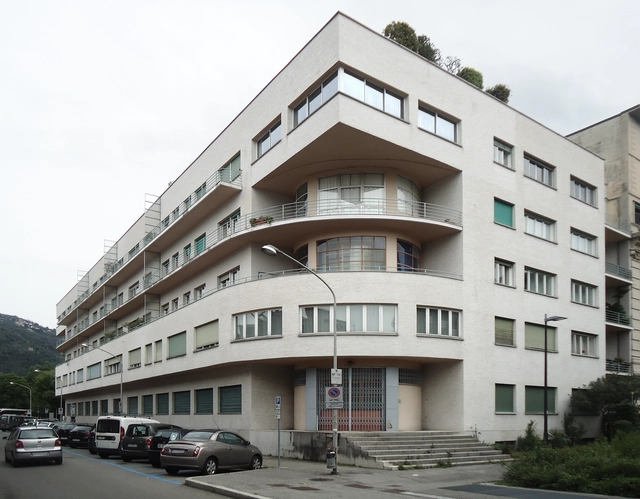
Calvin Seibert Sculpts Impressive Modernist Sandcastles - Image 1 of 4Calvin Seibert Sculpts Impressive Modernist Sandcastles - Image 2 of 4Calvin Seibert Sculpts Impressive Modernist Sandcastles - Image 3 of 4Calvin Seibert Sculpts Impressive Modernist Sandcastles - Image 4 of 4Calvin Seibert Sculpts Impressive Modernist Sandcastles - More Images+ 12

Monocle 24 Visit Richard Neutra's Residences in Los Angeles

In the latest episode of Section D, Monocle 24's weekly review of design, architecture and craft, the team visit Richard Neutra's iconic modernist Neutra VDL Studio residential complex and Residences in Los Angeles. Though Modernism has often been criticised for imposing universal rules on people and areas, it was Neutra's intense client focus that won him acclaim.

Monocle 24 Visit Richard Neutra's Residences in Los Angeles - Image 2 of 4