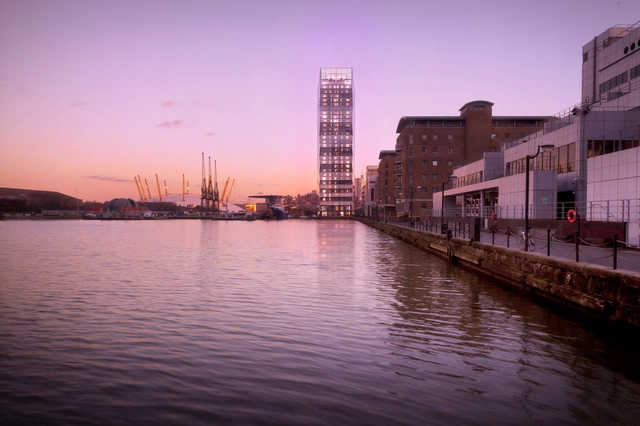
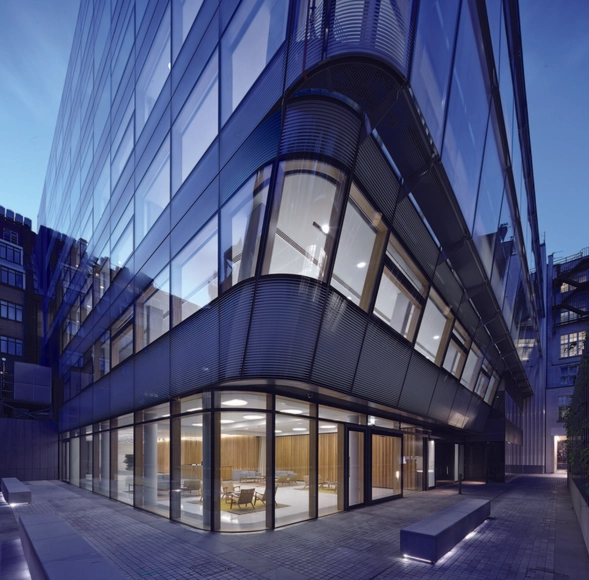
PLP Architecture has released their new design for a skyscraper at 22 Bishopsgate. Set to be 278m tall, it will be the tallest building in the City of London, second only to the Shard in the UK. The site was originally home to the Pinnacle, a slightly taller proposal that stopped work in 2012 due to economic restraints. Located in the midst of the city’s cluster of tall buildings, the new design will pick up where the Pinnacle left off, reusing the already built foundations and basements. Read more about this new development in London after the break.
Last month, as part of their Park Nights event series, COS assembled Spanish architects José Selgas and Lucía Cano (SelgasCano) at their new pavilion for the Serpentine Gallery in London's Hyde Park to discuss the concepts behind their design and the history of the Pavilion Commission with Serpentine directors Julia Peyton-Jones and Hans Ulrich Obrist. They were joined by Chilean architect Smiljan Radić, designer of the 2014 pavilion, and Japanese architect Sou Fujimoto, designer of 2013's, in an hour long conversation moderated by Sarah Ichioka.
The winner of a competition for a mixed-use building scheme, London-based Kamvari Architects has unveiled the design for Zartosht, a 300,000 square-foot retail and office building in Tehran, Iran. The building's design is based largely on local cultural contexts, like the region’s reputation for renowned fabric and textile shops, and environmentalism, particularly with respect to solar energy.
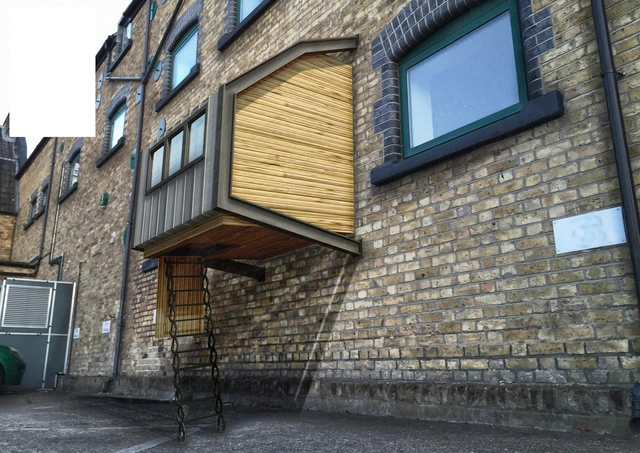
Exterior Rendered View. Image Courtesy of James Furzer
The 6th annual “Space for New Visions” competition has announced its winner: a project entitled “Homes for the Homeless,” by James Furzer of Spatial Design Architects. Hosted by FAKRO, a global manufacturer of roof windows and loft ladders, and A10 Magazine for European Architecture, the competition sought proposals that incorporated FAKRO products. With entries from around the world, projects were judged based on user comfort, environmental impact, functionality and natural light, among other things. Read about the winning entry after the break.
"London is on the verge of being ruined for all future generations," says Alain de Botton – a Swiss philosopher, notable author and founder of The School of Life and Living Architecture. "With a whopping 260 towers in the pipeline no area is safe, as planners, property developers and the mayor's office commit crimes against beauty to create fun buildings." In a film for The Guardian De Botton explains why he believes we're right to be nervous – and how we can stop this "clear desecration" of the UK's capital city.
The city of London has been growing rapidly in the past decade, and with the help of New London Architecture's large-scale urban model of the city, some strange and interesting trends can be seen. Since the advent of ever-taller buildings, London has put laws into place to prevent views to historically significant buildings like St. Paul’s Cathedral and the Parliament Building from being blocked. As a result, strangely-shaped designs like the Leadenhall Building, endearingly referred to as the “cheese grater” by Londoners, have emerged as a way to work around the sightlines enforced by the city. Watch the video above for more on this interesting design dilemma.
The Royal Academy of Arts in London have launched a new international ideas competition which aims "to refocus attention to the huge potential of the brownfield sites that still exist across London." 'Brownfield' sites, or those earmarked for potential building development that have had previous development on them, are plentiful in the UK capital. This competition seeks "speculative ideas [which] make the most of these missing pieces in London’s urban jigsaw."
Building a city has never been so easy. With Duncan Shotton Design Studio's Sticky Page Markers you can create your own urban landscape, while marking the pages of your books, catalogues, or notes.
New London Architecture (NLA) has named the winners of this years New London Awards, celebrating the best projects and architects shaping London today. Taking home top honors, Zaha Hadid was crowned "New Londoner of the Year" for her influential work, both in the UK and abroad. The jury commended Hadid for "her role as a champion of design to both the government and the general public alike," citing her success with the London Aquatic Center and the Serpentine Sackler Gallery.
Out of the 51 projects awarded, Pringle Richards Sharratt's Black Cultural Archives (BCA) in Brixton was named London's best new building. The Grade II listed structure, which had been on the English Heritage's Heritage at Risk Register since 1992, was restored as a new home for BCA’s extensive archives, serving as an exemplar for preservation and reuse.
Alice Theodorou, a graduating masters student from London'sRoyal College of Art, has developed a project which attempts to combat the challenges that London is set to face over the next 10,000 years. Her scheme factors in projections for population growth and then decline, rising sea levels, stricter energy targets, material depletion, future space exploration and, most interestingly, language obsolescence.
In the latest episode of Monocle's Section D, Josh Fehnert talks to Ben van Berkel, co-founder and principal of Amsterdam-based UNStudio, about London's new Caneletto residential tower. The office, which was founded in 1988, has completed projects around the world ranging from Rotterdam’s Erasmus Bridge to the Mercedes-Benz Museumin Stuttgart. With over 81 built projects, and 54 currently in progress (including Raffles City in Hangzhou and Scotts Tower in Singapore), London’s Canaletto Tower (which is due to be completed in 2015) marks the practice’s first major project in the UK. The tower, located at the confluence of two London districts — Islington and Shoreditch — marks a significant moment for the Dutch practice's œuvre.
Videos
Courtesy of Balmond Studio & Studio Libeskind
The violent insertion of Daniel Libeskind’s Spiral into the Victorian neighborhood of South Kensington renders a cataclysmic disruption into a landscape of order and propriety. It envisions a rupture in the fabric of space and time, aggressively anachronistic from the building it adjoins, unapologetically appealing not to cultured humanism but to the mathematical logic of complexity and chaos. What is now textbook "Libeskind" was in 1996 a shocking non-starter for the London establishment, an unacceptable risk for a city perpetually torn between its agitated cosmopolitan energies and its quintessential impulse toward nostalgia and restraint. Nearly twenty years after the Spiral was selected as the winner of a distinguished international competition, this controversial extension proposal for the Victoria and Albert Museum remains unbuilt.