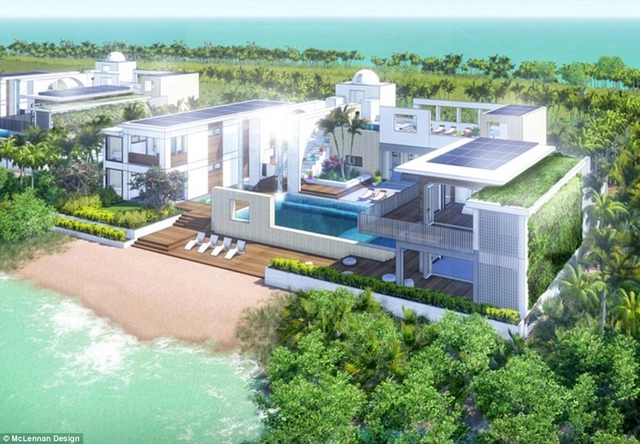
Founder of the Living Building Challenge, sustainability aficionado and architect Jason McLennan has been commissioned by famed actor Leonardo DiCaprio to design a 68-vila eco-resort on a private island in Belize. As The New York Times reports, the ambitious 42 hectare (104 acres) "Blackadore Caye, a Restorative Island" will be carried out by New York developer Delos by 2018.
The resort will feature an arc of floating suites built over the water and a network of artificial reefs and fish shelters, along with 48 millionaire villas and an indigenous plant nursery focused on manatee conservation.
“My goal was always the fact that I wanted to create something not just environmental, but restorative,” said DiCaprio to the newspaper. “A showcase for what is possible.”
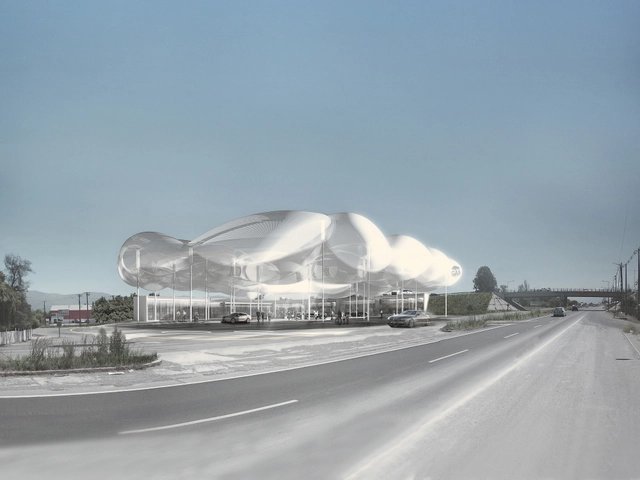
Where the Panamerican Route passes along Rancagua, Chile, it does so in a seemingly interminable straight line, intersecting with the H-35 toward the Pacific and the Andes. At this junction between two of Rancagua's arterial roads German practice raumspielkunst has envisioned "The Cloud," a new form of self-sufficient gas station.
Responding to the nature of its site as a meeting point between the industrial and the touristic, the environmentally efficient gas station would cater for thousands of commuters each day.
Searching for an alternative to costly and resource intensive materials, Mexican company Plastinova has developed a wood substitute from a byproduct of tequila and recycled plastic which it claims is not only renewable, but also stronger than the materials that it hopes to replace.
Sydney Opera House recently created a video exploring how Jørn Utzon was inspired by the form and function of nature. While Jørn Utzon may not have seen himself as a pioneer of sustainable techniques, sustainability was inherent in his design philosophy. Watch the video above to learn more.
Walk21 Vienna has launched its Walking Visionaries Awards, a challenge that invites people from around the globe to explore the many ways walking can be implemented into our daily lives to support sustainable and livable cities. Submit a solution now through April 30, 2015 for a chance to participate in the Walk21 Conference in Vienna, Austria in October 2015. 30 winners will receive a free ticket to the conference and given the chance to meet leading professionals and share their ideas with other visionaries through mediums such as lectures, round table discussions, and workshops. Additionally, the winners' solutions will be published in the conference documentation. Selected by both public opinion and a jury vote, winning submissions will be announced in June 2015. For more information or to submit an idea, visit walk21vienna.com.
"What I'm trying to look at is how do we make humans supportive of a natural world, in the way that the natural world is supportive of us?" In the latest installment of Arbuckle Industries'Archiculture interviews, architect, educator, environmentalist, and author Bill McDonough discusses some of the challenges and themes he has seen in our built environment. He focuses on environmentalism in architecture through the lens of carbon neutrality and the problems with that principle. He goes on to address some of his solutions, including a Cradle to Cradle design approach which changes the way environmental problems are tackled.
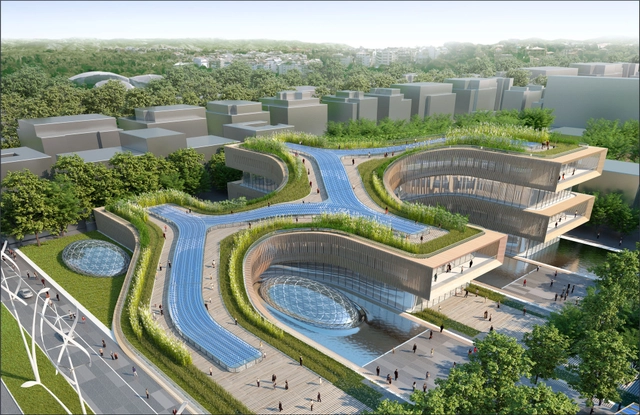
Developed for an international planning and architectural competition, this proposed masterplan for the Città della Scienza by Vincent Callebaut Architectures, coffice - studio di architettura e urbanistica, and Studio d'Architettura Briguglio Morales fuses sustainability with history to propose a self-sufficient urban ecosystem in Italy. Operating on the principle of living facades, the Città della Scienza revitalizes the forgotten military district into a vibrant, continually regenerating living city.
Read on after the break for a closer look at the plan.
"I must reorganize the environment of man by which then greater numbers of men can prosper,” says Buckminster Fuller in this rare interview on the Geodesic Life with Studs Terkel (recorded in 1965 and 1970). Animated by Jennifer Yoo and produced by Blank and Blank, this interview has been brought to life as the first of “The Experimenters” mini-series that features rare interviews with Bucky, Jane Goodall, and Richard Feynman focusing on science, technology and innovation.
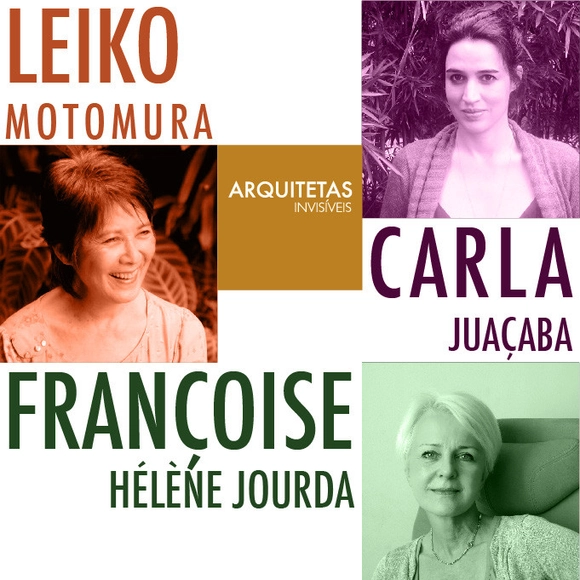
To celebrate International Women’s Day, we asked the Brazilian non-profit group Arquitetas Invisíveis to share with us a part of their work, which identifies women in architecture and urbanism. They kindly shared with us a list of 48 important women architects, divided into seven categories: pioneers, “in the shadows,” architecture, urbanism, social architecture, landscape architecture and sustainable architecture. We will be sharing this list over the course of the week.
Today, in the last post of the series, we present the female architects who put an emphasis on sustainability.
In the United States alone, more than 125 million plastic bottles are discarded each day, 80 percent of which end up in a landfill. This waste could potentially be diverted and used to construct nearly 10,000, 1200-square-foot homes (taking in consideration it takes an average of 14,000 plastic bottles to build a home that size). Many believe this process could be a viable option for affordable housing and even help solve homelessness.
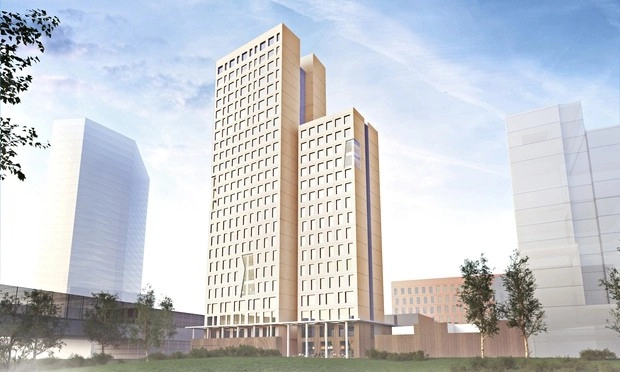
Rüdiger Lainer and Partner plans to construct the world’s tallest wooden skyscraper next year in Vienna’s Seestadt Aspern area. 76 percent of the 84-meter tower is expected to be made from wood rather than concrete, saving approximately 2,800 tonnes of CO2 emissions (equivalent to driving a car 25 miles a day for 1,300 years).
“I think it is important everyone now in 2014 thinks in different ways. We have wood, which is a perfect construction material for building,” she said. “It was used 200 years ago and it was perfect then and is perfect now,” says Kerbler project developer Caroline Palfy, commenting on the architects’ decision to use wood due to its environmental benefits.
An interior loft view and more details, after the break.
"...In many of our architecture schools [...] we're finding that the students themselves are asking for a more socially-conscious and a more environmentally-conscious kind of architecture, a kind of architecture that really serves human needs." In the latest Arbuckle Industries' Archiculture interview, former Boston Architectural College President Ted Landsmark discusses his experience in the industry. He delves into the demographic trends that make up the field of architecture today, and the influence these have on the work that is being done. He also touches on the "privileged" ideology associated with architecture, and how the shifting global demands and client preferences are abandoning this mentality.
The Curtin University Master Plan has become the first project to receive a 5 Star Green Star-Communities Rating by the Green Building Council of Australia (GBCA). Helmed by AECOM and Donaldson and Warn architects, the plan sets forth a strategy for the renewal of the University's main campus in Bentley, Perth, aiming to create a "vibrant urban community" that combines commercial, retail, residential, educational, and transport infrastructure. Sustainability is a cornerstone of the project, which seeks to be adaptable to, and respectful of, its site and heritage.
The 5-star rating honours Australian Excellence in "innovation, design excellence, environmental sustainability, economic prosperity and liveability". Learn more about the project and view selected images after the break.
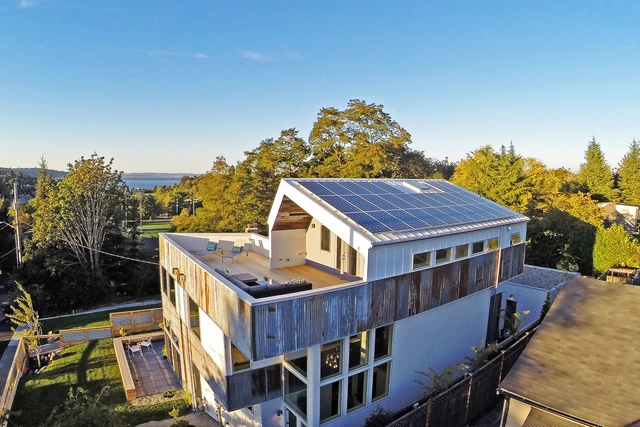
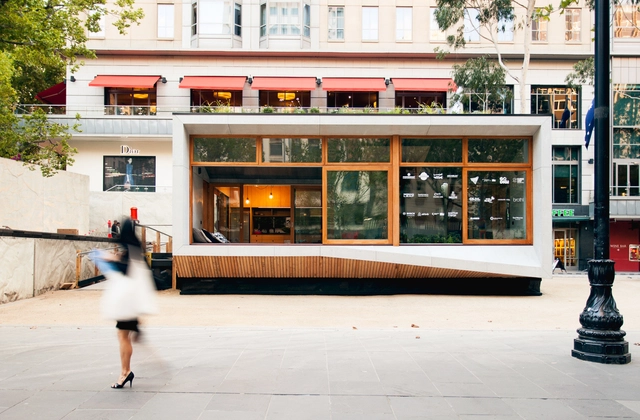
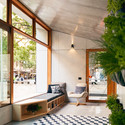
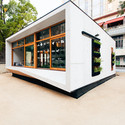
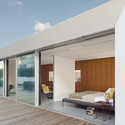
Australian company ArchiBlox has released its design for the world’s first carbon positive prefabricatedhouse. Representing a new movement in ArchiBlox houses, the carbon positive house provides the option for a more environmentally-conscious design, through both reducing embodied energy that accompanies new-home construction and maintaining positive-energy production. The groundbreaking product line began its first installation on February 8 at Melbourne’s City Square.
Largely overlooked in the development of Modernism, timber architecture is making a comeback in the 21st century with the success of designers such as last year's Pritzker Prize winner Shigeru Ban, and the push toward timber towers from large influential firms such as SOM. In the following extract, author Joseph Mayo introduces his new book, "Solid Wood: Case Studies in Mass Timber Architecture, Technology and Design," which examines the rise of mass timber design through historical analysis and contemporary case studies.
Few books have addressed the use of wood in large, non-residential buildings. While light frame construction and residential resources are common, little has been written about the use of wood in taller, urban, commercial and institutional buildings. Solid Wood presents a survey of new timber architecture around the world to reveal this construction type’s unique appeal and potential. Not surprisingly, enthusiasm for solid wood architecture (also known as mass timber architecture) and engineering is now growing rapidly among a new generation of architects and designers.
https://www.archdaily.com/600021/solid-wood-the-rise-of-mass-timber-architectureJoseph Mayo





















.jpg?1423355313&format=webp&width=640&height=580)
.jpg?1423355230 "© Zooey Braun")


.jpg?1423355313)
