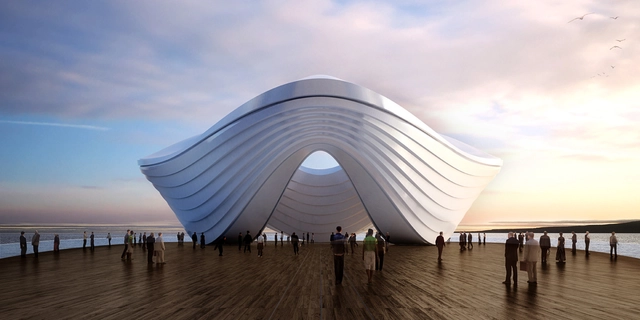
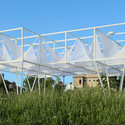
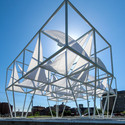
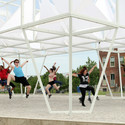
Chun Qing Li, founder director of London-based KREOD, has revealed planes for a 1,200 square meter international trade pavilion for the 2016 Rio Olympics. Floating on a platform in the Barra de Tijuca lagoon, adjacent to Olympic Park, the pavilion is expected to bring together entrepreneurs and industry leaders from Brazil, the United Kingdom and China to discuss future of business and showcase their products.
Lebanese design firm GM Architects will be presenting its “Museum of Civilization” at the Time Space Existence exhibition of the 2014 Venice Biennale. The firm will be the only group representing Lebanon at this year’s exhibition. Their museum design addresses the Biennale’s theme of fundamentals by exploring the historical basis of architectural culture in the rich and varied context of their home country.
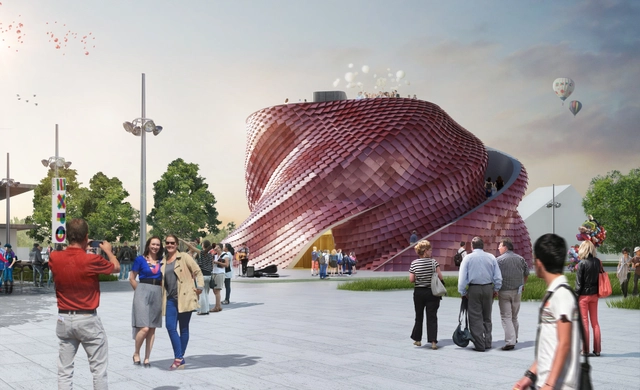
Daniel Libeskind has unveiled designs for Vanke’s first ever overseas pavilion for the 2015 Milan Expo. Clad in a self-cleaning, air purifying, metalized tile, which was designed by Libeskind in collaboration with the Italian company Casalgrande Padan, the “red serpentine-like” structure reinterprets the traditional Chinese Shitang (dining hall).
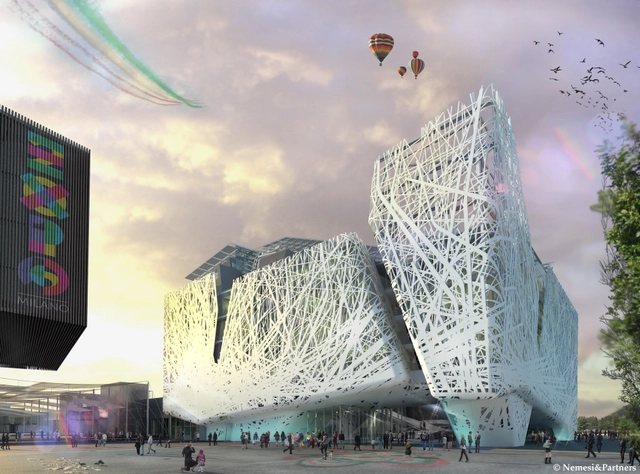
Roma-based Nemesi & Partnershas designed a 13,000 square meter “urban forest” that will serve as the Italian Pavilion at the 2015 Milan Expo. Enveloped within an intricate, branch-like skin, the six-story lattice structure will be made from 900 panels of “i.active BIODYNAMIC” cement that will “capture” air pollutants and convert them into inert salts.
Repurposing antiquated buildings is on the rise in China, and this proposal by Tianhua Architecture Design Companyserves as a prime example. Planned for a site in the Hexi district of Tianjin, the Shanghai-based practice will soon transform a 1917 textile mill into a contemporary art gallery and private museum.
The architects, who have adapted their design to emphasize the gridded layout and high ceilings of the existing structure, plan to insert a garden courtyard deep into the building’s core. This will not only counterpoint the structure’s industrialized aesthetic, but will provide natural light deep into the interior while preserving the exiting cruciform layout.