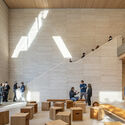
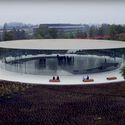
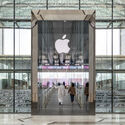
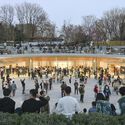
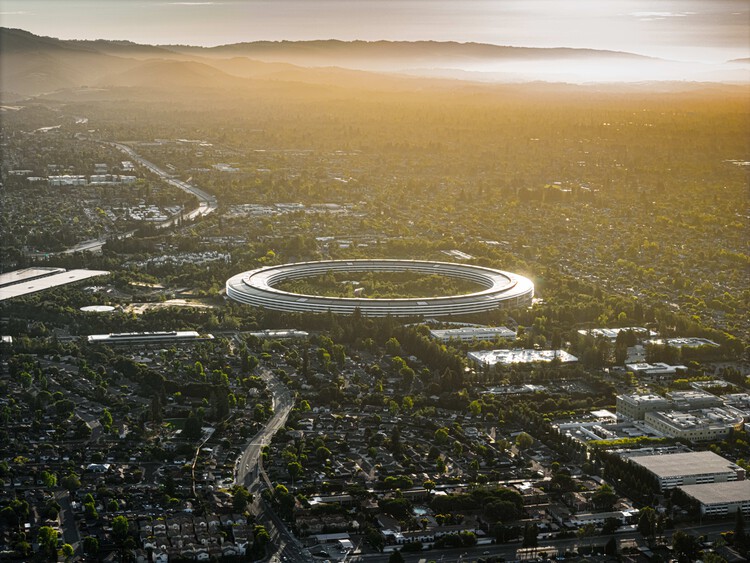
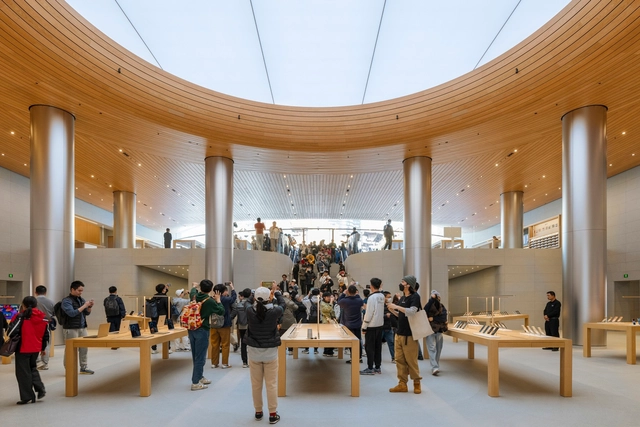
In 2026, Apple marked fifty years since its founding. Over the past two decades, Apple has developed a consistent architectural language that extends its brand into the built environment, transforming stores, workplaces, and public-facing spaces into active components of its identity. These environments guide movement, frame interaction, and condition the ways in which users encounter both products and the company itself.
From the handheld device to the urban interior, Apple has sought to maintain a high degree of control over form, material, and experience. Architecture becomes part of this system when the company begins to define how it is perceived and engaged with in physical space. Research on retail environments has shown how spatial layout, visibility, and circulation patterns can shape behavior and interaction, turning architecture into an interface between brand and user.
Design disciplines, like user experience (UX) design, have evolved to excel at devising experiences that make digital interfaces navigable. They accomplish this through a deep understanding of user needs and by mapping user journeys with meticulous attention to detail. The city represents a physical interface experienced by multiple users - residents, tourists, people of various ages and genders each experiencing it uniquely. In a time where digital interfaces are crafted for frictionless user experiences, why do many cities remain challenging to navigate?
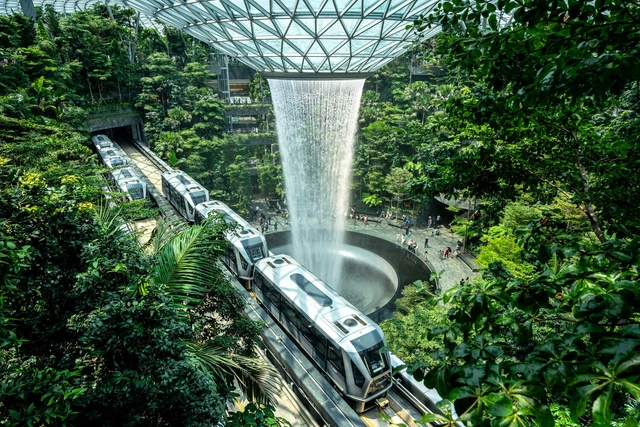
Air travel has opened up multiple avenues for travel experiences. Lately, these transitional spaces have become destinations themselves, with airports like the Hong Kong International Airport and Incheon International Airport commanding over 60 million visitors per year. Airports are often the first and last impression of a city, and designers and city planners are recognizing their role in telling a place's brand story. As hubs of both travel and tourism, these airports aim to blend functionality with cultural engagement, offering passengers a taste of the local flavor before they even leave the terminal.
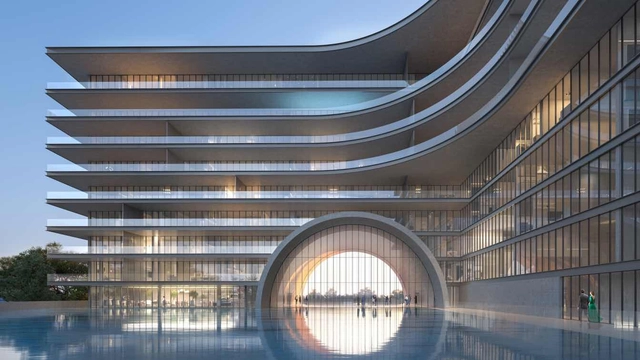
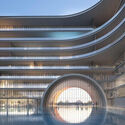
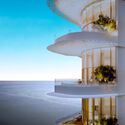
Metropolitan cityscapes come with the appeal of sophistication, luxury, and exclusivity. Their glittering skylines and vibrant energy attract thousands of tourists and residents seeking luxurious experiences every year. Catering to this market, several renowned brands and real estate firms have teamed up to offer "branded residences" – a modern typology that elevates hotel-like living into a daily delight.
The concept of branded residences can be traced back nearly a century to 1927 when New York City's Sherry-Netherland Hotel and Apartments joined forces with the famous Sherry's restaurant. Over the past decade, the trend has witnessed a 230% growth with over 580 developments from 133 brands equating to nearly 100,000 residential units established worldwide. The drive for this demand goes beyond aesthetics and architectural grandeur. World-class services and amenities such as spas, fitness centers, private cinemas, and concierge services offered by luxury housing developments build on a sense of indulgence.
To differentiate themselves in competitive markets, the world's favorite retailers are tapping into retail design to cultivate communities of brand enthusiasts. Since traditional marketing methods no longer engage customers, physical spaces offer an avenue for more immersive and personalized experiences that match their values and lifestyles. Evolving customer preferences have led to the creation of authentic retail experiences that serve now as areas of recreation and entertainment. Designing outlets that encourage engagement, exploration, and a sense of belonging enables brands to foster loyal followings.
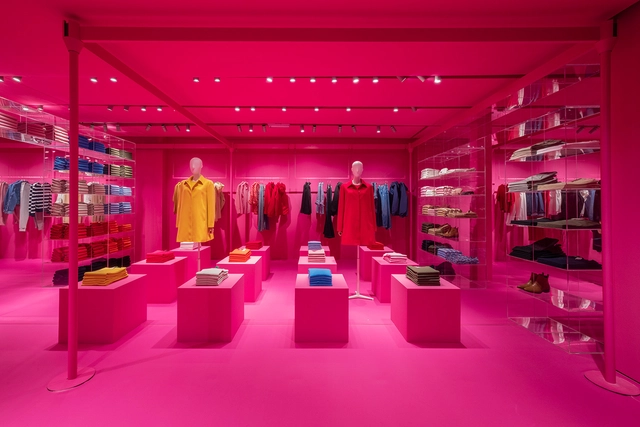
Benetton's physical store to mimic its virtual environment. Image Courtesy of Benetton
The evolution of retail design warrants a study of architectural practice in the digital realm. While physical commercial spaces have been the conventional center of shopping experiences, the emergent frontier of the metaverse—an interconnected network of virtual 3D environments—indicates an important shift in brand-consumer interactions. For architects, this liminal space presents a unique canvas, free from the material constraints that have traditionally molded design ideations. The metaverse is a new terrain where the architecture of imagination may be fully realized, inviting a reconceptualization of retail design possibilities.
The Second Studio (formerly The Midnight Charette) is an explicit podcast about design, architecture, and the everyday. Hosted by Architects David Lee and Marina Bourderonnet, it features different creative professionals in unscripted conversations that allow for thoughtful takes and personal discussions.
A variety of subjects are covered with honesty and humor: some episodes are interviews, while others are tips for fellow designers, reviews of buildings and other projects, or casual explorations of everyday life and design. The Second Studio is also available on iTunes, Spotify, and YouTube.
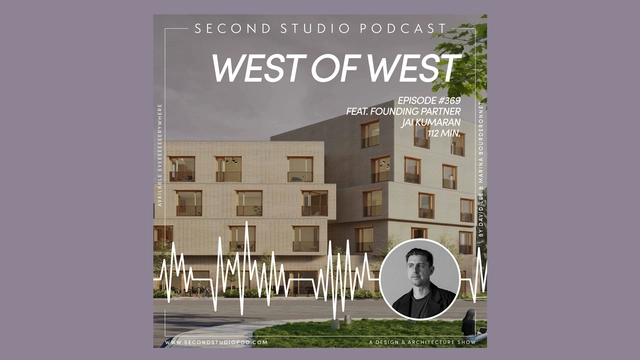
This week David and Marina of FAME Architecture & Design are joined by Architect Jai Kumaran, founding partner of West of West to discuss his background; the influence his father’s work had on his career; attending architecture school; why he pursued a master’s degree; starting and growing an office; exploring project types; branding in architecture; and more!
Spacon & X is a Copenhagen-based design and architecture studio that works to create spatial identity across different mediums. Their cross-disciplinary work boasts a fusion between traditionally separated fields, contributing to a holistic physical brand experience. Chosen by ArchDaily as part of our 2023 New Practices, the studio works with an explorative approach to architecture, design, event planning, and production.
The studio is run by three partners who each come from different backgrounds: Architecture, Fashion Design, and Scenographic Design. In an interview with Nikoline Dyrup Carlsen, Svend Jacob Pedersen, and Malene Hvidt, ArchDaily delves into their practice, exploring their distinct skill sets and their collaborative and exploratory work ethic. The interview also goes beyond the practice, discussing their unique methodology and commercial business development strategy. Housing 25 employees with various backgrounds, the studio includes architects, carpenters, building constructors, and craft makers and is dedicated to pushing the boundaries of design and architecture.
Branding for architects isn’t just about having a beautifully designed logo. In fact, when it comes to promoting your architecture firm, a distinctive brand is fundamental to communicating what makes your firm unique and different.
In our experience at Archmark branding and rebranding architecture firms, construction companies, and home service providers over the past ten years, we have developed a strategic process that makes branding easier than expected and reveals surprising results. In this article, we share the same steps we take with our clients so you apply them to your own branding efforts.
Dramatic societal transformations- such as pandemics and technological advancements - call for dramatic shifts in lifestyles. Architects keep up by exploring and proposing new models of housing, each iteration catering to society’s latest needs. The co-living model is one such example that has become a roaring success over the past few decades. Redefining the way people live, co-living seeks to provide a form of cost-effective social housing. Although widely targeted at younger generations, the co-living industryis evolving to cater to various niche groups.
When one steps into a Starbucks, they almost instantly know they are in the famed coffeehouse, and not at a McDonald's. Apart from the uniformed staff and a giant sign at the door, there are countless other factors that make a Starbucks look like a Starbucks. Textures, materials, shapes, colors, layouts, furniture, and lighting all contribute to the experience of being in a branded environment. These elements are replicated globally to create an identifiable image. As economic patterns change, brands are looking at extending their identities into spatial experiences in order to better engage with their customers in their daily lives.
The 1970’s were a dark time for New York City. While the economy was down, crime rates were at an all-time high. The negative public image also kept tourists away, driving the city into a financial crisis. To change perceptions about The Big Apple, the New York State Department for Economic Development approached advertising firm Wells Rich Greene to create an inviting marketing operation. After 45 years, the resulting I Love NY campaign remains fresh in the minds of locals and tourists, successfully revamping New York City’s brand. Cities across the world like Paris, Amsterdam and Jerusalem have similarly invested heavily in constructing magnetic brands for themselves.
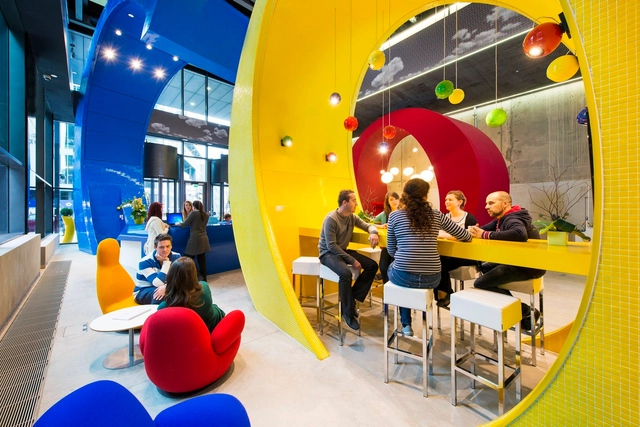
Architecture, unlike other aspects of culture (such as fashion or music), can only really be experienced and understood in person. For highly branded companies, designing a new building can be a prime opportunity to signal taste and values - but also creates an interesting architectural conundrum. While the buildings will be inhabited (nearly 24/7) by company employees, they’re also very much populated by the imaginations of people across the globe. What is it like to be in these places?
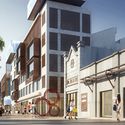
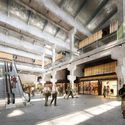
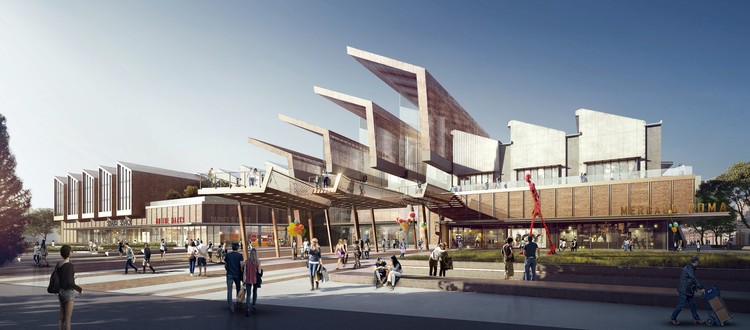
Fosun Group hired Woods Bagot to transform commercial planning of Dahua, an 82-year-old historic textile mill, into China’s next retail and entertainment district. Located in Xi’an’s urban center, the site sits next to Daming Palace, the Tang Dynasty’s royal residence and a national heritage site which attracts thousands of tourists each year.
Update:The deadlines for this opportunity have been extended
Call For tutors : Extended till January 28
Call for participants : Ends on February 28
MEDS workshop “Meetings of Design Students” is an international workshop that takes part each summer in a different country, focusing on various issues, themes, topics and settings that will help any designer expand their expertise. It is a chance to get in touch with diverse approaches to design, different building techniques, traditions and skills. MEDS workshop is both practical and educational because it focuses not only on creative theoretical designs, but actually compels participants to execute these designs during the 2-week span of the workshop. You can apply to MEDS as a tutor or as a participant.
A strong brand: it’s your introduction. It tells your story. It sets you apart.
More than just a logo, an effective brand is your best tool to show off the values of your practice and to demonstrate the services you provide. This seminar provides an introduction to building a brand from scratch. The 2.5 hour session will discuss the following:
Don’t miss this opportunity to showcase your design ideas and win cash prizes!
Design Capital 21 is an interior design competition for a new integrated mall. The integrated mall intends to adopt as its conceptual design this theme: the world’s famous capital cities from the five continents. Each floor must be representative of the continent by bringing to life the characteristics and identities of its capital cities.