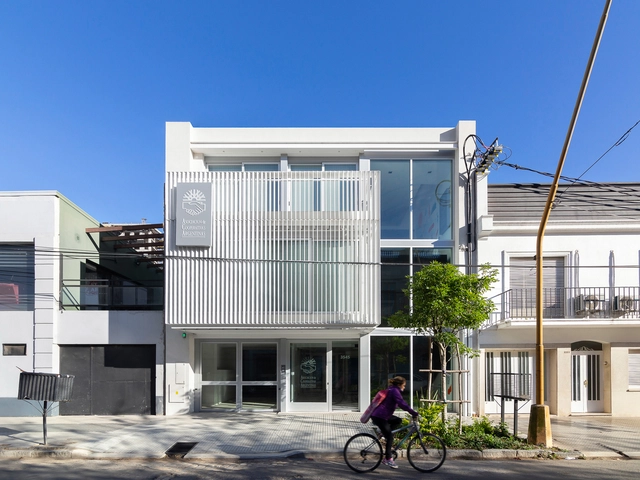
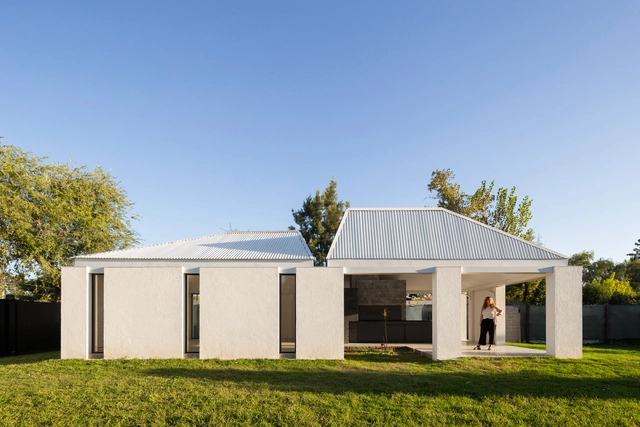
As a protagonist of the Argentinean culinary scene, the barbecue plays a prominent role. In architecture, beyond the dimensions of the spaces where they are installed, grills are consolidated as a meeting point for visitors and residents of the houses, coming into direct contact with the customs and culture of the country.
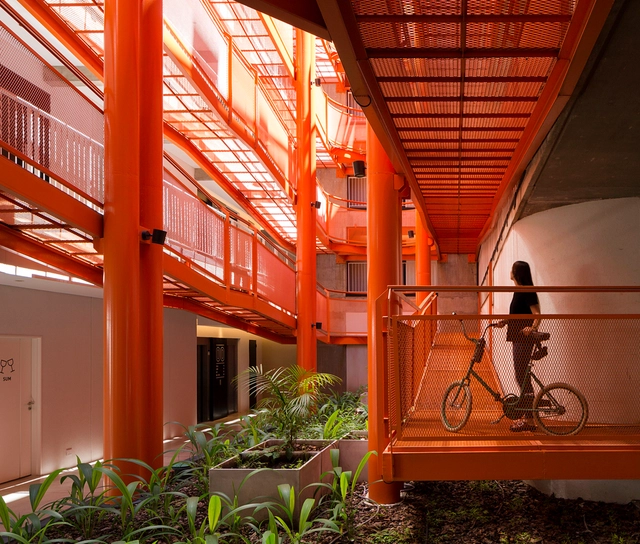
In collective housing projects, apartments, and residential complexes, design intentions regarding spatial qualities and atmospheres typically focus on the spaces where residents spend most of their time: the interiors of the housing units and, when available, common areas like gyms or multipurpose rooms. Circulation spaces, by contrast, are often treated merely as “transitional areas,” meaning they frequently address functional requirements rather than spatial experiences.
Wallpapers can be quite controversial. They can be typical of old-fashioned and antiquated homes, but at the same time, they can also add personality to otherwise dull spaces. One of the best parts of using these elements is that they can be quickly installed, and with relatively low costs. This also means that they aren't very long-lasting, and can therefore be quickly discarded and replaced, making them transient decoration items. As Joanna Banham—a researcher on wallpapers—states, “Wallpaper is often regarded as the Cinderella of the Decorative Arts – the most ephemeral and least precious of the decorations produced for the home. Yet, the history of wallpaper is a long and fascinating subject that dates back to the 16th century and encompasses a huge range of beautiful patterns created both by anonymous hands and by some of the best-known designers of the 19th and 20th centuries.” Today we are seeing another wallpaper resurgence, with numerous options of materials, patterns, and colors, and several examples of architects who have used them creatively in their projects. In this article, we go through the history of wallpapers and some of the current alternatives on the market, by diving into the Architonic catalog.
Achieving the best use of space, reducing the footprint of the buildings that are constructed and designing an optimal distribution that can meet the needs of their inhabitants are some of the requirements and challenges faced, day after day, by architects around the world. Through the implementation of certain materials, the definition of the morphology or even the geographical and natural conditions of the terrain, it is possible to carry out various strategies that make it possible to design homes with the comfort that their users need and in the smallest amount of square metres possible.
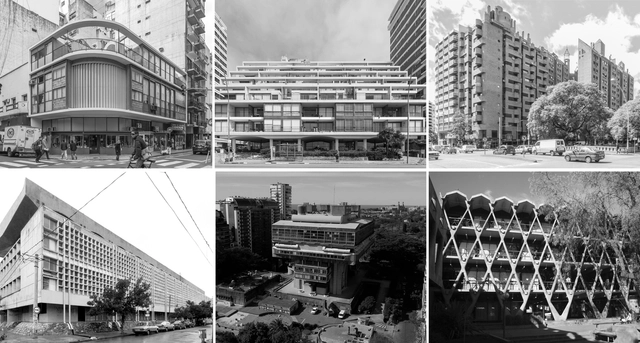
1. Casa de Estudios para Artistas / Antonio Bonet. 2. Terrace Palace / Antonio Bonet, Roberto Luna, Raúl Fernández y Alejandro Zamudio. 3. La Obra Urbana de Togo Díaz / José Ignacio Díaz. 4. Colegio Manuel Belgrano / Bidinost+Chute+Gasó+Lapacó+Meyer. 5. Biblioteca Nacional Mariano Moreno / Testa, Bullrich y Cazzaniga. 6. Facultad de Arquitectura de Mendoza / Enrico Tedeschi. Image
Within South America, different dates have been established to pay tribute to and honour the career, life and work of architecture professionals. While in Uruguay it is celebrated every 27th of November in relation to the creation of the first Faculty of Architecture, in Brazil every 15th of December in homage to the birth of Oscar Niemeyer or in Chile every 4th of August for the founding of the College of Architects, the Argentine Federation of Architects' Associations (FADEA) kept the 1st of July to commemorate the Day of the Argentinean Architect, respecting the establishment of the International Day of Architecture, established by the International Union of Architects (UIA) in 1985.
Few spaces are as intimate and contemplative as prayer rooms. Designed as both stand-alone structures and part of larger projects, prayer rooms are made as an architecture of introspection. Located within a house of worship or funerary space, or for their own dedicated purpose, these quiet rooms offer tranquil areas to consider life and the passage of time. Reflecting larger ideas on specific faiths and spirituality, they are designed as spaces of symbolism and sanctuary.
Brick has positioned itself as one of the materials that characterise and identify Argentinean and Latin American architectural culture. The diversity and versatility of masonry in our region have given rise to great heterogeneity in its uses and applications: structural walls, partitions, enclosures, screens, envelopes, skins, roofs, vaults, domes and floors allow us to visualise the great adaptability of this material in order to adapt to the particular requirements of each project.
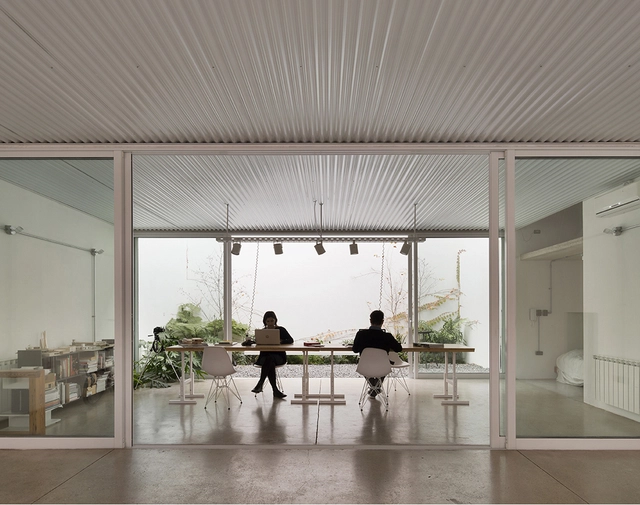
Urban Refuge Studio House / Estudio Berzero Jaros. Image
While many of the homes built during the Modern Movement—as design experiments on new ways of living—fostered the early emergence of "programmatic hybrids" by typically linking the residences of artists, painters, or architects with their workspaces (one need only recall, for instance, the atelier Le Corbusier designed for painter Amédée Ozenfant in 1922), today, new work models and hyperconnectivity have further driven the development of a new typology where workspaces are integrated into residential architecture. Architects, writers, photographers, designers, and painters increasingly choose to integrate their studios and workshops into their homes, merging living and working into a single whole.
Regardless of the design adopted for kitchen spaces, for some years now and with increasing frequency, many architects have been deciding to design kitchens by integrating them into other rooms in the home. Free of dividing walls or joinery, integrated kitchens are implemented with the aim of leaving the activities that take place there in full view of everyone, encouraging interaction and communication between the inhabitants.
Tools developed for woodworking, along with new production, milling, and treatment techniques, have gradually yielded highly diverse, high-quality products in various sizes, strengths, tones, shapes, and colors. These advancements have allowed wood, as a resource, to meet a wide range of construction needs, serving as structural support, building envelopes, cladding, or furniture in a vast number of architectural projects.




.jpg?1654617049&format=webp&width=640&height=580)