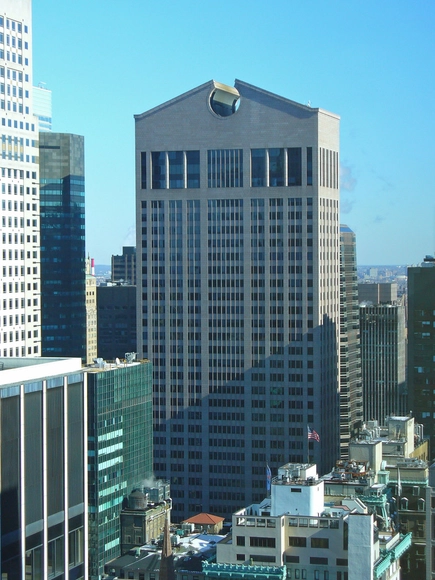
It may be the single most important architectural detail of the last fifty years. Emerging bravely from the glassy sea of Madison Avenue skyscrapers in midtown Manhattan, the open pediment atop Philip Johnson and John Burgee’s 1984 AT&T Building (now the Sony Tower) singlehandedly turned the architectural world on its head. This playful deployment of historical quotation explicitly contradicted modernist imperatives and heralded the mainstream arrival of an approach to design defined instead by a search for architectural meaning. The AT&T Building wasn’t the first of its type, but it was certainly the most high-profile, proudly announcing that architecture was experiencing the maturation of a new evolutionary phase: Postmodernism had officially arrived to the world scene.
This article was originally published on November 5, 2014. To read the stories behind other celebrated architecture projects, visit our AD Classics section.
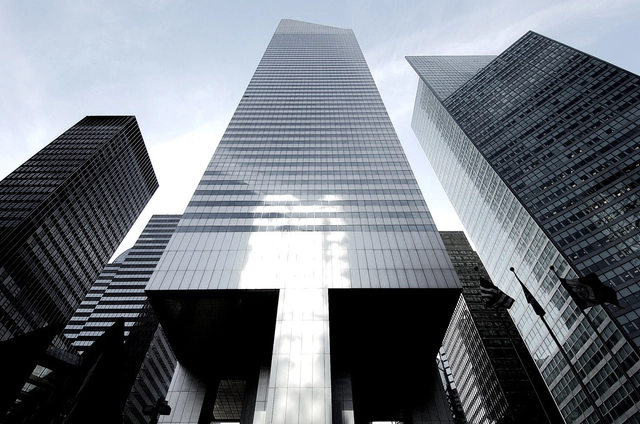
In a city of skyscrapers of nearly every shape and size, the Citigroup Center on Lexington Avenue is one of New York’s most unique. Resting on four stilts perfectly centered on each side, it cantilevers seventy-two feet over the sidewalk and features a trademark 45-degree sloping crown at its summit. The original structure responsible for these striking features also contained a grave oversight that nearly resulted in structural catastrophe, giving the tower the moniker of “the greatest disaster never told” when the story finally was told in 1995. The incredible tale—now legendary among structural engineers—adds a fascinating back-story to one of the most iconic fixtures of the Manhattan skyline.
This article was originally published on May 25, 2015. To read the stories behind other celebrated architecture projects, visit our AD Classics section.
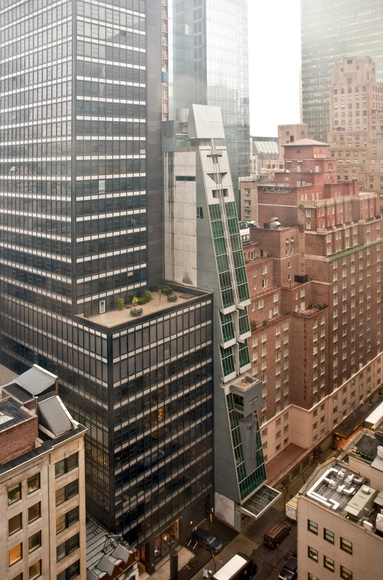
Before the impossibly “super-thin” tower became ubiquitous on the Midtown Manhattan skyline, Raimund Abraham’s Austrian Cultural Forum challenged the limits of what could be built on the slenderest of urban lots. Working with a footprint no bigger than a townhouse (indeed, one occupied the site before the present tower), Abraham erected a daring twenty-four story high-rise only twenty-five feet across. Instantly recognizable by its profile, a symmetrical, blade-like curtain wall cascading violently toward the sidewalk, ACFNY was heralded by Kenneth Frampton as “the most significant modern piece of architecture to be realized in Manhattan since the Seagram Building and the Guggenheim Museum of 1959.” [1]
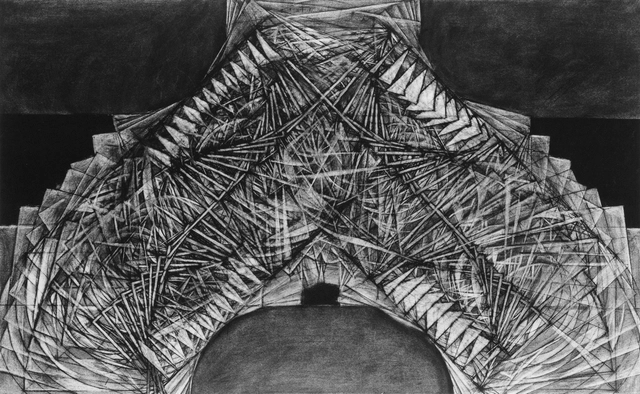
Christian Dickson, The Mark of Cain and Cain’s Mark. Thesis, 1991-92.
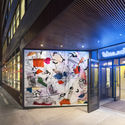
This exhibition celebrates The Irwin S. Chanin School of Architecture's experimental and influential pedagogy by presenting undergraduate Thesis projects completed at the school over the past 50 years.
Curated from materials documented in the Student Work Collection of the school's Architecture Archive, the exhibition includes physical hand drawings, born-digital drawings, and models of 35 undergraduate Thesis projects completed between 1969 and 2018. These materials are complimented by an exclusive preview of the school's Digital Access Project, an online database of the Student Work Collection that expands the exhibition's scope. The database will allow visitors to access, via computer terminals in the
This article was originally published on July 22, 2016. To read the stories behind other celebrated architecture projects, visit our AD Classics section.
The New Museum is the product of a daring vision to establish a radical, politicized center for contemporary art in New York City. With the aim of distinguishing itself from the city’s existing art institutions through a focus on emerging artists, the museum’s name embodies its pioneering spirit. Over the two decades following its foundation in 1977, it gained a strong reputation for its bold artistic program, and eventually outgrew its inconspicuous home in a SoHo loft. Keen to establish a visual presence and to reach a wider audience, in 2003 the Japanese architectural firm SANAA was commissioned to design a dedicated home for the museum. The resulting structure, a stack of rectilinear boxes which tower over the Bowery, would be the first and, thus far, the only purpose-built contemporary art museum in New York City.[1]
This article was originally published on February 11, 2014. To read the stories behind other celebrated architecture projects, visit our AD Classics section.
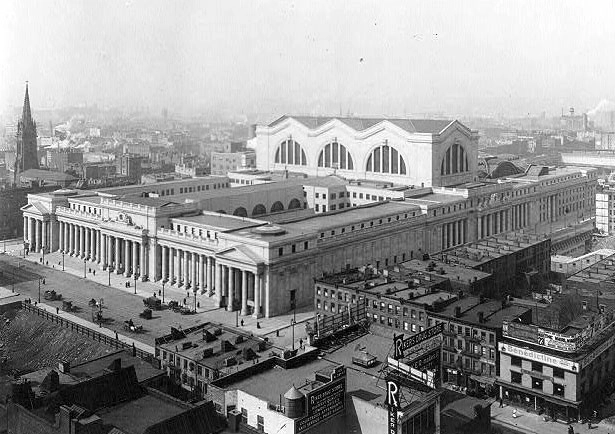
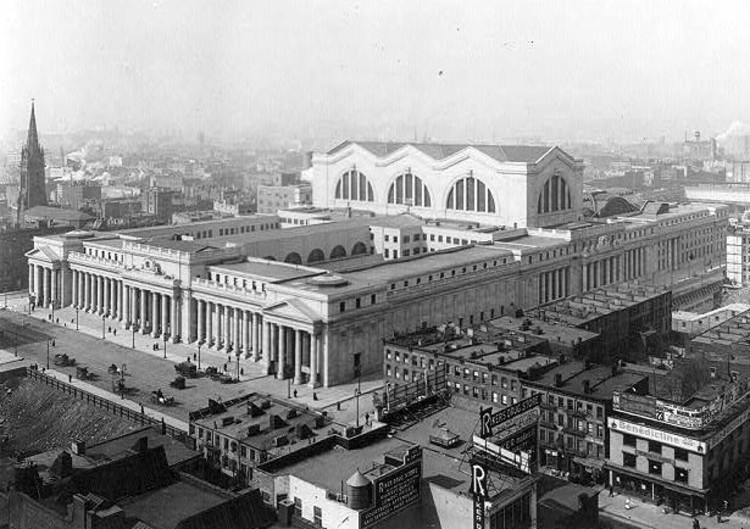
New York City’s original Pennsylvania Station was a monument to movement and an expression of American economic power. In 1902, the noted firm McKim, Mead and White was selected by the President of the Pennsylvania Railroad to design its Manhattan terminal. Completed in 1910, the gigantic steel and stone building covered four city blocks until its demolition in 1963, when it ceded to economic strains hardly fifty years after opening.

















.jpg?1413872412 "© Flickr user Steven Severing-Haus")







_Eric_Laignel.jpg?1535583348&format=webp&width=640&height=580)
_Eric_Laignel.jpg?1535583459 "© Eric Laignel")
_Eric_Laignel.jpg?1535583538 "© Eric Laignel")
_Eric_Laignel.jpg?1535583437 "© Eric Laignel")
_Eric_Laignel.jpg?1535583320 "© Eric Laignel")
_Eric_Laignel.jpg?1535583348)








.jpg?1431981450 "The director's office that occupies the box-like protrusion on the southern facade. Image © Photo by David Plakke, davidplakke.com; Courtesy of Austrian Cultural Forum New York")







.jpg?1463595741&format=webp&width=640&height=580)
.jpg?1463596013 "© Laurian Ghinitoiu")
.jpg?1463595919 "© Laurian Ghinitoiu")
.jpg?1463596094 "© Laurian Ghinitoiu")
.jpg?1463595878 "© Laurian Ghinitoiu")
.jpg?1463595741)




.jpg?1538547520&format=webp&width=640&height=580)
.jpg?1538547880 "© Albert Vecerka/Esto")

.jpg?1538547762 "© Albert Vecerka/Esto")
.jpg?1538547520)

.jpg?1537488742 "© Jeff-Goldberg")
.jpg?1537488821 "© Jeff-Goldberg")
.jpg?1537488754 "© Jeff-Goldberg")
