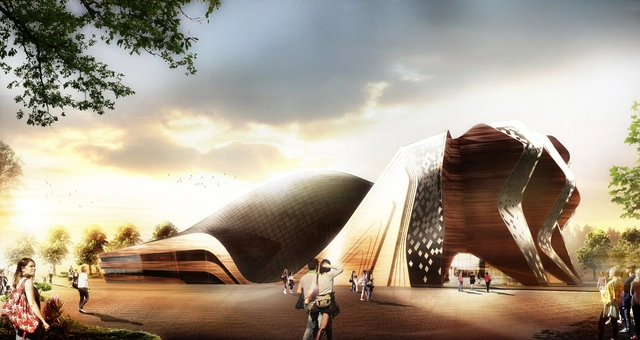
German architecture firm, GRAFT, has been selected as the winner of the "Apassionata" competition. Tasked with designing a temporary structure for the exhibition of horses, GRAFT proposed a complete wooden building that could be assembled, dismounted and reassembled at the convenience of the company.
Learn more after the break...
https://www.archdaily.com/459447/graft-wins-apassionata-competition-propose-temporary-structure-for-horse-showsJose Luis Gabriel Cruz
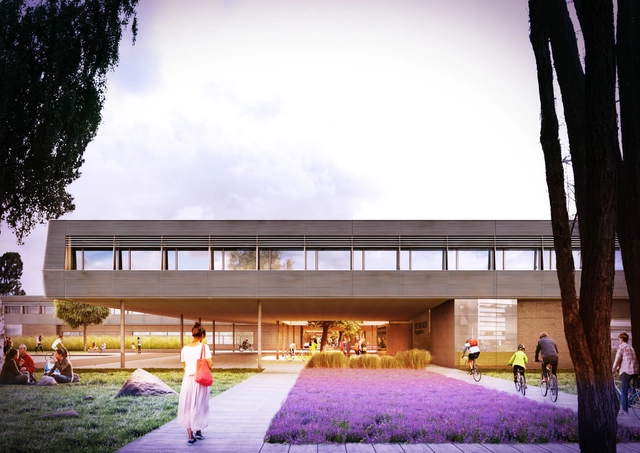
AustrianBramberger Architects have won the international competition to design the new High Tech Center in Villach, Austria. The winning scheme proposes four blocks of buildings and a corresponding area of dedicated open spaces, articulated longitudinally by a main axle. This axle, named “Communications Promenade” acts as a central route between the buildings and, in the future, it is proposed to connect the surrounding buildings, promoting the necessary infra- structures for the creation of an investigation campus.
View (winning scheme). Image Courtesy of TOTEMENT | PAPER
TOTEMENT | PAPER's competition proposal to design an international multipurpose cultural and leisure exhibition complex, close to Moscow's Kremlin, centers around resolving the aesthetic disconnection, or "visual conflict", between the image of a modern European city - defined by the Ismailovo hotel complex - and the historic context of the site. Their designs (two variations of each other of which one has won the competition) do not blend into the existing cultural monuments but rather offer a modern antidote to the issues of scale, perception and "grandiose historical stylization" that currently exists.
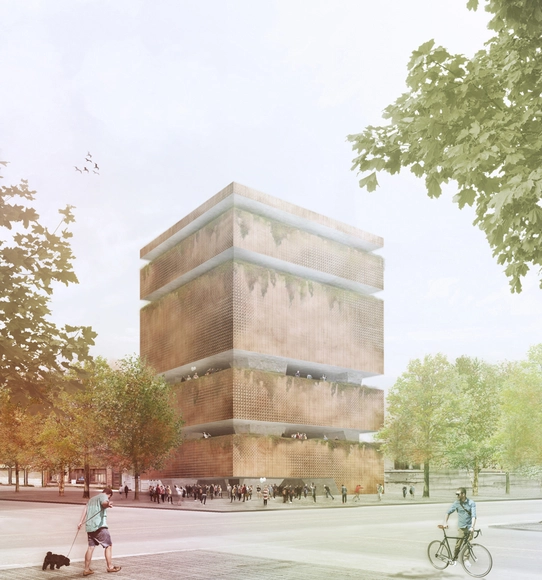
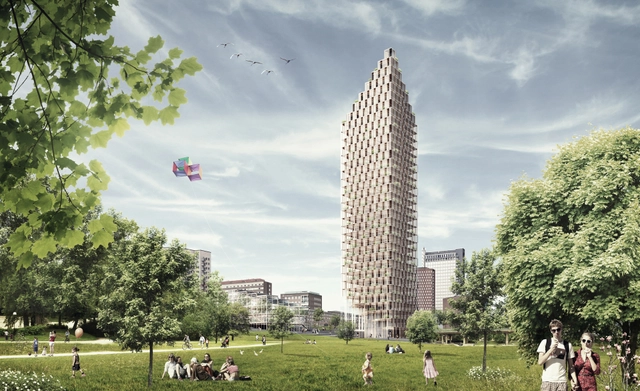
Wooden Skyscraper from the park. Image Courtesy of C.F. Møller and DinellJohansson
Scandinavian practice C.F. Møller Architects, in collaboration with DinellJohansson, has been announced as winner of the HSB Stockholm architectural competition. The winning scheme includes three "ultra-modern residential high-rises" planned for Stockholm's city center. Only one of these proposals will actually be built, including the world's tallest wooden skyscraper. Completion of the chosen tower is set for 2023, the 100th anniversary of the competition organizer and Sweden's largest housing association, HSB. View the three project proposals after the break.
View towards entrance. Image Courtesy of Andrea Maffei Architects
Andrea Maffei Architect'scompetition entry for a new stadium for Ruch Chorzów, one of Poland‘s largest football clubs, offers a capacity for 12,000 and provision for up to 16,000 seats. The design encourages the stadium and its surroundings to act as a new civic point of reference for Chorzów as part of a wider complex of shops and restaurants. The architects' understanding of the movement of people on match days is complimented by the facilities that the new stadium will offer to visitors seven days a week, the design for which will provide Ruch Chorzów with a state-of-the-art football pitch and associated amenities.
Vienna-based Delugan Meissl Associated Architects (DMAA) has been announced as winner of a competition to design a mixed-use, cultural complex in Munich. Dubbed Hanns Seidel Platz, the 40,500-square-meter scheme will provide a 160-unit “living tower,” office space, a civic center, concert hall and large public plaza for the district of Neuperlach.
This winning concept was developed in collaboration with the architecture firm Wimmer un Partner. It is expected for completion in 2019.
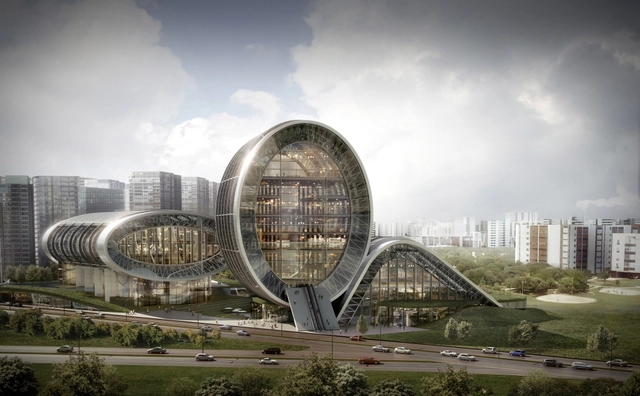
schmidt hammer lassen architects has been announced as the winners of a competition to design a large new central library in Ningbo, one of China's oldest cities with a population of seven million. The building will house the library's significant collection of over two million historic and ancient books, and will aim to double the library's daily visitors to around 8000 per day. Situated on the edge of a new ecological wetland area, the proposal will also form a new cultural hub within the city. As the latest in schmidt hammer lassen's long list of libraries (including the Royal Library in Copenhagen) with eight completed and four currently under construction, Ningbo's will be the practice's first in China.
Form4 Architecture has been awarded first place in the 2013 WAN Civic Buildings Competition for a proposal that promises to be a "catalyst for metropolitan living" in Taichung, Taiwan. The new city center, titled "Luminous Moon-Gate," was selected out of 46 entries in the "Future Schemes" category.
https://www.archdaily.com/455961/form4-architecture-awarded-first-place-for-new-cultural-center-in-taiwanJose Luis Gabriel Cruz
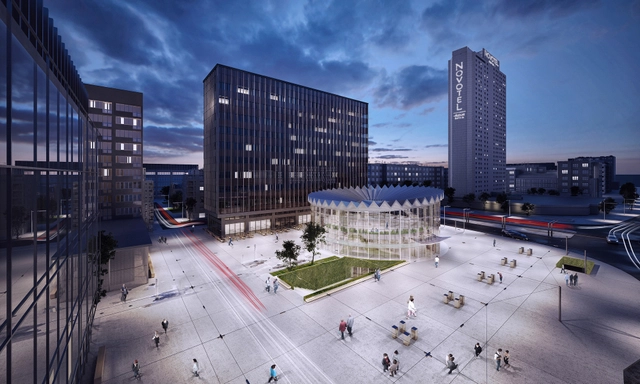
Poland-based GowinSiuta Studio has won "Changing the Face 2013 Rotunda Warsaw," an annual design competition (now in its 13th year) to revamp the "sawtooth-topped Rotunda, a favorite landmark and meeting spot in central Warsaw." Alongside being awarded the $15,500 prize money, the practice also plans to see their proposal realized by 2015. The studio's proposal, entitled Modern Urban Oasis / Warsaw City Lounge, transforms the Rotunda into an integral part of a public square.
The design for the Qom Central Building of Construction Engineering Organization by Partar Architecture Studio began with “a key question that discussed the feasibility and impossibility of imagining a unique design which best suits the spatial quality of traditional Iranian architecture." Partar’s design process was based on this challenge, and has led to an interesting proposal that attempts to bridge the art of architecture and the technology of construction using an understanding of the phenomenological aspects of Persian art and ornament, coupled with traditional Persian building techniques.
To commemorate its Bicentennial, the Chilean government has launched an initiative called "Bicentennial Legacy" to regenerate, revitalize, and consolidate the public spaces, heritage sites, and urban icons of the country.
https://www.archdaily.com/452562/call-for-proposals-a-landmark-for-santiagoPola Mora
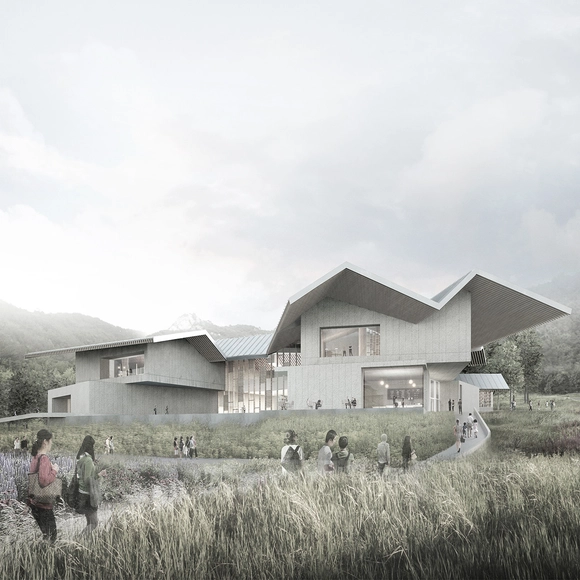
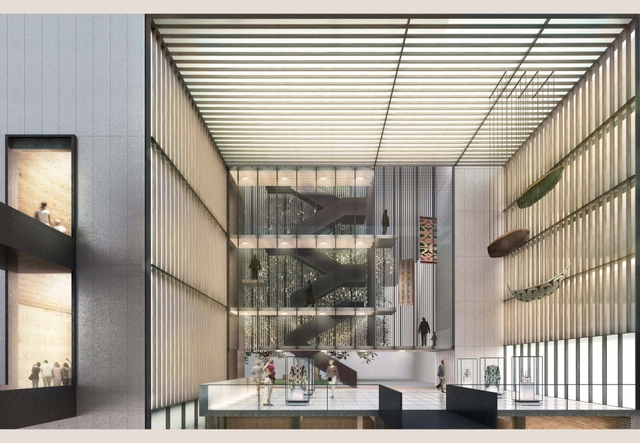
Seoul-based architectural firms, PWFERRETTO + UTOP, were recently selected winners of a competition commissioning a new pottery museum in the Goheung region of South Korea. The winning entry extends the museum experience throughout the 97,000 square meter site and is organized around four concepts, "genius loci, traditional village, landmark roof and nature journey."
https://www.archdaily.com/449398/winning-entry-for-new-pottery-museum-in-south-korea-pwferretto-utopJose Luis Gabriel Cruz
The winner of a competition to design a new extension for Chile's National History Museum has been announced. The competition, hosted by The Chilean Architecture Department of the Ministry of Public Works and the Department of Libraries, Archives and Museums, called for an 8,612 square feet annex devoted to exhibition and storage space. From the 54 proposals received, Aguiló + Pedraza Architects' stood out.
The Architect's description of the proposal, after the break.
Designed by Javier Mosquera González, the Winner of the Contest for the Cultural Center of Chapultepec, pretends to act as a lighthouse of culture, including intermediate spaces, high rise gardens and a sequence of solid and filtered spaces.
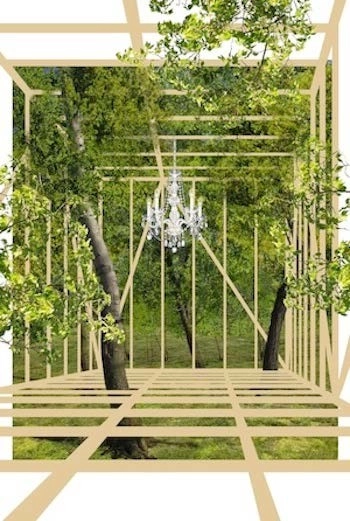
Socrates Sculpture Park and The Architectural League of New York recently announced the selection of Toshihiro Oki architect for tree wood as the winner of this year’s “Folly” competition – an extraordinary opportunity for emerging architects and designers to experiment and build large-scale projects for outdoor exhibition. tree wood will be a rigid yet airy geometrical wooden structure placed within a grove of trees – a lush and dense area at Socrates Sculpture Park. Visitors will peer into the structure through the floor beams where a formal, ornate chandelier will be suspended. The installation creates a dialogue between built structures and systems with the irregular and organic. This winning project will open at Socrates Sculpture Park on Sunday, May 12th from 2-6pm. More information after the break.
first place / Courtesy of Manus Leung and Kacper Krywult
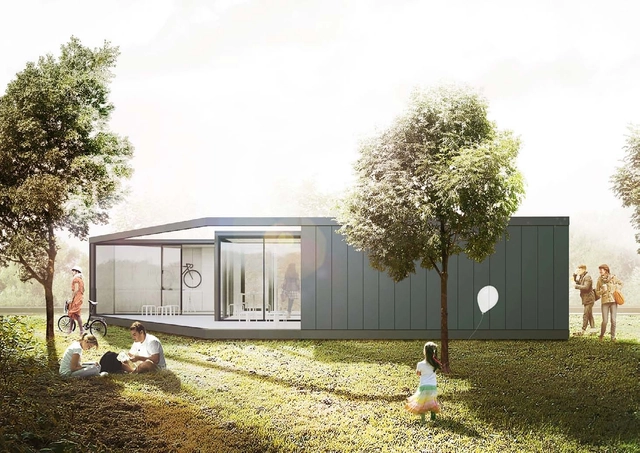
The Trimo Urban Crash competition asks students to design a unique modular space solution made from Trimo products and the products of their partners. This year, the aim was to encourage aspiring designers of urban space towards a bolder, more ambitious approach to understanding architecture and its place in the larger urban environment through the design of a creative urban meeting point – the Bike Base. Manus Leung from the Faculty of Built Environment at University of New South Wales, Australia and Kacper Krywult from the Faculty of Architecture / Warsaw University of Technology, Poland were announced as the overall winners for their project SHIFT. More images and information on the winners after the break.
White Noise (or The Buzz) reveals the latent potential of the community. It is the sound of the talent and value around us. The installation harnesses this latent value with an interactive sound environment (a collaboration with ARUP Acoustics) embedded in a playful series of figural abstractions, clad with white synthetic turf. The foregrounded backdrop of the architecture highlights the project’s main event, sharing and exchange among the people in the space, and manipulates readings of scale.
Looking to redefine the relationship between students, buildings and the city of Milan, Bocconi University challenged architects world-wide to design a “campus for the third millennium”. Although first prize was awarded to SANAA’s courtyard-centric complex formed by a series of undulating figures, OMA’s proposal provides an interesting twist to intercity university campuses.
Formulating a composition of objects that “represents a three-dimensional re-learning of humanistic values”, OMA’s Bocconi Urban Campus proposal sets the stage for Homo Economicus. Two clusters of independent buildings - an “extroverted” new school of management and the “introverted” a-frame student housing tower - are centered around a public amphitheater topped by a canopy of “architectural” umbrellas. While the thirteen story tower shelters the more intimate campus programs and acts as a backdrop to the boisterous new school, all spaces remain permeable to the activities of the surrounding city and establish the most appropriate and stimulating connection.





.jpg?1385617247&format=webp&width=640&height=580)