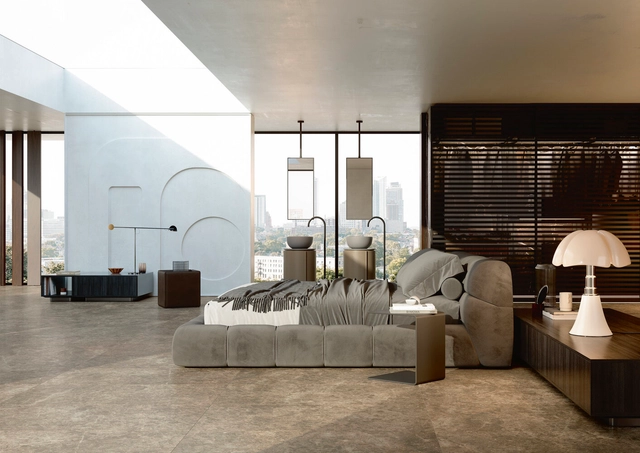
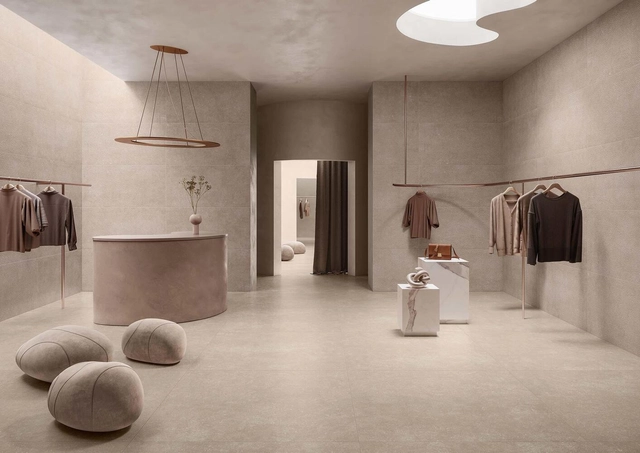
The search for the fundamental particle has been driving curious minds for much longer than we imagine. Leucippus and Democritus, Greek philosophers from the 5th century B.C., were the first to propose that the entire universe was made up of particles called atoms, indivisible and colliding against each other in an infinite void. Since then much has been studied about how dynamics actually take place at the atomic level (neutrons, protons and electrons), and there is still much to be discovered. Understanding the Higgs boson, for example, may even lead to a new understanding of the origin of the universe and life, since it can explain how elementary particles have mass. Moving from atomic abstraction to the world as we know it is a fascinating thing. It was this plunge into the particle –the smallest known part of the universe– which inspired the new collection by the Italian company Fiandre Architectural Surfaces, which produces ceramic pieces for spaces.
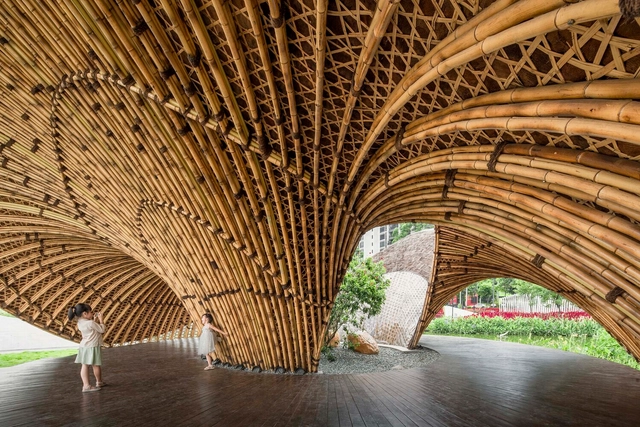
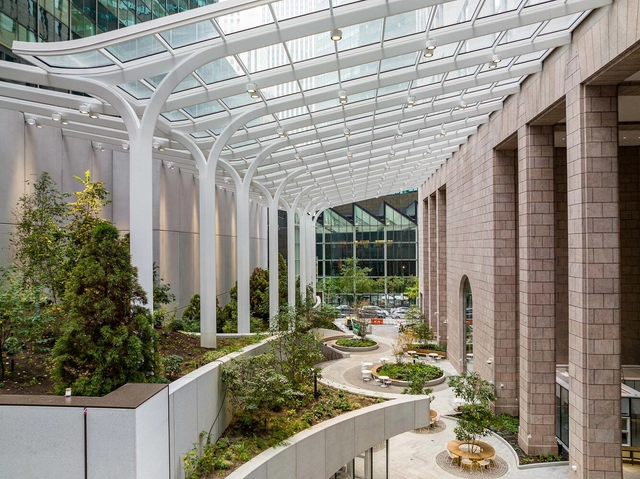
There was a time when buildings wanted to be mountains, roofs wanted to be forests, and pillars wanted to be trees. As the world began to go into a state of alert with the melting of glaciers and the consequent rise of Earth’s temperature, architecture – from a general perspective – was concerned with imitating the shapes of nature. Something close to human-made “ecosystems”, seen by many as allegoric and decorative, in service of marketable images of “sustainable development”.
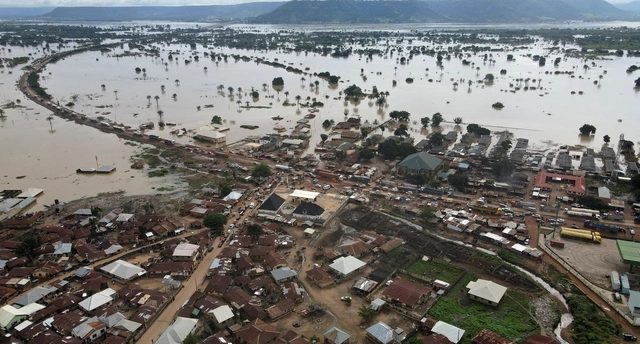
A few days ago, the world gathered at Sharm El Sheik, Egypt, for its annual climate change summit: COP27. Like the rest of Africa, Nigeria is represented by its retinue of bureaucrats, climate advocates, and other interest groups. Since the last meeting in Scotland (COP26), Nigeria signed the Climate Change Act into law, setting a target of attaining net-zero greenhouse gas emissions between 2050 and 2070. In the interim, Nigeria has developed an ambitious energy plan that would see it transition from fossil fuels to renewable energy, using its vast reserve of natural gas as a hedge. The country is at the forefront of the African Carbon Markets Initiative and plans to raise at least $500 million from carbon crediting trading to offset emitted carbon.
https://www.archdaily.com/992422/nigerias-ambitious-climate-agenda-and-its-misplaced-fixation-on-carbon-footprintMathias Agbo, Jr.
Designer and academic Brook Muller has authored a book called Blue Architecture: Water, Design, and Environmental Futures that presents innovative approaches to water-centric urban design. We asked him how a “hydro-logical” approach to architecture could allow us to design cities that improve water sustainability as well as promoting more equitable distribution of our most vital resource.
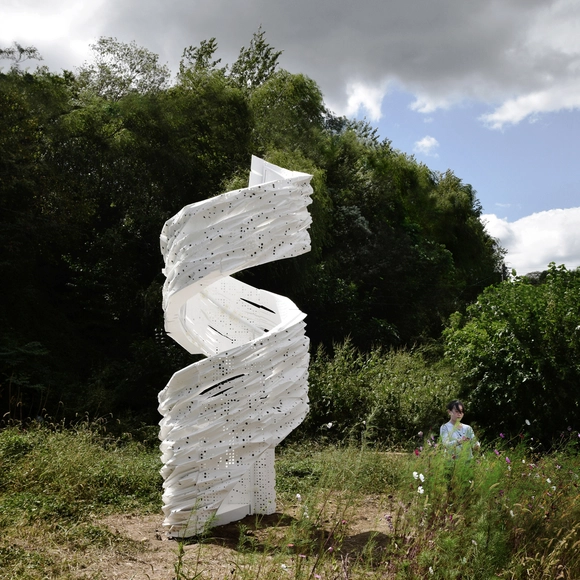
Expanded polystyrene (EPS) was discovered in 1839 in Berlin and became a widely used material in airplanes manufactured for World War II due to its extremely low density. It is this characteristic that makes it a suitable material for thermal and acoustic insulation, often specified in buildings, but also widely used in packaging. A rigid cellular plastic, it is the result of polymerizing styrene in water, whose end product are expandable beads that have a diameter of up to 3 millimeters. Unfortunately though, this material takes more than 500 years to decompose and, in the process, leaches harmful chemicals into the environment. Recycling is possible, but it is complex and costly. This means that most of the Styrofoam produced to date still remains on the planet, taking up valuable space in landfills, or worse, broken into tiny pieces and interfering with ocean life. "Decomposition Farm: Stairway" is a temporary installation that offers a possible solution to the environmental issues related to construction waste in the architectural field.
550 Madison Avenue (née the AT&T Building, more recently Sony Plaza) is among the more recognizable figures on New York’s skyline. Designed by architect-provocateur Philip Johnson, the 37-story skyscraper stands out thanks to its curious headgear: a classical pediment broken by a circular notch, inviting frequent comparisons to the top of a Chippendale grandfather clock. A singular, if largely inoffensive presence on today’s icon-heavy streetscape, the design was positively shocking on its debut in 1979, when Johnson himself appeared on the cover of Time holding a model of the project, then still four years from completion. The image heralded the arrival of something new in American architecture: the fading of the flat-crowned Modernist towers of the midcentury and the onset of the Postmodernist wave.
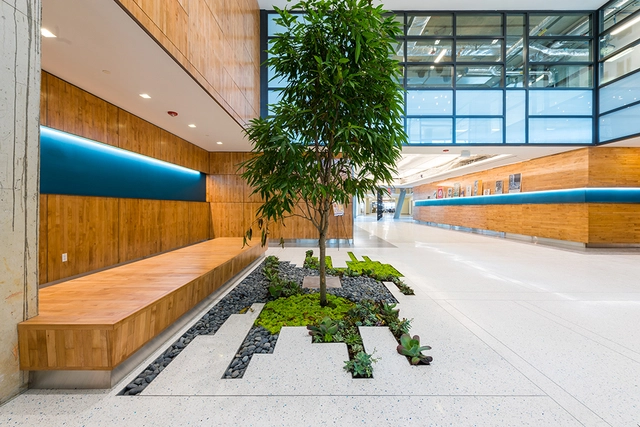
Uline Arena. Image Courtesy of Terrazzo & Marble, Photo by Brycen Fischer
When designing an architecture project, defining the flooring is a key element in achieving the comfort, style and functionality imagined by the design team. Depending on the type of use and its requirements, architects can choose the most suitable materials, textures and finishes for each project. Terrazzo & Marble offers a sustainable option to traditional materials like wood, carpet and ceramic with Terroxy Resin Systems, which are known for their sustainability, design flexibility, durability and low maintenance.
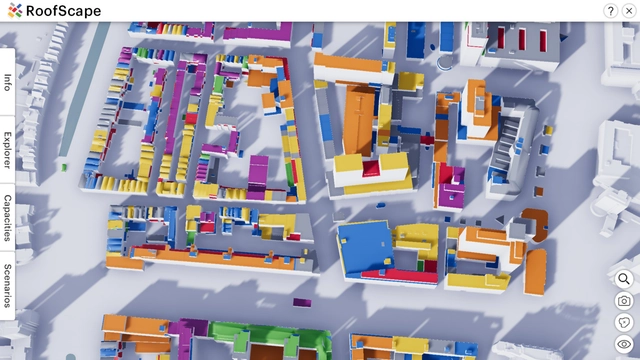
"Understanding precedes action." That is the motto of the Urban Observatory, an interactive installation and web app created by TED founder Richard Saul Wurman that compiled a wide range of urban data for over 150 cities, allowing users to compare various characteristics of those cities – from population density to traffic speed limits – side-by-side. Urban Observatory was first created in 2013, a banner year for news about urban big data; later that same year, Waag made headlines with its interactive map visualising the age of every building in the Netherlands. The emergence of such platforms allowed people to see the world around them in new ways.
With the rise of Google Earth and other GIS tools, and platforms like envelope.city, or environmental simulations based on digital twin models of cities, urban big data has quietly come to underpin a wide range of tools used by professionals who shape our cities, with both the amount of data collected and the influence it has over decision-making expanding dramatically. However, these advances typically happen behind closed doors and in undemocratic spaces. How long must we wait for software that has all the user-friendliness, accessibility, and appeal of those older platforms, but which provides the average person with the tools to shape their city? In other words, if "understanding precedes action", then why after almost a decade are we not seeing big-data-driven apps that encourage the public to actually do something?
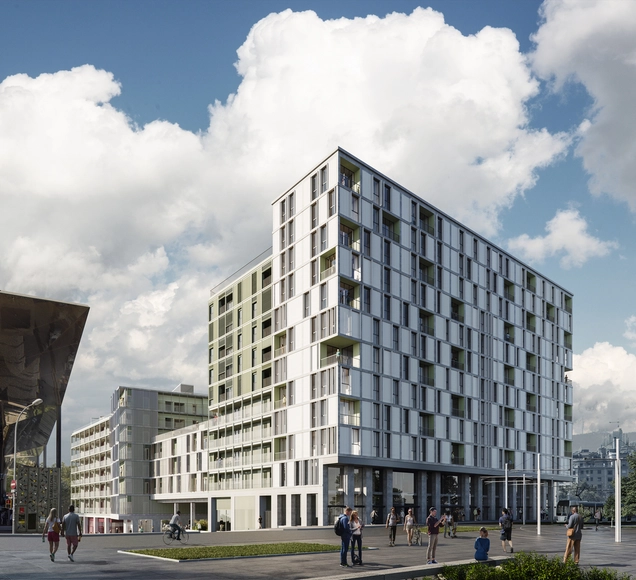
Illa Glories / CIERTO ESTUDIO. Image Cortesía de CIERTO ESTUDIO
CIERTO ESTUDIO was founded by six young architects in 2014. Since then, the team has not stopped growing and thus consolidating its professional practice in Barcelona. These six women architects are: Marta Benedicto, Ivet Gasol, Carlota de Gispert, Anna Llonch, Lucia Millet, and Clara Vidal.
The studio was born from plurality, therefore its thinking is inevitably diverse and this is reflected in its collaborative work methodology, always looking for the maximum architectural claim and its own character.
Rozana Montiel has been awarded the 2022 International Prize for Women Architects, organized by ARVHA (Association for Research on Cities and housing) with the support of the Ile de France Region, the French Higher Council of Architects Associations (CNOA), the Pavillon de l'Arsenal and the City of Paris.
https://www.archdaily.com/992247/rozana-montiel-wins-arvha-international-prize-for-women-architects-2022ArchDaily Team
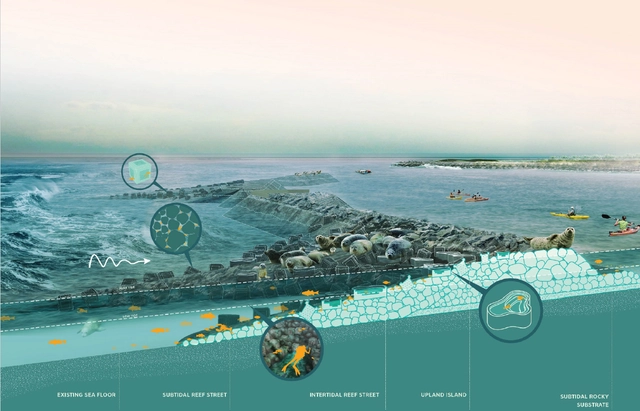
Living Breakwaters, Staten Island, NYC. Image Courtesy of SCRAPE
“Superstorm Sandy in 2012 was a wake-up call for NYC and made the city realize it needed to better prepare for climate change,” said Adrian Smith, FASLA, vice president at ASLA and team leader of Staten Island capital projects with NYC Parks. Due to storm surges from Sandy, “several people in Staten Island perished, and millions in property damage were sustained.”
On the 10th anniversary of Sandy, Smith, along with Pippa Brashear, ASLA, principal at SCAPE, and Donna Walcavage, FASLA, principal at Stantec, explained how designing with nature can lead to more resilient shoreline communities. During Climate Week NYC, they walked an online crowd of hundreds through two interconnected projects on the southwestern end of the island: Living Breakwaters and its companion on land — the Tottenville Shoreline Protection Project.
A Hungarian proverb says "Aki tagadja a múltat, az nem talál jövőt", telling of the importance of using our past experiences to write our future, but balancing these two endless worlds – the traditions and culture of one, with the technology and innovation of the other – is often key to creating timeless design.
At the annual 360 Design Budapest event, Hungary’s most important cultural showcase of emerging and existing homegrown talent, the interconnectedness of both time and art inspired three key themes of storytelling (history and tradition), education (youthful talent and sustainability) and digitalization (technology and innovation).
Here are some of the standout designers, manufacturers, and their products from the week:
The motto of the Solar Decathlon Europe 21/22 was to convert and expand rather than to demolish and reconstruct. Recycling windows, using biodegradable materials for luminaires and connecting light with sensors represented just some innovative examples of the international university-level student competition in Wuppertal, Germany. For the first time, the competition presented an award for sustainable architectural lighting. This was a question of quality as much as quantity, and that applies equally to daylight and artificial light.
Casalgrande Padana’s Stile stone effect porcelain stoneware tiles bring the sophistication and charm of natural stone to interiors. Image Courtesy of Casalgrande Padana
Sustainability was a hot topic at this year’s Cersaie trade fair, the biggest international ceramic tile and surfacing event, held annually in Bologna, which exhibits the latest developments in ceramics industry trends. Dynamic discussions explored the environmental impact of the raw materials of ceramics, the thermal properties of ceramic tiles as insulators, the biophilic effect of ceramic tiles within urban interiors – and much more.
Considering the time, energy, and environmental impact of a construction process, architecture must explore different methodologies that work with the existing built environment. For example: how to give life to a forgotten building? Adaptive reuse gives new opportunities to abandoned buildings, following the idea that good architecture must be durable, innovative and recyclable.
Architects should not design just for the present, but should also think of how to adapt buildings for the future. In view of the world’s current situation regarding the climate crisis and available natural resources, adaptive reuse explores strategies for sustainability and design innovation, working to reduce energy consumption, minimal carbon impact and positive social impact.
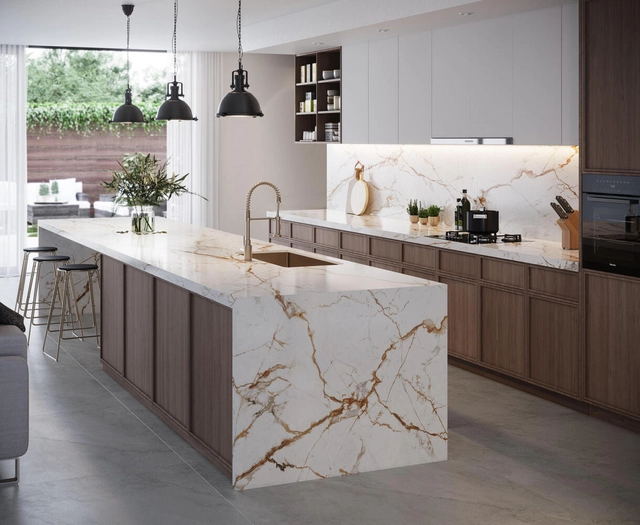
Dekton’s Onirika range brings the poetry of natural stone with its rhythmic veining to high-tech composite surfaces. Awake, seen here, recalls Poanazzo stone, with its oxide and grey markings. Image Courtesy of Cosentino
Opulence comes at a cost and it’s not just the sort that will leave your purse lighter. Exotic woods dent, gold tarnishes, marble stains and chips. But it doesn’t stop us hankering after the materials we perceive to be effortlessly elegant and replete with character. Okay, so we also like a bit of polish and precision in our building materials these days, alongside durability and ethical manufacture, ease of installation and maintenance alongside hygienic surfaces. But what’s often been missing from modern engineered materials is old-fashioned warmth and poetry. Is it too much to ask for both?
https://www.archdaily.com/991975/high-performance-yet-natural-cosentinos-new-surfacesEmma Moore
Reflecting on what the materials of the future will be like, we will talk about a material that is booming in Barcelona and which perhaps leads us to respond by suggesting that, as always, everything comes back.
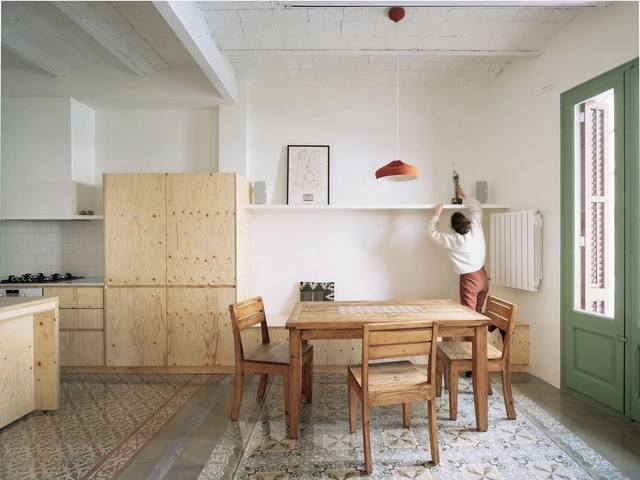
For some years now, hydraulic mosaics have been back on trend, generating interest due to their high artisan value and their diverse designs, perfect for combining traditional environments with avant-garde details.
The architectural practice has always been rooted in what people now call “human-centered design”. The term, coined by Irish engineer Mike Cooley in his 1987 publication “Human-Centred Systems” describes a design approach around identifying people’s needs and solving the right problem with simple interventions. Architecture balances between being aesthetic art and practical design. With multiple collaborators and goals for the project, the needs of the end-user often get compromised in the design process. To help architects better design for people, new methodologies may be inspired by human-centered design techniques developed by user experience (UX) designers.