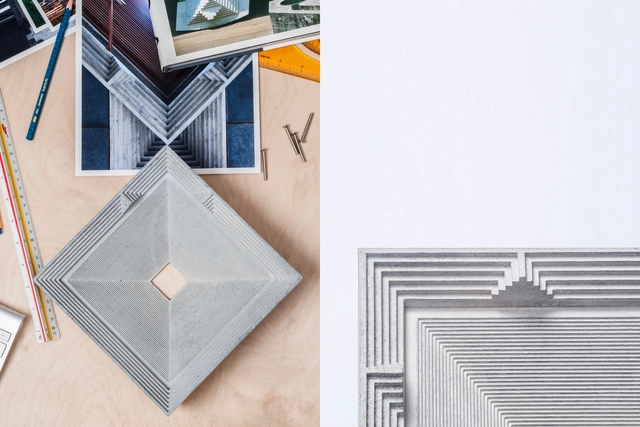
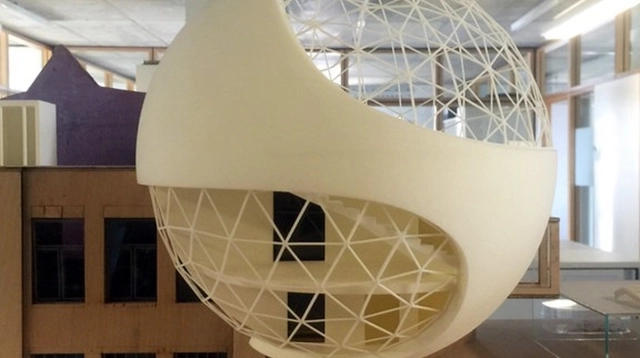
To be certain, architecture students are required to perform a wide variety of skills to complete a project. But thanks to some guys named Gates and Jobs (among many others), we are now able to execute nearly all of our tasks on one magical machine: the computer. While things like sketching and model making will always be fundamental parts of our profession, the laborious task of hand drafting has already become the "walk to school uphill both ways" of architecture – that is, something most of us are happy to have moved on from.
As long as there have been buildings mankind has sought to construct its way to the heavens. From stone pyramids to steel skyscrapers, successive generations of designers have devised ever more innovative ways to push the vertical boundaries of architecture. Whether stone or steel, however, each attempt to reach unprecedented heights has represented a vast undertaking in terms of both materials and labor – and the more complex the project, the greater the chance for things to go awry.
Moontopia Competition Winner - TEST LAB. Image Courtesy of Eleven-Magazine.com
Eleven Magazine has announced the winners of the international design competition “Moontopia,” which asked architects to imagine a self-sufficient lunar colony designed for living, working, researching and space tourism.
From a pool of proposals from hundreds of applicants worldwide, 9 schemes were selected by an expert jury including space-architects, academics and NASA designers as the winners of the competition. Check out the winning projects below.
In this latest photoseries, architectural photographer Danica O. Kus takes her lens inside New York City’s SeaGlass Carousel, designed by WXY Architecture + Urban Design with artist George Tsypin. Completed in summer 2015, the 2,575 square foot nautilus-shaped pavilion has become a new attraction within a Piet Oudolf-designed landscape in Battery Park, drawing in visitors with an immersive LED and audio experience inspired by bioluminescent organisms found deep within the ocean.
2016 was a defining year for ArchDaily. The change and uncertainty around the globe which emerged during the past year allowed us to double down on our mission to provide information, knowledge, and tools to architects, leveling the access to architectural knowledge and enabling a more diverse, equitable profession. As part of this, we now have a renewed focus on data-driven decisions and crowdsourcing architecture's understanding of its own work. The flagship of this crowdsourcing effort has always been our annual Building of the Year awards.
Now, for the 8th consecutive year, we are tasking our readers with the responsibility of recognizing and rewarding the projects that are making an impact in the profession, with ArchDaily's 2017 Building of the Year Awards. By voting, you are part of an unbiased, distributed network of jurors and peers that has elevated the most relevant projects over the past seven years. Over the next two weeks, your collective intelligence will filter over 3,000 projects down to just 16 stand-outs—the best in each category on ArchDaily.
The project aims to extend and reinvigorate the campus core along McCaul Street in downtown Toronto and will include approximately 55,000 square feet of new construction, in addition to the renovation of 95,000 square feet of existing campus space.
https://www.archdaily.com/803612/morphosis-teeple-architects-among-firms-to-lead-ocad-universitys-expansion-in-torontoOsman Bari
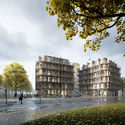
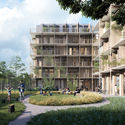
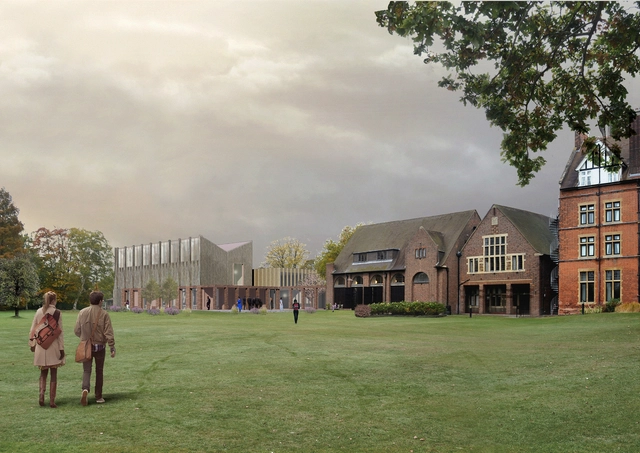
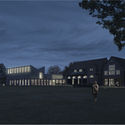
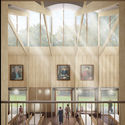
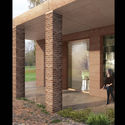
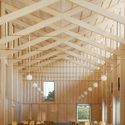
Belsize Architects has released the plans for 6 Pavilions, a new student accommodation project that will form a part of the University College’s larger masterplan in north Oxford.
To be built on the site of a Victorian residential home, the project will feature 30 units arranged within six pavilions around a central courtyard. Communal areas of the pavilions will be connected at the ground level.
CAAT STUDIO has unveiled Organizing the Forgotten Urban Spaces, a design that revitalizes the Mirdamad Bridge in Tehran, Iran through the creation of an open anthropology museum.
Developed by studying the existing 7-meter-high and 14.1-meter-wide bridge, the design focuses on improving the pedestrian nature of the space. For example, in order to address issues of noise under the bridge, the project utilizes an arch- and dome-like geometry to create “an acoustic mode in the roof […] and body,” along with covered pillars.
Designed by Rafael Viñoly Architects, 'One River Point' is set to be the latest addition to Miami’s ever-growing luxury real estate market. Comprised of two 65-story-tall towers, the project is a mixed-use residential development situated along the Miami River, in the city’s downtown core.
The Harvard Graduate School of Design has announced a new, free online course entitled "The Architectural Imagination." Taught by the school's Eliot Noyes Professor of Architectural Theory K. Michael Hays alongside Professor of Architectural History Erika Naginski and G. Ware Travelstead Professor of the History of Architecture and Technology Antoine Picon, the course is advertised as "introductory" level and described as teaching "how to 'read' architecture as a cultural expression as well as a technical achievement." It will be delivered through edX, a platform for high-quality massive open online courses (MOOCs) which was founded by Harvard and MIT in 2012.

Employing the latest in aluminum and metals innovation, Ben van Berkel and UNStudio have erected the ALPOLIC fair stand at BAU 2017, the world’s leading trade fair for architecture, materials and systems. Emphasizing the inherent strength of the ultra-light material, the parametric design utilizes geometric principles to create a self-supporting semi-private stand for gathering and the display of products.
Continuing in her firm’s tradition of blurring the lines between architecture, art and environment, Elizabeth Diller, founding partner of Diller Scofidio + Renfro, is producing an opera for the High Line. Dubbed the “Mile Long Opera,” the production will be set along New York’s new favorite attraction, which was designed by DS+R with James Corner and Piet Oudolf and opened to the public in 2009.
Videos
Courtesy of Feng Xue, Helen Chan, and Oscar Reyes (FOH)
A team composed of Feng Xue, Helen Chan, and Oscar Reyes (FOH) has won Director’s Choice Award in the AC-CA competition to design a contemporary footbridge in Dublin, Ireland. Entitled The Catalyst, the team’s proposal aims to become “a dynamic link which stimulates diverse urban activities and facilitates a spectacular cityscape.”
Designed around the idea of enhancing the surrounding Dockland neighborhood and Dublin as a whole, The Catalyst acts as both a physical link, as well as a new vantage point, encouraging passers-by to pause and reflect on the city.
In our global society, the movement of humans from one country to another has had extraordinary impact, changing our perceptions through the the exchange of ideas and introduction of new cultures. This can be seen in the adoption of traditional architectural techniques in contemporary architecture, as well as in the dissemination of contrasting architectural philosophies such as the International Style and Critical Regionalism.
Now, in this new interactive map produced by Max Galka of Metrocosm, these movements have been tracked in a eye-catching, easy-to-read infographic.
Known for its light weight and high strength properties, graphene has been promised to us as the material of the future for quite some time now. But difficulties in translating its 2D strength into 3-dimensional applications have so far held it back from common use. Now, thanks to new research by the Massachusetts Institute of Technology (MIT), that future may now be closer than ever before. In the school’s latest experiment, researchers have discovered how the material could be shaped into to sponge-like form to resist forces 10 times greater than steel.
Reviled by Parisians for its shocking inside-out appearance when it first opened in 1977, the Centre Pompidou has reached its 40th birthday, and as a gift, is set to receive to 2-year, $110 million renovation that will preserve the unique structure for years to come.
On February 10 2017, Netflix will launch a new documentary series—Abstract: The Art of Design—which will present "the most creative designers" from various fields in the design word, with the aim of demonstrating how design influences all aspects of our lives. One of the eight protagonists in the spotlight will be Danish architect Bjarke Ingels, of BIG, who will present his vision of architecture alongside professionals in interior design, graphic design, automotive design, illustration, and set design.
Check out the series feature designers after the break: