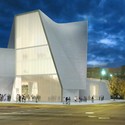
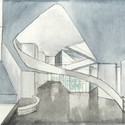
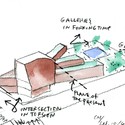
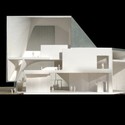
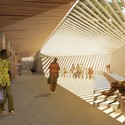
Steven Holl Architects have just unveiledVirginia Commonwealth University’s new Institute for Contemporary Art. With an inviting sense of openness, the building will form a gateway into the University, linking the city of Richmond to the campus. A dynamic architectural promenade will connect the building’s most important spaces, engaging visitors in a variety of changing perspectives. Flexible spaces throughout the building will be capable of accommodating a vast assortment of exhibitions and performances.
Continue after the break for more images and the architect’s project description.
CIVITAS, the organizer of the Reimagining the Waterfront, has announced the winners of the ideas competition for the design of the East River Esplanade between 60th and 125th in New York City bound by the East River to the East and the FDR Drive to the west. Joseph Wood of New Jersey, USA; Takuma Ono and Darina Zlateva of New York City, USA and Matteo Rossetti of Italy claimed first, second and third prize respectively. The competition aspires to bring to new and fresh ideas to the conversation about this waterfront, which over the years has had many issues of disrepair. Anyone who has attempted to bike down this path can appeal to just how unpleasant it can be – massive potholes that take up the whole path, traffic rushing by just a foot away just beyond a shoulder (which is not provided everywhere) and cobbled paths that create a bumpy ride. The proximity to the East River, and the views of Randall’s Island, Queens, Roosevelt Island and the Queensboro Bridge are its saving grace.
There have already been many talks about the state of the East River Esplanade, particularly that it stops abruptly at East 53rd street at the foot of the Queensboro Bridge and starts up again around East 38th street. Last summer MAS, an organization in NYC that advocates for intelligent urban planning, design and preservation, hosted a day-long charette to design an esplanade along the ConEd piers located between East 38th and East 41st Streets. MAS appealed to the community for ideas for “The Next Great NYC Waterfront” and worked alongside W Architecture and Landscape Architecture to produce a report, which can be found here. With CIVITAS’s competition, the issues are again acknowledged to continue brainstorming the future of the waterfront.
The Architect’s Newspaper reviewed the competition winners in an article by Tom Stoelker, which are imaginative and considered. The proposals of the winners and honorable mentions will be exhibited at the Museum of the City of New York between June 6th and September 2012 which will give the public access to some possibilities for the future of the East River Esplanade.
Join us after the break for more on the proposals.
The American Institute of Architects (AIA) and its Committee on the Environment (COTE) have selected the top ten examples of sustainable architecture and green design solutions. Now in its 16th year, the COTE Top Ten Green Projects program is one of the profession’s best known recognition program for sustainable design excellence.
The highlighted projects are the result of a thoroughly integrated approach to architecture, natural systems and technology. They have made a positive contribution to their communities, improved comfort for building occupants and reduced environmental impacts through strategies such as reuse of existing structures, connection to transit systems, low-impact and regenerative site development, energy and water conservation, use of sustainable or renewable construction materials, and design that improves indoor air quality.
All the projects will be honored at the AIA 2012 National Convention and Design Exposition, next month in Washington, D.C. Continue after the break to review the top ten green projects.
In Upstate New York, residents are clamoring to raze down their Government Center, Paul Rudolph’s classic 1970 example of brutalist design. Ostensibly, this is due to flood-damage. But it can’t hurt that, as one resident was quoted in The New York Times as saying, it’s “a big ugly building.”
In Minnesota, city officials would rather tear down M. Paul Fiedberg’s Peavey Plaza, a “Modernist gem” completed in ’73, than spend the time, money, and effort to revitalize it.
In Baghdad, on the other hand, a gymnasium completed in 1982, suffering the signs of decades of violence, poverty, and ill-executed renovation, has sparked a small preservation movement, reawakening a country to its neglected cultural heritage.
The architect behind this Iraqi endeavor? None other than Le Corbusier himself.
Read More on the “forgotten” Le corbusier in Baghdad, after the break…
MONU – magazine on urbanism is a unique bi-annual international forum for artists, writers and designers that are working on topics of urban culture, development and politics.
Each issue collects essays, projects and photographs from contributors from all over the world to a given topic. Thus MONU examines the rural as a strict counterpart to the urban as it appears to be a condition of the past. At least, this is what Kees Christiaanse posits in an interview with us entitled “The New Rural: Global Agriculture, Desakotas, and Freak Farms”. He points out that, today, non-urban spaces interact so frequently and intensely with urbanity that you can no longer describe something as strictly rural. Therefore, we can no longer separate the city from the countryside as these are not polarized entities and each other’s enemies, but rather the result of each other.
They have just released their latest issue on the topic of “Non-Urbanism”. You can see more about the articles on their official website. Also, you can browse the entire issue (video after the break).
We are only 100 days away from the 2012 London Olympics, and LEGO has announced the release of their latest model in the Architecture Landmark series: The Big Ben.
The Big Ben, officially known as the Clock Tower, is one of the UK’s most recognizable buildings and a global symbol of Victorian London and the Gothic Revival style. It was designed by the unlikely team of Classical architect Charles Barry and Gothic Revival pioneer Augustus Pugin and completed in 1859.
Big Ben is the fourteenth model in the LEGO Architecture range, which uses the LEGO brick to interpret the designs of iconic architecture around the world. It is the first model to be designed by Rok Zgalin Kobe from Slovenia who joins Adam Reed-Tucker as a LEGO architect.
A powerful and expressive design it itself, Ludwig Mies van der Rohe’s Neue Nationalgalerie in Berlin is still admired as a concrete, steel, and glass landmark today. Dedicated to culture and the fine arts, the building will be going through a major renovation, which will be overseen by British architect, David Chipperfield who has recently worked extensively in Berlin, finishing work on the war-ravaged Neues Museum on the Museum Island complex in 2009. The renovation will start in 2015 and last three years, during which time the museum will be closed. The building, completed in 1968, is Mies van der Rohe’s only work in Germany after World War II and is in need of thorough modernization after 40 years. Restoration of the glass facade, stone terrace and concrete and steel structure, along with new security and fire technology are included in the project.
The Canadian Centre for Architecture (CCA) is launching the 2012 program to stimulate curatorial opportunities for students and young professionals: the Young Curator Program and the Power Corporation of Canada Curatorial Internships Program. The Young Curator Program offers the opportunity to propose and curate a project on the contemporary debate in architecture, urbanism, and landscape design, from exhibition in the octagonal gallery or online, publications, seminar, series of events and more, during a residency of 3 months at the CCA. The Power Corporation of Canada Curatorial Internships Program encourages students and recent graduates in design disciplines, arts and humanities to become acquainted with the CCA’s collection, exhibition, and research programs through an internship of 6 to 9 months in Montréal.
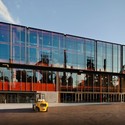
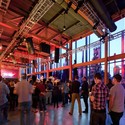
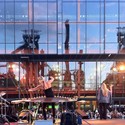
The American Institute of Architects Pennsylvania Chapter has awarded a Silver Medal, the institute’s highest honor, to Spillman Farmer Architects for their highly successful ArtsQuest Center at SteelStacks. Located on the landmark Bethlehem Steel site in eastern Pennsylvania, the dynamic performing arts, media and cultural center has served as an anchor for the revitalization effort in the City of Bethlehem that is transforming the once-abandoned historic industrial core into a dynamic, sustainable and livable mixed-use community. The 200-foot industrial ruins towering above the ArtsQuest Center is part of the country’s largest privately-owned brownfield.
AIA jurors praised the project saying, “The design captures the energy and utilitarian beauty that the best of the industrial revolution once offered. At the same time it demonstrates the power that a truly successful marriage of architecture and program can exert in bringing new purpose and hope to the most abandoned parts of our community.”
Continue reading after the break for more information and images.
The ten finalists competing in the final phase of the National Mall Design Competition are dreaming big. Proposals to restore the National Mall include flourishing lakeside gardens, contemporary cafés hovering over water, grassy new amphitheaters and underground pavilions exposed at the foot of the Washington Monument. Since the announcement of the finalists, the teams have been refining there proposals behind closed doors.
Now, the Trust for the National Mall has released the highly anticipated proposals to the public. From now until Sunday, at the Smithsonian Castle and the National Museum of American History, you can view each proposal in its entirety. If you don’t live in the D.C. area, no need to worry. Continue after the break to catch a glimpse of each submission and learn how you can help the jury decided who will revamp America’s “front yard”.
If you could construct your house out of materials made, recycled, or found within 100-miles of your lot, would you? And if you did, would you feel proud that you never once stepped into The Home Depot? Would you tout the fact that you took an environmental stand, that you did your bit to help the world?
Would you have?
As we mentioned in February, The Architecture Foundation of British Colombia has launched a competition to construct the 100-mile House. Inspired by the 100-mile Diet of locavore fame, in which you only eat what is grown or harvested within 100 miles of your home, the 100-mile house challenges you to construct historically, “using only materials and systems made/ manufactured / recycled” within a 100 mile radius.
But is this method truly better for the environment? Or just another example of pretentious pseudo-greenery?
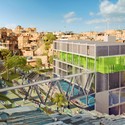
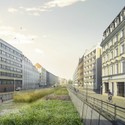
A secondary school project in Gando, Burkina Faso, a community center project in São Paulo, Brazil, and an urban renewal plan in Berlin, Germany are the winners of the Global Holcim Awards for 2012. These leading sustainable construction projects were selected from 15 finalist submissions by a jury of independent experts led by Enrique Norten. The finalists were the regional Holcim Awards 2011 winning projects that had been selected from more than 6,000 entries in 146 countries.
All 53 prize-winning projects at the regional level also competed for further prizes based on their contributions to sustainable construction through innovative building materials and construction technologies. The Global Holcim Innovation prizes conferred by a jury of materials and industry experts led by Harry Gugger went to projects in Switzerland, Germany and the United Kingdom.
Continue after the break to view the winning proposals!
David Chipperfield, Stirling Prize-winning architect and director of the 13th international Venice Biennale, has been commissioned by the Prussian Cultural Heritage Foundation (PCHF) to renovate the Neue National Gallery. The 20th century icon was designed by the legendary Ludwig Mies van der Rohe, who celebrated his 126th birthday this week.
Hermann Parzinger, president of the Prussian Cultural Heritage Foundation, said: “With David Chipperfield, I know this icon of modern architecture in the best hands. In working with him on the Museum Island, I learned the sensitivity in dealing with the architectural heritage and the conceptual clarity of his approach is greatly appreciated.”
Addicted to checking your favorite site, like ArchDaily, for constant updates, or checking in with Facebook or Foursquare? Don’t worry – you’re not alone, and Columbia’s Spatial Information Design Lab can prove it. In addition to sharing your whereabouts with friends, your geographic mark provides valuable insight in examining the psycho-geography and economic terrain of the city.
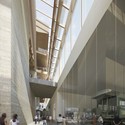
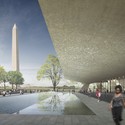
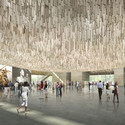
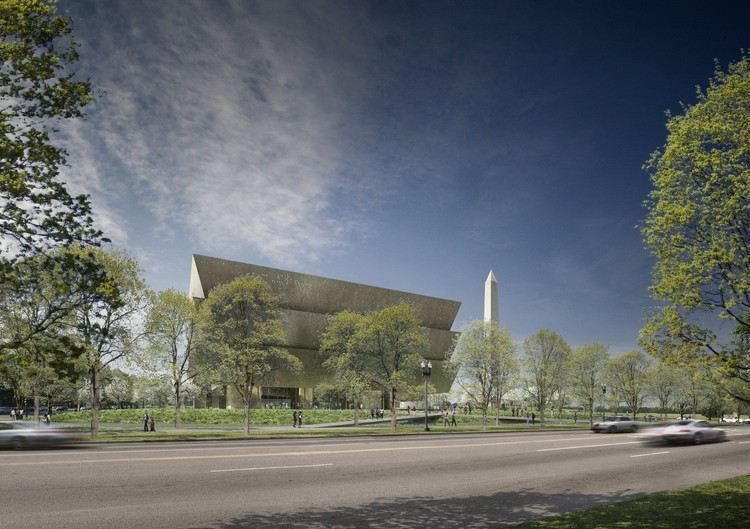
We have been covering the progress of the Smithsonian National Museum of African American History and Culture over the last several months, our most recent being President Obama’s speech at the ceremony for the official ground breaking. Adjaye Associates recently shared with us some insight into the inspiration for the design and its grounding principles. We also have several new perspective renders illustrating the internal experience. More details after the break.
The contenders: NYU and the Greenwich Village community. Let Round 2 commence.
Almost two years after we first brought you news about NYU 2031, NYU’s plans for expansion in Brooklyn, Governor’s Island, and (most controversially) in Greenwich Village, and the fight has not only continued, but escalated. A debate, hosted by The Municipal Art Society of New York, two nights ago brought about 200 NYU affiliates and community residents together, but only spatially; there was a considerable lack of willingness to compromise from either camp.
NYU’s plan, thought up by Toshiko Mori Architect, Michael Van Valkenburgh Associates, and Grimshaw Architects, has ruffled feathers mostly for the fact of its bulk. The 2.5 million square-foot development (1.1 million of which would be underground) is the largest ever proposed for the Village, and has drawn criticism for its potential to diminish light, greenery, and open space in the neighborhood.
After many years spent fighting to preserve the famous Robin Hood Gardens social housing complex in East London, the architecture community mourns another loss. Tower Hamlets Council and the London Thames Gateway Development Corporations have approved the demolition of the 1960s Brutalist complex in an effort to make way for a new £500 million sustainable development comprised of energy efficient, mixed-tenure homes and an enlarged central park. The historic building was built by modernist architects Alison and Peter Smithson and remains an important piece to Great Britain’s architectural history. Continue reading for more.
Sana’a, Yemen is at risk of being the first capital city in the World to run out of renewable, reliable and clean water supplies. With seasonal rain, expensive bottled water and polluted reservoirs, the residents of Sana’a are constantly faced with waterborne diseases and severe drought hazards.
In celebration of World Water Day, we would like to catch you up with the progress Sabrina Faber who was selected as winner of the 2010/2011 Philips Livable Cities Award – a global initiative designed to generate innovative, meaningful and achievable ideas to improve the health and well-being of city-dwellers across the world. Although the project went on hold due to political unrest, The Rainwater Aggregations (RAINS) Project was still able to complete three sites just in time for World Water Day. Continue reading for more.
Walk into the cafeteria at the Googleplex and you are nudged into the “right” choice. Sweets? Color-coded red and placed on the bottom shelf to make them just a bit harder to reach. “Instead of that chocolate bar, sir, wouldn’t you much rather consume this oh-so-conveniently-located apple? It’s good for you! Look, we labelled it green!”
Like the Google cafeteria guides you to take responsibility of your health, Google wants to transform the construction industry to take responsibility of the “health” of its buildings. They have been leveraging for transparency in the content of building materials, so that, like consumers who read what’s in a Snickers bar before eating it, they’ll know the “ingredients” of materials to choose the greenest, what they call “healthiest,” options.[2]
These examples illustrate the trend of “medicalization” in our increasingly health-obsessed society: when ordinary problems (such as construction, productivity, etc.) are defined and understood in medical terms. In their book Imperfect Health, Borasi and Zardini argue that through this process, architecture and design has been mistakenly burdened with the normalizing, moralistic function of “curing” the human body. [3]
While I find the idea that design should “force” healthiness somewhat paternalistic and ultimately limited, I don’t think this “medicalized” language is all bad – especially if we can use it in new and revitalizing ways. Allow me to prescribe two examples: the most popular and the (potentially) most ambitious urban renewal projects in New York City today, the High Line and the Delancey Underground (or the Low Line).
More on “curative” spaces after the break. (Trust me, it’s good for you.)
U.S. Department of Energy has announced the date and location of the 2013 Solar Decathlon. Appearing for the first time outside of Washington D.C., the highly anticipated competition will take place in 2013 from October 3rd through the 13th at the Orange County Great Park in Irvine, California. Launched in 2002, the biennial event will challenge twenty collegiate teams to design, build and operate a solar-powered house that is cost-effective, energy-efficient and attractive. Participants are judged by their ability to blend affordability, consumer appeal and design excellence with optimal energy production and maximum efficiency.
Continue reading after the break for more information and the complete list of the 2013 teams.
Norman Foster’s Swiss Re Building will soon have a new neighbor! London-based practice Fletcher Priest Architects have designed a 16-story tower that will replace the existing, outdated 1980s office building. Now under construction, the new 230,000 square-foot office building at 6 Bevis Marks will reuse 50% of the original structure and be 80% more energy efficient than the current building. Continue reading for more.