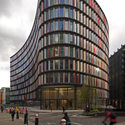
6 Bevis Marks / Fletcher Priest Architects

©

Norman Foster’s Swiss Re Building will soon have a new neighbor! -based practice Fletcher Priest Architects have designed a 16-story tower that will replace the existing, outdated 1980s office building. Now under construction, the new 230,000 square-foot office building at 6 Bevis Marks will reuse 50% of the original structure and be 80% more energy efficient than the current building. Continue reading for more.

Architecture City Guide: London

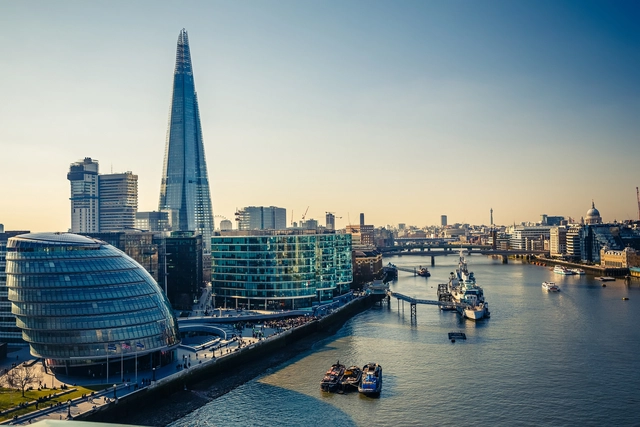
This week, with the help of our readers, our is headed to . This is our second stop in Europe, and once again I had to capitulate and double the number of buildings that we normally feature. We could not feature all of the suggestions, and will be adding to the list in the near future. We really appreciate those readers who offered their suggestions and the use of their pictures to make up this list.

Samuel Johnson famously said, “When a man is tired of London, he is tired of life.” As home to a long tradition of kings and queens, the Royal Society, and the roots of the Industrial Revolution, it is not surprising that there is a rich tension and collaboration between the historic and contemporary architecture in London. This reflects a city and culture that has a strong history of celebrating the past while also moving forward. Conflicts often emerge, as the goals of one side clash with those of the other. This relationship, however, is why I find walking the streets of London so appealing - those beautiful moments when history and progress collide.

Once again, thanks to all our readers for your help. We encourage you to add more of your favorites in the comment section below.

The Architecture City Guide: London list and corresponding map after the break.

Central St. Giles Court / Renzo Piano & Fletcher Priest Architects

© RPBW ph. Maurits van der Staay

The proposed concept for the site was to transform a single-use office building into a genuinely mixed use development incorporating office, retail, restaurant and residential use; seeking to create a new destination integrated within the local area.

The architects chose to situate the buildings around a new courtyard in the center of the site, which is connected by a publicly accessible route and ground floor public uses to the surrounding streets and spaces.

The key elements of the scheme were to introduce activity into the area, provide a mix of uses particularly retail, restaurants and housing introducing daytime and night time surveillance, and creating a properly managed and controlled environment which is reflected in the urban design approach to the layout of retail units, spaces and pedestrian routes.

Architects: Renzo Piano Building Workshop in collaboration with Fletcher Priest Architects
Location: , England
Design team: J.Moolhuijzen, M.van der Staay (partner and associate in charge), N.Mecattaf (associate) with L.Battaglia, S.Becchi, A.Belvedere, G.Carravieri, E.Chen, D.Colas, P.Colonna, W.Matthews, G.Mezzanotte, S.Mikou, Ph.Molter, Y.Pagès, M.Pare, L.Piazza, M.Reale, J.Rousseau, S.Singer Bayrle, R.Stampton and M.Aloisini, R.Biavati, M.Pierce, L.Voiland; O.Auber, C.Colson, Y.Kyrkos (models)
Structure: Ove Arup & Partners
Cost Consultant: Davis Langdon
Pre-Construction Advice: Bovis Lend Lease
Facades: Emmer Pfenninger & Partners
Lighting: P.Castiglioni / G.Bianchi
Fit-out for Affordable Residential: PRP
Landscaping: Charles Funke Associates
Client: Legal & General with Mitsubishi Estate Corporation Stanhope PLC
Project Year: 2002-2010
Drawings and Photographs: Courtesy of RPBW, Courtesy of L&G and MEC, Michel Denance, Hufton & Crow, Joost Moolhuijzen, Maurits van der Staay