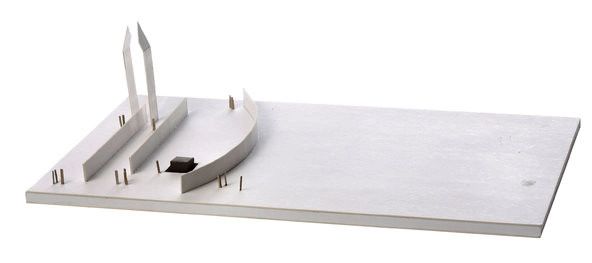
The pavilion aspires to shed new light onto the status of Korean Architecture allowing the outside world to acquire a deeper and more in-depth understanding of what is currently relevant in the field of architecture in the country. “Walk in Architecture” expresses an idea and at the same time its paradox; it treats architecture as a place or a subject, like “Walk in Venice” or “Walk in a forest”. Walk is a collective action which combines associations: when you walk you think, you meditate, you observe, you dream, you wonder.
The exhibit is is supported by thin wooden supports, holding drawings, diagrams and video displays. Great examples from a country where pedestrians are taking more space than cars. This takes place at the Korean Pavilion at the Giardini, designed by Seok Chul Kim and Franco Mancuso in 1995.
We visited “Migrating Landscapes”, the installation at the Canada pavilion for the 13th Venice Biennale. This exhibit has been organized and curated by Winnipeg- based 5468796 Architecture and Jae-Sung Chon, who joined together for this project to form the Migrating Landscapes Organizer (MLO). MLO invited, through a national competition, young Canadian architects and designers from a wide range of cultural and educational backgrounds to create scale models of ‘dwellings’ and accompanying videos that draw on cultural memories.
The installation uses pieces of unfinished wood in different sizes, a wooden landscape, where each of the participants “fit” their projects and a panel with a short video. A mix between the roughness of the wood, and the precision you can achieve with this material. My favorite? The Pickle House.
You can find more details about this exhibit in our previous article. More photos by ArchDaily after the break, and soon an interview with the curators!
The life of a city-funded project is a tumultuous one. After winning a design competition early this year and receiving public support to move forward, Diller, Scofidio + Renfro’s “Granite Web” design for the redevelopment of the nineteenth-century Terrace Gardens in Aberdeen, Scotland was recently rejected by the city council in a 22-20 vote. The project promised to bring a revived pulse to the heart of the city centre with a public space that would bring a year-round civic garden onto the “unattractive” Denburn dual carriageway and railway line.
As we shared earlier, the world’s 28-year old creative technological master will team with 83-year-old starachitect for Facebook’s newest addition to their Menlo Park campus. The two, although worlds apart in terms of forte, find common ground in the never ending creative process, and the desire to continually push boundaries of the expected and the ordinary. As we noted in our previous piece, the building will offer a equalized sense of status – no private cubicles or showy corner offices – and encourage a collaborative work environment, admix a warm splash of colors, textures and natural lighting.
Gone from the building will be Gehry’s flashy ways of manipulating sheets of metal, and the resulting superfluous sense of affluence often emitted from these grand structures. Rather, Gehry’s work for Facebook will offer an ”equalizier”, a massive one story warehouse measuring 420,000 sqf, to house the company’s future 2,800 engineers with the underlying intention of fostering a comfortable environment to allow Facebook to keep getting better.
More about the newest headquarters after the break.
Everyday, Americans all over the country go to work. They get in their cars, arrive at the office, and sit inside. Then, they go home, maybe watch some TV, and go to bed. 5 days a week. About 50 weeks a year.
Our built environment is where we now spend about 90% of our time. Unluckily for us, however, a recent Forbes article suggests that, most of the time, indoor air quality is actually worse than outdoor, to the point where it’s potentially hazardous: “paint, carpet, countertops, dry wall, you name it and chances are it’s got some sort of toxic ingredient.”
And yet we have little way of knowing just how bad our building’s “ingredients” are for us. Until now.
The forward-thinking firm is on the cutting-edge of a movement, instigated by clients and fast taking over the architecture world – towards “healthy” buildings (inside and out).
Read more about Perkins+Will’s revolutionary Transparency Project, after the break…
In continuing our coverage of the Architecture Billings Index, we share this past month’s score of 48.7 While such a mark still falls in negative territory (any score under 50 indicates a decline in billings), July’s activity was a considerable jump from June’s meager 45.9. And, even better, July’s new projects inquiry index moved up almost two full points to 56.3. Regionally, the South is surprisingly leading the averages with 52.7, followed by the Midwest with 46.7, the West with 45.3, and lastly, the Northeast region capping out at 44.3. In terms of the sector breakdown, multi-family residential remains strong with 51.4 followed by commercial/industrial projects and institutional projects. AIA Chief Economist, Kermit Baker, PhD, Hon. AIA, explained, “Even though architecture firm billings nationally were down again in July, the downturn moderated substantially. As long as overall economic conditions continue to show improvement, modest declines should shift over to growth in design activity over the coming months.”
While any Frank Lloyd Wright deserves to be preserved in our opinion, this quirky house, which Neil Levine, architectural historian and Harvard professor, went so far as to describe as “one of Frank Lloyd Wright’s most innovative, unusual and personal works of architecture” offers us an important glimpse into Wright’s development. Because of its circular spiral plan (completed six years before the Guggenheim), concrete-block detailing, and interior design, the house was (and still is) considered to be one of Wright’s most “remarkable and praiseworthy” efforts since Fallingwater.
Although the situation is dire, work done by the Frank Lloyd Wright Building Conservancy has awarded a temporary demo delay while the City of Phoenix decides whether to bestow historic preservation and landmark designation upon the house. This is where you come in. An online petition to the City of Phoenix has been set-up; as of right now, they’re 360 signatures short of their 1,000 person goal.
For almost 40 years no intact Wright building has been intentionally demolished.Let’s make sure we don’t start with this one. Sign the online petition (and then share it on Facebook, twitter, etc.), now!
For more information or to get involved, check out the SAVE WRIGHT page. For more images (including sketches) of the David Wright House, check out the gallery after the break…
UPDATE: This post originally stated that Villa Asserbo was 3D Printed, when in fact its pieces were printed using rapid prototyping technology (a subtractive, rather than additive process).
But today we heard a story about an alternative to 3D Printing‘s capabilities in the here and now - and its implications are pretty exciting.
In a small town outside of Copenhagen, Danish architects Eentileen joined forces with London-based digital fabrication and architecture specialists, Facit Homes, to create Villa Asserbo: a 1,250 square foot, sustainable home made from Nordic plywood fabricated via CNC miller and easily “snapped” together.
No heavy machinery, no cranes, no large labor force. Just a couple of guys, a few easily printed pieces, and six weeks.
Get more details about this sustainable, printed House, after the break…
As previously announced, the Portuguese architects behind “OCO – Ocean & Coastline Observatory” have won Habitat for Humanity’s Open Architecture Challenge: RESTRICTED ACCESS 2011. Over 500 teams from 74 countries submitted innovative solutions for the recovery and reuse of disabled and abandoned military sites. These submissions were filtered down to 13 finalists by a jury of 33 esteemed professionals. The Lisbon-based architects of OCO claimed grand prized with their vision to redevelop a desolate military site, that once defended the coast of Trafaria in Portugal, into a civic space that promotes coastal preservation.
Staten Island, arguably New York’s most often forgotten borough, may finally be getting its moment in the spotlight. Talks are in the works of creating a giant 600 ft Ferris wheel near the Staten Island Ferry Terminal to generate activity for the waterfront. To put 600 feet in perspective, think bigger than the Singapore Flyer at 451 feet and the London Eye’s 450 ft marker, and much bigger than Coney Island’s Wonder Wheel at 150 feet. While millions enjoy the free trip across the harbor on the ferry every year, few venture far from the boat. The Ferris Wheel is intended to capitalize on the Island’s amazing views of Manhattan and build up the Island’s visitor flow. “It’s the greatest thing that has been proposed for Staten Island, especially on the waterfront. This could landmark us. We have 2 million tourists a year on the ferry, so we have a built-in audience to use it, and it’s a different audience every day. Once you can attract them off that boat, you got them here,” James Molinaro, the borough president, stated.
BoomSPDesign is at it again! Now in its fifth addition, the creative design, architecture and art forum has quickly become known for attracting elite creatives from around the globe to share their passions in this unique, Sao Paulo forum. Centered around all things creative, the three day event will commence on August 22nd at the Centro Universitario Belas Artes de Sao Paulo.
Curator and cultural promoter Roberto Cocenza stated: “This year we are connecting, via Sao Paulo, two continents, Old World with the New World: We have the German Juergen Mayer H. bringing the sophistication of European thought and sensibility, with his intricate architectural patterns, and then we have Fernando Romero, a young talent from Mexico that with his rambunctious Sumaya Museum quickly entered the pantheon of iconic contemporary architecture.”
The American Institute of Architects, California Council (AIACC) has announced the 2012 Design Award Recipients. Since 1982, AIACC has recognized excellence in architecture and design through the AIACC Design Awards Program. An esteemed Design Awards jury has selected these award winners out of 300 submittals. Continue after the break to review the projects!
At a time when sustainability is high on the agenda and construction costs continue to soar, many Cambridge residents are questioning a proposal to demolish a sound and respected school building to replace it with a new school one that will strive to be a “green facility”. The Martin Luther King Elementary School (1968-1971) was designed by Catalan architect Josep Lluis Sert (Sert, Jackson and Associate). As it stands today, the school compliments the many other buildings in Cambridge that Sert worked on while also teaching at Harvard University, including the Peabody Terrace Graduate Housing complex just across the street.
Read on to find out what the community is doing to save the building from demolition and why it can prove to be a more sustainable option for the city.
Alred Hitchcock (13 August 1899 – 29 April 1980), who would have turned 113 today, is often known as the “Master of Suspense.” But we here at ArchDaily would like to tweak that moniker slightly, to the Master Architect of Suspense.
Hitchcock, who actually worked as a set designer in the 1920s, not only maintained meticulous control over his film sets as a director (many of which were mounted in studio), but incorporated many architectural themes into the narratives themselves.
More on Hitchcock’s use of Architecture, after the break…
“Legos were the ultimate building tool, capable of making the most advanced space ships, powerful vehicles, impressive buildings, and incredible cities. As a child, everyone I knew loved Legos, and this never seemed to change. In high school, whenever a conversation with friends happened to shift upon Legos, everyone would gleefully reminisce about their days making fantastic structures out of those awesome little building blocks. No doubt Legos played a supporting role in my growth in appreciation for architecture.” - Architect Albert Lam, in a Blog post for the LPA
When you ask architects what inspired them, almost all (according to one study, 99%) can trace the calling back to the same, simple origin: playing with their LEGO bricks.
The LEGO Group, which turns 80 today, can boast that there are approximately 62 LEGO bricks for ever person on earth. However, it wasn’t until 1958, when the newly-plastic LEGO bricks incorporated the classic knob-and-tube-connecting-system, that they overtook the Froebel block (Frank Lloyd Wright’s toy of choice) to become the massively popular architectural inspiration they are today.
But while the influence of LEGO on architects may be self-evident, not many know about Architecture’s contribution to LEGO. In fact, only through the lens of Architecture, can you truly understand why LEGO merits its bold moniker as “The Toy of the Century.”
Find out Architecture & LEGOs unlikely relationship, after the break…
Check out these new renderings of One World Trade Center from the Port Authority and the Durst Organization. The images were released to illustrate recent design modifications – such as a treatment for the tower’s first 20 stories and the elimination of the casing around the antenna. These fresh thirteen visuals offer a look at the tower from perspectives taken around the boroughs and New Jersey. While these renderings offer a taste of what can be expected, it is great to physical progress being made and how close we are to a completed tower.
Illinois Institute of Technology (IIT) Provost Alan Cramb announced today the appointment of Wiel Arets as the new dean of the IIT College of Architecture. Born in the Netherlands, Arets, an internationally acclaimed architect, educator, industrial designer, theorist, and urbanist, is known for his academic progressive research and hybrid design solutions. He is currently the professor of building planning and design at the Berlin University of the Arts. His architecture and design practice, Wiel Arets Architects, has multiple studios throughout Europe and its work has been nominated for the European Union’s celebrated ‘Mies van der Rohe Award’ on numerous occasions.
Arets, who was dean of the Berlage Institute in Rotterdam from 1995-2002, will join IIT this fall and will lead an academic program originally shaped by the vision and work of Ludwig Mies van der Rohe. Considered by many to be one of the founders of modern architecture and design, Mies chaired the IIT architecture program from 1938-1958 and designed the IIT Main Campus, home to many of his iconic structures including S.R. Crown Hall.
In our final segment of Thinking Past Day 17 – our series examining the larger implications of hosting the Olympic Games – we conclude with ideas for the future host cities that involve dividing the Games across 7 permanent sites, complete with reusable architecture and a focus on sustainability at the urban level.
The effects of urban displacement coupled with post-Games housing concerns for the Athletes’ Village in Olympic Park – which we addressed in Part II - will definitely test the future viability of the Olympic Committee’s planning strategies. It is interesting to note that in relation to the entirety of the Olympic map, the area designated for the Village represents only a minuscule portion of the land that must be reintegrated post-Olympics. So, if we zoom out from the Athletes’ Village, what will become of the vast expanses of land currently supporting the major sporting facilities?
Each element in this model represents a character in Ayn Rand’s Atlas Shrugged, and the space between these elements represents the relationship between them. Model by writer Kanasu Nagathihalli and architecture student Chelsea Hyduk. Image via The New York Times
"Great architects build structures that can make us feel enclosed, liberated or suspended. They lead us through space, make us slow down, speed up or stop to contemplate. Great writers, in devising their literary structures, do exactly the same." A recent post by Matteo Pericoli of The New York Times describes what happens when writers, students in Pericoli's creative writing course, team up with architects in order to "physically build the architecture of a text." The resulting models are physical representations of the emotions, relationships, and narrative-styles of stories by authors as varied as David Foster Wallace, Ayn Rand, and Virginia Woolf. Check out all the models, and their accompanying descriptions, at the NYT.
The Los Angeles International Airport (LAX), one of the world’s busiest airports, is undergoing a facelift. As part of a multi-phase project, AECOM is working with Los Angeles World Airports (LAWA) to create a sensational experience for the 61 million passengers who travel in and out of LAX annually. The project aspires to unify the disparate components of the airport’s central terminal area (CTA) and insert grand gestures that provide architectural hierarchy — yielding LAX as exciting as the city in which it resides. Through an artful integration of lighting, graphics, and architecture, the design draws from key existing airport elements such as the 1960s architecture of the Theme Building and the 60-foot polychromatic light pylons that define the airport’s entry.
Officials have warned that the 2,000 year old Colosseum in Rome is leaning. About a year ago, they noticed the south side of the Colosseum was leaning about 40cm lower than the north. As reported on the guardian, Prof Giorgio Monti from La Sapienza’s construction technology department stated that this could be the result of a crack in the 13-meter-thick concrete slab below the amphitheater; however, it too early to judge.
Zawia, a periodical publication and online forum on design, architecture, and urbanism, just released their first issue which features contributions from Saskia Sassen, Stefano Boeri, Joseph Grima, WAI architecture think tank, Carlo Ratto, Markus Miessen and many others. Their ‘Change’ volume will attempt to demonstrate if architects are ready to embrace the changing ideals and the new modes of operation, and if they are willing to help better people’s lives rather than focusing on glorifying design or architecture. It is targeted towards discussing the significantly changing realities imposed on all social, political and economic systems and their influence on design disciplines. For more information, please visit here.
With a quarter million LEGO bricks and 300 hours of finger intensive labor, Warren Elsmore and his wife constructed a mini replica of the 2012 Olympic Park in London. As Gizmodo reports, the model weighs about 80kg and would cost around $300,000 to build for scratch!
American retailer Coach has commissioned OMA to develop a new merchandising system that accommodates Coach’s wide diversity of products while returning to the clarity of Coach’s heritage stores. Since establishing its first workshop 1941, Coach has expanded from a specialist leather atelier to a global distributor of “democratized luxury goods”. This expansion has clouded the clarity of the brand’s original library-like stores, which used a rigorous organizational system that categorically sort projects inside minimal wooden shelving at assisted counters. OMA intends to create a flexible, modular system that embodies the clarity of the original stores and responds to the individual needs of locale.




![OCO – Ocean & Coastline Observatory wins [UN] RESTRICTED ACCESS 2011 - Image 5 of 4](https://images.adsttc.com/media/images/55f7/1111/ab63/c20c/5d00/0009/medium_jpg/03_12490_image-03.jpg?1442255093)