Regarding urban development, the choice between demolition and adaptive reuse holds far-reaching implications. From debates around the cultural and historical significance of structure to the environmental impact of the process of razing and rebuilding, compared to the cost of preserving and adapting, the matter of demolitions has ignited the architectural community to come together and ask for more responsible assessment strategies in hopes of rediscovering the value of existing structures. This article gathers some of the stories of buildings facing the threat of demolition and the processes that led to their rescue.
An architecture lecture series society at the Scott Sutherland School of Architecture and the Built Environment in Aberdeen, Scotland. The society, 57°10, has been running for 27 years and invites guest lecturers to the school to talk about the ideas and projects explored by their practices. The society prides itself in being student led; providing lectures that will in turn inspire our future architects, perhaps on topics out-with the discourse of the school.https://www.facebook.com/FiftySevenTenSociety
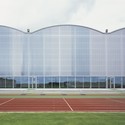
Sasanbell has been chosen to design the UK's "most sustainable facility:" the £200 million Aberdeen Exhibition & Conference Centre (AECC). The Glasgow-based company will provide a new home for the city's existing exhibition and conference center, which will be redeveloped by Cooper Cromar, freeing up space for future development and providing a sizable venue that can accommodate "large and popular events."
Just recently, the City of Aberdeen announced a £300m city-wide plan of improving roads, schools and cultural buildings, with only £20m allotted for the city center, which will be pedestrianized but not much else. Thus, confirming the "final nail in the coffin" for DS+R's ambitious web of lush gardens and cultural landmarks.

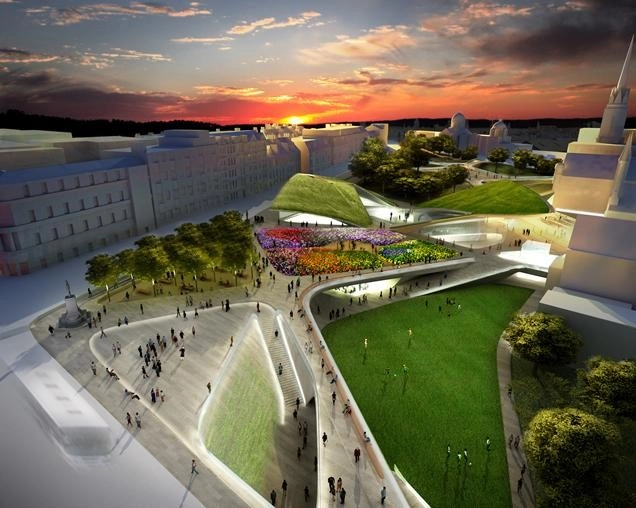
The life of a city-funded project is a tumultuous one. After winning a design competition early this year and receiving public support to move forward, Diller, Scofidio + Renfro’s “Granite Web” design for the redevelopment of the nineteenth-century Terrace Gardens in Aberdeen, Scotland was recently rejected by the city council in a 22-20 vote. The project promised to bring a revived pulse to the heart of the city centre with a public space that would bring a year-round civic garden onto the “unattractive” Denburn dual carriageway and railway line.
DS+R plans to redevelop the nineteenth-century Union Terrace Gardens with a Granite Web that intends to “fuse nature and culture into a vital social network at the heart of the city” with an “elastic web of three-dimensional interconnections” that spans across the six-hectare site. Continue reading for more information.
Sitting near the southern boundary of Foresterhill at the edge of the Westburn field, Snohetta’s plans for Maggie’s Cancer Care Center at the Aberdeen Royal Infirmary is envisioned as a pavilion within the parkland. The facilities will be mainly on the ground floor with a mezzanine area for office functions.
The Elizabeth Montgomerie Foundation (EMF) and Maggie’s are raising £3m in an attempt to bring a Maggie’s Center to Foresterhill Hospital in Aberdeen to provide for the families of Grampian. Aberdeen is Scotland’s third largest caner treatment center but is the only clinical center in Scotland not supported by Maggie’s.
5710 (Fifty Seven Ten) Society recently announced their lecture series for 2011-2012. The series kicks off with an opening party on September 29th and runs until April 26th.
The lecture series will be held at The Scott Sutherland School of Architecture and The Built Environment in Aberdeen, Scotland. It is a non-profit organisation run by students, which invites guest speakers to lecture in the School. Speakers are usually practicing architects of interest to students and to the school, and the society aims to create a link between architectural education and architectural practice. However, lecturers are also invited from related disciplines such as art, architectural photography and interior design. More information on the event after the break.
Tesseract is a collective of architecture students from RGU in Aberdeen, Scotland, who came together under the common ambition of using our creativity for humanity. They are now traveling to Delhi, India to work with local NGO Anusaran in the construction of a new hostel that will provide accommodation for children, young women and visiting volunteers, as well as classrooms, meeting and dining areas.