




-
Architects: Zaha Hadid Architects
- Area: 15950 m²
- Year: 2011
-
Photographs: Helene Binet
-
Manufacturers: KEIM, Kingspan Insulated Panels, Serge Ferrari
© Hufton + Crow

Project Team: Alex Bilton, Alex Marcoulides, Barbara Bochnak, Carlos Garijo, Clay Shorthall, Ertu Erbay, George King, Giorgia Cannici, Hannes Schafelner, Hee Seung Lee, Kasia Townend, Nannette Jackowski, Nicolas Gdalewitch, Seth Handley, Thomas Soo, Tom Locke, Torsten Broeder, Tristan Job, Yamac Korfali, Yeena Yoon
Design Concept
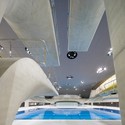
The architectural concept of the London Aquatic Centre is inspired by the fluid geometries of water in motion, creating spaces and a surrounding environment that reflect the riverside landscapes of the Olympic Park. An undulating roof sweeps up from the ground as a wave - enclosing the pools of the Centre with a unifying gesture of fluidity, while also describing the volume of the swimming and diving pools.

© Hufton + Crow
The Aquatics Centre is designed with an inherent flexibility to accommodate 17,500 spectators for the London 2012 Games in ‘Olympic’ mode while also providing the optimum spectator capacity of 2000 for use in ‘Legacy’ mode after the Games.

Northern Plaza & Roof (Legacy Mode)
Site Context
The Aquatics Centre is within the Olympic Park Masterplan. Positioned on the south eastern edge of the Olympic Park with direct proximity to Stratford, a new pedestrian access to the Olympic Park via the east-west bridge (called the Stratford City Bridge) passes directly over the Centre as a primary gateway to the Park. Several smaller pedestrian bridges will also connect the site to the Olympic Park over the existing canal.

Legacy Rendering
The Aquatic Centre addresses the main public spaces implicit within the Olympic Park and Stratford City planning strategies: the east-west connection of the Stratford City Bridge and the continuation of the Olympic Park along the canal.

Ground Floor Plan (Olympic Mode)

Podium & Roof (Legacy Mode)
Layout
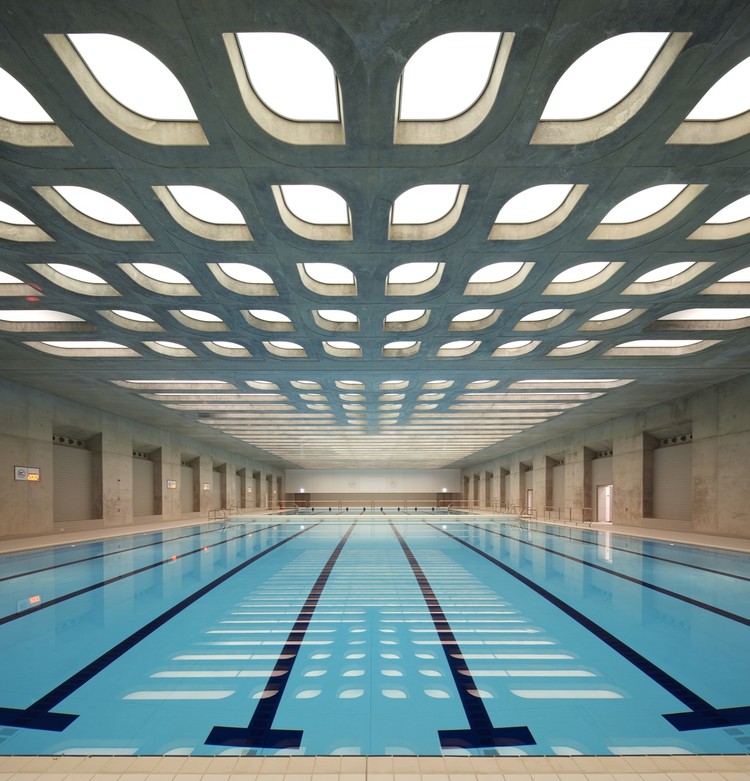
The Aquatics Centre is planned on an orthogonal axis that is perpendicular to the Stratford City Bridge. All three pools are aligned on this axis. The training pool is located under the bridge with the competition and diving pools located within the large pool hall enclosed by the roof. The overall strategy is to frame the base of the pool hall as a podium connected to the Stratford City Bridge

© Hufton + Crow
This podium element contains of a variety of differentiated and cellular programmes within a single architectural volume which is seen to be completely assimilated with the bridge. The podium emerges from the bridge to cascade around the pool hall to the lower level of the canal.

Longitudinal Section (Olympic Mode)
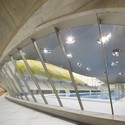
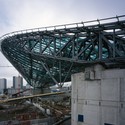
The pool hall is expressed above the podium by a large roof which arches along the same axis as the pools. Its form is generated by the sightlines of the 17,500 spectators in its Olympic mode. Double-curvature geometry has been used to generate a parabolic arch structure that creates the unique characteristics of the roof. The roof undulates to differentiate between the volumes of competition pool and the diving pool. Projecting beyond the pool hall envelope, the roof extends to the external areas and to the main entrance on the bridge that will be the primary access in Legacy mode. Structurally, the roof is grounded at 3 primary positions with the opening between the roof and podium used for the additional spectator seating in Olympic mode, then in-filled with a glass façade in Legacy mode.

© Hufton + Crow


