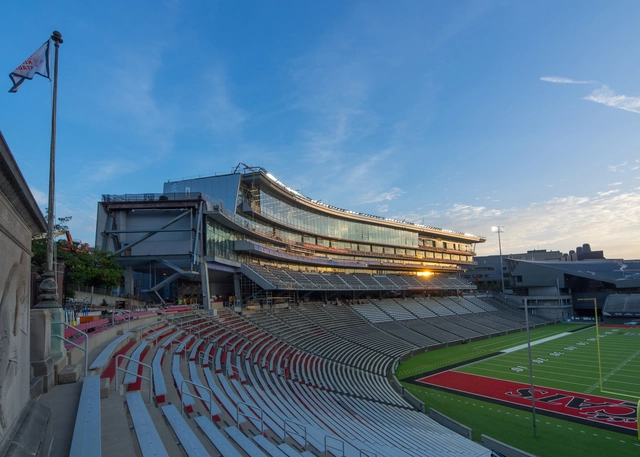
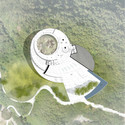
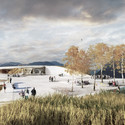
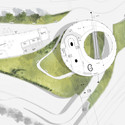
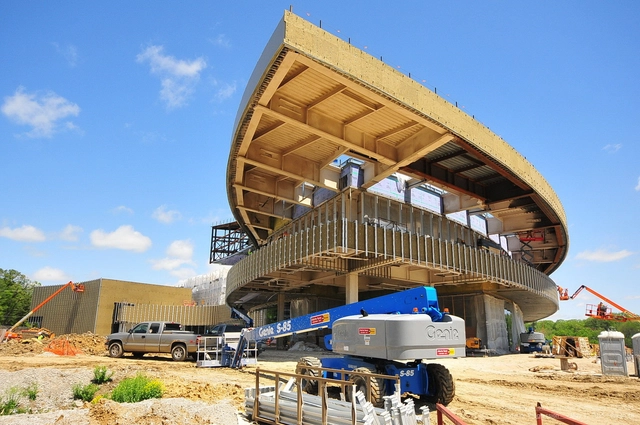
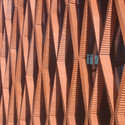
Architecture Research Office (ARO) and Heery International have designed the West Pavilion, a 115,000 square-foot extension to the University of Cincinnati’s Nippert Stadium. Set at one of America’s most historic college football venues, the new expansion will stretch 450 feet in length —about half of the stadium—and “will introduce the program’s first true premium seating, club spaces, and high-end press facilities.”
In addition to being a part of university-wide expansions, the project is the centerpiece of the $86 million renovation of Nippert Stadium itself, which includes adding more restrooms and concessions, and better pedestrian circulation.
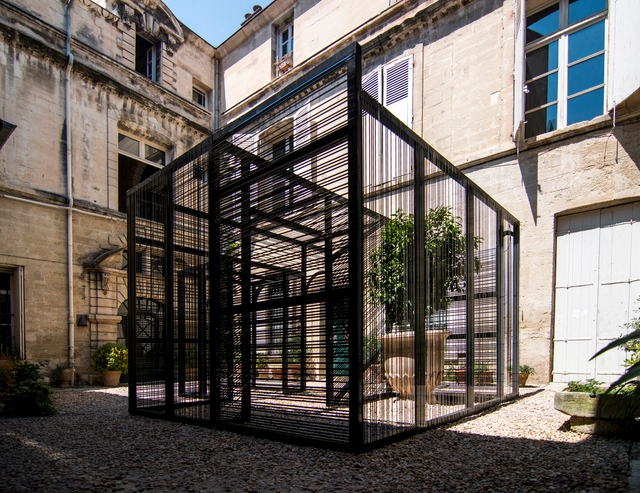
For the 10th Festival des Architectures Vives in Montpellier, Syracuse University commissioned a team to design an installation in the courtyard of Hôtel Audessan. The project, “Trans(inter)ference,” was a 3D drawing designed and constructed by Maya Alam and Daniele Profeta, with the help of three Syracuse University students.
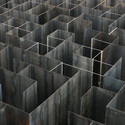
Focusing on the in-between of architecture, the project favors the space between idea and resolution, "between old and new." The installation was developed by projecting the facades of Hôtel Audessan through one another, creating a labyrinth of layered views.
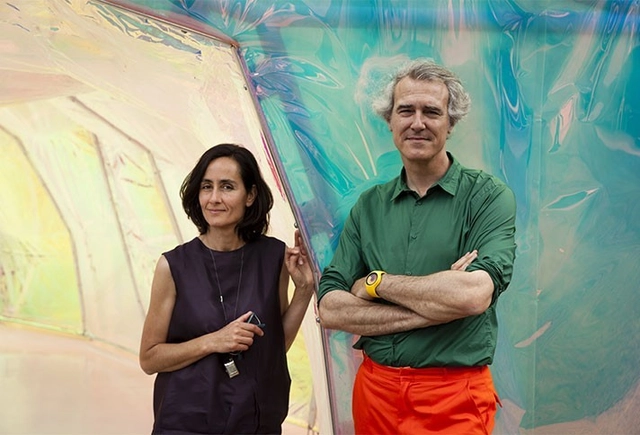
Last month, as part of their Park Nights event series, COS assembled Spanish architects José Selgas and Lucía Cano (SelgasCano) at their new pavilion for the Serpentine Gallery in London's Hyde Park to discuss the concepts behind their design and the history of the Pavilion Commission with Serpentine directors Julia Peyton-Jones and Hans Ulrich Obrist. They were joined by Chilean architect Smiljan Radić, designer of the 2014 pavilion, and Japanese architect Sou Fujimoto, designer of 2013's, in an hour long conversation moderated by Sarah Ichioka.
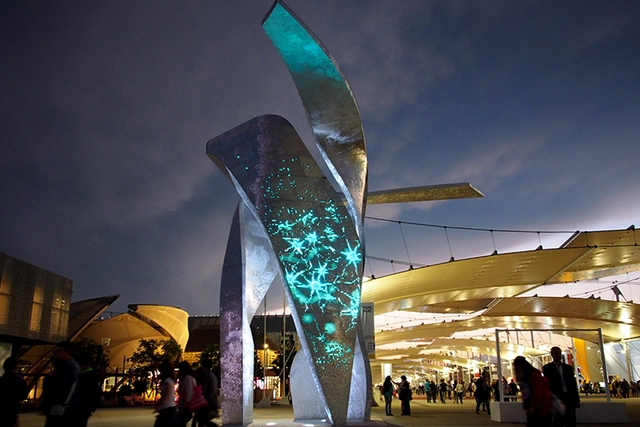
Daniel Libeskind teamed up with the professionals at Immersive and Innovision to realize the four 10-meter-high, "shimmering" sculptures that are outlining the Milan Expo 2015's central square. The LED-lit aluminium structures, dubbed "the Wings," were designed to "animate the public space with a constant flow of pulsating patterns and imagery related to the theme of the Expo: health, energy, sustainability and technology." They will remain on view through the duration of the Expo, which concludes October 31.
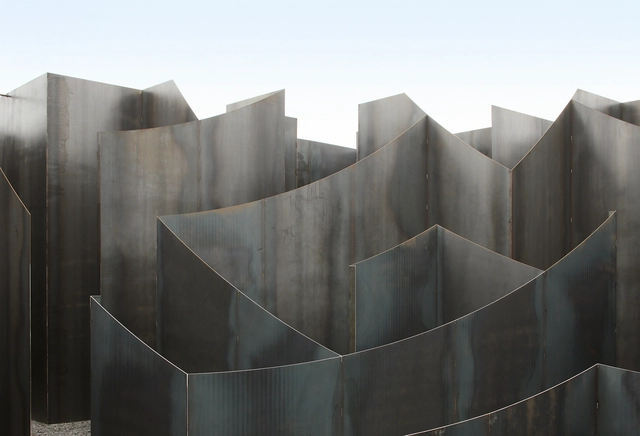
Gijs Van Vaerenbergh, an artistic collaboration between architects Pieterjan Gijs and Arnout Van Vaerenbergh, have created a labyrinthine intervention at the heart of the c-mine arts centre in Genk, Belgium. The development of this sculptural-spatial intervention has its foundations in the artists' interest in fundamental architectural typologies; earlier installations of theirs have been based on structures like the city gate, the bridge, the wall, and the dome. Here, the "age-old" form of the labyrinth" is explored as a spatial experience in a unique composition of wall and void.
Air pollution in urban areas is quickly racing to the forefront of the environmental discussion, with several major cities facing a serious deterioration of breathable air supply. New Delhi, Beijing, Los Angeles, Moscow and Karachi represent a handful of cities facing the world's worst urban pollution, each with recorded amounts of particulate matter exceeding acceptable levels. In 2014, the World Health Organization issued a report estimating that 7 million people suffered premature deaths in 2012 due to air pollution exposure.
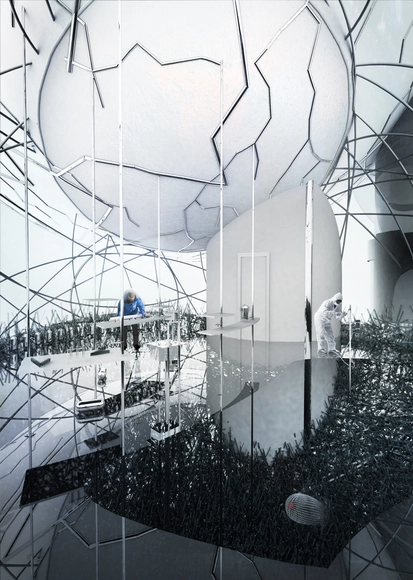
Enter Aeriform Ecologies: An Atmospheric Archive for Industrial Effluvium. Conceived as a thesis project by Jennifer Ng, University of Michigan with thesis advisor Kathy Velikov, Aeriform Ecologies delves into the possibilities for byproducts of petroleum production by proposing a network of solutions for the 'spatial runoffs' created by fossil fuel extraction. Based on a futuristic approach that includes a network of unmanned atmospheric gas harvesting dirigibles, the project blurs the lines between science, technology, and architecture.
Explore the effervescent world of Aeriform Ecologies after the break
BW International is now accepting entries for its Design a Beautiful House competition, an international call offering £25,000 (about $39,000 USD) to winner(s). The competition is open to all designers, students, artists, and others from anywhere across the globe, and requires no registration fee.
Entrants are asked to think about the definition of beauty in order to create a design that considers the ways that beauty and aesthetics can enhance the function of a home and the experiences of its users.
Traversal Landscape by Taehyung Park. Image via Social Cooperation Architects
Social Cooperation Architects (SCoopA) have announced the winners of their competition centered on the theme of the 2015 Expo Milano: Feed the World. The competition collected ideas and solutions from all over the world that addressed problems such as social inequality, population growth and the scarcity of resources. Currently the winners and honorary mentions are on display at the 2015 Expo Milano. Read on for the winning proposals and their accompanying boards after the break.
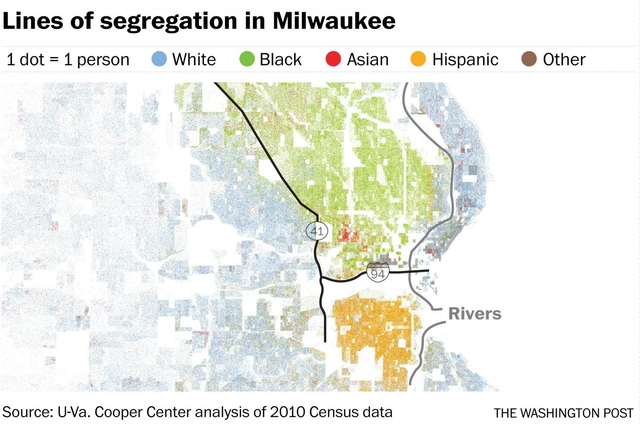
The Washington Post has published a piece looking at how infrastructure acts as a form of segregation in cities in the US. Using racial dot maps from the University of Virginia’s Weldon Cooper Center for Public Service, they show how highways, railroads, historically uncrossable avenues, and similar urban design decisions have a huge impact on the physical isolation of different races. These types of infrastructure were also found to reinforce boundaries set by natural patterns of topography and bodies of water. Cities found to have clear infrastructural segregation include Pittsburgh, Hartford, Detroit, Washington, D.C., and Milwaukee. Read the full article, here.
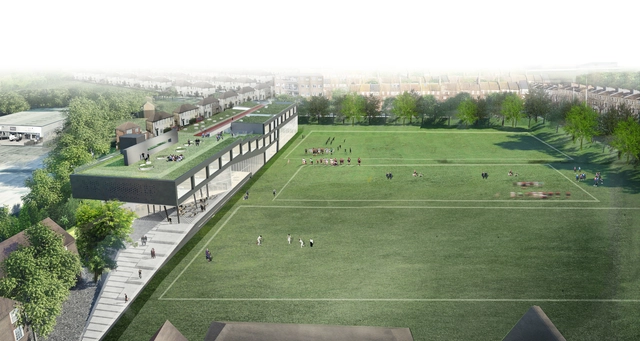
OMA has been selected to design a new building for Brighton College that will host its sport and science departments. Their design combines the two departments into one linear building that runs along the edge of the playing field.
The sport facilities are housed on the same level as the field, while the science department stretches over the top “like a skeletal bridge.” Views between the two departments are offered on the inside creating “lively and animated circulation throughout the new building.” The façade is inspired by the terrace housing that runs opposite the building.
La Paz, the historic de-facto capital of Bolivia, is widely renowned for its incredible setting, colonial architecture, and cultural buildings. El Alto, on the other hand, is not. It was, in fact, La Paz's rather dismal satellite city, all low rise brick and commuting. Yet El Alto has become the centre of an entirely new, independently evolved architectural style that is rapidly catching on across South America.
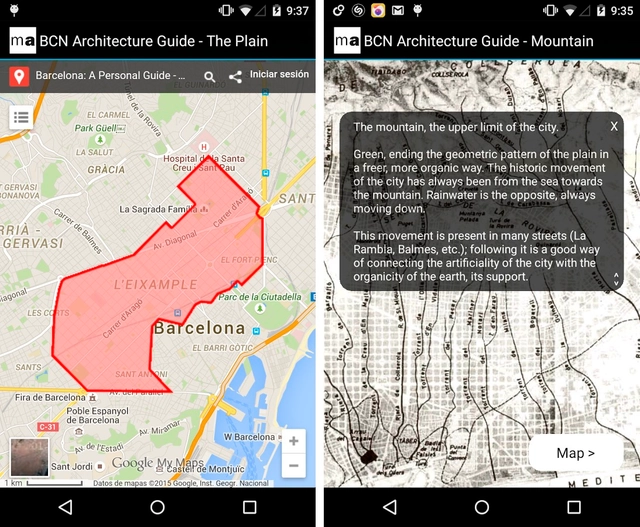
Spanish architect Josep Lluís Mateo of Mateo Arquitectura has launched the “BCN Architecture Guide,” a free application to help travelers and architecture lovers explore Barcelona. The app guides users to both highlights of the city’s built environment as well as its natural environment, including some “places to experience nature in tension with the city, places to be rather than objects to look at.”
For this edition of The Urbanist, Monocle 24's weekly "guide to making better cities," the team investigate politics in global "power cities." Visiting Brussels, capital of Belgium and administrative capital of the European Union, they explore how politics have changed the city over the last four decades. Further south, they travel to Vienna which, "diplomatically remains very important and wields power." Yet even though the UN have an outpost there, is the Austrian capital still a stage for international diplomacy? The episode also makes a quick stop at Embassy Row in Washington D.C. to examine the architecture of diplomatic design.
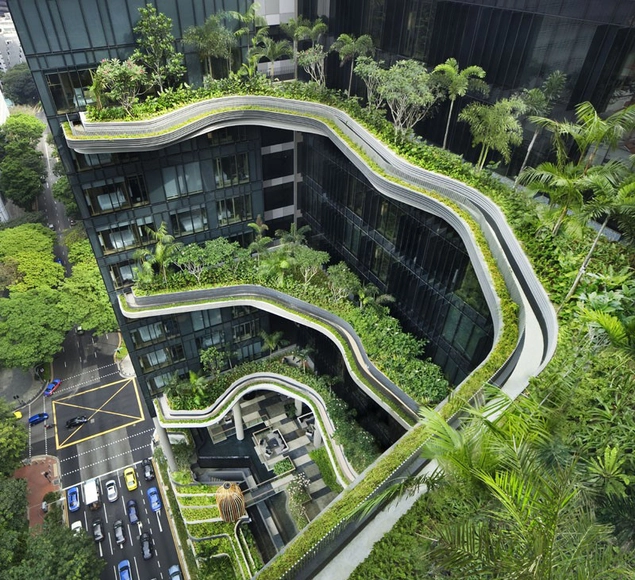
The Council on Tall Buildings and Urban Habitat (CTBUH) has announced the winner and finalists of its 2015 Urban Habitat Award. Launched in 2014, the Urban Habitat Award recognizes the contributions of tall buildings to the urban realm. The winners this year were chosen for influencing their environment and cultural context intelligently, adding social sustainability to their immediate site and wider context. See all of the finalists and the winner after the break.
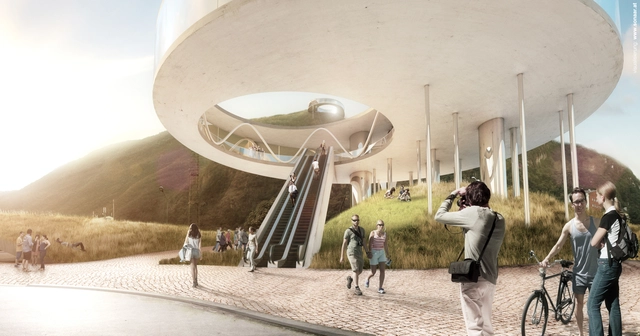
The Italian city of Bolzano, located in the foothills of the alps, has an intimate connection with the mountains that surround it. However, for almost 40 years, one of the most commanding views of Bolzano has been inaccessible, since the cable car which led up to the Virgolo mountain was closed in 1976. After winning an international design competition hosted by The SIGNA Group, Snøhetta has now been selected to replace that cable car, making the summit of Virgolo accessible once again and returning a valuable tourist asset to the city.
What do Ice Cube, the members of Pink Floyd, and Seal have in common with fashion icon Tom Ford and former president Thomas Jefferson? They all studied architecture. Perhaps a representation of the diversity of talents in architecture studios, household names like Samuel L. Jackson and Courteney Cox found their footing as students of architecture prior to reaching success in other fields.
We've put together a list of some of the most unexpected names gracing the yearbooks of architecture schools from around the world, including the likes of Queen Noor of Jordan and George Takei of Star Trek fame. Discover "Weird Al" Yankovic's true (architectural) passions after the break.
Hancher Under Construction. Image Courtesy of Pelli Clarke Pelli Architects
US firm Pelli Clarke Pelli Architects is renowned for their iconic and sustainable designs, having won numerous awards, including the AIA’sFirm Award. They currently have several projects under construction, ranging from a transit center in San Francisco to an office and retail tower in Seville, Spain. Read on after the break for an overview of three of their current projects, all in various states of completion.
The Royal Institute of British Architects (RIBA)’s Future Trends Survey for June 2015 shows "an all-time high," with the workload index ascending to +44 compared to +37 last month. All nations and regions within the United Kingdom returned positive balance figures, with practices in the Midlands and East Anglia responding most confidently about workloads in the next quarter. Following a slight fall last month, the private housing sector workload forecast increased to +39 (from +34), while the public sector saw a modest increase back into positive figures. Workload forecast balance figures have remained extremely high. The survey reports that large-sized practices continue to be the most optimistic about growth, while small and medium-sized practices "remain in strongly positive territory."
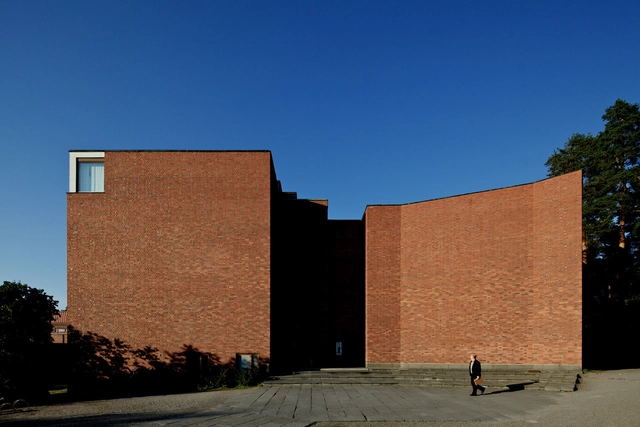
Tommi Lindh, director of the Alvar Aalto Foundation, shares four exciting reasons to enjoy the architectural offerings of Finland this summer.
Architecture hasn't been this intensively represented in the Finnish summer events ever. The whole summer is full of nice places to visit, but what makes August so very special is what's happening in Helsinki and Jyväskylä in the beginning of the month. The Alvar Aalto Symposium kicks off with lectures by the Museum of Finnish Architecture in Helsinki on Wednesday, August 5 and continues to Jyväskylä where the main event starts on Friday, August 7 with the first thematic session and a keynote presentation by Liu Xiaodu of Urbanus.
The World Architecture Festival (WAF), the world’s largest architectural festival and awards event held annually in Singapore, has announced the theme of this year's program: 50:50. The theme is inspired by Singapore’s upcoming 50th anniversary as an independent country, and will look back on how architecture and urbanism have changed during the last 50 years, as well as forward on what may change or stay the same in the next 50 years to come.
https://www.archdaily.com/770672/waf-announces-2015-festival-themeAD Editorial Team
Advances in computers and fabrication technology have allowed architects to create fantastic designs with relative ease that in years past would likely require the labor of countless master craftsmen. Architecture firms like Gramazio Kohler Architects are known for their innovative approach to digital fabrication, adapting technology from a variety of fields. To create this stunning new brick façade for Keller AG Ziegeleien, Gramazio Kohler used an innovative robotic manufacturing process called “ROBmade,” which uses a robot to position and glue the bricks together.
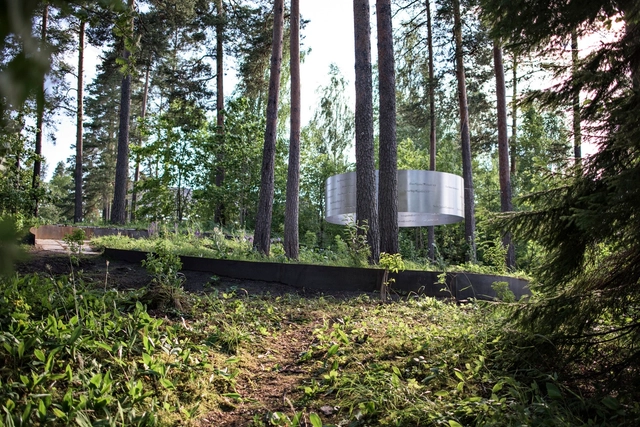
Marking the fourth anniversary of the terror attack in Norway that left 77 dead, today the island of Utøya has opened "The Clearing," a memorial designed by Norwegian firm 3RW to commemorate the 69 victims of the shooting massacre on the island.