Why open architecture competitions are good for Architects, a counter argument

Maya Lin Vietnam Memorial Entry

Derek Leavitt (@architectderek on Twitter) recently posted an opinionated blog entry on ‘Why Open Architecture Competitions Are Bad for Architects’  . The author outlined why entering competitions is detrimental not only to the individual, but also to the field of architecture.
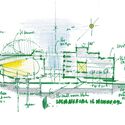
Competition has been a defining characteristic of architecture for centuries.  Without competitions to spur creativity, a young woman would have never submitted her graceful yet powerful black line…and we would be without the Vietnam Memorial.  Without architects using competitions as a way to test urban gestures, a young team would have never submitted their idea to use just a portion of their allotted site, leaving the rest for a public plaza…and we would be without the Pompidou Center in .  And, dating quite farther back, without an Italian man initially losing a competition and then determined to further his architectural understanding, we would be without the grand achievement of Brunelleschi’s dome.
The point is that although competitions are demanding, and at times may seem unfair, they are a staple in our profession which pushes the field forward.  With this in mind, we will attempt to argue in favor of the open competition, in the hope that we can persuade and inspire you to keep listening to your instinctive competitive nature and keep compiling those entries.

International Ideas Competition for Urban Sea Level Rise

An international ideas competition SEA-CHANGE 2030+ has been launched by the Australian Institute of Landscape Architects (AILA). This is the world’s second urban sea level rise ideas competition and the first to invite active participation from both design professionals as well as tertiary and school students to tackle the effects of climate change.

The competition invites design proposals to either protect the city from rising Harbour water or to make modifications to the environment to ensure sea level rise does not adversely affect property, parks and open spaces.

Entries are due by June 30 and prize winners announced in late July. For complete information, visit the competition’s official website.

Container Studio / Maziar Behrooz Architecture

© Courtesy of

Architects: Maziar Behrooz Architecture
Location: Amagansett, NY,
Project Area: 840 sq ft
Project Year: 2010
Photographs: Dalton Portella & Francine Fleischer

In Progress: Milstein Hall Steel / OMA

It seems that after overcame the danger of having both their accreditation and new architecture school eradicated from the campus, there has been smooth sailing in terms of the physical construction of OMA’S Milstein Hall.  The building is right on schedule to be fully completed in the Fall of 2011, as the structural steel, and the exterior structure + roof are being erected.

More images of the steel and more about the current construction phase after the break.

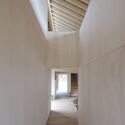
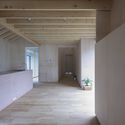
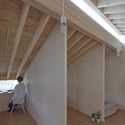
Between / Katsuhiro Miyamoto & Associates

©

Architecture: Katsuhiro Miyamoto & Associates
Location: Takarazuka-City, Hyogo, Japan
Site Area: 121.10 sqm
Built Area: 62.24 sqm
Total Floor Area: 128.65 sqm
Project Year: 2009
Photographs: Katsuhiro Miyamoto & Associates

Monaco Pavilion / NAÇO Architecture

Copyright Hu Wenkit

As the previous pavilions we have featured on AD for the World Expo 2010 illustrate, the exhibition is, undoubtedly, a giant testing ground to experiment with the latest avant-garde design concepts. In late March, we featured Naço Architectures pavilion and we have just be informed of some details of the facade treatment.  The facade’s main focus was to capitalize on ’s seemingly eternal presence of sun and sea. Designed so visitors will experience different lighting effects, the pavilion’s prominent water screen casts its reflections on and around the pavilion’s façade, “to symbolize a country surrounded by sea and sunshine and attached to respect its environment.”

More images and more about the facade after the break.

Maximum Garden House / Formwerkz Architects

© Jeremy San

Architects: Formwerkz Architects
Location: ,
Design Team: Alan Tay, TF Wong, Benny Feng
Project Area: 350 sqm
Project Year: 2010
Photographs: Jeremy San

2010 Washington Unbuilt Awards Calls for Entry

The 2010 Washington UNBUILT Awards Program recognizes excellence in projects that to date remain unbuilt – theoretical, academic, and other unbuilt projects. Projects entered will be displayed and judged as part of the DesignDC conference in August 2010. This competition is conducted by the Washington Chapter/ and is conducted independently of other awards programs sponsored by the National American Institute of Architects and other components.

Digital submissions must be registered online at www.aiadc.com and received at the offices of the Washington Chapter/AIA between April 15 and June 30, 2010. Seen at Death by Architecture.

AD Round Up: Industrial Architecture Part III

Amazing projects from Chile, Venezuela, Germany, Turkey, and Italy! It’s Industrial Architecture at it’s best. Check them all after the break.

Aonni Mineral Water Plant / Bebin & Saxton
Chilean Patagonia has a particularity that is distinguished and exclusively of that place: THE DETACHMENT. We can notice disunity, a separation of what was linked before, the surrounding elements live in constant alteration. This detachment produces cracks, isolations, torsions, new tensions. The glaciers detach from the massive ice fields, the trees get inclined by winds, the islands live separated from the land surrounded by water, and the geography is the result of energic erosions (read more…)

Strelka Institute / OMA + AMO

Strelka Construction Site © Strelka

It was just announced that OMA + AMO  will collaborate with Strelka, a postgraduate school for media, architecture and design in Moscow.  The new school is launching an educational program where a select group of students will work intensely and innovatively on a series of themes aimed to reshape ’s current role in the world.  In an attempt to raise the ambition of the creative industries in , the institute will challenge students with a variety of projects.  The students will guided by the expertise of both Russian and international creative leaders.

More about the collaboration after the break.

MaxMix Cities International Competition winners

First Prize / Asia / Jung Woo Oh

The International Competition “Celebration of Cities Maxmix Cities” winners were announced last year. Three projects from architecture students and three from architects were awarded in the three categories (W. Europe, E. Europe and Asia).

See the winners after the break.

Copper Fish / XPACE

© Alexandre Kapellos

Architects: XPACE architecture + urban design / Maud Cassaignau, Markus Jung
Location: Luxembourg, Luxembourg
Realization: Maud Cassaignau
Engineer: Reto Bonomo
Contractor: Prefalux
Project Area: 86 sqm
Project Year: 2006–2009
Photographs: Alexandre Kapellos

AD Classics: Solomon R. Guggenheim Museum / Frank Lloyd Wright

Swelling out towards the city of , the Solomon R. Guggenheim Museum was the last major project designed and built by  between 1943 until it opened to the public in 1959, six months after his death, making it one of his longest works in creation along with one of his most popular projects. Completely contrasting the strict Manhattan city grid, the organic curves of the museum are a familiar landmark for both art lovers, visitors, and pedestrians alike.

More on Wright’s Guggenheim Museum after the break.

Pamphlet Architecture 32 Call for Entries

By addressing the capacity to cope, the ability to bounce back, and the mitigation and management of risk, proposals are welcome that showcase a fresh understanding of the possibilities and opportunities of resilience in architecture, from the large to the small scale. Whether resilience stems from natural disaster, civil conflict, global warming, catastrophe, and so on, is the applicant’s discretion. Please visit the submission site for more details.

The winner will receive a prize of $2,500 and the opportunity to have their manuscript published by Princeton Architectural Press as 32. The registration fee is $25 for students and $50 for professionals. The winner will be announced in September 2010.

More information can be found here.

Vitra Showroom

Chairless by Aravena

This past weekend, we were invited to celebrate the 50th anniversary of the Panton chair and other Vitra creations at their showroom in the Meatpacking District in .  The showroom was buzzing with people socializing and viewing the different designs on the showroom’s staggered levels.  We were especially excited to see Alejandro Aravena’s novel “Chairless“,  a strap of fabric that is a way to eliminate the need for the traditional chair, and yet allows the person to become the integral part of the furniture. Inspired by the Ayoreo Indians who sit on the ground with a tight strap around their back, Aravena developed this concept to produce a seating device that  relieves the spine and legs.  “It is obvious that many things have evolved since the beginning of time and that progress has accumulated in our lives in the form of sophisticated needs and desires. But it is also true that there are many things and needs that haven’t changed much since our origins and they can still be satisfied in an extremely simple way: sitting comfortably on the ground is one of them,” explained Aravena.

More about after the break.

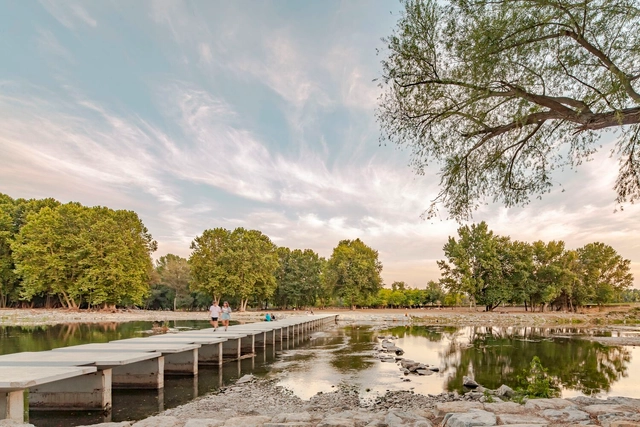
Sava Footbridge / Peter Gabrijelčič + Peter Koren

© Miran Kambič

Authors: mag. Peter Gabrijelčič, u.d.i.a., ing.
Location: Radovljica,
Investor: DRSC
Construction year: 2007
Photographer: Miran Kambič, Dejan Simčič

See ArchDaily's exclusive coverage of the Pritzker Prize

Pritzker Ceremony / SANAA

ArchDaily had the privilege of attending the ceremony last night on historic Ellis Island as Kazuyo Sejima and Ryue Nishizawa were honored.  Regarded as the highest honor bestowed upon an architect, the Pritzker Prize’s newest laureates were continually praised throughout the evening for their keen ability to teach us that what is not present can be as important as what is present.

As past laureates, such as Renzo Piano, Frank Gehry, Thom Mayne, Richard Meier, Jean Nouvel, and Rafael Moneo looked on, Lord Palumbo, chairman of the jury, discussed Sejima’s and Nishizawa’s work style; an intensively collaborative design process which is so balanced between the two minds that it is impossible to say which one of the pair is responsible for which architectural decision within a given project.

Although the two share similar philosophies when it comes to light, form and space, their differences create “all the possibilities”.  Sejima explained that within , there are actually three firms:  each has his/her own individual practice, yet come together to discuss and critique their work under the international firm .  While some criticize this process as inefficient and confusing, Sejima replied, with a laugh, that the organization is simply how they like to work.

Lycée de Jolimont / Laurens & Loustau Architectes

© Damien Aspe

Architects: Laurens & Loustau Architects
Location: Toulouse (31),
Project Team: Marc Laurens, Pierre Loustau
Client: S.A Cogemip, Région Midi-Pyrénées
Engineer: Ingénierie Studio
Project Area: 2,810 sqm
Project Year: 2002-2004
Photographs: Damien Aspe

Australia St infants School COLA / Scale Architecture

© Brett Boardman

Architects: Scale Architecture
Location: Sydney,
Project Team: Matthew Chan, Bernard Cheng (Principal Australia St Infants School)
Client: Australia St Infants School
Project Year: 2009
Photographs: Brett Boardman

Architecture Foundation Cordoba / Point Supreme Architects

Greek architects Point Supreme shared their urban plan + architecture foundation building competition proposal for , with us.  The proposal seeks to connect the San Pablo block with the more central part of the city by capitalizing on the site’s diversity of entry points.  The building, an architecture institution, is designed to frame the void that resides next to and under the structure.

More about the proposal after the break.

Facade Renovation / Martin Fenlon Architecture

Martin Fenlon‘s rusted steel was recently constructed in LA.   The was a facade renovation that took the existing building and added a ‘tube frieze’ in place of typical signage, where a band of undulating stainless steel tubes evoke the surface of the nearby ocean.  The approach provides a textured effect and adds to the industrial character of the area.

More images and more about the facade after the break.